
The Enduring Wisdom of Kintsugi: How the Japanese Art of Golden Repair is Reshaping Modern Psychology and Sustainability
Born in 15th-century Japan, the practice of repairing broken pottery with gold has evolved from a meticulous craft into a global metaphor for trauma recovery and environmental resilience.
By Chen Wang

In short
- Kintsugi is a 15th-century Japanese technique for repairing broken pottery with lacquer dusted in powdered gold, silver, or platinum.
- The practice is rooted in wabi-sabi, an aesthetic philosophy that celebrates imperfection and views breakage as part of an object's history.
- Traditional repairs use urushi, a toxic tree sap that becomes highly durable and food-safe once cured in a specialized humidity cabinet.
When a cherished ceramic bowl shatters on the floor, the instinct in most modern households is to sweep up the shards and throw them away. If an attempt is made to salvage the piece, the goal is almost always deception: using clear epoxy to hide the fracture and pretend the damage never occurred.
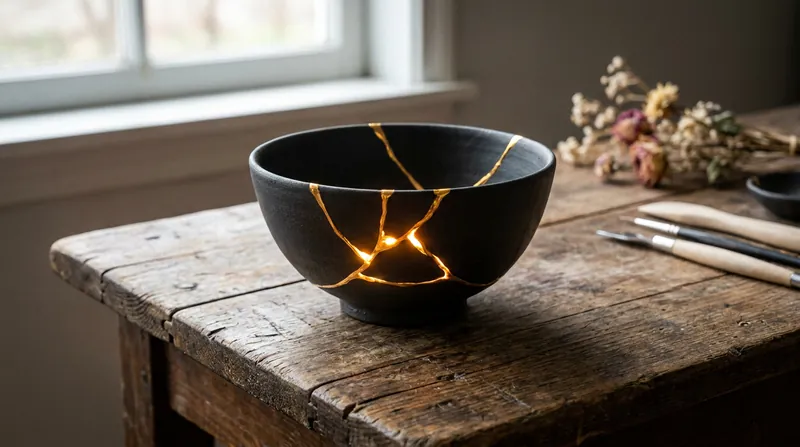
The traditional Japanese art of kintsugi takes the exact opposite approach. Translating literally to "golden joinery," kintsugi is the meticulous practice of repairing broken pottery using a specialized lacquer dusted with powdered gold, silver, or platinum. Instead of concealing the cracks, the technique illuminates them, transforming the web of fractures into a glowing, metallic focal point.[1][2]
The visual result is striking. A repaired vessel looks as though veins of solid gold are coursing through its clay, binding the fragments together with a precious metal scar. But kintsugi is far more than a decorative repair technique; it is the physical manifestation of wabi-sabi, the Japanese philosophical framework that finds beauty in imperfection, impermanence, and the natural patina of age.
By treating breakage and repair as a vital part of an object’s history rather than a fatal ruin, kintsugi elevates the damaged item into something more valuable and storied than it was before it fell.[1]
While the craft dates back more than half a millennium, kintsugi is currently experiencing a massive global renaissance. In an era defined by fast fashion, overflowing landfills, and a growing awareness of mental health, the principles of golden repair have transcended the pottery studio.
Today, the 15th-century technique is being embraced by trauma therapists as a profound metaphor for human resilience, and by environmentalists as a radical counter-narrative to throwaway culture. Understanding how kintsugi works—both chemically and philosophically—reveals why this ancient practice has become a guiding light for modern healing and sustainability.[4][5]
The origins of kintsugi are rooted in the Muromachi period of feudal Japan, specifically the late 15th century. According to widespread historical consensus and popular legend, the technique was born from the aesthetic dissatisfaction of Shogun Ashikaga Yoshimasa. The military ruler possessed a highly prized Chinese celadon tea bowl that had broken.
Desperate to save his favorite vessel, he sent the shards back to China for restoration. When the bowl was finally returned to Japan, the shogun was dismayed to find it held together by heavy, unsightly metal staples—the standard Chinese repair method of the era, known as juci.[1][3]
The crude, utilitarian staples offended the refined sensibilities of the Japanese court, prompting local craftsmen to search for a more elegant solution. They began experimenting with native lacquers, eventually developing a method that not only restored the structural integrity of the bowl but transformed its aesthetic entirely. This innovation coincided perfectly with the flourishing of the Japanese tea ceremony (chanoyu). As tea masters like Sen no Rikyū began to formalize the rituals of tea drinking, they championed the wabi-sabi aesthetic, elevating rustic, asymmetrical, and repaired utensils over pristine, mass-produced imports.[3]
The actual mechanism of kintsugi is a grueling, highly specialized chemical process that requires immense patience and respect for volatile natural materials. The foundation of the repair is urushi, a natural lacquer harvested from the sap of the Toxicodendron vernicifluum tree.
Because this tree is a close relative of poison ivy, raw urushi contains urushiol, a highly allergenic compound that causes severe skin rashes upon contact. Artisans must work with extreme caution, often building up an immunity over years of practice. Despite its toxicity in a raw state, urushi has been utilized by Japanese craftsmen for over 9,000 years due to its unparalleled durability once cured.[2][3]
To begin a repair, the artisan first cleans and files the broken edges of the ceramic shards. The adhesive used to bind the pieces is not a synthetic glue, but a mixture of raw ki-urushi and either wheat flour (creating mugi urushi) or rice paste (creating nori urushi).
This organic, sticky compound is carefully applied to the fractures, and the vessel is pieced back together like a three-dimensional puzzle. If the original impact shattered the ceramic so violently that small fragments were lost entirely, the artisan creates a putty called sabi urushi—a blend of lacquer and fine clay powder—to sculpt replacement pieces and fill the voids.[2]
The most misunderstood aspect of kintsugi is the drying process. Urushi lacquer does not simply dry by evaporation in the open air; it must harden through a complex chemical reaction that requires the absorption of oxygen and ambient moisture.
To achieve this, the repaired object is placed inside a specialized wooden cabinet known as a muro. Inside the muro, the temperature and humidity are meticulously controlled. The vessel must sit in this warm, damp environment for anywhere from one to three weeks just for the base adhesive layers to properly cure and solidify.[2]
Once the structural repair is fully hardened, the artisan meticulously sands the seams flush with the ceramic surface using charcoal or specialized stones. A final, thin layer of colored urushi is then painted precisely over the repaired cracks. Before this topcoat can fully set, the artisan uses a soft brush to dust the wet lacquer with finely powdered gold, silver, or platinum.
This final step, heavily influenced by the decorative maki-e painting tradition, is what gives kintsugi its signature luminous veins. Once the metal powder is polished, the toxic lacquer is completely inert, rendering the vessel entirely food-safe and ready to return to the tea room.[1][3]
In recent years, the meticulous physical process of kintsugi has been widely adopted by the psychological community as a framework for trauma recovery. Therapists and mental health practitioners utilize the concept to help patients navigate the aftermath of profound loss, failure, or emotional injury.
Traditional Western approaches to trauma often implicitly focus on "getting back to normal"—a desire to erase the damage and return to a pristine, pre-injury state. Kintsugi offers a radically different paradigm: the acknowledgment that a shattered life cannot be put back together exactly as it was, and that the goal of healing is not to hide the scars.[4][5]
This aligns closely with the psychological concept of post-traumatic growth, which studies how individuals can experience positive psychological changes as a result of struggling with highly challenging life circumstances. By reframing emotional scars as veins of gold, patients are encouraged to view their vulnerabilities and past traumas as sources of unique strength and wisdom. The philosophy of mushin—often translated as "no mind" or the acceptance of change and fate—teaches that fighting against the reality of a fracture only causes more suffering. Acceptance allows the repair work to begin.[1][4]
Beyond individual psychology, kintsugi is increasingly invoked in global conversations about environmental sustainability and the ethics of consumption. The practice is deeply intertwined with mottainai, a Japanese cultural concept expressing a sense of regret over waste and a deep respect for the inherent value of material resources. In an era where fast fashion, planned obsolescence, and single-use plastics dominate the global economy, the idea of spending weeks painstakingly repairing a broken cup is a profound act of rebellion against disposable culture.[5]
Sustainability advocates and leaders of the Right to Repair movement point to kintsugi as the ultimate historical precedent for circular economics. It challenges the modern reflex to immediately replace anything that is slightly damaged. By investing time, skill, and precious materials into a broken object, the artisan acknowledges the labor of the original potter, the clay harvested from the earth, and the energy of the kiln. The repair enriches the relationship between the user and the object, transforming a mass-produced commodity into an irreplaceable vessel of memory.[4][5]
This ethos has inspired a new generation of contemporary artists and designers to adapt kintsugi principles to modern materials. Artists like Rachel Sussman and Yee Sookyung have expanded the technique beyond traditional tea bowls, using golden joinery to repair everything from cracked urban pavements to shattered contemporary sculptures.
Architects are beginning to incorporate visible, celebrated repairs into building renovations, rather than hiding structural reinforcements behind drywall. Even in fashion, the concept of visible mending—using brightly colored threads to repair torn denim or knitwear—draws direct inspiration from the golden seams of kintsugi.[4]
Architects are beginning to incorporate visible, celebrated repairs into building renovations, rather than hiding structural reinforcements behind drywall.
Ultimately, the enduring power of kintsugi lies in its universal truth. Whether applied to a 16th-century celadon bowl, a traumatized human psyche, or a society grappling with ecological waste, the lesson remains the same. Breakage is an inevitable part of existence, but it does not dictate the end of an object's usefulness or a person's capacity for joy. With patience, care, and a willingness to confront the damage honestly, the broken pieces can be reassembled into something far more resilient, complex, and beautiful than perfection ever could be.[5][6]
Terms to know
- Urushi
- A natural, highly durable lacquer harvested from the sap of the Toxicodendron vernicifluum tree, used as the primary adhesive and filler in kintsugi.
- Wabi-sabi
- A Japanese aesthetic and philosophical concept that finds beauty in imperfection, impermanence, and the natural wear of time.
- Mottainai
- A cultural term expressing a sense of regret over waste, emphasizing the inherent value of objects and the importance of reusing them.
- Mushin
- A Zen concept translating to 'no mind,' which in the context of kintsugi refers to the peaceful acceptance of change, fate, and the inevitability of breakage.
- Muro
- A specialized wooden cabinet used by lacquer artisans to maintain the precise humidity and temperature required for urushi to properly cure.
Questions readers ask
Is kintsugi-repaired pottery safe to eat or drink from?
Yes. While raw urushi lacquer is highly toxic and related to poison ivy, it undergoes a chemical change during the curing process. Once fully hardened, it becomes completely inert and food-safe.
Can I put kintsugi ceramics in the microwave or dishwasher?
No. Authentic kintsugi uses real powdered gold, silver, or platinum, which will spark and cause damage in a microwave. The delicate lacquer also cannot withstand the harsh heat and abrasive detergents of a dishwasher.
How long does a traditional kintsugi repair take?
A proper repair takes several weeks to several months. The urushi lacquer requires one to three weeks in a specialized humid cabinet (muro) just to cure a single layer, and the process requires multiple layers.
Can kintsugi be done with materials other than gold?
Yes. While gold is the most famous, traditional artisans also frequently use silver or platinum powder. Additionally, some repairs are finished with just the dark lacquer itself, a technique known as urushitsugi.
Different angles
Traditional Artisans & Historians
Focuses on the rigorous chemical process, the toxicity of raw urushi, and the historical context of the Muromachi period tea ceremony.
For traditionalists, kintsugi is first and foremost a master craft that demands years of rigorous apprenticeship. Historians emphasize that the practice cannot be separated from its roots in the 15th-century tea ceremony, where the wabi-sabi aesthetic first elevated rustic, repaired objects over pristine imports. Artisans are particularly protective of the authentic chemical process, noting that true kintsugi requires raw urushi sap—a highly toxic relative of poison ivy that demands immense respect. They argue that the modern proliferation of 'fast kintsugi' kits, which use synthetic epoxies and fake gold dust, strips the practice of the patience and danger that give the final repair its philosophical weight.
Mental Health Practitioners
Views the practice as a tangible framework for post-traumatic growth, emphasizing that emotional scars should be integrated rather than hidden.
Psychologists and trauma therapists have increasingly adopted kintsugi as a powerful clinical metaphor. In Western psychological traditions, the implicit goal of trauma recovery has often been to return the patient to a 'pre-injury' baseline—essentially hiding the cracks. Mental health practitioners argue that kintsugi offers a healthier paradigm: post-traumatic growth. By teaching patients to view their emotional scars as veins of gold, therapists help individuals integrate their traumas into their identity. This camp emphasizes the concept of 'mushin' (acceptance of change), arguing that healing only begins when a person stops trying to pretend the breakage never occurred.
Sustainability Advocates
Champions the 'mottainai' philosophy as a direct counter to modern throwaway culture, using visible repair to advocate for circular economics.
Environmentalists and leaders of the Right to Repair movement view kintsugi through the lens of 'mottainai'—a Japanese concept expressing deep regret over waste. For this camp, the act of spending weeks repairing a broken ceramic bowl is a radical political statement against planned obsolescence and fast fashion. They argue that modern consumer capitalism relies on the illusion that damaged goods are worthless and must be immediately replaced. By celebrating visible mending, sustainability advocates use kintsugi to promote a circular economy, arguing that society must relearn how to invest time and care into the objects we already own rather than perpetually extracting new resources.
- Traditional Artisans & Historians
- Focuses on the rigorous chemical process, the toxicity of raw urushi, and the historical context of the Muromachi period tea ceremony.
- Mental Health Practitioners
- Views the practice as a tangible framework for post-traumatic growth, emphasizing that emotional scars should be integrated rather than hidden.
- Sustainability Advocates
- Champions the 'mottainai' philosophy as a direct counter to modern throwaway culture, using visible repair to advocate for circular economics.
Perspectives this story doesn't cover
- Mass-market ceramic manufacturers
- Synthetic epoxy developers
Sources
Source coverage
6 outlets
3 viewpoints surfaced






- [1]WikipediaTraditional Artisans & Historians
Kintsugi: The Japanese art of repairing broken pottery
Read on Wikipedia → - [2]Encyclopedia BritannicaTraditional Artisans & Historians
Kintsugi: Traditional Japanese technique
Read on Encyclopedia Britannica → - [3]ArtsyTraditional Artisans & Historians
The Centuries-Old Japanese Tradition of Mending Broken Ceramics with Gold
Read on Artsy → - [4]Enjyu JapanSustainability Advocates
From Tea Ceremony to Modern Life: The Evolution of Kintsugi
Read on Enjyu Japan → - [5]MediumMental Health Practitioners
Kintsugi and the Art of Psychological Resilience
Read on Medium → - [6]Factlen Editorial TeamSustainability Advocates
Synthesis by Factlen editorial team
Read on Factlen Editorial Team →
More in Culture
See all →Global Heritage
UNESCO Adds 24 New World Heritage Sites, Highlighting Nelson Mandela's Legacy and Rome's Via Appia
3 sources

Heritage Protection
Israeli Airstrike Damages Tyre's World Heritage Site, Triggering Global Heritage Protection Protocols
4 sources

Cultural Heritage
The Global Revival of Kintsugi: How the Ancient Art of Repair Became a Modern Movement
6 sources
Midsummer
The Magic of Midsummer: How the Nordic World Celebrates the Longest Day of the Year
4 sources

Comments
Every angle. Every day.
Get Culture stories with full source coverage and perspective breakdowns, free every day.