
The End of the Green Screen: How LED Volumes Became the New Standard for TV Production
Once a billion-dollar novelty reserved for blockbuster sci-fi, virtual production using LED volumes has completely normalized across the television industry in 2026. By rendering photorealistic 3D environments in real time, the technology is slashing post-production times, reducing carbon footprints, and giving actors a physical world to react to.
By Factlen Editorial Team
- Creative Filmmakers
- Emphasize the benefits of in-camera visual effects, natural lighting, and regaining creative control on set.
- Technologists & Studio Operators
- Focus on the pipeline efficiency, market growth, and the technical evolution of real-time rendering.
- Broadcast Producers
- Value the flexibility of instant set changes and the ability to scale virtual environments for live television.
What's not represented
- · Traditional location scouts and set builders whose roles are being displaced by digital environments.
- · Independent filmmakers who cannot yet afford the high upfront costs of volume stage rentals.
Why this matters
For viewers, this technological shift means higher-quality visual effects and more ambitious storytelling on standard television budgets. For the industry, it represents a fundamental rewiring of how shows are made, moving visual effects from post-production to the live set while drastically reducing the environmental impact of global location shoots.
Key points
- Virtual production using LED volumes has transitioned from a blockbuster novelty to a normalized standard in the television industry by 2026.
- The technology uses real-time game engines to render 3D environments that respond to camera movements, creating a flawless parallax effect.
- LED screens emit natural light that accurately reflects on actors and props, eliminating the artificial color spill associated with green screens.
- The virtual production market is projected to grow to $6.5 billion by 2030, driven by cost savings on travel and post-production.
The traditional green screen is slowly being retired from the modern soundstage. For decades, live-action television production had to choose between two primary workflows: pack up the crew to shoot on a physical location, or capture actors in an abstract green void and composite the digital world later in post-production. Today, a completely new paradigm has taken over the industry. By surrounding performers with massive, high-definition screens that render photorealistic environments in real time, the television industry has fundamentally rewired how visual stories are told, moving visual effects out of the editing bay and back onto the live set.[5]
The catalyst for this industry-wide shift was 'the volume,' a groundbreaking technology popularized by Industrial Light & Magic's StageCraft system for the first season of The Mandalorian. What began as a bespoke, blockbuster-budget experiment designed to bring the Star Wars universe to the small screen has rapidly democratized. As the underlying software became more accessible and hardware costs began to stabilize, the technology trickled down from massive franchise tentpoles to standard episodic television, commercials, and even daily broadcast news.[7]
In 2021, the Göteborg Film Festival's Nostradamus Report made a bold prediction that raised eyebrows across the entertainment sector: by 2026, virtual production methods would be 'completely normalized' across the industry. Five years later, that ambitious forecast has fully materialized. Studios around the world have invested heavily in permanent virtual production infrastructure, shifting the industry's default approach from 'fix it in post' to capturing the final image directly through the camera lens on the day of the shoot. This normalization marks a rare moment where a highly complex technological innovation was adopted almost universally within half a decade, driven by the undeniable efficiencies it offers to demanding production schedules.[1][4]

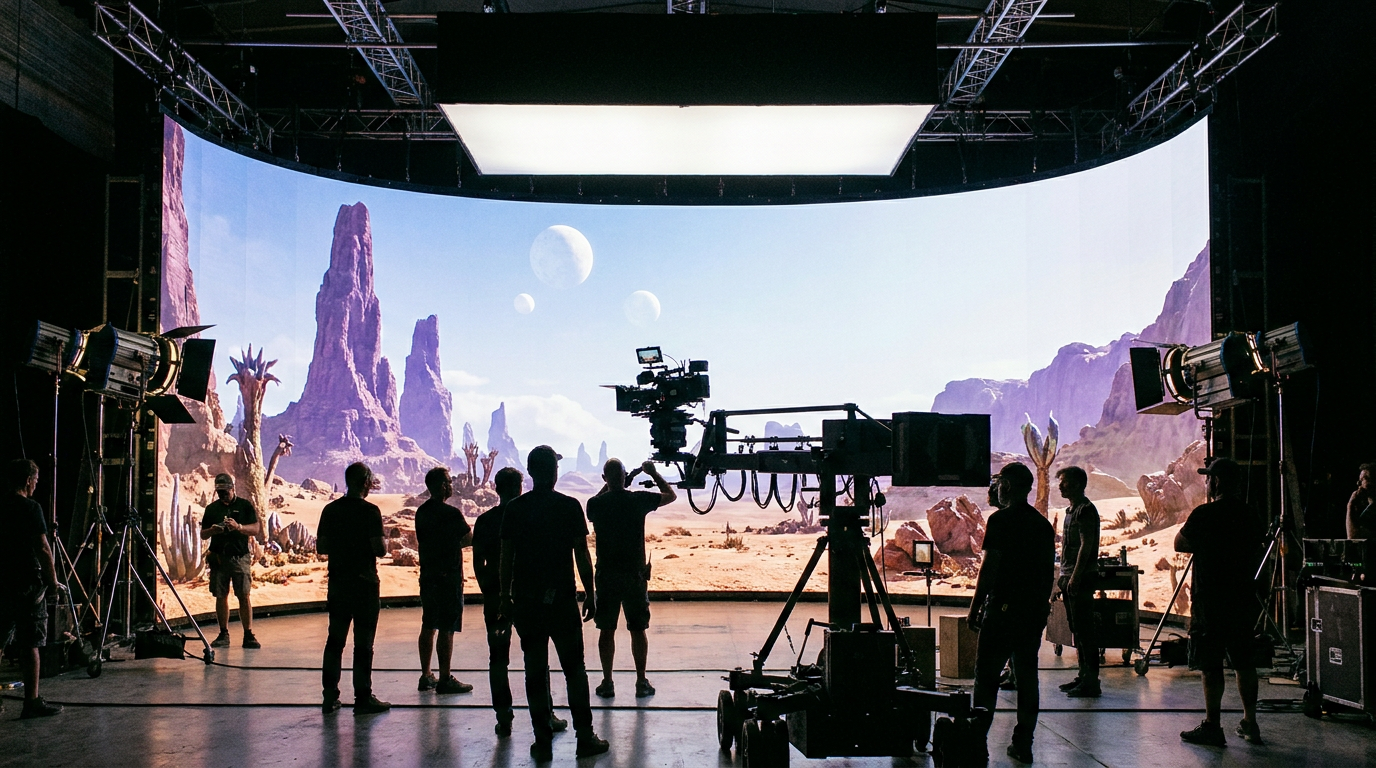
At the core of this production revolution is the LED volume itself. Rather than relying on a single flat panel acting as a glorified digital backdrop, a true volume is a massive, immersive array of high-definition LED screens. These screens are typically arranged in sweeping curved walls, complete with integrated ceilings and sometimes even digital floors, effectively wrapping the physical set and the actors in a seamless 360-degree digital environment. This architectural setup gives directors and camera operators unprecedented creative freedom to frame shots and move the camera without breaking the illusion of the virtual world.[5][7]
However, the physical screens are only half of the equation. The true magic of the volume relies on real-time 3D rendering, powered by sophisticated software originally built for the video game industry, most notably Epic Games' Unreal Engine. Instead of playing back a pre-rendered, static video file, the game engine generates a fully three-dimensional, photorealistic environment on the fly. This means the digital world is entirely interactive; lighting can be adjusted, digital props can be moved, and the time of day can be shifted from high noon to golden hour with a few simple keystrokes.[2][7]
The crucial link between the physical set and the digital engine is advanced camera tracking. As the physical cinema camera moves on a crane or a Steadicam, tracking software sends its exact spatial coordinates and lens focal data directly to the game engine. The engine instantly recalculates the perspective of the digital background to match the camera's movement, creating a flawless parallax effect. Distant digital mountains move slower across the screen than foreground digital trees, tricking the human eye—and the camera sensor—into perceiving genuine three-dimensional depth on a two-dimensional screen.[2][5]
This synchronized process, known in the industry as In-Camera Visual Effects (ICVFX), captures the final, composited pixels directly through the lens during the live shoot. The most immediate and striking benefit of this workflow is the lighting. Traditional green screens notoriously bounce a toxic, artificial green 'spill' onto the actors' skin and shiny physical props, requiring painstaking and expensive digital cleanup in post-production. ICVFX eliminates this problem entirely by replacing the green void with the actual intended environment. Because the screens are emitting the exact colors of the scene, the ambient light behaves exactly as it would on location.[2][5]

Because the LED screens emit actual, calibrated light, the digital environment illuminates the physical set naturally and organically. If a scene takes place during a virtual sunset over a Martian landscape, the warm amber light wraps perfectly around the actor's face and reflects accurately in their eyes. If a character walks past a digital neon sign, the colored light naturally glides across their wardrobe. This interactive lighting bridges the gap between the physical and digital worlds, creating a level of photorealism that is incredibly difficult and time-consuming to achieve with traditional compositing.[5][7]
Because the LED screens emit actual, calibrated light, the digital environment illuminates the physical set naturally and organically.
This distinct lighting advantage has made LED volumes the undisputed champion for shooting driving scenes. Filming inside a moving car on a traditional green screen is notoriously difficult due to the complex, moving reflections on the curved glass windows and the glossy chassis of the vehicle. Today, high-end television productions almost exclusively use virtual production for simulated travel. By surrounding a stationary car with screens displaying a moving streetscape, the reflections of streetlights and passing buildings map perfectly onto the vehicle, delivering a flawless illusion of motion.[1][6]
Beyond the technical achievements, the technology fundamentally changes the actor's experience on set. For years, performers in heavy visual effects shows had to stare at a tennis ball on a green stick and pretend it was a terrifying dragon or a distant, awe-inspiring galaxy. With an LED volume, performers can actually see and react to the world around them. The environment is physically present in the room, allowing for more grounded, authentic performances as actors interact with the scale and mood of the digital scenery in real time.[5]
For directors and cinematographers, the volume represents a triumphant return to creative control. In traditional visual effects pipelines, crucial aesthetic decisions are often deferred to months of post-production, where the director might be reviewing composited shots long after the actors have gone home. With an LED volume, the creative team can collaboratively sculpt the scene while still on set. If a digital mountain is blocking the perfect shot, the environment artist can simply move it. This immediacy fosters a highly collaborative atmosphere that traditional green screens often stifle.[5][6]

The underlying economics of modern television have rapidly accelerated this technological adoption. Episodic TV currently demands feature-film visual quality, but it must be delivered on highly compressed schedules and significantly tighter budgets. By bringing multiple global locations into a single, controlled soundstage, productions eliminate the massive logistical costs of company moves, weather delays, and international travel. A crew can shoot a complex scene without worrying about losing the sunlight, as the digital sun can be frozen in the sky for a twelve-hour shooting day.[2][6]
This newfound efficiency translates directly to a booming industrial sector. Market analysts project that the virtual production market will reach an estimated $3.3 billion in 2026, with long-term forecasts predicting explosive growth to $18.5 billion by 2035. This financial trajectory is driven not just by blockbuster television, but by the rapid adoption of the technology in commercial advertising, corporate filmmaking, and music video production, where tight turnaround times and brand consistency are paramount. The ability to guarantee a specific look without the variables of location shooting makes it an incredibly attractive investment for studios.[1][4]
The environmental impact of this shift is equally significant, aligning with the entertainment industry's broader sustainability goals. By replacing massive international location shoots with localized virtual environments, studios are drastically reducing their carbon footprints. A production can shoot a dialogue scene in the Sahara Desert in the morning and an action sequence on the Arctic tundra in the afternoon, all without a single cast or crew member boarding an airplane or leaving a soundstage in London or Los Angeles.[4][5]
Beyond prestige episodic television, the technology is rapidly trickling down to broadcast studios and live event production. News programs, sports broadcasts, and election coverage are increasingly utilizing smaller LED volumes to create expansive, dynamic sets that can be instantly reconfigured. A single physical studio space can host a morning talk show with a virtual city skyline, and then seamlessly transition into an immersive, data-driven sports analysis environment for the evening broadcast, maximizing the utility of the physical real estate.[3][5]

However, the transition to this new production paradigm has not been entirely frictionless. The industry is currently grappling with a severe skills shortage. Operating an LED volume requires a highly specialized, hybrid workforce that understands both the artistic nuances of traditional cinematography and the technical complexities of advanced IT networking, lighting control protocols, and real-time rendering software. Training programs and universities are racing to graduate technicians who can bridge this gap, but demand continues to outpace supply. This bottleneck occasionally forces productions to delay shoots or pay premium rates for the handful of experienced virtual production supervisors available.[1][4]
Furthermore, when executed poorly, virtual production can look flat, artificial, and distinctly 'video game-like,' leading to misplaced skepticism from some traditional producers. Success on a volume stage requires a complete inversion of the standard production schedule. Digital environments must be fully built, lit, and tested during pre-production, long before the cameras roll. This requires bringing experienced virtual production supervisors and Digital Imaging Technicians (DITs) into the creative process much earlier than traditional workflows dictate. Productions that attempt to rush this preparatory phase often find themselves struggling on set, proving that the technology is only as good as the planning behind it.[1][6]
Despite these growing pains, the trajectory of the television industry is clear. As the global talent pool expands, hardware costs decrease, and software tools become more intuitive, the LED volume is cementing its status not just as a specialized visual effects tool, but as the foundational infrastructure of modern visual storytelling. By merging the limitless possibilities of digital environments with the tangible reality of live-action performance, virtual production has successfully rewritten the rules of television, leaving the era of the green screen firmly in the past.[4][8]
How we got here
2019
Industrial Light & Magic debuts 'StageCraft' LED volume technology for the first season of The Mandalorian.
2020–2021
Pandemic travel restrictions accelerate the adoption of virtual production for commercials and television.
2021
The Nostradamus Report predicts virtual production will be 'completely normalized' across the industry within five years.
2024
Major software updates to real-time engines focus specifically on virtual production workflows, lowering the barrier to entry.
2026
LED volumes become standard infrastructure for episodic television, broadcasting, and advertising.
Viewpoints in depth
Technologists & Studio Operators
Focus on pipeline efficiency, market growth, and the technical evolution of real-time rendering.
For the engineers and studio managers building these stages, the LED volume represents a fundamental shift in production logistics. They point to the massive time efficiencies gained by eliminating company moves between physical locations and reducing weather-related downtime. From a business perspective, this camp emphasizes the rapid market growth—projected to hit $18.5 billion by 2035—as proof that virtual production is no longer a novelty but a core infrastructure investment. Their primary concern in 2026 is standardizing workflows and training a new generation of technicians who can seamlessly bridge the gap between traditional film lighting and complex IT networking.
Creative Filmmakers
Emphasize the benefits of in-camera visual effects, natural lighting, and regaining creative control on set.
Directors and cinematographers champion the LED volume for its ability to restore the collaborative magic of a live set. In traditional green-screen workflows, crucial visual decisions are deferred to post-production, often leaving the director out of the final compositing process. By capturing final pixels in-camera, filmmakers can adjust the time of day, move digital set pieces, and perfect the lighting in real time. Furthermore, they highlight the immense benefit to actors, who can now deliver performances while reacting to a visible, immersive environment rather than an abstract green void.
Broadcast Producers
Value the flexibility of instant set changes and the ability to scale virtual environments for live television.
Outside of prestige episodic television, broadcast and live-event producers view virtual production as the ultimate tool for flexibility. This camp focuses on the ability to instantly switch a single soundstage from a morning news desk to a sprawling, augmented-reality sports analysis studio. They emphasize that while broadcast volumes may not require the photorealism of a high-end sci-fi drama, the technology allows them to expand their visual scope and deliver experience-driven design without expanding their physical real estate.
What we don't know
- How quickly the industry can train enough specialized technicians to meet the surging global demand for virtual production stages.
- Whether the cost of high-end LED panels will decrease enough to make the technology accessible to ultra-low-budget independent filmmakers.
- How the integration of generative AI will further disrupt the creation of the 3D environments displayed on the volumes.
Key terms
- LED Volume
- A massive, often curved array of high-definition LED screens that wraps around a physical set to display digital environments.
- In-Camera Visual Effects (ICVFX)
- The process of capturing final visual effects directly through the camera lens during the shoot, rather than adding them in post-production.
- Parallax
- The visual effect where background objects appear to move slower than foreground objects as the camera moves, creating a sense of 3D depth.
- Real-Time Engine
- Software, originally developed for video games like Unreal Engine, used to render photorealistic 3D environments instantly as the camera moves.
- Digital Imaging Technician (DIT)
- A crew member responsible for managing on-set color grading and ensuring the digital background seamlessly matches the physical lighting.
Frequently asked
Why is an LED volume better than a green screen?
LED volumes emit natural light that reflects accurately on actors and props, eliminating the artificial 'spill' of green screens. They also allow actors to see the environment they are performing in.
Does this mean TV shows no longer shoot on location?
Not entirely, but it drastically reduces the need. Productions can now shoot multiple global locations in a single day on a soundstage, saving time and reducing their carbon footprint.
What is the biggest challenge with virtual production today?
The industry is currently facing a skills shortage. Operating an LED volume requires specialized technicians who understand both traditional cinematography and real-time game engine software.
Sources
Source coverage
8 outlets
3 viewpoints surfaced







[1]Computer Graphics WorldTechnologists & Studio Operators
Garden Studios explores the evolution, challenges, and future of virtual production
Read on Computer Graphics World →[2]3Peak StudioTechnologists & Studio Operators
Virtual production has moved past the novelty phase in 2026
Read on 3Peak Studio →[3]TVB EuropeBroadcast Producers
The year ahead: a look at audio and virtual production in 2026
Read on TVB Europe →[4]Garden StudiosTechnologists & Studio Operators
Virtual production in 2026: Did the industry predictions come true?
Read on Garden Studios →[5]MediumCreative Filmmakers
The set that isn't there: How volumetric LED walls work
Read on Medium →[6]VFX VoiceCreative Filmmakers
The LED volume is being shaped by technological advancements
Read on VFX Voice →[7]AVIXACreative Filmmakers
What is LED Volume?
Read on AVIXA →[8]Factlen Editorial TeamBroadcast Producers
Synthesis by Factlen editorial team
Read on Factlen Editorial Team →
Every angle. Every day.
Get entertainment stories with full source coverage and perspective breakdowns delivered to your inbox.