
The End of New START: A Guide to the Lapse of the US-Russia Nuclear Arms Control Treaty and the New Nuclear Reality
For the first time since the 1970s, the United States and Russia are operating without a legally binding nuclear arms control treaty. Here is how the New START agreement worked, why it expired, and what governs the global nuclear balance now.
By Paige Carter

- Multilateral Deterrence Realists
- Argues that arms control must adapt to include China and emerging technologies rather than clinging to outdated bilateral models.
- Bilateral Restraint Advocates
- Emphasizes the immediate danger of losing US-Russia transparency and urges informal adherence to the old limits.
- Global Security Observers
- Focuses on the broader implications for the global non-proliferation regime and the anxieties of non-nuclear states.
Why this matters
The expiration of New START removes the final legal cap on the world's two largest nuclear arsenals, fundamentally altering the framework of global security. Understanding this shift is essential for navigating the new era of multipolar deterrence involving the U.S., Russia, and an expanding Chinese nuclear force.
Key points
- The New START treaty officially expired on February 5, 2026, ending decades of bilateral US-Russia nuclear limits.
- The treaty capped deployed strategic warheads at 1,550 and established a rigorous verification and inspection regime.
- The U.S. declined a one-year extension, citing the need for a new multilateral framework that includes China's growing arsenal.
- Without inspections, both militaries must rely on intelligence estimates, increasing the risk of worst-case scenario planning.
- Experts warn of "uploading," where reserve warheads could be rapidly deployed onto existing missiles during a crisis.
On February 5, 2026, the global security architecture crossed a historic threshold. The New Strategic Arms Reduction Treaty (New START)—the last remaining bilateral nuclear arms control agreement between the United States and Russia—officially expired. Its lapse marks the first time since the early 1970s that the world's two largest nuclear powers are operating without legally binding limits on their strategic arsenals.[1][7]
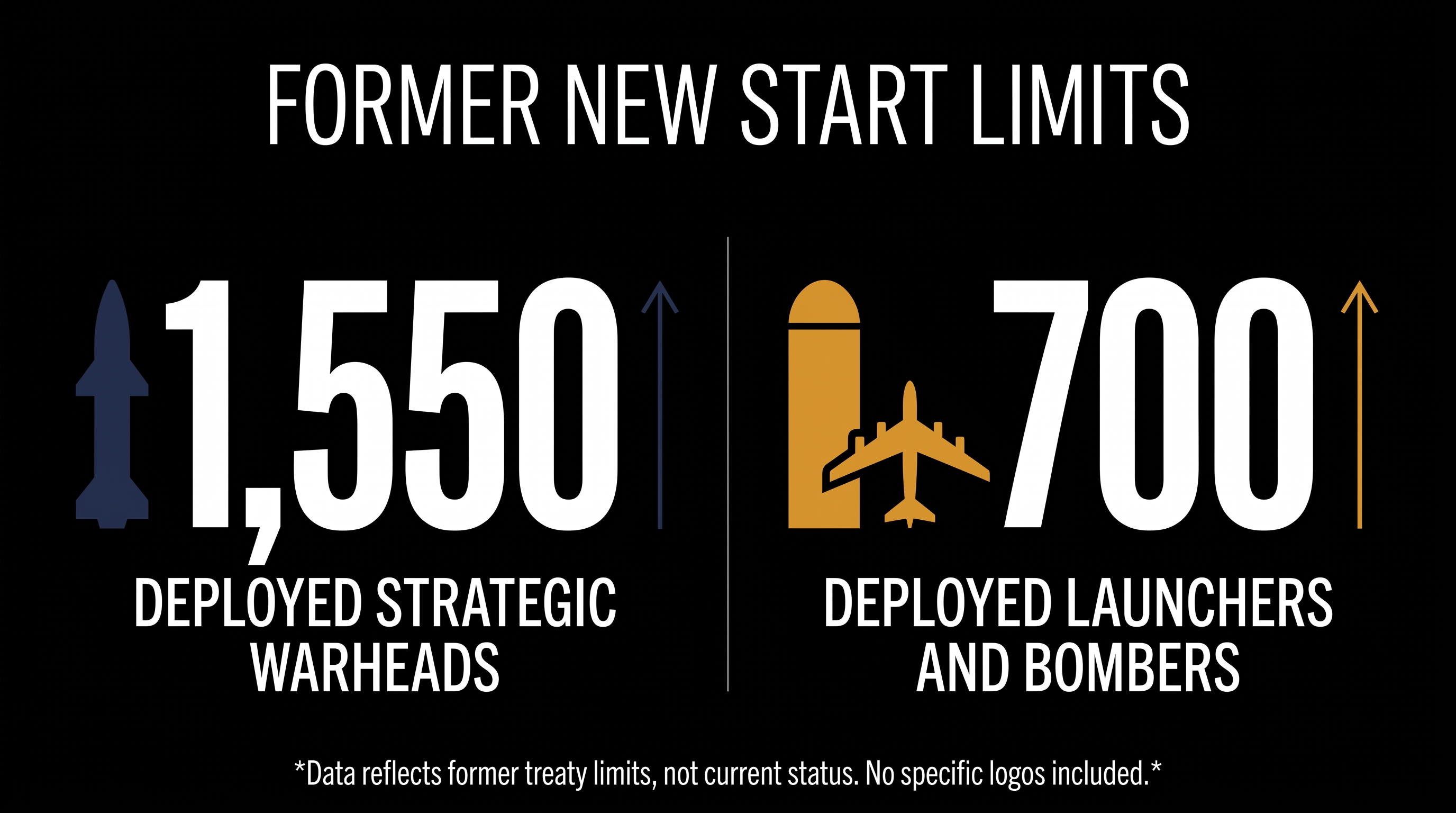
Signed in 2010 by U.S. President Barack Obama and Russian President Dmitry Medvedev, New START was the cornerstone of modern nuclear deterrence. The agreement strictly capped each nation at 1,550 deployed strategic nuclear warheads and 700 deployed delivery systems, which included intercontinental ballistic missiles (ICBMs), submarine-launched ballistic missiles, and heavy bombers.[1][4]
However, the treaty's true value extended far beyond its numerical ceilings. New START established a rigorous verification mechanism that provided both militaries with unprecedented transparency. This included biannual data exchanges detailing the status of nuclear forces and the right to conduct short-notice, on-site inspections at each other's nuclear bases.[2]
This transparency regime began to fracture well before the treaty's expiration date. In February 2023, amid the fallout from the invasion of Ukraine, Russia suspended its formal participation in New START. Mutual inspection visits and data exchanges ceased, though both Washington and Moscow publicly committed to abiding by the treaty's central numerical limits.[1][6]
By its own legal design, New START could not survive indefinitely. The treaty was drafted for an initial 10-year term with the option for a single five-year extension. That extension was exercised at the final hour in February 2021, setting a hard expiration date of February 5, 2026, unless a completely new framework was ratified.[1][4]
In the months leading up to the deadline, diplomatic efforts to bridge the gap stalled. In September 2025, Russian President Vladimir Putin proposed a voluntary, one-year extension of the treaty's central limits, provided the United States acted in a similar spirit of restraint.[6]
While U.S. President Donald Trump initially indicated that the proposal sounded like a good idea, the administration ultimately declined to formalize a stopgap measure. By January 2026, the U.S. position had solidified around the reality of the expiration, with the administration arguing that the bilateral framework was no longer sufficient for modern security needs.[2][4]
President Donald Trump initially indicated that the proposal sounded like a good idea, the administration ultimately declined to formalize a stopgap measure.
The primary driver behind the U.S. reluctance to simply renew the bilateral status quo is the rapid expansion of China's nuclear capabilities. The Pentagon estimates that Beijing is significantly increasing its operational warhead count, fundamentally shifting the global landscape from a two-power dynamic to a three-power nuclear age.[3]
From the perspective of U.S. defense planners, locking into a treaty that strictly limits American and Russian forces while leaving China's growing arsenal entirely unconstrained is a strategic liability. Consequently, the U.S. has insisted that any future arms control framework must be multilateral.[3][7]
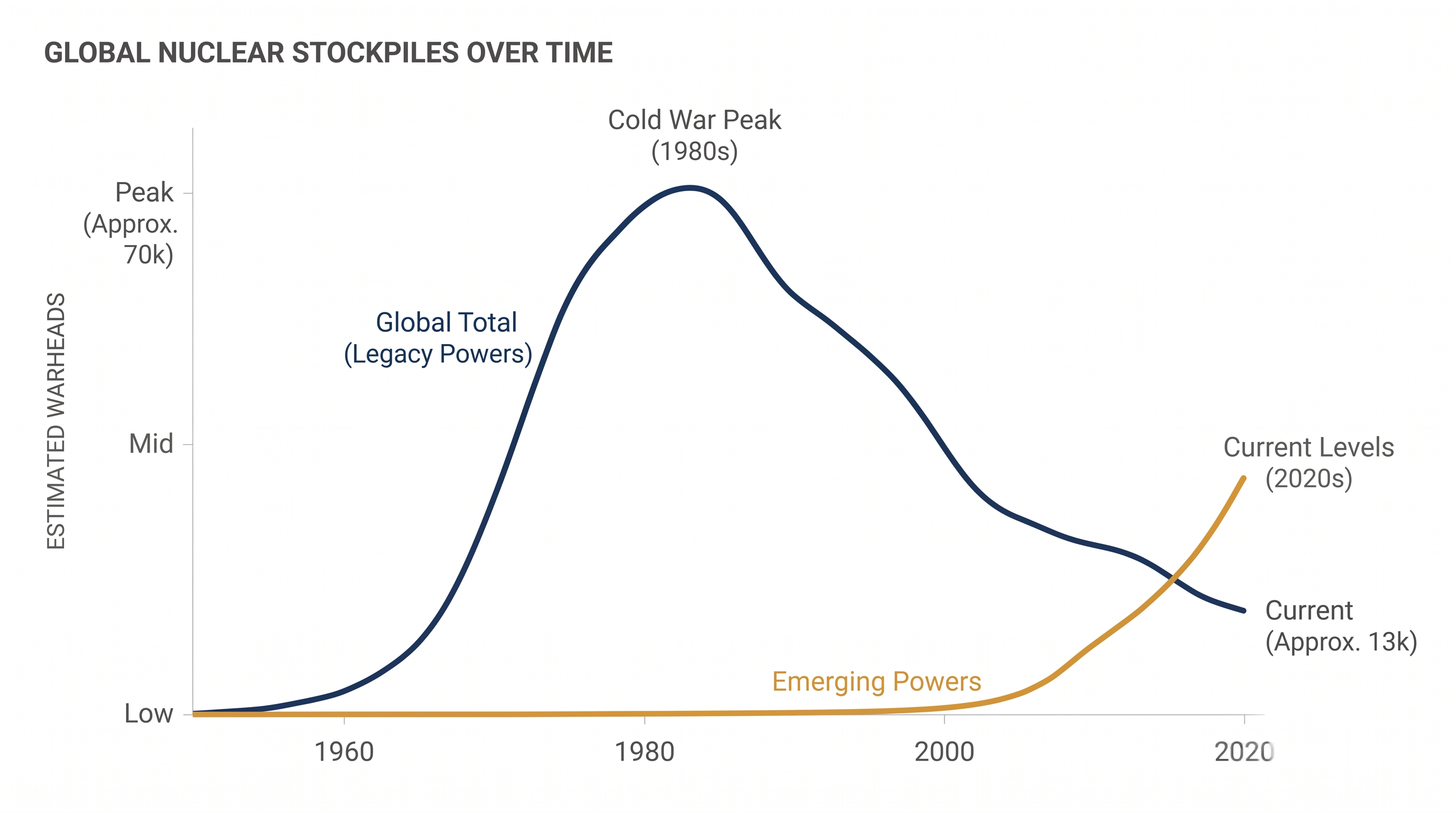
Despite the treaty's lapse, analysts do not expect an immediate, dramatic surge in the production of new nuclear weapons. In the near term, both the United States and Russia are likely to keep their deployed strategic forces relatively close to the former New START ceilings, as maintaining deterrence does not strictly require a massive numerical buildup.[3]
The more pressing risk lies in the technical capacity for "uploading." Both nations possess thousands of non-deployed reserve warheads. Without treaty limits, either side could relatively quickly load these additional warheads onto existing missiles, rapidly escalating the number of deployed weapons during a crisis.[2][3]
Furthermore, the permanent loss of the verification regime forces both militaries to rely entirely on national technical means—such as satellite surveillance and intelligence gathering—to monitor the other's capabilities. Without the certainty provided by data exchanges and inspections, defense planners are naturally pushed toward worst-case scenario modeling.[1][2]
This ambiguity complicates crisis management. When transparency disappears, the pressure to adopt a "launch on warning" posture increases, as leaders may feel compelled to make civilization-altering decisions within minutes based on unverified intelligence estimates rather than established baselines.[2][7]
The expiration also carries profound diplomatic consequences across the globe. Non-nuclear-weapon states, particularly across the Global South, view the collapse of New START as a failure of the United States and Russia to uphold their disarmament commitments under Article VI of the Nuclear Non-Proliferation Treaty (NPT).[1][3]
As the world navigates this new era, the nature of nuclear competition is shifting. Rather than focusing purely on warhead counts, the major powers are directing resources toward advanced delivery systems, hypersonic glide vehicles, artificial intelligence integration, and space-based sensors.[3][7]
For now, global strategic stability relies on informal, unilateral restraint rather than binding international law. The guardrails of the Cold War and post-Cold War eras have been dismantled, leaving a complex, multipolar nuclear reality where deterrence is maintained through ambiguity and technological edge rather than mutual verification.[2][7]
How we got here
April 2010
The United States and Russia sign the New START agreement in Prague.
February 2021
The treaty is extended for a final five-year term just days before its initial expiration.
February 2023
Russia suspends its formal participation in the treaty's inspection and data exchange mechanisms.
September 2025
Russian President Vladimir Putin proposes a one-year voluntary adherence to the treaty's limits.
February 5, 2026
New START officially expires, removing all legally binding caps on U.S. and Russian strategic arsenals.
Viewpoints in depth
U.S. Strategic Planners
Advocates for a modernized, multilateral approach to nuclear deterrence.
U.S. defense officials argue that bilateral arms control is obsolete in a multipolar world. They point to China's rapid nuclear expansion as evidence that capping U.S. forces while leaving Beijing unconstrained is a strategic vulnerability. From this perspective, the lapse of New START, while unfortunate for transparency, frees the United States to adapt its deterrence posture to address simultaneous threats from multiple nuclear-armed adversaries.
Russian Leadership
Focuses on maintaining parity while shifting competition to new domains.
Moscow has consistently framed the breakdown of arms control as a consequence of broader Western hostility. While Russian leadership proposed a temporary extension of the numerical limits, they have also emphasized that any future agreements must account for the nuclear arsenals of U.S. allies like the UK and France. Following the treaty's lapse, Russia is expected to maintain numerical parity while heavily investing in asymmetric technologies, such as hypersonic weapons, to bypass traditional defense systems.
Global Non-Proliferation Advocates
Warns of cascading risks to the global non-proliferation regime.
Organizations like the International Campaign to Abolish Nuclear Weapons (ICAN) and non-nuclear states view the expiration as a dangerous dereliction of duty. They argue that by abandoning legally binding limits, the U.S. and Russia are violating their commitments under the Nuclear Non-Proliferation Treaty. This camp warns that the lack of restraint at the top encourages other nations to pursue independent nuclear capabilities, increasing the likelihood of regional arms races and accidental escalation.
What we don't know
- Whether the U.S. and Russia will continue to informally abide by the 1,550 warhead limit in the long term.
- How China will respond to U.S. efforts to bring Beijing into a multilateral arms control framework.
- The extent to which the loss of mutual inspections will accelerate the development of new, unregulated nuclear delivery systems.
Key terms
- Strategic Nuclear Weapons
- High-yield nuclear weapons designed to be launched across intercontinental distances, targeting the adversary's homeland.
- Uploading
- The process of taking non-deployed reserve nuclear warheads and rapidly loading them onto existing, deployed delivery systems.
- National Technical Means
- Intelligence-gathering assets, such as surveillance satellites and radar networks, used to monitor another country's military capabilities.
- Deterrence
- A military strategy under which one power uses the threat of massive retaliation to prevent an adversary from initiating an attack.
Frequently asked
Does this mean the U.S. and Russia are building more nukes?
Not necessarily immediately. Both sides are currently expected to maintain their deployed forces near the old limits, but they now have the legal freedom to expand their arsenals at any time.
Why didn't they just sign a new treaty?
The geopolitical climate severely deteriorated following the invasion of Ukraine, and the U.S. insists that any new treaty must also limit China's rapidly expanding nuclear arsenal.
How will they know what the other side is doing?
Without the treaty's on-site inspections and data exchanges, both countries will rely entirely on satellite surveillance and intelligence gathering to estimate the other's capabilities.
Sources
Source coverage
7 outlets
3 viewpoints surfaced







[1]Chatham HouseBilateral Restraint Advocates
Letting New START expire would signal that the world's largest nuclear powers are abandoning restraint
Read on Chatham House →[2]Nuclear Threat InitiativeMultilateral Deterrence Realists
New START Expiration: Background and Consequences
Read on Nuclear Threat Initiative →[3]Belfer CenterMultilateral Deterrence Realists
The Expiration of New START and the Future of Arms Control
Read on Belfer Center →[4]Congressional Research ServiceMultilateral Deterrence Realists
U.S.-Russian Nuclear Arms Control: Overview and Potential Considerations for Congress
Read on Congressional Research Service →[5]Dawn NewsGlobal Security Observers
New START treaty set to expire
Read on Dawn News →[6]Arms Control AssociationBilateral Restraint Advocates
Russia Proposes One-Year Extension of New START Limits
Read on Arms Control Association →[7]Factlen Editorial TeamGlobal Security Observers
Synthesis by Factlen editorial team
Read on Factlen Editorial Team →
Every angle. Every day.
Get guides stories with full source coverage and perspective breakdowns delivered to your inbox.