
EU Commission Adopts T+1 Settlement Rules, Forcing Systemic Overhaul of European Financial Markets
The European Commission has officially adopted regulatory standards mandating a shift to a one-day securities settlement cycle (T+1) by October 2027. The move aligns the bloc with North American markets but requires a massive operational overhaul to compress post-trade processing times.


- European Regulators
- View the transition as a necessary modernization to reduce systemic risk, lower margin requirements, and keep European capital markets globally competitive.
- Banking and Brokerage Industry
- Emphasize the massive operational burden, the 83% reduction in processing time, and the urgent need for automated straight-through processing.
- Financial Market Infrastructure
- Focus on the technical coordination required to synchronize the transition across Europe's fragmented network of exchanges and depositories.
Why this matters
The transition to T+1 will drastically reduce counterparty risk and free up capital across European markets, but it forces asset managers and brokers to completely automate their post-trade operations. Firms that fail to upgrade their systems face severe settlement penalties and liquidity crunches.
Key points
- The EU Commission has officially adopted rules mandating T+1 settlement by October 11, 2027.
- An interim deadline of December 7, 2026, requires firms to complete allocations by 11:00 p.m. on the trade date.
- The transition reduces counterparty risk and lowers margin requirements at clearinghouses.
- Firms will lose 83% of their current post-trade processing time, shrinking the window from 12 hours to two.
- The UK and Switzerland are aligning their transitions with the EU to prevent market fragmentation.
- Europe's transition is complicated by its 32 regulators, 40 depositories, and 11 national currencies.
The European Commission has officially adopted the regulatory framework that will force the European Union's financial markets to transition to a T+1 settlement cycle.[1][2]
The adoption of the European Securities and Markets Authority (ESMA) proposal sets in stone a final go-live date of October 11, 2027, for the new regime.[1][4]
It also establishes a critical interim regulatory deadline of December 7, 2026, by which firms must comply with strict new allocation and confirmation protocols.[1][2]
The transition represents one of the most significant structural overhauls to the European post-trade landscape in decades, fundamentally altering how securities are exchanged.[3]
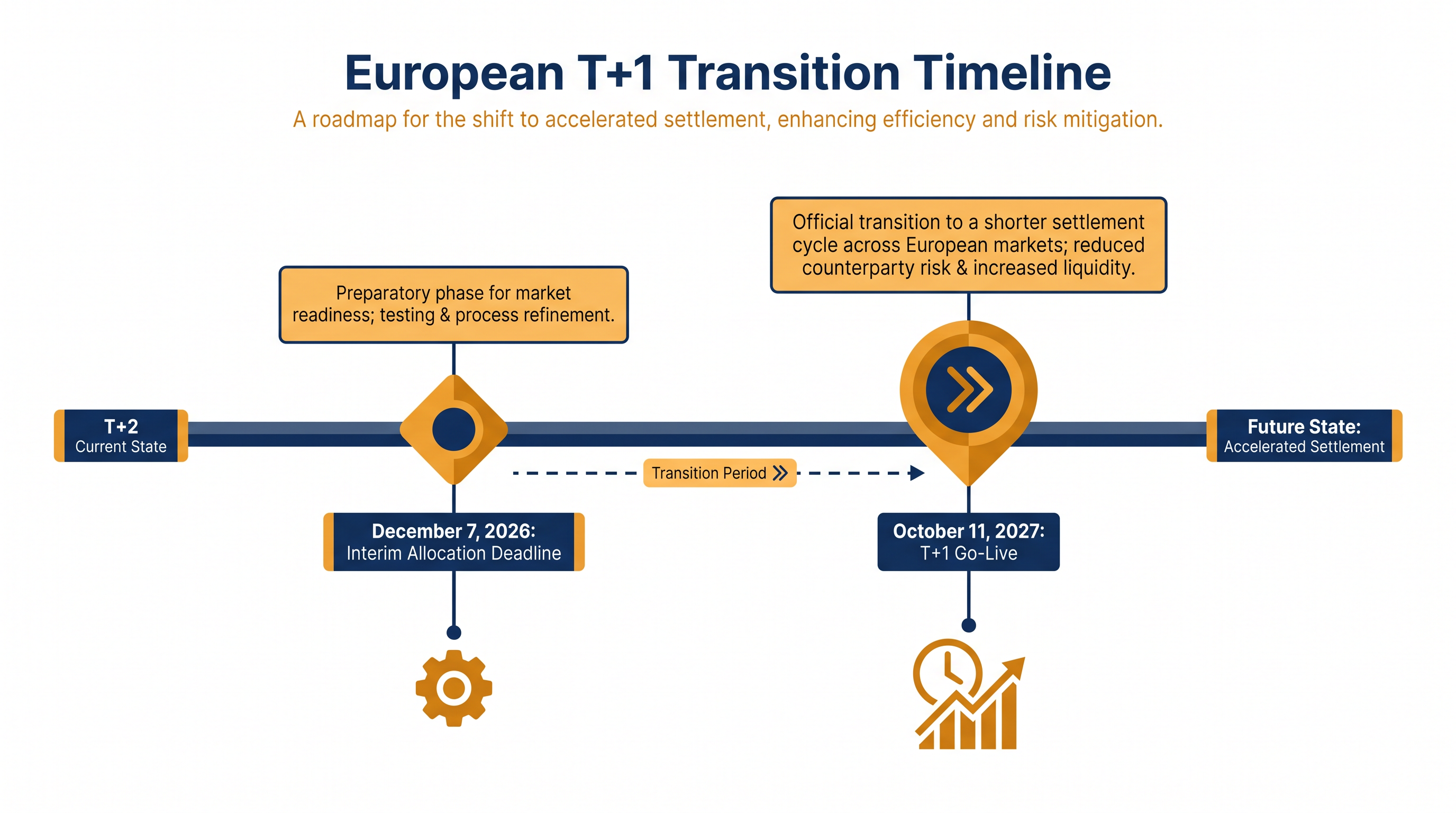
Under the current T+2 model, the final exchange of cash for securities occurs two business days after a trade is executed. T+1 compresses that window to a single day.
The primary mechanism driving this change is risk reduction. By halving the time between execution and settlement, the market minimizes the window during which a counterparty could default.[4]
This reduction in counterparty risk directly translates to lower margin requirements at central clearinghouses, freeing up billions of euros in capital that can be deployed elsewhere in the economy.[4]
However, the operational burden of this compression is immense. According to the Association for Financial Markets in Europe (AFME), losing one day in the settlement cycle actually eliminates roughly 83% of the available time for post-trade processing.
Trade settlement teams will see their core processing window shrink from 12 hours under the T+2 regime to just two hours under T+1.
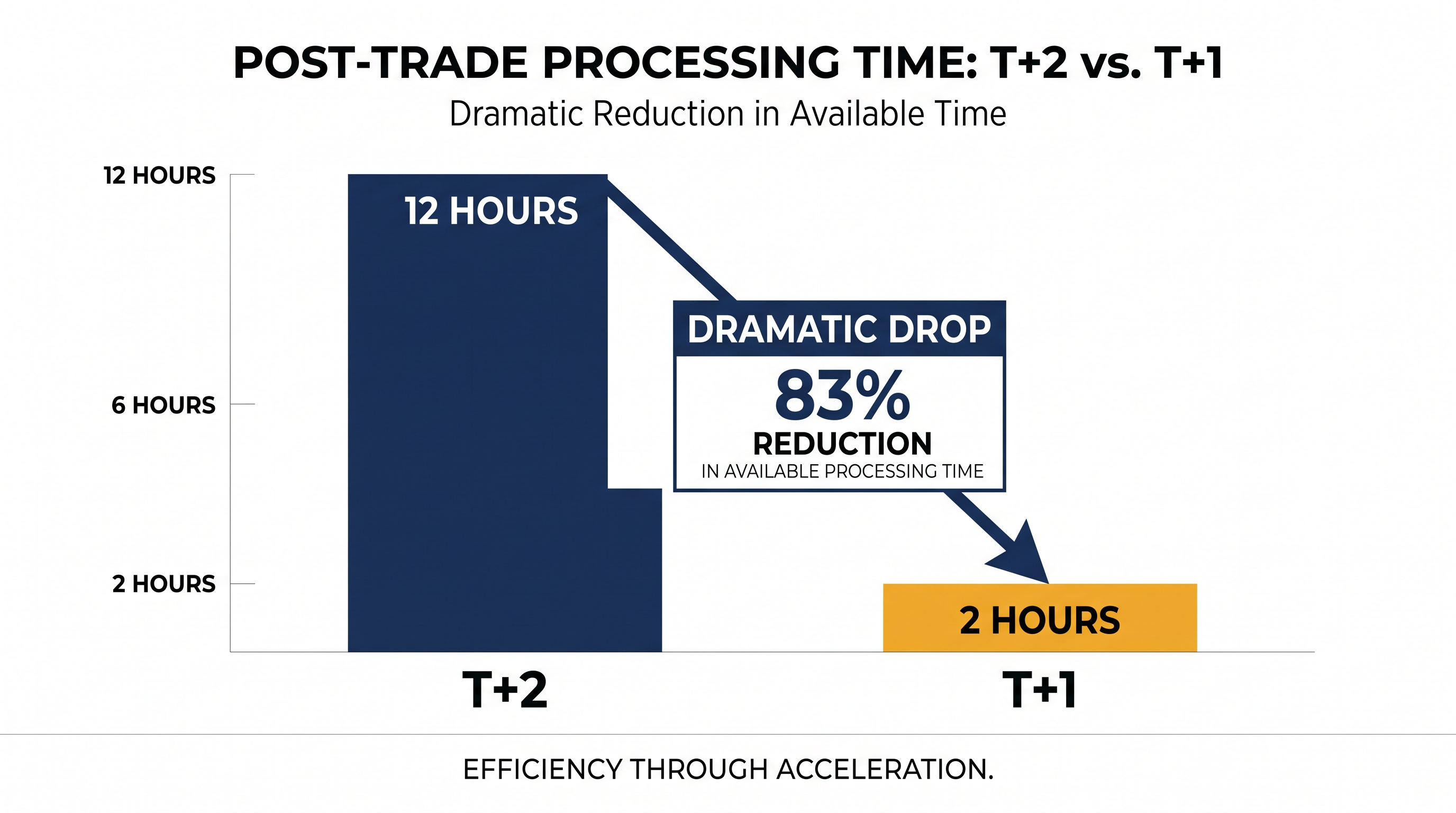
Trade settlement teams will see their core processing window shrink from 12 hours under the T+2 regime to just two hours under T+1.
This necessitates a total departure from manual processing. Firms will be forced to implement straight-through processing (STP) and automated allocation systems to meet the new deadlines.[3]
The final rules adopted by the Commission include a notable compromise following intense lobbying from the French financial community, including industry groups and regulators.[1]
ESMA had initially proposed a strict regulatory requirement that all settlement instructions be submitted no later than 11:59 p.m. on the trade date.[1]
Industry participants demonstrated that this hard deadline would cause severe bottlenecks, particularly for cross-border trades involving foreign exchange components that need to be calculated and settled across time zones.[1]
In response, the Commission downgraded the 11:59 p.m. instruction deadline to a "strong recommendation" to allow firms to take advantage of overnight processing cycles without facing immediate regulatory breaches.[1]
However, the 11:00 p.m. deadline for the allocation and confirmation phase remains a binding regulatory requirement, ensuring that the initial post-trade data is locked in on the trade date.[1][3]
The European transition is uniquely complex compared to the United States, which successfully moved to T+1 in May 2024.
While the U.S. benefits from a single currency and a unified depository system, Europe's market is highly fragmented, comprising 32 different regulators, 40 central securities depositories (CSDs), and 11 national currencies.
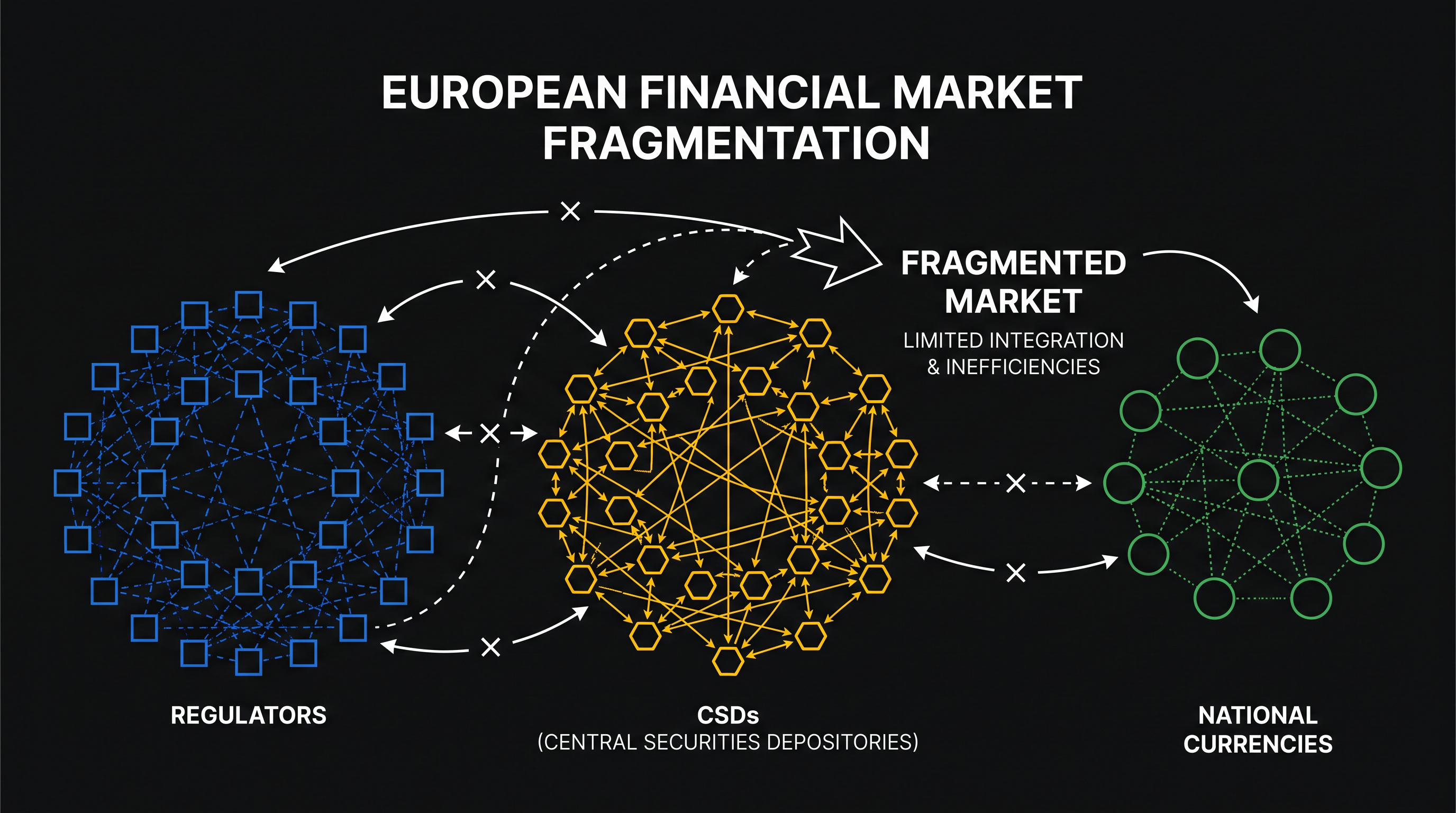
To prevent market fragmentation across the continent, the United Kingdom and Switzerland have committed to aligning their own T+1 transitions with the EU's October 2027 deadline.[3][4]
Regulators across the bloc, including the Dutch Authority for the Financial Markets (AFM) and Italy's Consob, have issued urgent warnings for market participants to accelerate their testing and system upgrades.[2]
How we got here
May 2024
The United States, Canada, and Mexico successfully transition their financial markets to T+1 settlement.
Nov 2024
ESMA publishes its final report recommending October 2027 for the EU's T+1 transition.
July 2026
The EU Commission officially adopts the regulatory technical standards to enforce the transition.
Dec 2026
Interim regulatory deadline for automated allocation and confirmation processes takes effect.
Oct 2027
Scheduled go-live for T+1 settlement across the EU, UK, and Switzerland.
Viewpoints in depth
European Regulators
View the transition as a necessary modernization to reduce systemic risk, lower margin requirements, and keep European capital markets globally competitive.
For regulatory bodies like ESMA and national authorities, the primary driver of the T+1 transition is systemic risk reduction. By halving the time between trade execution and settlement, the market minimizes the window during which a counterparty could default. This directly translates to lower margin requirements at central clearinghouses, freeing up billions of euros in capital that can be deployed elsewhere in the economy. Regulators also view the move as an existential necessity to maintain parity with North American and Asian markets, ensuring that European capital markets remain attractive to global investors.
Banking and Brokerage Industry
Emphasize the massive operational burden, the 83% reduction in processing time, and the urgent need for automated straight-through processing.
Banks, brokers, and asset managers face a monumental operational challenge. According to industry groups like AFME, losing one day in the settlement cycle actually eliminates roughly 83% of the available time for post-trade processing, shrinking the core window from 12 hours to just two. This necessitates a total departure from manual processing and legacy systems. Firms are being forced to invest heavily in straight-through processing (STP) and automated allocation systems. The industry successfully lobbied to soften the strictest 11:59 p.m. settlement instruction deadlines, arguing that hard cutoffs would cause severe bottlenecks, particularly for cross-border trades involving complex foreign exchange components.
Financial Market Infrastructure
Focus on the technical coordination required to synchronize the transition across Europe's fragmented network of exchanges and depositories.
Exchanges, clearinghouses, and central securities depositories (CSDs) must orchestrate a transition that is vastly more complex than the U.S. migration. While the U.S. benefits from a single currency and a unified depository system, Europe's market is highly fragmented, comprising 32 different regulators, 40 CSDs, and 11 national currencies. Infrastructure providers are focused on ensuring that testing phases are robust and that the UK and Switzerland remain perfectly aligned with the EU's timeline to prevent catastrophic market fragmentation and settlement failures across borders.
What we don't know
- Whether smaller asset managers and regional brokers will have the capital to upgrade their legacy systems in time for the December 2026 interim deadline.
- How the compressed timeline will impact the failure rate of cross-border trades that require complex foreign exchange conversions.
- If the 'strong recommendation' for the 11:59 p.m. instruction deadline will eventually be hardened into a strict regulatory requirement if voluntary compliance is low.
Key terms
- T+1 Settlement
- The completion of a securities transaction and the exchange of cash for assets exactly one business day after the trade is executed.
- Central Securities Depository (CSD)
- A specialized financial organization that holds securities so that ownership can be easily and electronically transferred through a book entry.
- Allocation and Confirmation
- The post-trade process where a block trade is divided among individual client accounts and the exact trade details are agreed upon by both parties.
- Straight-Through Processing (STP)
- An automated electronic process that handles a financial transaction from execution to final settlement without any manual intervention.
Frequently asked
Why is Europe moving to T+1 settlement?
To reduce counterparty risk, lower margin requirements at clearinghouses, and remain competitive with North American and Asian markets that have already shortened their settlement cycles.
Will the UK and Switzerland move at the same time?
Yes, both jurisdictions have aligned their transition schedules with the EU's October 11, 2027 deadline to prevent market fragmentation across the continent.
What happens if a firm misses the new deadlines?
Firms that fail to settle trades on time will face mandatory financial penalties under the Central Securities Depositories Regulation (CSDR) and risk severe liquidity bottlenecks.
Sources
Source coverage
4 outlets
3 viewpoints surfaced




[1]Societe GeneraleBanking and Brokerage Industry
EU Commission Adopts ESMA's T+1 Proposal
Read on Societe Generale →[2]Regulation TomorrowEuropean Regulators
Dutch AFM Issues Update on EC's T+1 Rules
Read on Regulation Tomorrow →[3]BNP ParibasBanking and Brokerage Industry
Navigating the Transition to T+1 in Europe
Read on BNP Paribas →[4]ETF StreamEuropean Regulators
ESMA Confirms 'No Delay' to T+1 Deadline
Read on ETF Stream →
Every angle. Every day.
Get meta stories with full source coverage and perspective breakdowns delivered to your inbox.