
IOC Terminates 12-Year Esports Olympics Partnership With Saudi Arabia, Canceling 2027 Event
The International Olympic Committee and Saudi Arabia have mutually agreed to cancel their 12-year partnership to host the Olympic Esports Games. The decision follows a strategic review by new IOC leadership and highlights the ongoing friction between traditional Olympic values and the commercial gaming industry.
By Omar Haddad

- Traditional Olympic Movement
- Argues that any Olympic esports event must strictly align with traditional Olympic values, excluding violent games and requiring careful integration.
- Saudi Esports Ambitions
- Focuses on rapidly building a global hub for competitive gaming through massive investment, independent of traditional sports bureaucracy.
- Esports Industry & Publishers
- Prioritizes the inclusion of the world's most popular game titles and clear, commercially viable tournament formats over legacy sports traditions.
Why this matters
The collapse of this landmark partnership forces the $2.4 billion competitive gaming industry to chart its own course independent of traditional sports institutions. It also underscores the difficulty of merging legacy Olympic values with modern, commercially driven digital entertainment.
Key points
- The IOC and Saudi Arabia have mutually canceled their 12-year partnership to host the Olympic Esports Games.
- The inaugural event, originally scheduled for 2027 in Riyadh, will no longer take place.
- New IOC leadership initiated a strategic review, citing differing views on esports within the Olympic movement.
- Disagreements over the inclusion of popular violent video games clashed with traditional Olympic values.
- The IOC has suspended its Esports Commission while it develops a new approach to digital competition.
- Saudi Arabia will continue its independent esports expansion, including the annual Esports World Cup.
The International Olympic Committee (IOC) and Saudi Arabia have officially dismantled their ambitious 12-year partnership to host the inaugural Olympic Esports Games. Originally slated for 2025 and later pushed to 2027, the Riyadh-based event was envisioned as a historic bridge between traditional athletics and the booming competitive gaming industry.[1][2]
Instead, the collaboration collapsed after just 14 months. Following an internal review, both parties announced a mutual agreement to end their cooperation, opting to pursue their esports ambitions on separate paths. The decision marks a significant pivot for the Olympic movement and a rare setback for Saudi Arabia's Vision 2030 sports initiatives.[3][4]
The unraveling of the deal highlights the profound friction between the deeply traditional Olympic framework and the fast-moving, commercially driven world of competitive video gaming. To understand why the partnership failed, it is necessary to examine the leadership changes within the IOC, the clash over acceptable game titles, and the divergent financial models of the two organizations.
The partnership was originally championed by former IOC President Thomas Bach, who saw esports as a vital tool for engaging younger audiences. In July 2024, the IOC unanimously approved the creation of the Olympic Esports Games, securing a 12-year hosting and financing agreement with the Saudi Olympic and Paralympic Committee.[5]
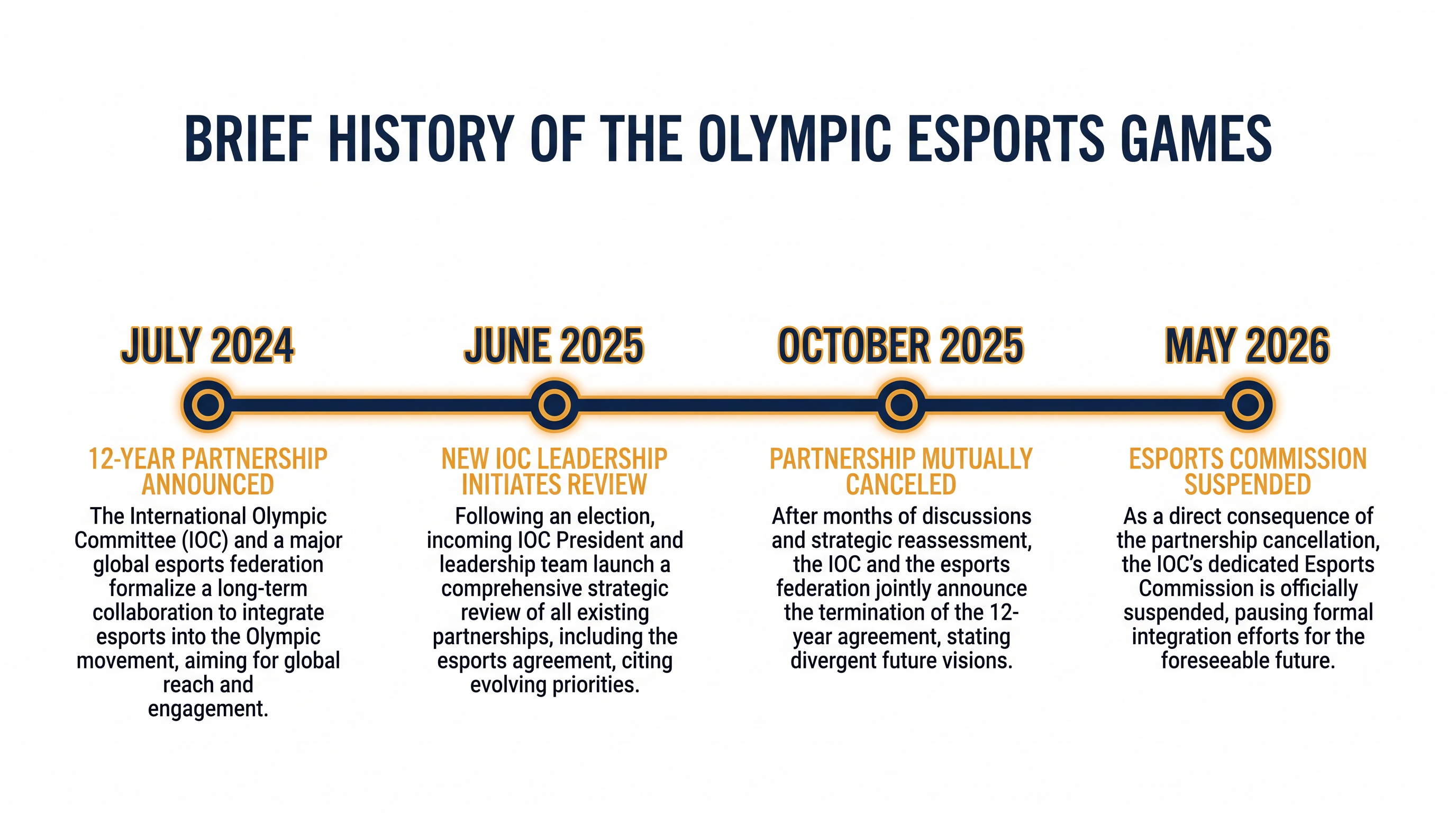
However, the landscape shifted dramatically when Kirsty Coventry assumed the IOC presidency in June 2025. Coventry immediately initiated a "Pause and Reflect" agenda, a comprehensive review designed to ensure all Olympic operations were structurally sound and aligned with the organization's long-term goals.[6]
During a press conference, Coventry explained that the cancellation was not about discomfort with Saudi Arabia, but rather a need for strategic regrouping. She noted that early in the review process, it became clear there were multiple, conflicting views regarding esports coming from across the entire Olympic Movement.[6]
A primary sticking point was the nature of the games themselves. The IOC has historically maintained strict guidelines regarding violence, insisting that Olympic esports must align with traditional Olympic values. This stance effectively disqualifies popular "shooter" titles like Call of Duty or Counter-Strike, which dominate global esports viewership and prize pools.[2]
A primary sticking point was the nature of the games themselves.
For the esports community and major game publishers, an event stripped of its most popular titles lacked legitimacy. Reports indicated ongoing concerns from publishers about the proposed format and a lack of concrete details regarding the competition's structure, leading to the initial postponement from 2025 to 2027.[3]
The structural differences between the two entities also played a role. The IOC operates as a massive, federated bureaucracy that requires consensus among international sports federations. In contrast, the Saudi esports apparatus—driven by the Esports World Cup Foundation—moves with the agility of a well-funded startup, unencumbered by decades of traditional sporting dogma.[4]
Following the cancellation of the Saudi deal, the IOC's internal esports apparatus has ground to a halt. In May 2026, the IOC quietly suspended the activities of its dedicated Esports Commission, placing the entire project on an indefinite hiatus while leadership determines its next steps.[5][7]
Despite the suspension, the IOC maintains that the Olympic Esports Games are not entirely dead. The organization stated it will use the feedback from the review process to develop a new approach and pursue a different partnership model, aiming to spread the opportunities more widely across different host nations.[2][4]
Meanwhile, Saudi Arabia remains undeterred in its quest to become the global epicenter of competitive gaming. The kingdom continues to pour billions into the sector under Crown Prince Mohammed bin Salman's Vision 2030 program, hosting record-breaking tournaments that attract top-tier teams and developers.[8]
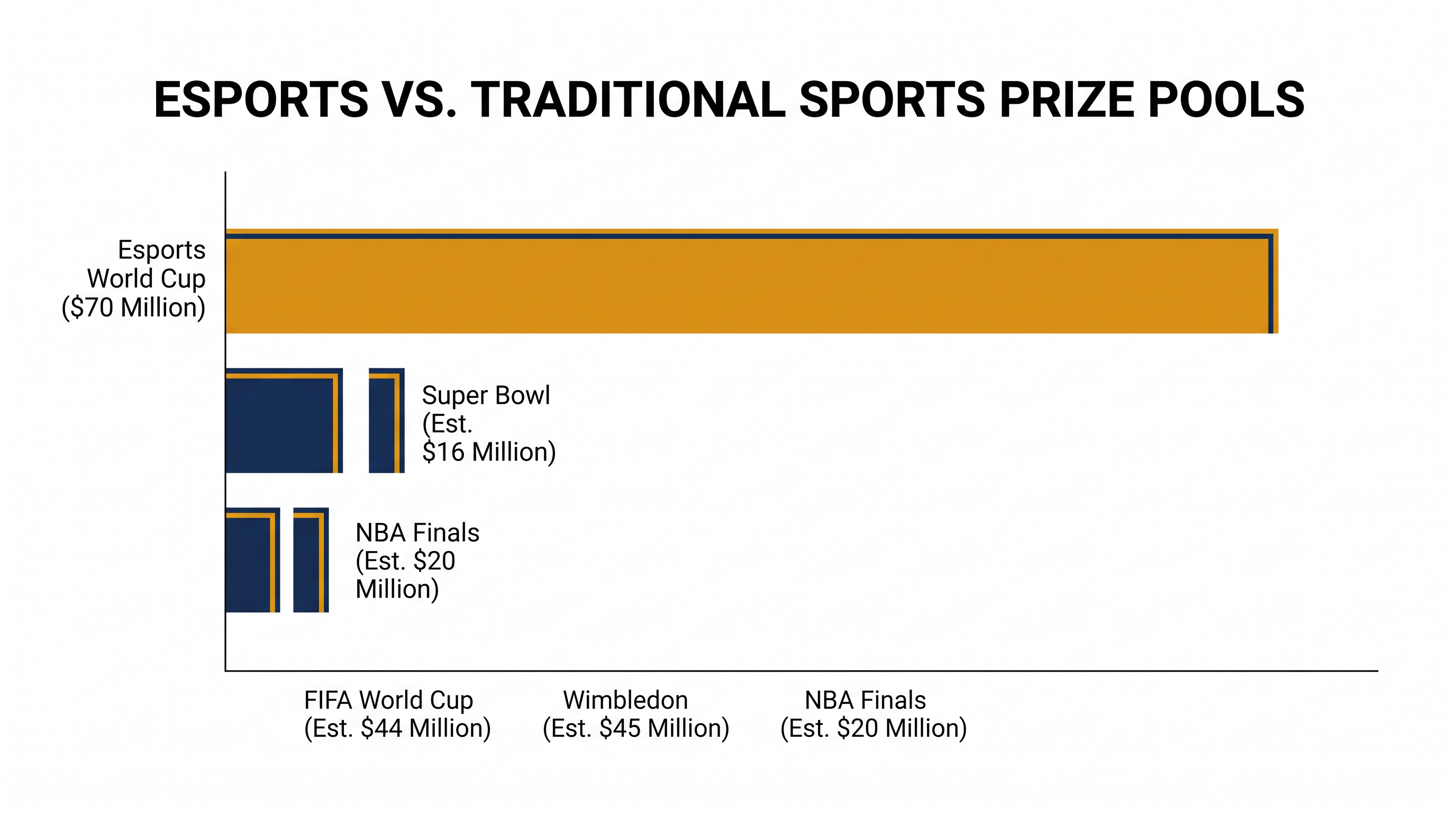
The annual Esports World Cup, held in Riyadh, serves as the centerpiece of this strategy. Unbound by Olympic restrictions on violent content, the event features a staggering $70 million prize pool distributed across a wide array of the world's most popular game titles.[2]
Looking ahead, Saudi Arabia is already preparing to launch the Esports Nations Cup in November 2026. This proprietary international tournament will run every two years, effectively creating a direct, independent alternative to the IOC's stalled Olympic Esports Games.[2][8]
The collapse of the IOC-Saudi partnership underscores a fundamental reality: esports does not necessarily need the Olympics to thrive. With an estimated global value of $2.4 billion and a deeply entrenched ecosystem of publishers, teams, and fans, competitive gaming has already built its own massive infrastructure.[6]
Ultimately, the failed 2027 event serves as a cautionary tale about the difficulties of merging legacy sports institutions with digital-native entertainment. While the IOC regroups to figure out its digital future, the esports industry will continue to expand on its own terms, driven by publisher control and massive private investment.
How we got here
July 2024
The IOC and Saudi Arabia announce a 12-year partnership to host the Olympic Esports Games.
June 2025
Kirsty Coventry assumes the IOC presidency and initiates a strategic review of Olympic operations.
October 2025
The IOC and Saudi Arabia mutually agree to cancel the 2027 event and end their partnership.
May 2026
The IOC officially suspends the activities of its dedicated Esports Commission.
Viewpoints in depth
The Olympic Movement's View
The IOC prioritizes long-term alignment with traditional sporting values over immediate expansion into gaming.
Under new President Kirsty Coventry, the IOC has adopted a 'Pause and Reflect' strategy to ensure all new ventures fit the organization's long-term goals. For the Olympic movement, the primary concern is brand safety and adherence to the Olympic Charter. This means strictly avoiding games that simulate real-world violence, even if those titles dominate the esports market. The IOC views its role as elevating digital competition responsibly, rather than simply co-opting existing commercial tournaments.
Saudi Arabia's View
The kingdom views esports as a central pillar of its economic diversification and is willing to build the infrastructure independently.
Through its Vision 2030 initiative, Saudi Arabia aims to position Riyadh as the undisputed global capital of competitive gaming. While the Olympic partnership offered prestige, the kingdom's Esports World Cup Foundation has proven it can attract top-tier talent and massive viewership without the IOC's involvement. By operating independently, Saudi organizers can feature the world's most popular shooter games and offer unprecedented prize pools, unconstrained by the bureaucratic hurdles of traditional sports federations.
The Esports Industry's View
Game publishers and competitive players remain skeptical of traditional sports organizations dictating the terms of their industry.
The esports ecosystem is fundamentally different from traditional sports because the 'fields of play'—the games themselves—are proprietary intellectual property owned by private corporations. Publishers were reportedly hesitant to hand over control of their games to the IOC without clear details on formatting and revenue sharing. Many in the gaming community feel that esports has already built its own successful ecosystem and does not need the validation of the Olympic rings to legitimize its massive global audience.
What we don't know
- Whether the IOC will eventually launch a restructured Olympic Esports Games with a different host nation.
- Which specific game publishers formally pushed back against the IOC's proposed tournament formats.
- How the absence of an Olympic pathway will impact the long-term mainstream broadcasting rights for competitive gaming.
Key terms
- Olympic Esports Games (OEG)
- A proposed standalone global competition organized by the International Olympic Committee to feature competitive video gaming.
- Esports World Cup
- An annual international esports tournament held in Riyadh, Saudi Arabia, featuring massive prize pools and multiple game titles.
- Vision 2030
- Saudi Arabia's government program aimed at diversifying its economy away from oil, heavily investing in sports, gaming, and entertainment.
- Pause and Reflect
- A strategic review process initiated by IOC President Kirsty Coventry to evaluate the long-term viability and alignment of Olympic operations.
Frequently asked
Why did the IOC cancel the 2027 Esports Games?
The IOC and Saudi Arabia mutually agreed to end the partnership following a strategic review by new IOC leadership, citing differing views within the Olympic movement and a desire to realign esports with traditional Olympic values.
Will there ever be an Olympic Esports Games?
The IOC states it is still committed to the concept and is developing a new approach and partnership model, though its dedicated Esports Commission is currently on hiatus.
What happens to Saudi Arabia's esports plans?
Saudi Arabia continues to heavily invest in esports independently, hosting the annual Esports World Cup and planning the debut of an Esports Nations Cup in late 2026.
Why were popular games excluded from the Olympic plans?
The IOC has historically maintained strict guidelines against games that simulate real-world violence, effectively disqualifying popular shooter titles like Call of Duty from Olympic consideration.
Sources
Source coverage
8 outlets
3 viewpoints surfaced








[1]South China Morning PostSaudi Esports Ambitions
IOC, Saudi Arabia cancel 12-year deal for Riyadh to host video gaming Esports Olympics
Read on South China Morning Post →[2]PC GamerEsports Industry & Publishers
The International Olympic Committee has cancelled a 12-year deal with Saudi Arabia
Read on PC Gamer →[3]GamesIndustry.bizEsports Industry & Publishers
The inaugural Olympic Esports Games, due to take place in Saudi Arabia in 2027, has been cancelled
Read on GamesIndustry.biz →[4]The Sports ExaminerTraditional Olympic Movement
ESPORTS: Olympic Esports Games deal with Saudi Arabia ends as Coventry reported uncomfortable with event's direction
Read on The Sports Examiner →[5]GamesBidsTraditional Olympic Movement
The highly anticipated Olympic Esports Games originally set to open in 2027 may now never be held at all
Read on GamesBids →[6]SwimSwamTraditional Olympic Movement
The Olympic ESports Games in Saudi Arabia have been canceled
Read on SwimSwam →[7]UNNTraditional Olympic Movement
The IOC has suspended the Esports Commission and terminated a 12-year contract with Saudi Arabia
Read on UNN →[8]Shane the GamerSaudi Esports Ambitions
IOC Cancels 12-Year Olympic Esports Games Deal With Saudi Arabia
Read on Shane the Gamer →
Every angle. Every day.
Get gaming esports stories with full source coverage and perspective breakdowns delivered to your inbox.