
The Compliance Redesign: How CPSC Revokes Obsolete 1971 Rules for Infant Bouncer Seats and Activity Centers to Improve Clarity
The CPSC is streamlining baby product safety by revoking outdated 1971 regulations, relying entirely on rigorous modern ASTM standards. The move clarifies the compliance landscape for manufacturers and helps parents confidently choose between infant bouncers and stationary activity centers.
By Tiago Sousa


- Juvenile Product Manufacturers
- Value the clarity of testing against a single, modern ASTM standard rather than cross-referencing obsolete FDA mandates.
- Regulatory Reformers
- Argue that eliminating duplicative, 55-year-old rules reduces unnecessary compliance costs and aligns with federal deregulation directives.
- Child Safety Advocates
- Support the transition because the modern standards mandate stricter stability tests and explicit suffocation warnings.
Why this matters
For manufacturers, this eliminates the cost and confusion of testing against duplicative, 55-year-old rules. For parents, it guarantees that the bouncers and activity centers on store shelves are tested against modern, data-driven safety metrics, making the choice between the two products purely about developmental fit.
Key points
- The CPSC is revoking obsolete 1971 safety rules for infant bouncers and stationary activity centers.
- The move eliminates duplicative testing requirements without reducing consumer safety protections.
- Both products are now governed exclusively by modern, data-driven ASTM International standards.
- Bouncers are designed for infants 0-6 months and must pass strict stability tests.
- Activity centers are for older babies with neck control and require redundant safety springs.
- Neither product is safe for infant sleep and must be used within strict developmental windows.
The Consumer Product Safety Commission (CPSC) has officially cleared the books of a 55-year-old regulatory overlap, issuing a direct final rule to revoke obsolete 1971 safety standards for infant bouncer seats and stationary activity centers. Effective September 21, 2026, the move eliminates outdated provisions that have long confused manufacturers, testing laboratories, and consumer advocates. For decades, companies building juvenile products were forced to navigate a dual-regulatory system, ensuring their designs met both modern engineering standards and legacy rules drafted during the Nixon administration. By officially retiring these redundant mandates, the CPSC is streamlining the compliance process and ensuring that the baby gear reaching store shelves is governed exclusively by the most rigorous, up-to-date safety science available.[1][2]
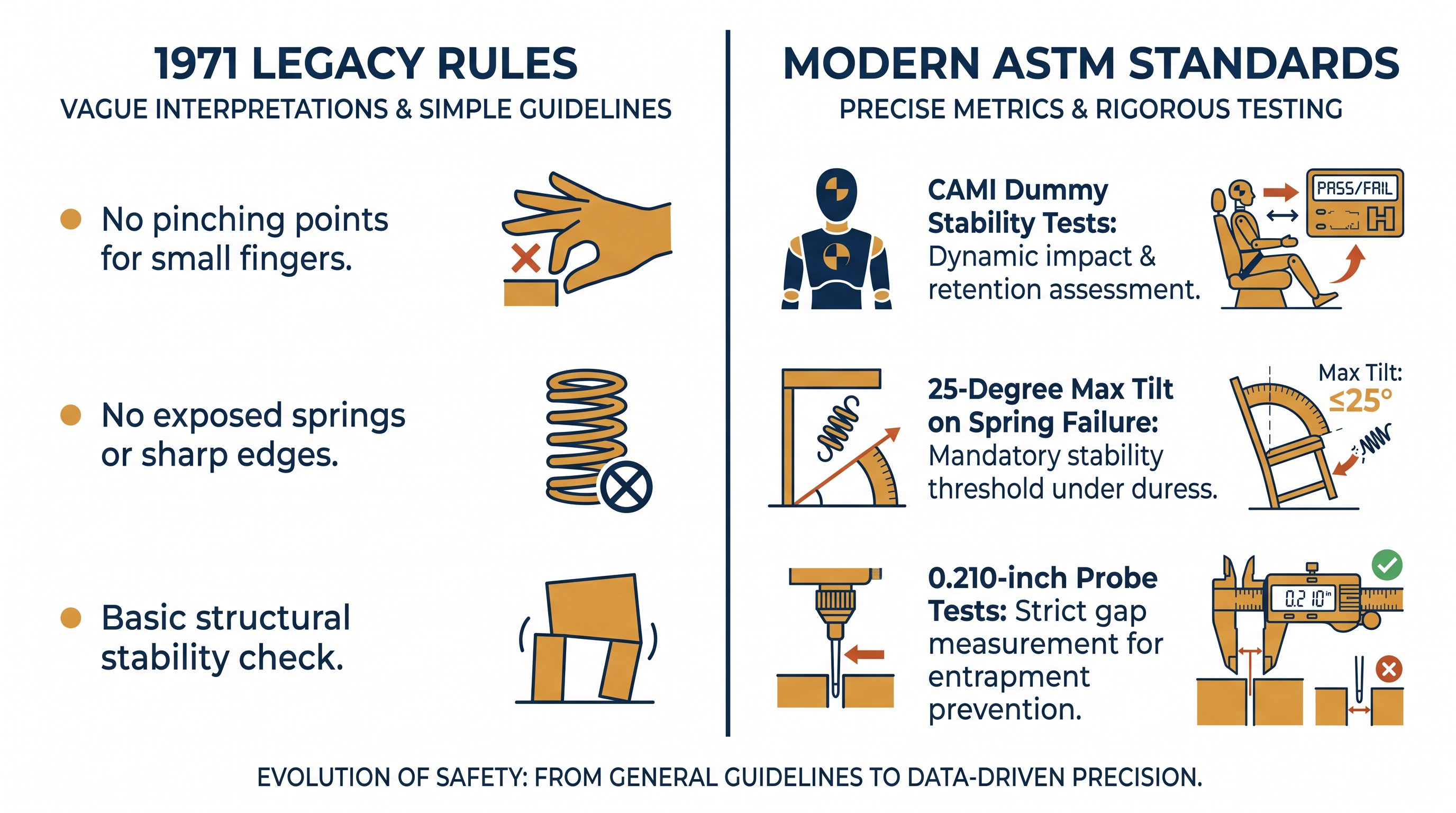
The revoked rules, originally drafted by the Food and Drug Administration (FDA) under the Federal Hazardous Substances Act, were a product of their time. Written before comprehensive pediatric data was widely utilized in product design, the 1971 regulations relied on broad, subjective bans against "scissoring, shearing, or pinching" effects, as well as prohibitions on exposed coil springs and vaguely defined finger entrapment hazards. While well-intentioned half a century ago, these legacy requirements became increasingly obsolete as product engineering evolved. By dropping these outdated rules, the CPSC is placing its full regulatory weight behind modern, highly specific ASTM International standards—specifically 16 CFR 1229 for bouncers and 16 CFR 1238 for activity centers—which leave no room for subjective interpretation on the factory floor.[1][4][6]
Crucially, this regulatory redesign does not lower the safety bar for infants; rather, it replaces vague 1970s mandates with precise, data-driven engineering tests based on modern anthropometric measurements. The newer ASTM standards utilize decades of pediatric research to dictate exact probe dimensions, weight limits, and structural stress tests that far exceed the protections offered by the old FDA rules. With the compliance landscape now streamlined, manufacturers face fewer duplicative testing costs and administrative hurdles. More importantly, parents can evaluate the two distinct product categories—infant bouncers and stationary activity centers—based purely on their developmental merits and modern safety profiles, knowing that both are held to the highest contemporary standards.[1][3][5][7]
For parents navigating the often-overwhelming baby gear market, the choice between an infant bouncer seat and a stationary activity center represents a distinct developmental trade-off. Both products are now governed by clear, rigorous, and streamlined federal standards, but they serve entirely different stages of an infant's first year of life. Understanding the specific use cases, physical requirements, and safety limitations of each category is essential for making an informed purchase. With the regulatory confusion cleared away, the comparison between the two products becomes a straightforward analysis of what a growing baby actually needs at different milestones.[7]
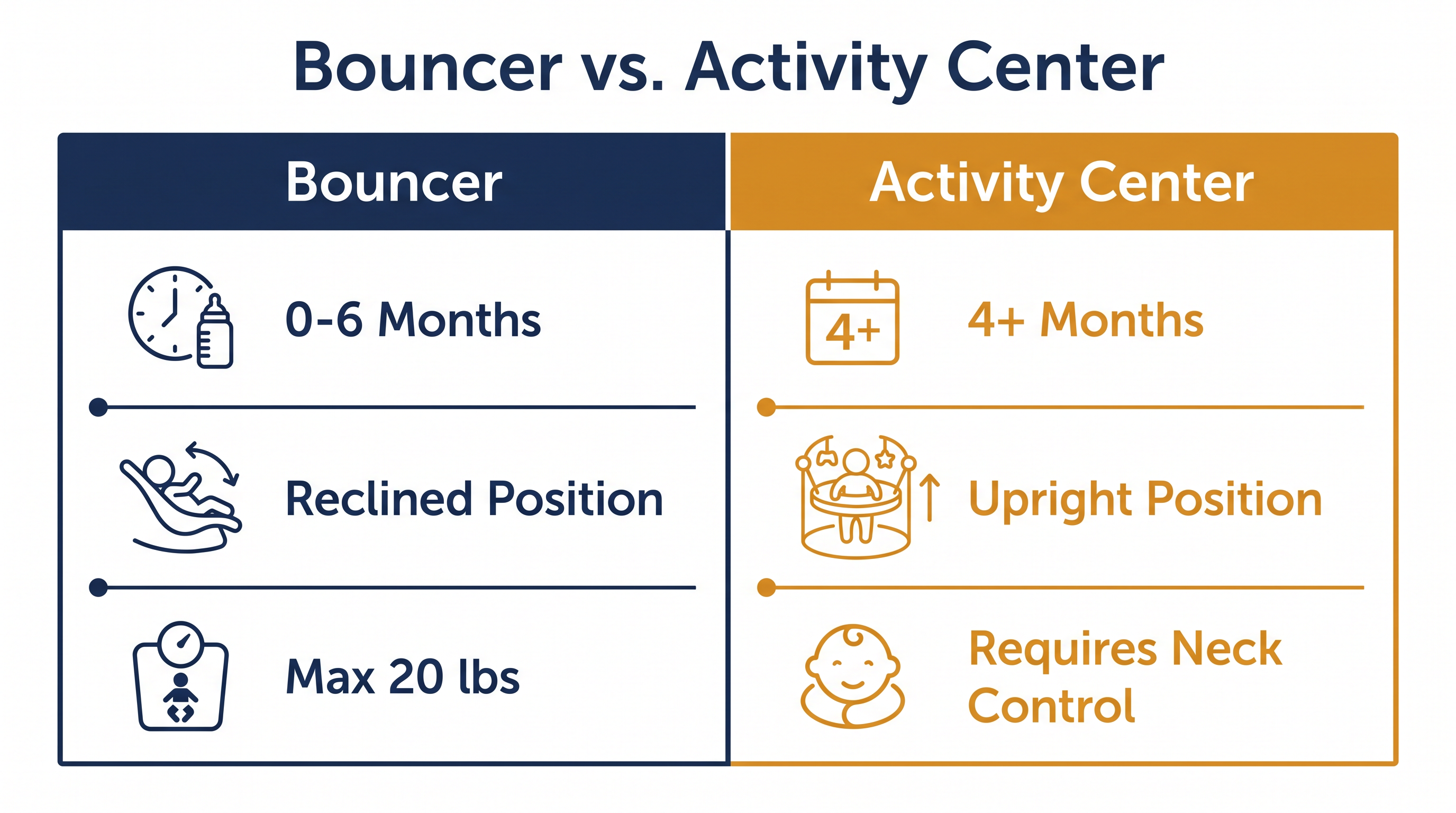
The case for infant bouncer seats centers entirely on early-months utility, soothing capabilities, and everyday portability. Designed specifically for newborns and infants up to roughly six months of age, bouncers provide a comfortable, reclined environment that allows a baby to bounce gently via their own kicking movements or a caregiver's physical assistance. Because they are typically constructed from lightweight tubular frames and fabric, they are incredibly easy to move from room to room. This portability offers parents a safe, secure place to set a baby down while cooking, showering, or working, all while keeping the infant comfortably within the caregiver's direct line of sight.[5][6][7]
The case against infant bouncer seats is rooted in their severely limited lifespan of use and their strict positional limitations. Once a baby reaches the manufacturer's weight limit—typically around 20 pounds—or begins attempting to sit up unassisted, the bouncer is no longer dynamically stable or safe to use. Furthermore, they pose a significant hazard if misused as a sleep environment. The reclined angle of a bouncer can cause a sleeping infant's head to slump forward, creating a severe risk of positional asphyxiation. Because babies outgrow them so quickly, some parents find the investment difficult to justify for only a few months of active use.[5][7]
The case against infant bouncer seats is rooted in their severely limited lifespan of use and their strict positional limitations.
The evidence supporting the safety of modern bouncers relies heavily on the rigorous ASTM F2167 standard that the CPSC has now fully embraced. To pass these contemporary federal requirements, bouncers must survive strict forward, sideward, and rearward stability testing using a weighted CAMI infant dummy to ensure they will not tip over during vigorous bouncing. The standard also mandates highly visible, permanent warning labels stitched directly onto the product. These warnings explicitly state that the bouncer must never be placed on a soft, elevated surface like a bed or sofa, and that any sleeping infant must be immediately removed and placed into a firm, flat crib.[1][5][7]
The case for stationary activity centers focuses on active physical engagement, upright posture, and fine motor skill development. Designed for older babies—typically starting around four to six months of age, once they possess rock-solid head and neck control—these freestanding units surround the child with a 360-degree tray of interactive toys. Unlike the reclined bouncer, activity centers allow a sitting or standing infant to spin, rock, and bounce on their own two feet. This provides a level of upright visual stimulation and independent play that a reclined bouncer simply cannot match, keeping older babies highly entertained while safely contained in one spot.[6][7]
The case against stationary activity centers involves their large physical footprint in the home and the potential developmental toll of overuse. They are inherently bulky, difficult to store, and take up significant floor space in a living room or nursery. More importantly, pediatric physical therapists frequently warn that leaving a baby in an activity center for prolonged periods can negatively impact hip development or encourage toe-walking. Because the child's weight is supported by a fabric sling rather than their own skeletal structure, excessive use can interfere with the natural development of crawling and walking mechanics that are better fostered through unrestricted floor play.[7]
The evidence supporting their mechanical safety is anchored in the comprehensive ASTM F2012 standard. Because these activity centers often rely on heavy-duty springs to facilitate bouncing and rocking motions, the modern rules require a fail-safe redundant safety system. If a primary spring or support mechanism fails during use, the unit must still fully support the testing weight and come to rest at an angle no greater than 25 degrees from horizontal. This strict engineering requirement ensures that a mechanical failure will not result in the child being ejected from the seat or trapped within the collapsing frame.[1][6]
The CPSC's revocation of the 1971 rules directly benefits the precise engineering of both of these product categories. Under the old FDA rules, manufacturers had to ensure no hole was larger than 0.125 inches in diameter to prevent finger entrapment, a metric that lacked scientific nuance. The modern ASTM standards, utilizing 1975 University of Michigan anthropometric data, use a much more accurate 0.210-to-0.375-inch probe test that accounts for the actual depth, shape, and flexibility of a child's finger. By relying solely on these modern metrics, manufacturers can design better, more interactive toys without compromising the fundamental safety of the product.[1][7]
Ultimately, an infant bouncer seat fits well when parents of a newborn need a highly portable, safe, and soothing spot for their awake baby during the first few fragile months of life. It is the ideal solution for keeping a pre-mobile infant secure, comfortable, and gently entertained while the caregiver is nearby and actively supervising. For families living in smaller spaces or multi-story homes, the lightweight nature of a bouncer makes it an indispensable daily tool for managing life with a newborn.[7]
A stationary activity center fits well when a baby has outgrown the reclined stage, possesses excellent neck control, and craves upright, interactive stimulation. It is highly effective for short, 15-to-20-minute bursts of play that keep an older infant engaged while allowing parents a brief hands-free moment. For babies who are eager to stand and observe the room from a vertical perspective, an activity center provides a safe, contained environment to practice bearing weight on their legs before they are ready to cruise or walk independently.[6][7]
Crucially, neither product fits well when used outside of its strict developmental window or intended purpose. Bouncers must be permanently retired the moment a baby tries to sit up or roll over, and activity centers must be packed away once a toddler begins walking or attempting to climb out of the seat. Above all, neither product is ever an appropriate substitute for a firm, flat bassinet or crib. Understanding these boundaries ensures that the CPSC's modern safety standards are paired with responsible, developmentally appropriate parenting.[5][6][7]
How we got here
1971
The FDA issues foundational safety regulations for baby bouncers and walkers under the Federal Hazardous Substances Act.
1973
Regulatory authority over these juvenile products is transferred from the FDA to the newly created CPSC.
2008
Congress passes the CPSIA, directing the CPSC to establish mandatory safety standards for durable infant products.
2017
The CPSC adopts 16 CFR 1229, establishing the modern ASTM F2167 standard for infant bouncer seats.
2019
The CPSC adopts 16 CFR 1238, establishing the modern ASTM F2012 standard for stationary activity centers.
July 2026
The CPSC issues a direct final rule revoking the obsolete 1971 regulations to eliminate duplicative testing.
September 2026
The revocation officially takes effect, leaving the modern ASTM standards as the sole regulatory framework.
Viewpoints in depth
Regulatory Reformers
Argue that eliminating duplicative, 55-year-old rules reduces unnecessary compliance costs and aligns with federal deregulation directives.
Proponents of the CPSC's direct final rule view the 1971 regulations as a textbook example of regulatory bloat. Because the FDA originally drafted these rules before modern anthropometric data existed, they relied on subjective bans that forced manufacturers to conduct redundant testing. By clearing these obsolete provisions from the Code of Federal Regulations, reformers argue the government is reducing the compliance burden on businesses without sacrificing a single layer of consumer protection.
Juvenile Product Manufacturers
Value the clarity of testing against a single, modern ASTM standard rather than cross-referencing obsolete FDA mandates.
For the companies designing and building baby gear, the revocation is a major operational win. Under the overlapping regime, engineers had to ensure products met the highly specific metrics of ASTM F2167 and F2012 while simultaneously proving they didn't violate the vague 'pinching' or 'scissoring' definitions of the 1971 rules. Manufacturers argue that relying solely on the modern ASTM standards allows them to innovate more freely, knowing exactly which precise probe measurements and stability weights their products must survive in the lab.
Child Safety Advocates
Support the transition because the modern standards mandate stricter stability tests and explicit suffocation warnings.
While safety advocates are traditionally wary of deregulation, they broadly support this specific revocation because the modern standards are vastly superior. The 1971 rules lacked any requirements for structural integrity, occupant retention, or fall hazards. Advocates emphasize that the modern 16 CFR 1229 and 1238 standards actively save lives by mandating redundant spring systems in activity centers and requiring highly visible warnings that bouncers must never be used for infant sleep.
What we don't know
- Whether the removal of the 1971 rules will significantly lower retail prices for these products, or if testing savings will simply be absorbed by manufacturers.
- How quickly all legacy testing documentation will be phased out by third-party conformity assessment bodies.
Key terms
- ASTM International
- An international standards organization that develops and publishes voluntary technical standards for a wide range of materials and products.
- Anthropometric Data
- Measurements of the size, proportions, and physical properties of the human body, used to design safe consumer products.
- Direct Final Rule
- A rulemaking procedure used by federal agencies to issue a rule without prior proposal when the agency expects no significant adverse comments.
- CAMI Dummy
- A specialized testing dummy designed to simulate the weight and weight distribution of an infant, used in product stability tests.
- Stationary Activity Center
- A freestanding, non-mobile product that surrounds a sitting or standing infant, allowing them to bounce, spin, and play.
Frequently asked
Why did the CPSC revoke the 1971 rules?
The 1971 rules were outdated and duplicative. The CPSC now relies on modern, stricter ASTM standards that use precise engineering tests rather than vague bans.
Are baby bouncers less safe now?
No. The revocation does not lower safety standards; it simply removes obsolete overlap. Bouncers must still pass the rigorous 16 CFR 1229 mandatory standard.
When should I stop using an infant bouncer?
You should stop using a bouncer when your baby reaches the manufacturer's weight limit (often 20 pounds) or begins attempting to sit up unassisted.
Can my baby sleep in a bouncer or activity center?
No. Neither product is safe for sleep. Bouncers pose a positional asphyxiation risk, and sleeping infants should always be moved to a firm, flat crib.
Sources
Source coverage
7 outlets
3 viewpoints surfaced






[1]Federal RegisterRegulatory Reformers
Revocation of Obsolete Rules Regarding Infant Bouncer Seats and Stationary Activity Centers
Read on Federal Register →[2]VitalLawRegulatory Reformers
FINAL RULES—BABY PRODUCTS—CPSC revokes obsolete rules on infant bouncer seats, stationary activity centers
Read on VitalLaw →[3]Sandler, Travis & Rosenberg, P.A.Juvenile Product Manufacturers
CPSC Removes Obsolete Regulations on Two Child Products
Read on Sandler, Travis & Rosenberg, P.A. →[4]TUV RheinlandJuvenile Product Manufacturers
USA - Revocation of Obsolete Rules Regarding Infant Bouncer Seats and Stationary Activity Centers
Read on TUV Rheinland →[5]IntertekJuvenile Product Manufacturers
U.S. – CPSC Approves ASTM F2167-19 for Infant Bouncer Seats in Direct Final Rule
Read on Intertek →[6]Consumer Product Safety CommissionChild Safety Advocates
Business Guidance: Stationary Activity Centers
Read on Consumer Product Safety Commission →[7]Factlen Editorial TeamChild Safety Advocates
Synthesis by Factlen editorial team
Read on Factlen Editorial Team →

Every angle. Every day.
Get shopping stories with full source coverage and perspective breakdowns delivered to your inbox.