
The Packaging Redesign: How California's Ban on All Plastic Checkout Bags Forces a Retail Shift
Starting January 1, 2026, California will ban all plastic checkout bags, closing a loophole that allowed thicker plastic film and forcing a statewide shift to recycled paper and reusable alternatives.
By Ivan Smirnov

- Environmental Advocates
- Focused on eliminating marine pollution and closing legislative loopholes.
- Retailers & Supply Chain
- Focused on the logistical friction and costs of transitioning to paper.
- Local Municipalities & Public
- Focused on the necessity of habit changes and the practical checkout experience.
Why this matters
This law fundamentally changes the daily checkout experience for 39 million Californians and forces national retailers to overhaul their packaging logistics. Understanding the environmental break-even points of paper versus reusable bags ensures shoppers aren't accidentally increasing their carbon footprint.
Key points
- California's SB 1053 bans all plastic carryout bags at checkout starting January 1, 2026.
- The law closes a 2014 loophole that allowed retailers to sell thicker plastic bags labeled as 'reusable.'
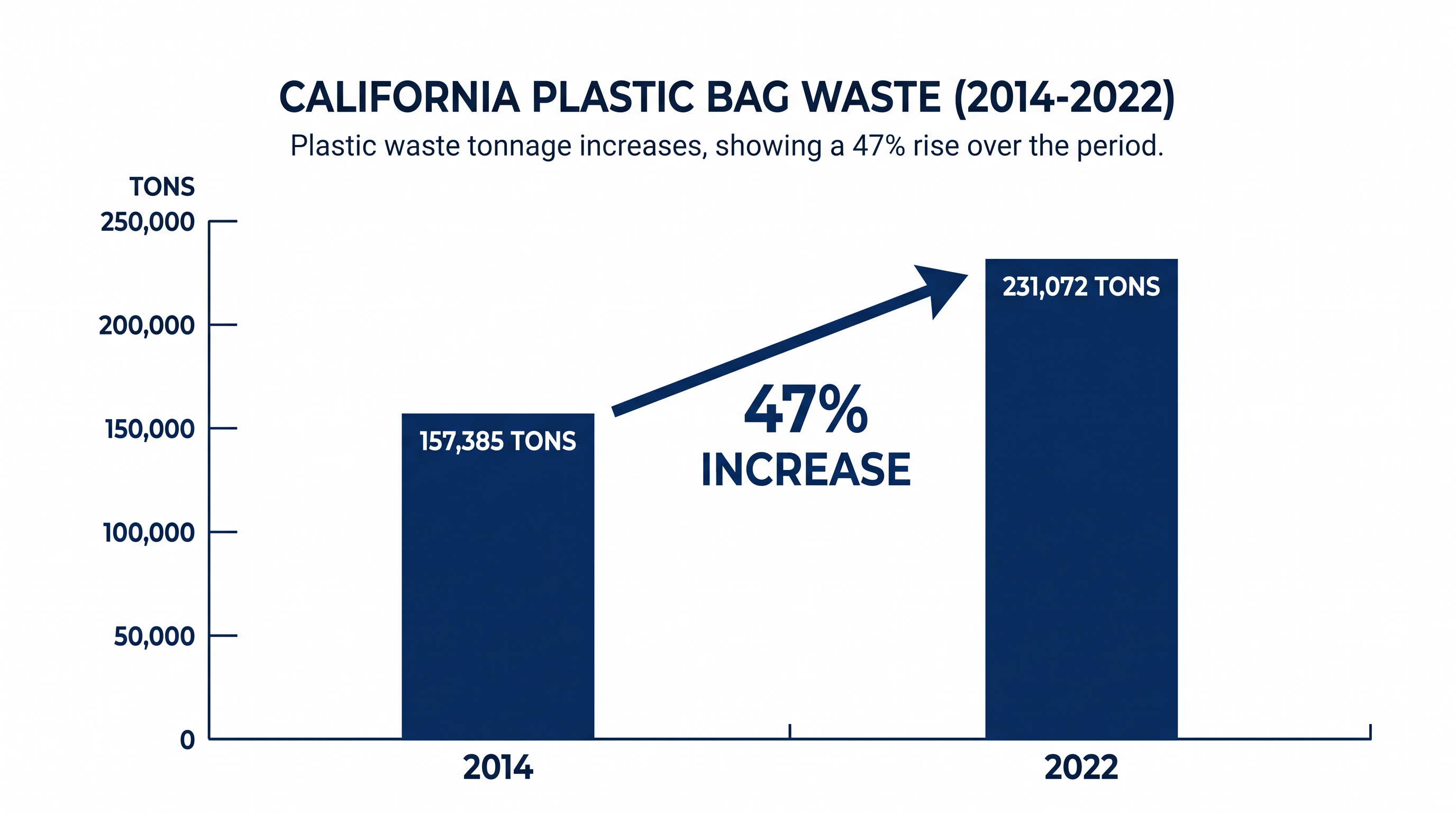
- State data shows discarded plastic bag waste increased by 47% between 2014 and 2022.
- Shoppers must now bring their own bags or purchase recycled paper bags for a minimum of $0.10.
- Paper bags require significantly more water and energy to manufacture, forcing a trade-off in environmental impacts.
- Reusable bags must be used at least eight times to achieve a lower environmental footprint than single-use plastic.
The era of the "reusable" thick plastic bag is officially over in California. As of January 1, 2026, Senate Bill 1053 takes effect, banning all plastic carryout bags at grocery stores, pharmacies, and convenience stores across the state. The legislation decisively closes a decade-old loophole created by the state's original 2014 bag ban. That earlier law prohibited thin, single-use plastic bags but allowed retailers to sell thicker plastic film bags for a small fee, provided they met specific durability standards. The legislative theory was that shoppers would treat these thicker bags as durable goods and reuse them for months. Instead, consumer behavior remained largely unchanged. Shoppers simply paid the fee, used the heavy-duty plastic bags for a single trip home, and threw them in the trash, inadvertently worsening the state's environmental footprint.[1][2]
The environmental consequences of that loophole were starkly quantified in state waste data. According to CalRecycle, the total tonnage of discarded plastic bags in California actually surged by 47 percent between 2014 and 2022, climbing from 157,385 tons to 231,072 tons. Millions of pounds of heavy plastic ended up in landfills, clogged municipal recycling machinery, and polluted coastal waterways. To halt this trend, the new law forces a strict packaging redesign at the checkout counter. Retailers are now legally restricted to a binary choice: they can either offer recycled paper bags for a mandatory fee, or they can rely entirely on customers to bring their own heavy-duty reusable bags. This shift forces both consumers and the retail supply chain to navigate a new set of logistical and environmental trade-offs.[2]
When evaluating the recycled paper bag—now the default option for shoppers caught empty-handed—the arguments for its use center entirely on end-of-life disposal. Paper bags are universally accepted in curbside recycling programs across California municipalities. If they do escape into the environment as litter, they biodegrade naturally over a short period without posing the severe marine entanglement and microplastic ingestion risks associated with plastic film. For the consumer, paper offers a frictionless, sanitary option for unplanned grocery runs, ensuring that food items are transported safely without the need to carry dedicated textiles at all times.[3]
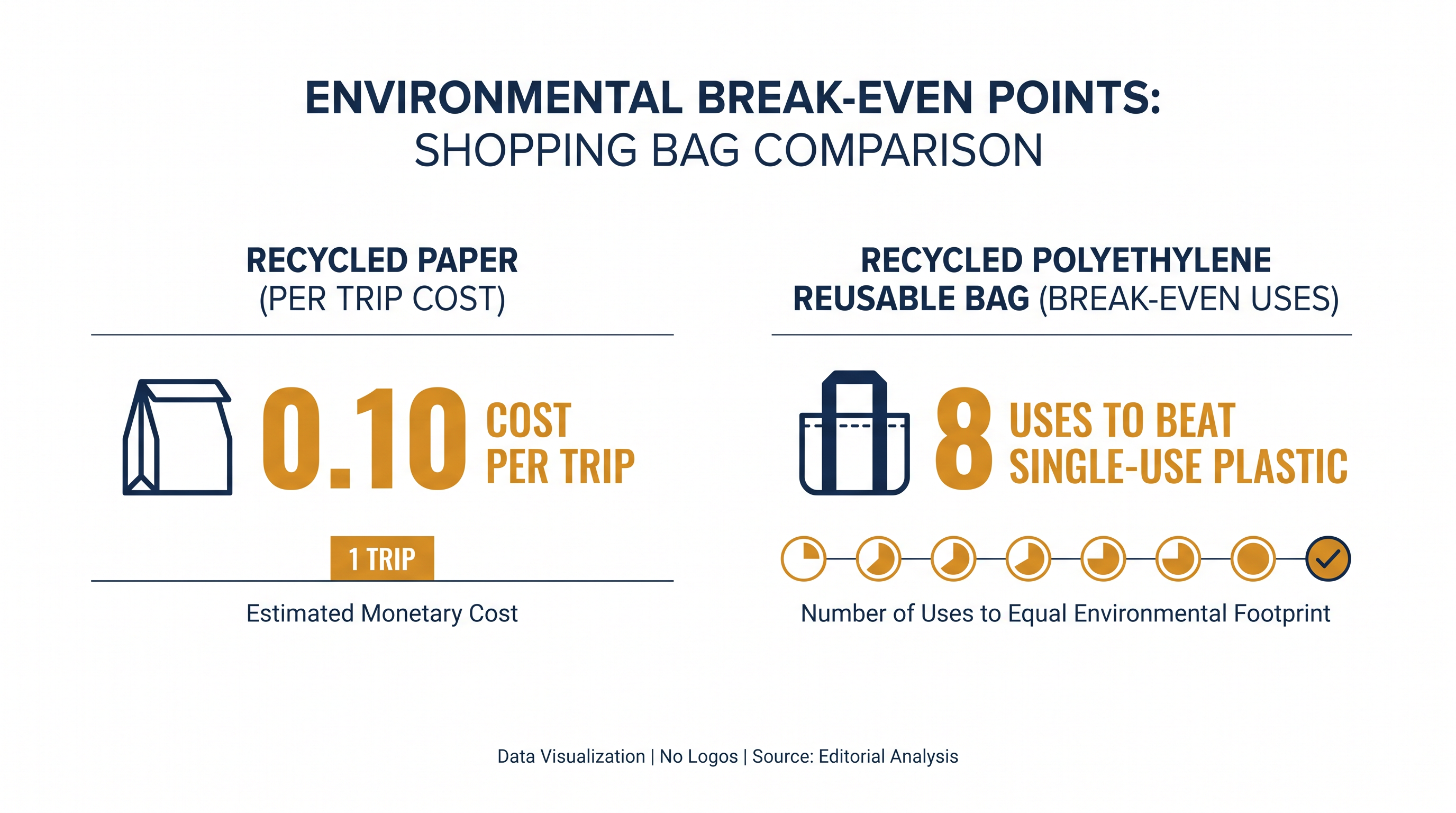
However, the arguments against paper bags focus heavily on their massive manufacturing footprint and complex retail logistics. Producing paper requires significantly more water, energy, and chemical inputs than manufacturing plastic film. Furthermore, paper bags are incredibly heavy and bulky. For retailers, transitioning entirely to paper means bags take up vastly more pallet space in warehouses and stockrooms. A single pallet of compressed plastic bags might supply a checkout lane for weeks, whereas the equivalent volume of paper bags might last only a few days. This increases shipping weights, transportation emissions, and inventory management costs for grocers operating on razor-thin margins.[3]
However, the arguments against paper bags focus heavily on their massive manufacturing footprint and complex retail logistics.
The evidence supporting these logistical and financial trade-offs is reflected directly in the legislation's pricing mandates. To offset the higher procurement and shipping costs that retailers face, California law mandates a minimum charge of $0.10 per paper bag at the point of sale. Industry data indicates that wholesale paper bags often cost grocers between 10.5 and 11.7 cents each, meaning the fee is a direct cost-recovery mechanism rather than a profit center. To mitigate the environmental impact of paper production, the law also dictates that by 2028, all paper bags sold in the state must contain at least 50 percent post-consumer recycled material. This forces the packaging industry to rapidly scale up its recycled fiber supply chains to meet the demands of the largest consumer market in the United States.
The alternative option—heavy-duty reusable bags made of canvas, woven textiles, or recycled polyethylene—represents the ultimate goal of the legislation. The arguments for true reusable bags are compelling: when utilized consistently over months or years, they offer the absolute lowest lifecycle environmental footprint of any packaging option. They hold significantly more weight than paper, resist tearing or breaking when exposed to condensation from cold groceries, and completely eliminate the per-trip financial penalty for the shopper. By removing single-use materials from the equation entirely, true reusables directly address the root cause of municipal waste management bottlenecks.[3]
Conversely, the arguments against reusable bags revolve around behavioral friction and exceptionally high upfront manufacturing costs. Consumers must remember to bring them into the store, a habit that takes time to build. They must also be regularly washed to prevent bacterial cross-contamination from raw meats and unwashed produce. More importantly, the initial carbon and water costs to manufacture a heavy canvas or thick woven bag are massive. Because they require intensive agricultural inputs for cotton or complex chemical processing for durable synthetics, these bags become a severe environmental liability if they are discarded prematurely or hoarded in closets without being used.[3]
The evidence quantifying the break-even point for reusable bags highlights the critical importance of consumer habits. A lifecycle assessment conducted by California State University, Chico, found that a reusable bag made from recycled polyethylene must be used at least eight times to achieve a lower footprint in energy, water, and greenhouse gas emissions than a traditional single-use plastic bag. Once that threshold is crossed, the environmental benefits compound rapidly, utilizing 50 percent less energy and 30 percent less water over its lifespan. However, if a consumer purchases a heavy cotton tote bag and throws it away after only two or three trips, the environmental damage—particularly in agricultural water use and textile processing—far exceeds the impact of simply using paper.[3][4]
Ultimately, the success of California's packaging redesign depends entirely on how the public adapts to the new checkout reality. The heavy-duty reusable bag model fits well when shoppers successfully build the habit of keeping bags in their vehicles or near their front doors, ensuring dozens of uses per item and driving the per-trip environmental impact down to near zero. This behavioral shift aligns perfectly with the state's goal of eliminating throwaway culture. Conversely, the new system does not fit well when consumers treat the $0.10 paper bags as a direct, single-use substitute for plastic. If millions of shoppers simply absorb the dime fee and discard paper bags after one use, California will drastically increase its retail shipping weights, water usage in manufacturing, and overall packaging costs without solving the underlying crisis of single-use waste.[3]
How we got here
2014
California passes SB 270, becoming the first state to ban thin plastic checkout bags, though it allowed thicker plastic alternatives.
2016
California voters uphold the original plastic bag ban by passing Proposition 67 at the ballot box.
2022
State waste data reveals a 47 percent increase in discarded plastic bags as consumers treat thick bags as single-use.
September 2024
Governor Gavin Newsom signs SB 1053 into law, officially closing the thick-plastic loophole.
January 2026
The total ban on all plastic carryout bags takes effect at grocery and retail stores statewide.
January 2028
All paper checkout bags provided by retailers must contain a minimum of 50 percent post-consumer recycled material.
Viewpoints in depth
Environmental Advocates
Focused on eliminating marine pollution and closing legislative loopholes.
Environmental groups argue that the 2014 law was well-intentioned but fundamentally flawed because it relied on the honor system for reuse. By allowing thicker plastic bags, the state inadvertently increased the total tonnage of plastic entering landfills and coastal ecosystems. For these advocates, the new ban is a necessary correction that prioritizes measurable lifecycle outcomes—eliminating the material entirely—over theoretical reuse rates.
Retailers and Supply Chain
Focused on the logistical friction and costs of transitioning to paper.
The packaging industry and retail grocers emphasize that paper bags are not a frictionless substitute for plastic. Because paper is significantly heavier and bulkier, stores must dedicate more warehouse space and increase the frequency of delivery trucks to maintain inventory. They argue that the mandatory $0.10 fee is essential for cost recovery, as wholesale paper bags cost significantly more to procure and transport than compressed plastic film.
Consumer Behavior Analysts
Focused on the psychological shift required to make the law effective.
Analysts point out that regulating the material at checkout only solves half the problem; the rest depends on consumer habits. If shoppers simply switch to buying $0.10 paper bags for every trip, the state will trade a plastic waste problem for a massive increase in water and energy consumption. True environmental gains will only materialize if the public embraces the friction of remembering, washing, and reusing heavy-duty bags dozens of times.
What we don't know
- Whether the shift to paper bags will cause localized supply chain shortages for recycled fiber.
- How strictly local jurisdictions will enforce the ban on smaller, independent convenience stores.
- If the $0.10 fee will be enough to deter consumers from treating paper bags as single-use items.
Key terms
- Post-consumer recycled material
- Material generated by households or commercial facilities that can no longer be used for its intended purpose, which is then repurposed into new products.
- Lifecycle assessment
- A scientific analysis of the environmental impacts associated with all stages of a product's life, from raw material extraction to final disposal.
- Polyethylene
- The most common type of consumer plastic, traditionally used to manufacture both thin single-use grocery bags and thicker reusable film bags.
Frequently asked
Are plastic produce and meat bags banned?
No. The ban applies specifically to carryout bags at the checkout counter. Bags used inside the store to protect loose produce, fresh meat, or pharmacy prescriptions remain permitted.
Do I have to pay for paper bags?
Yes. Retailers are legally required to charge a minimum of $0.10 per recycled paper bag to offset their higher procurement and shipping costs.
Can I still use the thick plastic bags I already own?
Yes. Shoppers are encouraged to bring any bags they already own from home, including older thick plastic bags, canvas totes, or backpacks.
Are compostable plastic bags allowed at checkout?
No. Senate Bill 1053 bans all plastic film carryout bags, regardless of whether they are labeled as compostable or biodegradable, due to issues with municipal composting infrastructure.
Sources
Source coverage
4 outlets
3 viewpoints surfaced


[1]CBS 8Local Municipalities & Public
California will ban all plastic checkout bags beginning Jan. 1
Read on CBS 8 →[2]ABC 10Local Municipalities & Public
Starting Jan. 1, 2026, plastic bags at California retail stores will no longer be available
Read on ABC 10 →[3]Daily JournalEnvironmental Advocates
California's 2026 plastic checkout bag ban represents a politically powerful response
Read on Daily Journal →[4]City of NapaLocal Municipalities & Public
Plastic Bag Ban - Questions About Bags
Read on City of Napa →

Every angle. Every day.
Get shopping stories with full source coverage and perspective breakdowns delivered to your inbox.