
The Art of Kintsugi: How the Japanese Tradition of Golden Repair is Finding Global Resonance
Rooted in the 15th century, the Japanese practice of mending broken pottery with gold-dusted lacquer has evolved from a specialized craft into a global symbol of psychological resilience and sustainability.
By Factlen Editorial Team
- Psychologists and Therapists
- Focuses on the metaphorical power of Kintsugi in trauma recovery, emphasizing that emotional scars should be integrated and celebrated.
- Traditional Artisans
- Focuses on the preservation of the physical craft, the mastery of urushi lacquer, and the rejection of modern synthetic shortcuts.
- Sustainability Advocates
- Views Kintsugi as the ultimate rejection of disposable consumer culture and a model for the circular economy.
- Factlen Editorial Team
- Synthesizes the historical, philosophical, and modern applications of the craft into a cohesive narrative.
What's not represented
- · Mass-market ceramic manufacturers
- · Modern synthetic adhesive developers
Why this matters
In an era of psychological burnout and disposable consumerism, Kintsugi provides a powerful, actionable framework for reframing failure. By treating physical and emotional fractures as sites of value rather than shame, the philosophy offers a sustainable approach to both mental health and environmental stewardship.
Key points
- Kintsugi is the 500-year-old Japanese art of repairing broken ceramics using urushi lacquer dusted with precious metals.
- The practice is rooted in wabi-sabi, a philosophy that finds beauty in imperfection, and mottainai, a deep regret over waste.
- The traditional repair process takes weeks to complete, as the natural lacquer must cure in a climate-controlled environment.
- Modern psychologists and medical professionals are increasingly adopting Kintsugi as a framework for trauma recovery and institutional resilience.
In an era defined by mass production and disposable culture, a shattered ceramic bowl is usually destined for the landfill. The modern instinct is to replace the broken, the flawed, and the aging with something shiny and new. But a 500-year-old Japanese tradition offers a radical, luminous alternative.[8]
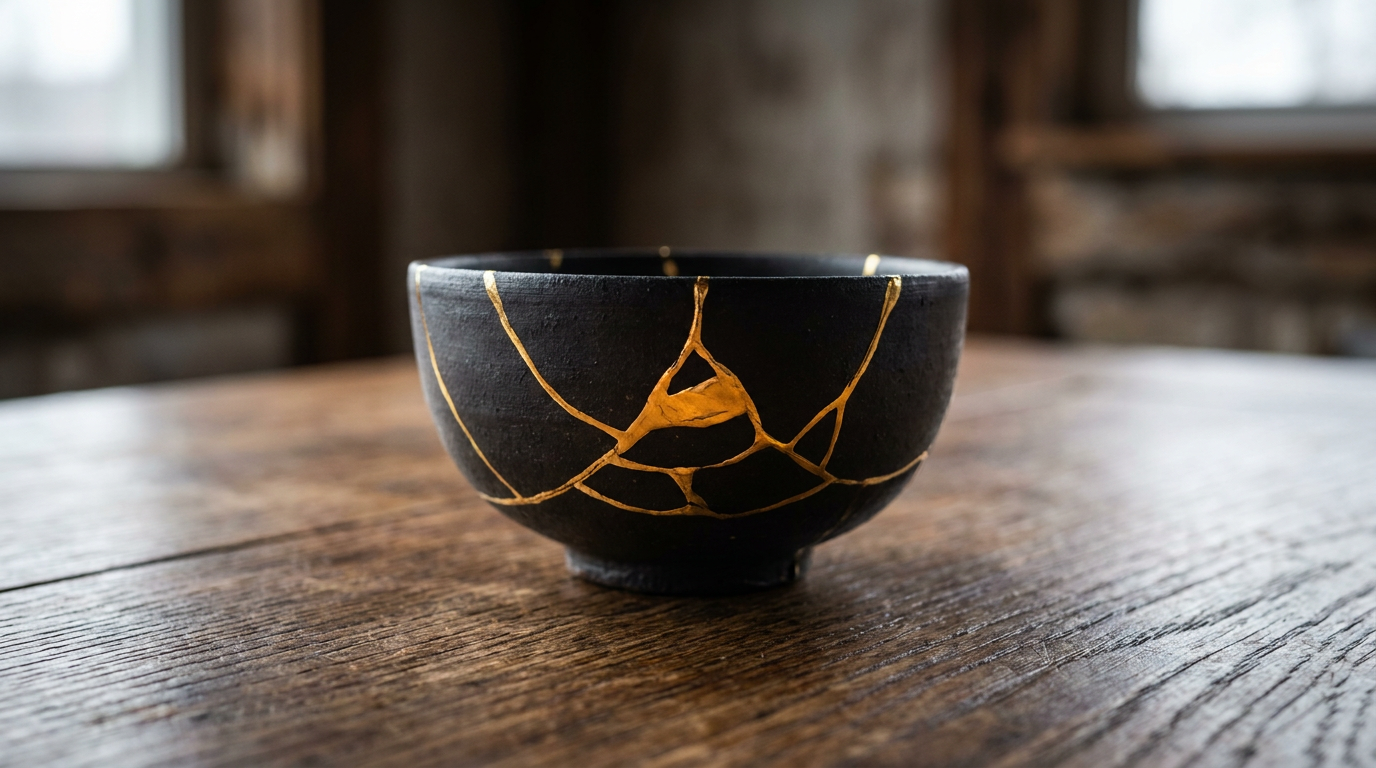
Kintsugi—literally translating to "golden joinery"—is the ancient art of repairing broken pottery by mending the fractures with lacquer dusted in powdered gold, silver, or platinum. Rather than attempting to disguise the damage, the technique illuminates it. Over the past decade, this highly specialized ceramic craft has surged in global popularity, evolving from a niche artisanal practice into a profound cultural metaphor for human resilience and environmental sustainability.[1][8]
The origins of the practice trace back to the late 15th century. According to historical consensus, the Japanese shōgun Ashikaga Yoshimasa accidentally shattered his favorite Chinese tea bowl. Desperate to save it, he sent the pieces back to China for repair.[1][4]
When the bowl was finally returned to the shōgun, it had been stitched back together using crude, unsightly metal staples—the standard repair method of the era. Dissatisfied with the aesthetic ruin of his prized possession, Yoshimasa tasked his own craftsmen with finding a more elegant solution. The result was the birth of Kintsugi, a technique that transformed the bowl's ugly fractures into a deliberate, beautiful design.[1]

While the gold is the most visible element of the craft, the true structural foundation of Kintsugi is urushi. Harvested from the sap of the indigenous lacquer tree, urushi is a highly toxic substance in its raw form, yet it acts as an incredibly durable natural adhesive. Archaeological evidence suggests that East Asian cultures have utilized this remarkable sap for over 9,000 years.[1][2]
Repairing a shattered vessel with urushi is a painstaking, multi-stage process that demands immense patience. Artisans begin by mixing the raw lacquer with wheat starch to create mugi-urushi, a thick, sticky putty used to fill wide gaps and bind the broken shards back together.[1][8]
Unlike modern synthetic superglues, urushi does not simply dry upon exposure to air. Instead, it cures through a complex chemical polymerization process. The repaired ceramic must be placed in a muro—a specialized wooden cabinet with strictly controlled temperature and high humidity—often for weeks at a time. This temporal requirement is not incidental; the slow curing process is essential for the lacquer to form bonds that will hold permanently.[2]
Unlike modern synthetic superglues, urushi does not simply dry upon exposure to air.
Only after the foundational lacquer has fully hardened and been meticulously sanded smooth does the artisan apply a final, hair-thin layer of red lacquer along the seams. Before this final layer sets, it is dusted with pure, finely milled gold powder. The break is transformed into a shimmering, raised scar, rendering the object more valuable than it was before it fell.[1][8]

The enduring appeal of Kintsugi lies in its deep philosophical roots, primarily the Zen Buddhist aesthetic of wabi-sabi. This worldview fundamentally challenges the Western interpretation of beauty as rooted in flawless symmetry. Instead, wabi-sabi celebrates the imperfect, the impermanent, and the incomplete, recognizing the graceful aging of objects and the inevitable wear of time.[4]
Kintsugi is equally intertwined with the concept of mottainai, a Japanese term that expresses a deep sense of regret concerning waste. Historically, living in an island nation with limited resources meant that discarding a functional object was considered a profound failure of stewardship. Mottainai fosters a reverence for the natural materials used to create an object and the human labor invested in its crafting.[6][7]
Today, the principles of mottainai and Kintsugi are being championed by the global sustainability movement. In a world grappling with the environmental devastation of single-use plastics and fast fashion, the philosophy of golden repair offers a compelling blueprint for the circular economy. It suggests that repairing and repurposing can be acts of luxury and care, rather than mere economic necessity.[6][7]

Beyond its environmental implications, Kintsugi has recently transcended the physical realm to become a powerful framework in modern psychology. Mental health professionals and trauma specialists are increasingly utilizing the concept as a tangible metaphor for emotional healing and resilience.[4][5]
In therapeutic settings, the "Kintsugi Healing" approach explicitly blends the principles of golden repair with modern trauma recovery research. Patients are encouraged to view their psychological fractures not as permanent defects, but as sites of profound transformation. The act of patiently applying the "lacquer" of social support, therapy, and coping mechanisms allows individuals to rebuild their lives with newfound strength.[5]
The metaphor has even been formalized in high-stress medical training. A recent study published in the UK proposed the "Kintsugi method" as a novel framework for paramedic reflective practice. By mapping their operational traumas to the stages of ceramic repair—from acknowledging the "break" of a difficult call to applying the "gold" of integrated learning—first responders are taught to process their experiences without losing their professional resolve.[3]

A similar framework is being applied to institutional design. Researchers studying organizational metacrisis argue that modern institutions—from universities to governments—must develop "crack literacy." Rather than hiding systemic failures behind public relations, healthy institutions should trace their history of breaking and repair visibly, investing precious resources into holding the fragments together.[2]
There is a striking paradox at the heart of the practice. While Kintsugi philosophically embraces imperfection, the physical execution of the craft demands extreme precision, rare materials, and a near-ritualistic dedication to perfectionism. It does not simply accept the flaw; it elevates it through meticulous, deliberate effort.[8]
Ultimately, the global resonance of Kintsugi reveals a deep, universal human yearning for grace in the face of adversity. Whether applied to a shattered teacup, a fractured ecosystem, or a broken human spirit, the golden seams serve as a permanent reminder that damage is not the end of the story. Through patient, intentional repair, the broken pieces can be reassembled into something profoundly beautiful, carrying the history of their survival on their surface.[1][4][8]
How we got here
9,000 BCE
Earliest archaeological evidence of urushi lacquer being used as an adhesive and coating in East Asia.
Late 15th Century
Shogun Ashikaga Yoshimasa returns a broken tea bowl to China, sparking the invention of Kintsugi when it returns with ugly metal staples.
2006
Nobel laureate Wangari Maathai introduces the concept of 'mottainai' to the United Nations as a framework for global sustainability.
2020s
Kintsugi experiences a massive global resurgence as a metaphor for psychological resilience and trauma recovery.
Viewpoints in depth
Traditional Artisans
Focuses on the preservation of the physical craft and the mastery of urushi lacquer.
For traditional practitioners, Kintsugi is fundamentally a material discipline. They emphasize that the true value of the craft lies not just in the gold, but in the mastery of urushi lacquer—a toxic, difficult-to-harvest sap that requires years of apprenticeship to handle safely. Artisans often express concern over the modern proliferation of 'faux Kintsugi' kits that use synthetic epoxies and mica powder, arguing that these shortcuts bypass the patience and historical continuity that give the authentic practice its soul.
Psychologists and Therapists
Focuses on the metaphorical power of Kintsugi in trauma recovery.
Mental health professionals view Kintsugi as a profound framework for reframing human suffering. In trauma therapy, patients often feel permanently damaged or 'broken' by their experiences. The Kintsugi metaphor shifts this narrative, teaching that emotional scars do not need to be hidden or erased to achieve wholeness. Instead, by actively engaging in the slow work of healing—the 'golden joinery' of therapy and social support—individuals can integrate their traumas and emerge with a unique, resilient beauty.
Sustainability Advocates
Views Kintsugi as a model for the circular economy and a rejection of disposable culture.
Environmentalists and sustainability advocates focus heavily on the concept of mottainai embedded within Kintsugi. They argue that the modern global economy is built on a destructive cycle of extracting, consuming, and discarding. Kintsugi offers a radical counter-narrative: that objects have inherent dignity and that repairing them is an act of environmental stewardship. By elevating repair to an art form, advocates believe society can shift away from fast fashion and single-use plastics toward a more sustainable, circular model of living.
What we don't know
- How the mass commercialization of 'faux Kintsugi' (using epoxy and synthetic gold paint) will impact the preservation of the authentic, highly toxic urushi lacquer tradition.
- The long-term clinical efficacy of 'Kintsugi Healing' frameworks compared to traditional cognitive behavioral therapy in formal psychiatric settings.
Key terms
- Kintsugi
- The Japanese art of repairing broken pottery with lacquer dusted with powdered gold, silver, or platinum.
- Urushi
- A highly durable, naturally derived lacquer made from the sap of the Chinese lacquer tree, used as the primary adhesive in Kintsugi.
- Wabi-sabi
- A Japanese aesthetic and philosophical concept that finds beauty in imperfection, impermanence, and simplicity.
- Mottainai
- A Japanese term expressing a sense of regret concerning waste, often used to encourage the sustainable use of resources.
- Mugi-urushi
- A mixture of urushi lacquer and wheat starch used to fill gaps and bind broken ceramic shards together.
Frequently asked
Is Kintsugi-repaired pottery food safe?
Yes, traditional Kintsugi using pure urushi lacquer and genuine gold is food safe once fully cured. However, modern synthetic epoxy versions are often not safe for culinary use.
How long does the Kintsugi process take?
Traditional repairs can take anywhere from several weeks to three months, as the urushi lacquer requires extended time to cure in a climate-controlled environment.
Can any broken item be repaired with Kintsugi?
While most ceramics can be repaired, items shattered into microscopic dust or made of certain highly porous materials may be too degraded to reconstruct successfully.
Sources
Source coverage
8 outlets
4 viewpoints surfaced








[1]WikipediaTraditional Artisans
Kintsugi
Read on Wikipedia →[2]Australian Journal of Environmental EducationSustainability Advocates
When Universities Break: Metacrisis, Kintsugi and the Art of Crack Literacy
Read on Australian Journal of Environmental Education →[3]ResearchGatePsychologists and Therapists
Reflective Repair: Using the Kintsugi Method to Foster Emotional Resilience in Paramedic Practice
Read on ResearchGate →[4]TEDxMelbournePsychologists and Therapists
Kintsugi: the art and philosophy, from broken to beautiful
Read on TEDxMelbourne →[5]Deeper JapanPsychologists and Therapists
Kintsugi Futures: Repair and Emotional Resilience
Read on Deeper Japan →[6]POJ StudioTraditional Artisans
Kintsugi Dictionary Part 1: Mottainai
Read on POJ Studio →[7]BokksuSustainability Advocates
Mottainai Concept: Japan's Path to Sustainability and Respect
Read on Bokksu →[8]Factlen Editorial TeamFactlen Editorial Team
Synthesis by Factlen editorial team
Read on Factlen Editorial Team →

Every angle. Every day.
Get culture stories with full source coverage and perspective breakdowns delivered to your inbox.