
The -5°C Equilibrium: How Ethanol and Sucrose Dictate a Cocktail's Final Serving Temperature
The final temperature of a shaken drink is governed by freezing point depression, where dissolved alcohol and sugar molecules physically block ice formation. This chemical reality forces the liquid well below the standard freezing point of water, fundamentally altering how the human palate perceives sweetness and alcoholic burn.
By Baran Demir

Share this story
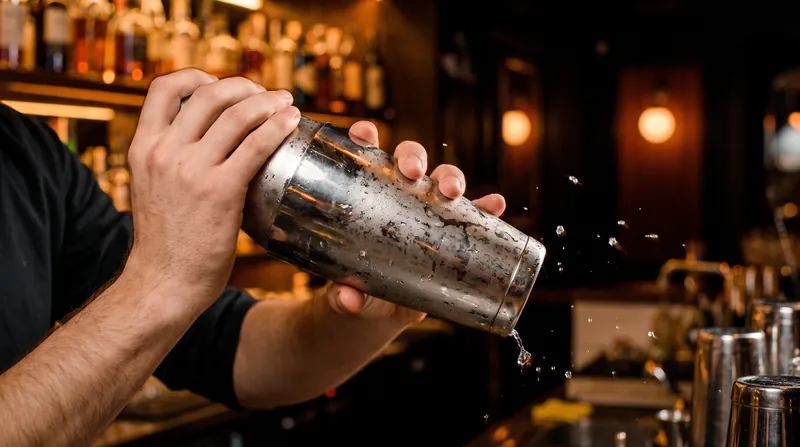
A cocktail's final temperature is not determined by how aggressively you shake the tin, but by the exact ratio of alcohol and sugar inside it. When you mix a standard Daiquiri or Margarita, the dissolved ethanol and sucrose molecules physically block water from forming an ice lattice, forcing the liquid's freezing point down to roughly -5°C to -7°C (23°F to 19°F). The drink will chill exactly to that new freezing point and stop, no matter how long the ice sits in the glass.[9]
You feel this thermal reality the moment a properly chilled Martini hits your palate. The glass frosts over instantly because the liquid inside is significantly colder than the freezing point of the ambient moisture in the room. This phenomenon, known in chemistry as freezing point depression, dictates the texture, dilution, and flavor profile of every mixed drink you pour.[3][9]
To understand why a drink gets colder than ice, you have to look at the molecular structure of the ingredients. Pure water freezes at 0°C (32°F). But as the CK-12 Foundation's 2019 reference materials on colligative properties explain, adding any solute to a solvent lowers that freezing point. The solute particles disrupt the solvent's ability to form a solid crystalline structure.[3]
In a cocktail, the primary solute is ethanol. According to data published by the Royal Society of Chemistry, pure ethanol freezes at a staggering -114°C (-173°F). When you blend ethanol with water, the freezing point of the resulting solution drops in direct proportion to the alcohol by volume (ABV).[1]
"Because alcohol has a much lower freezing point than water, it requires significantly colder temperatures to solidify," notes the educational platform HowStuffWorks in their breakdown of the process. A standard bottle of 80-proof vodka, which is 40 percent alcohol, will not freeze until it reaches approximately -27°C (-16°F)—well below the -18°C (0°F) baseline of a standard home freezer.[6]
But alcohol is rarely the only dissolved solid in the shaker. Sugar plays an equally critical role in driving down the temperature. PreGel Canada, a specialty dessert ingredient manufacturer, detailed this interaction in a 2022 technical bulletin on frozen desserts. They noted that both sucrose and alcohol act as anti-freezing agents, binding with water molecules and requiring more energy to be removed before the mixture can solidify.[5]
When you combine a 40 percent ABV spirit with a rich simple syrup (a 2:1 ratio of sugar to water), you are stacking these freezing point depressions. The National Center for Biotechnology Information outlines the standard chemical composition of these beverages, showing that a typical shaken sour cocktail lands around 15 to 20 percent ABV with 10 percent dissolved sugar.[2]
This specific concentration is what creates the -5°C (23°F) equilibrium. When you add ice to this room-temperature mixture and begin to shake, the ice begins to melt. Melting is an endothermic process—it absorbs heat from the surrounding liquid, rapidly dropping the temperature of the cocktail.[4][9]
The chilling process hits a thermodynamic wall the moment the liquid reaches its new, depressed freezing point. Culinary technologist Dave Arnold, writing for Cooking Issues in 2010, explained this fundamental rule of mixology: "There is no chilling without dilution, and there is no dilution without chilling."[7]
Arnold's 2010 analysis demonstrated that once the cocktail reaches thermal equilibrium with the melting ice, the temperature plateaus. You can shake a drink for ten seconds or ten minutes; once it hits that -5°C to -7°C window, it will not get any colder unless you introduce a colder chilling medium, like liquid nitrogen or dry ice.[7]
This extreme cold is not just a textural preference; it is a biological necessity for flavor balance. The human tongue perceives flavors differently at different temperatures. A 2005 study archived by the NCBI on heat and taste perception found that the intensity of certain tastes, particularly sweetness and bitterness, is highly temperature-dependent.[8]
At room temperature, a Daiquiri tastes cloyingly sweet and aggressively alcoholic. The volatile ethanol molecules vaporize easily, rushing into the olfactory bulb and creating a harsh burn. But at -5°C, the volatility of the alcohol is suppressed, and the perception of the sucrose is muted, allowing the subtle esters of the rum and the bright malic acid of the lime to step forward.[8][9]
The math of freezing point depression also explains why stirred drinks, like a Negroni or a Manhattan, feel heavier and warmer than shaken drinks. Stirring is a gentler mechanical action that melts ice more slowly. A stirred drink typically reaches equilibrium around -2°C to -3°C (28°F to 26°F), resulting in less dilution and a more viscous mouthfeel.[9]
Home bartenders can manipulate this equation by adjusting their freezer settings or the size of their ice. Large, dense ice cubes have less surface area than crushed ice, meaning they melt—and chill—more slowly. If you start with ingredients stored in the freezer at -18°C, you bypass the melting phase entirely, resulting in a drink that is bracingly cold but entirely undiluted, which often throws the flavor balance off completely.[9]
The perfect cocktail is a fleeting state of thermal balance. The moment you strain the liquid into a glass, the ambient air begins warming it, and the freezing point depression equation runs in reverse. The drink wakes up, the aromatics release, and the window of optimal consumption begins to close.[9]
Different angles
The Culinary Technologist View
Treats cocktail preparation as an applied physics problem where temperature and dilution are inextricably linked.
For culinary technologists, the shaker is simply a thermodynamic engine. They argue that a bartender's stylistic flair matters far less than the physical reality of endothermic reactions. Because ice must melt to chill the surrounding liquid, achieving a target temperature of -5°C requires a specific, unavoidable amount of water to be added to the drink. This camp advocates for measuring ingredients by weight and calculating exact dilution percentages, ensuring that the final ABV and sugar concentration perfectly match the depressed freezing point of the mixture.
The Sensory Science View
Focuses on how temperature manipulation is a tool for hacking the human palate.
Sensory researchers view freezing point depression not just as a physical phenomenon, but as a biological necessity for palatability. At room temperature, a 20 percent ABV solution with 10 percent sugar overwhelms the olfactory bulb with volatile ethanol fumes and saturates the tongue's sweet receptors. By driving the temperature down to -5°C, the kinetic energy of the ethanol molecules is reduced, preventing them from vaporizing into the nasal cavity. Simultaneously, the TRPM5 ion channels in the taste buds become less responsive to sucrose, allowing the drinker to perceive the nuanced botanical and ester compounds that would otherwise be masked by heat and sugar.
- Culinary Technologists
- Focuses on the precise thermodynamic math and dilution ratios required to achieve perfect thermal equilibrium in beverages.
- Sensory Scientists
- Examines how extreme cold alters human receptor binding, suppressing the perception of ethanol burn and excessive sucrose.
- Chemical Educators
- Explains the fundamental colligative properties of solvents and solutes that govern freezing point depression.
Sources
Source coverage
9 outlets
3 viewpoints surfaced








- [1]Royal Society of ChemistryChemical Educators
Freezing Points Of Aqueous Alcohols: Free Energy Of Interaction Of The CHOH, CH⇇, CONH And C[double bond]C Functional Gro
Read on Royal Society of Chemistry → - [2]NCBISensory Scientists
Chemical Composition of Alcoholic Beverages, Additives and Contaminants
Read on NCBI → - [3]CK-12 FoundationChemical Educators
Freezing Point Depression
Read on CK-12 Foundation → - [4]Study.comChemical Educators
Predicting Relative Freezing Point Depressions
Read on Study.com → - [5]PreGel CanadaCulinary Technologists
The Cooler Side of Cocktails How to Handle Alcohol in Frozen Desserts
Read on PreGel Canada → - [6]HowStuffWorksChemical Educators
Does Alcohol Freeze?
Read on HowStuffWorks → - [7]Cooking IssuesCulinary Technologists
Cocktail Science in General:Part 2 of 2
Read on Cooking Issues → - [8]NCBISensory Scientists
Heat as a Factor in the Perception of Taste, Smell, and Oral Sensation
Read on NCBI → - [9]Factlen Editorial Team
Synthesis by Factlen editorial team
Read on Factlen Editorial Team →
More in Food & Drink
See all →Alcohol Science
The 8-Gram Standard: How the Mass of Pure Ethanol in an Alcohol Unit Varies Globally
6 sources
Spirits Science
The Ouzo Effect: How Spontaneous Emulsification Creates the Milky Cloud in Anise Spirits
7 sources
Cocktail Science
The 66° to 68° Brix Window: How Sugar Concentration Dictates the Microbial Stability and Crystallization of Simple Syrup
6 sources
Cocktail Science
The 10% to 20% Air Incorporation: How Shaking Creates Opacity and Texture in Cocktails
6 sources
Comments
Every angle. Every day.
Get Food & Drink stories with full source coverage and perspective breakdowns, free every day.