
The 2026 Guide to Used EV Battery Health Certificates
As the used electric vehicle market booms, new regulations and diagnostic tools are finally solving the biggest buyer anxiety: battery degradation.
By Factlen Editorial Team
- Consumer Advocates
- Focus on transparency and protecting buyers from hidden replacement costs.
- Regulators & Policymakers
- Focus on standardizing data and ensuring the long-term viability of the zero-emission transition.
- Diagnostic Industry
- Focus on leveraging big data to prove battery longevity and provide CARFAX-style reports.
- Factlen Analysis
- Synthesizing market trends, regulatory shifts, and consumer impact.
What's not represented
- · Independent Auto Mechanics
- · Traditional Used Car Dealerships
Why this matters
For years, the fear of a dying battery kept budget-conscious buyers away from used electric vehicles. New transparency laws and diagnostic tools now allow shoppers to verify battery health before buying, unlocking massive discounts on reliable, low-maintenance cars.
Key points
- The used EV market is surging in 2026, offering buyers near-new vehicles at 40% to 50% discounts.
- New California regulations mandate that 2026 model-year EVs display a clear, customer-readable battery State of Health (SoH) metric.
- Third-party diagnostic companies are providing "Battery Passports" for older EVs, analyzing charging history to certify battery health.
- Real-world data shows the average EV battery retains over 95% of its original capacity after five years of use.
- Mileage is not the only factor in battery health; charging habits and climate exposure play a more significant role in long-term degradation.
The used car market in 2026 is undergoing a quiet revolution. As millions of electric vehicles come off their initial three-year leases, a flood of second-hand inventory is driving prices down by as much as 40 to 50 percent compared to new models. For budget-conscious shoppers, it is an unprecedented buyer's market, leading to record-breaking sales volumes this spring.[1]
Yet, a single, lingering anxiety has historically kept many consumers on the sidelines: the fear of a dying battery. Because the battery pack represents a massive portion of an electric vehicle's total value, buying a used EV without knowing its true condition felt like a high-stakes gamble to the average driver.[1]
Unlike a gasoline engine, where a mechanic can easily check compression and listen for knocks, an EV's battery pack has long been treated as a sealed black box. Automakers rarely provided clear, accessible data on how much capacity the battery had lost over time, leaving buyers to rely on dashboard range estimates that fluctuate wildly with the weather.[7]
That dynamic is fundamentally changing this year. A wave of new regulations, led by the California Air Resources Board (CARB), is forcing automakers to pull back the curtain on battery degradation, transforming how used EVs are bought and sold and empowering consumers with hard data.[2]
Under CARB's Advanced Clean Cars II framework, which takes effect for the 2026 model year, manufacturers are now required to provide a "customer-readable state of health metric." This means drivers no longer need proprietary dealership software to see how much life their battery has left; the data must be accessible directly through the vehicle's dashboard or a standardized diagnostic port.[2]

The regulation also mandates strict warranty baselines. Automakers must guarantee that 2026 model-year batteries retain at least 70 percent of their original capacity for eight years or 100,000 miles. By 2030, that requirement scales up to 80 percent retention for 10 years or 150,000 miles, providing a massive safety net for second and third owners.[2]
While the CARB rules apply to new cars rolling off the lot today, the diagnostic industry has rapidly stepped up to serve the millions of older EVs already on the road. Independent companies are now generating comprehensive "Battery Health Certificates," effectively creating a CARFAX-style report specifically for EV batteries.[4]
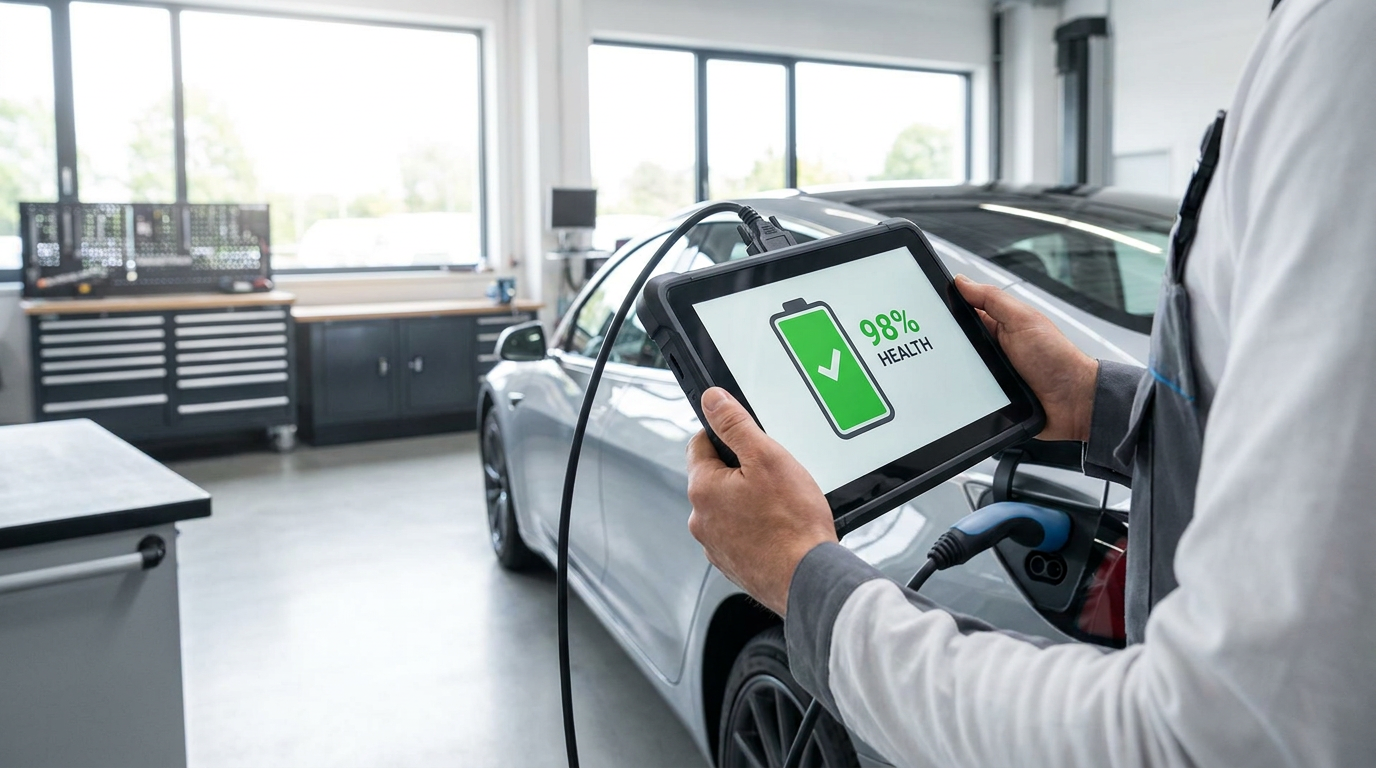
Firms like Recurrent Auto tap into a vehicle's telematics or onboard diagnostic (OBD-II) port to measure its State of Health (SoH). The SoH is a simple percentage comparing the battery's current capacity to its factory original. A car that left the factory with a 300-mile range and an SoH of 90 percent will reliably deliver about 270 miles on a full charge today.[4][7]
Firms like Recurrent Auto tap into a vehicle's telematics or onboard diagnostic (OBD-II) port to measure its State of Health (SoH).
These certificates analyze more than just current capacity. They look at the vehicle's charging history, counting how many times it was subjected to high-stress DC fast charging versus gentle Level 2 home charging, and factor in the climate where the car was driven. Extreme heat and frequent rapid charging are known to accelerate wear.[7]
The data emerging from these mass diagnostics is actively debunking the most persistent myth of the EV transition: that batteries need to be replaced every five years. Real-world telemetry is proving that modern lithium-ion packs are far more resilient than early skeptics claimed.[3]
According to the 2025 Battery Performance Index, which analyzed over 8,000 electric vehicles across 36 manufacturers, battery degradation is remarkably slow and predictable. The study found that the average EV battery retains a staggering 95.1 percent of its original capacity after five years of use.[3]

Even older vehicles perform exceptionally well. Eight- to nine-year-old EVs still hold a median capacity of around 85 percent. The data proves that while maximum range decreases slightly over time, catastrophic battery failure is exceedingly rare, and most packs will easily outlast the chassis of the car itself.[3]
Interestingly, industry data reveals that mileage alone is a poor indicator of battery health. A high-mileage fleet vehicle that was consistently charged at low speeds and kept in a temperate climate often boasts a healthier battery than a low-mileage car that sat in extreme heat or relied exclusively on rapid highway chargers.[3]
The push for battery transparency is not limited to North America. Governments and industries worldwide are recognizing that a healthy, trustworthy used EV market is essential for achieving broader climate goals and making zero-emission transport accessible to all income brackets.[8]
In the United Arab Emirates, the Road and Transport Authority introduced a mandate in 2026 requiring a certified Battery Health Certificate for any used EV over three years old to qualify for comprehensive motor insurance. Insurers now use the SoH score to calculate premiums and assess risk, treating the battery passport as a critical financial document.[5]
Similarly, the UK government is actively exploring standardized battery health checks as part of its automotive sector plan, recognizing that consumer confidence is the linchpin of the second-hand electric market. Remarketing studies in Europe show buyers are willing to pay a premium for a used EV that comes with a verified health certificate.[6]

For today's car buyer, this convergence of regulation, diagnostic technology, and hard data changes the math entirely. The steep depreciation curve of EVs is no longer a warning sign of hidden defects; it is a financial opportunity to acquire advanced technology at a fraction of the original cost.[1][8]
Armed with a verified State of Health report and backed by robust factory warranties, consumers can now navigate the used EV market with the same confidence as buying a traditional car. The black box has been opened, and the electric bargain of the decade is waiting on the lot.[8]
How we got here
2012
California introduces the first Advanced Clean Cars regulations, setting early zero-emission vehicle targets without strict battery durability mandates.
August 2022
CARB proposes the Advanced Clean Cars II framework, introducing the first standardized battery health and warranty requirements for future EVs.
2024
Third-party diagnostic companies begin mass-analyzing real-world EV data, proving that battery degradation is much slower than early consumer fears suggested.
January 2026
The CARB ACC II mandate takes effect, requiring all new 2026 model-year EVs to feature customer-readable State of Health metrics.
March 2026
Used EV sales hit record highs in the US, driven by steep depreciation on off-lease vehicles and growing consumer confidence in battery longevity.
Viewpoints in depth
Consumer Advocates
Focus on transparency and protecting buyers from hidden replacement costs.
Consumer protection groups argue that the transition to electric vehicles cannot succeed if the secondary market is treated as a gamble. For years, buyers of used gasoline cars could rely on established mechanical inspections to avoid 'lemons.' Advocates view mandatory State of Health (SoH) displays and third-party battery certificates as essential equalizers, ensuring that lower-income buyers who depend on the used market aren't saddled with a $10,000 battery replacement bill shortly after purchase.
Automakers & Dealerships
Balancing the cost of compliance with the benefits of higher resale values.
While some legacy automakers initially pushed back against strict durability mandates—citing the rapid evolution of battery chemistry and the unpredictability of user charging habits—the industry is increasingly embracing battery transparency. Dealerships find that providing a certified battery report significantly speeds up sales and justifies higher trade-in values. For manufacturers, proving that their batteries last longer than expected helps defend the brand's reputation and supports stronger residual values on lease returns.
Diagnostic Innovators
Leveraging big data to demystify battery chemistry for the general public.
Companies specializing in EV telematics view battery health not as a static number, but as a dynamic curve influenced by climate, charging speed, and software management. By aggregating billions of miles of real-world driving data, these firms have built predictive models that often outperform the automakers' own dashboard estimates. Their goal is to create a universally trusted 'Battery Passport' that travels with the car throughout its lifecycle, standardizing valuation across borders and brands.
What we don't know
- How quickly the standardized battery health displays mandated by California will be adopted voluntarily by automakers in non-mandate states or international markets.
- Whether the rise of certified battery reports will completely eliminate the steep depreciation curve currently making used EVs so affordable.
Key terms
- State of Health (SoH)
- A percentage indicating a battery's current maximum capacity compared to its original capacity when it was brand new.
- OBD-II Port
- The On-Board Diagnostics port, a standardized plug under the dashboard used by mechanics and diagnostic tools to read a vehicle's internal data and fault codes.
- DC Fast Charging
- High-power public charging stations that can refill an EV battery in minutes rather than hours, which can generate excess heat and slightly accelerate battery wear if used exclusively.
- Battery Passport
- A digital certificate that tracks an electric vehicle battery's manufacturing history, state of health, and charging data throughout its lifespan.
Frequently asked
What is a good State of Health (SoH) for a used EV?
An SoH of 85% to 95% is excellent for a used EV that is 3 to 5 years old. Most experts recommend avoiding vehicles with an SoH below 80% unless the price is heavily discounted or the battery is still under warranty.
Does fast charging ruin an EV battery?
Frequent, exclusive use of DC fast chargers can accelerate degradation slightly, but modern thermal management systems mitigate most of the damage. However, a car primarily charged at home on a Level 2 charger will generally have a healthier battery.
How much does it cost to replace an EV battery?
Out-of-pocket battery replacements can cost between $5,000 and $15,000 depending on the make and model. However, federal and state regulations mandate long warranties (typically 8 years or 100,000 miles), making out-of-pocket replacements rare for modern EVs.
Can I check the battery health myself?
Starting with 2026 models in states following CARB regulations, the SoH must be easily readable on the dashboard. For older models, you can use third-party services like Recurrent Auto or request an OBD-II scan from an EV-certified mechanic.
Sources
Source coverage
8 outlets
4 viewpoints surfaced








[1]InsideEVsConsumer Advocates
Everything You Need To Know About Used EV Battery Health In 2026
Read on InsideEVs →[2]WardsAutoRegulators & Policymakers
EV Regulations Continue Evolving
Read on WardsAuto →[3]Drive ElectricDiagnostic Industry
Concerned about EV battery life? This new study may surprise you
Read on Drive Electric →[4]Recurrent AutoDiagnostic Industry
Recurrent Reports & Range Score for Electric Vehicles
Read on Recurrent Auto →[5]eSanadRegulators & Policymakers
Used EV Battery Health Certificate and UAE Insurance 2026
Read on eSanad →[6]Vehicle Remarketing AssociationRegulators & Policymakers
Gov't plans for used EV battery health checks highlighted at VRA meeting
Read on Vehicle Remarketing Association →[7]FLOConsumer Advocates
Assessing Battery Health When Buying a Used Electric Vehicle
Read on FLO →[8]Factlen Editorial TeamFactlen Analysis
Synthesis by Factlen editorial team
Read on Factlen Editorial Team →



Every angle. Every day.
Get shopping stories with full source coverage and perspective breakdowns delivered to your inbox.