
The 2026 Guide to Mirrorless Cameras: Global Shutters, Stacked Sensors, and AI Autofocus
As the DSLR era officially ends, modern mirrorless cameras are leveraging stacked sensors, global shutters, and deep-learning AI to redefine what is photographically possible.
By Factlen Editorial Team
- Computational Photography Advocates
- Embrace AI and digital processing as the future of the medium.
- Tactile Traditionalists
- Prioritize the mechanical joy and intentionality of the photographic process.
- Hybrid Creators
- Demand equal performance for both high-end video and still photography.
- Wildlife & Action Specialists
- Demand stacked sensors, extreme burst rates, and crop-factor reach.
What's not represented
- · Smartphone-only casual shooters
- · Film photography purists
Why this matters
Understanding the latest sensor architectures and AI capabilities ensures you invest in a camera system that actively improves your hit rate and creative potential, rather than buying into obsolete technology.
Key points
- Major manufacturers have ceased DSLR development, making mirrorless systems the definitive standard for 2026.
- Stacked sensors and global shutters have virtually eliminated rolling shutter distortion for fast-moving subjects.
- Deep-learning AI autofocus can now recognize skeletal structures and track subjects even when temporarily obscured.
- Computational features like Live ND and in-camera focus stacking are bridging the gap between smartphones and dedicated cameras.
For anyone shopping for a dedicated camera in 2026, the technological landscape has fundamentally shifted. The long-running, passionate debate between traditional DSLRs and mirrorless systems is officially over, with every major manufacturer having ceased development on optical-viewfinder platforms. Today's mirrorless cameras are no longer just digital replacements for film bodies; they are high-performance computers built around advanced silicon, utilizing artificial intelligence and computational processing to capture images that were physically impossible to achieve just a decade ago. Whether you are a professional wedding shooter or a hobbyist upgrading from a smartphone, understanding the new terminology is crucial to making an informed investment.[3][6]
The most significant breakthroughs driving this new era are happening directly on the image sensor. For years, the industry standard was the Back-Side Illuminated (BSI) CMOS sensor, which flipped the internal wiring to the back of the silicon chip to allow more light to hit the photodiodes. While BSI architecture dramatically improved low-light performance and reduced grain in dark environments, it still suffered from a fundamental bottleneck: the camera processor had to read the image data line-by-line from top to bottom, much like a scanner moving across a page. This sequential reading process takes a fraction of a second, but in the world of high-speed photography, that delay introduces a host of optical challenges that engineers have spent the last five years trying to eliminate.[5]
This line-by-line readout creates what is known as the 'rolling shutter' effect. When photographing a fast-moving subject—like a swinging golf club, a speeding race car, or a spinning airplane propeller—the subject physically moves in the microsecond before the sensor finishes reading the bottom of the frame. The result is a skewed, gelatinous distortion where straight lines appear to bend and warp. To solve this frustrating limitation, sensor engineers developed the 'stacked' sensor, a design that fundamentally changes how data is handled at the moment of capture. By addressing the data bottleneck directly at the source, stacked sensors paved the way for the blistering continuous shooting speeds that define today's flagship camera models.[5]
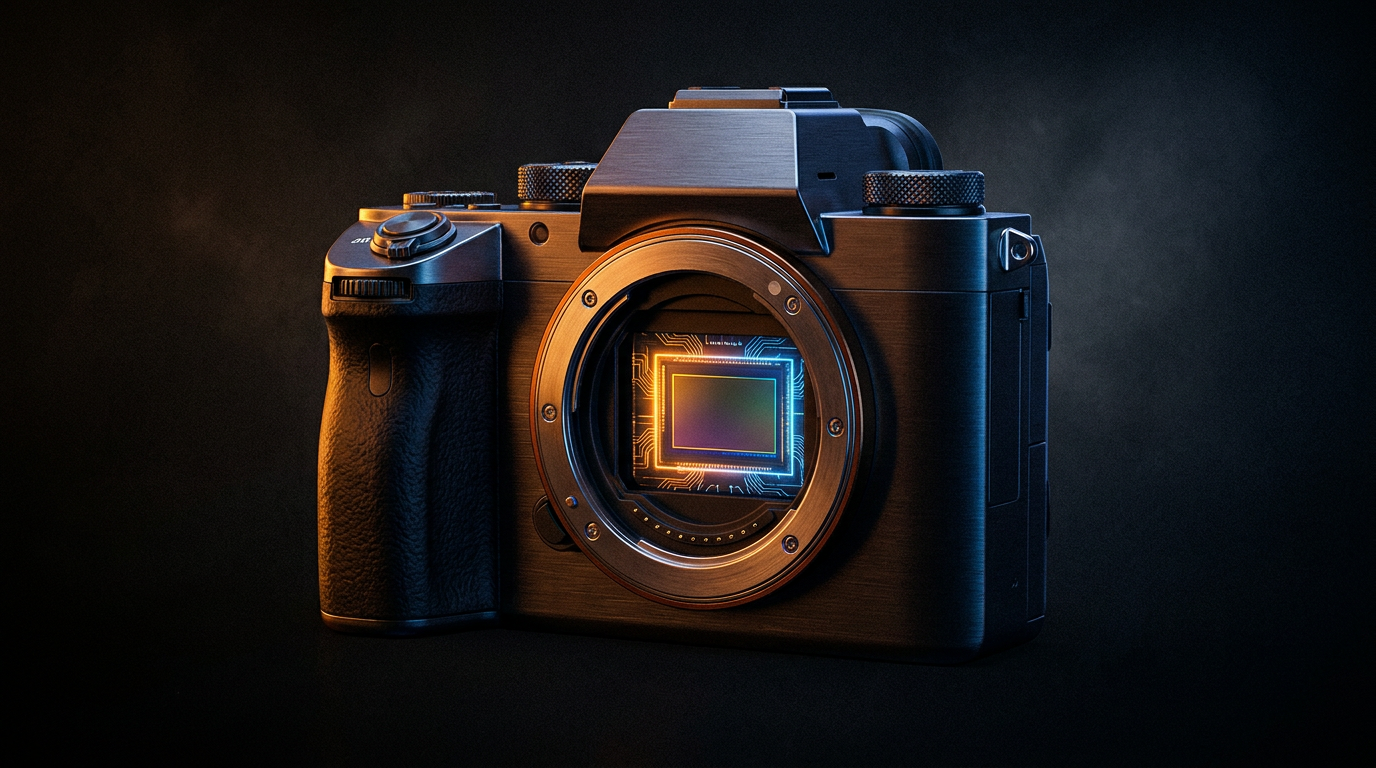
A stacked sensor is built much like a microscopic skyscraper. Instead of placing the memory and processing circuitry next to the pixels—which takes up valuable real estate—manufacturers bond a dedicated layer of high-speed DRAM directly underneath the light-gathering layer. This allows the camera to offload massive amounts of data almost instantly. Cameras equipped with fully stacked sensors, such as the flagship Nikon Z8 and Canon EOS R5 Mark II, can shoot at blistering speeds of 30 to 120 frames per second with virtually no rolling shutter distortion. The viewfinder never blacks out, giving the photographer a continuous, uninterrupted view of the action as it unfolds.[1][5]

But the true holy grail of sensor technology, which has finally reached consumer models in 2026, is the global shutter. Found in specialized, high-end bodies like the Sony A9 III, a global shutter eliminates the line-by-line scan entirely. Instead, every single pixel on the sensor begins and ends its exposure at the exact same instant. It acts less like a scanner and more like a sudden flash of light, capturing the entire scene in one unified microsecond. This represents the most significant leap in shutter technology since the transition from film to digital. While the manufacturing process is incredibly complex, the real-world benefits for working professionals are immediately apparent.[5]
The implications of a global shutter are profound for professional action shooters. It completely eradicates motion distortion, no matter how fast the subject is moving across the frame. Furthermore, it allows photographers to synchronize their studio flashes at any shutter speed—even up to a staggering 1/80,000th of a second—without needing specialized, power-draining high-speed sync equipment. While early global shutters currently come with a slight penalty to base dynamic range and low-light noise, they represent the definitive future of action, sports, and commercial photography, solving physics problems that have plagued the medium for decades. For commercial shooters who mix ambient sunlight with powerful strobes, the global shutter offers unprecedented creative control over exposure.[5][6]
Beyond the physical sensor architecture, the 'brain' of the 2026 mirrorless camera has undergone a complete artificial intelligence revolution. Autofocus is no longer about manually toggling a single focus point over a subject's face using a joystick. Modern systems utilize deep-learning algorithms trained on millions of reference images to instantly recognize and track specific subjects. Whether you are pointing the lens at humans, birds, airplanes, trains, or insects, the camera's processor identifies the subject in real-time, locking a tracking box onto it with a success rate that borders on magic. This computational leap means photographers spend less time fighting their gear and more time focusing on composition and timing.[3][4]
Beyond the physical sensor architecture, the 'brain' of the 2026 mirrorless camera has undergone a complete artificial intelligence revolution.
These AI autofocus systems actually understand the skeletal structure of their subjects. If a person turns their back, puts on sunglasses, or is momentarily obscured by a passing vehicle or a tree branch, the camera predicts their movement and maintains focus on exactly where their eye should be. Canon has even reintroduced and perfected 'Eye Control AF' in models like the EOS R5 Mark II. By utilizing infrared sensors inside the electronic viewfinder, the camera tracks the photographer's own pupil, allowing them to shift the focus point across a crowded scene simply by looking at a different subject. It is a seamless, futuristic integration of human intent and machine precision that drastically increases the 'keeper rate' of usable photos.[1][2]

Despite these universal technological leaps, choosing the right camera still requires navigating the complex world of different sensor sizes. Full-frame sensors, which match the physical dimensions of classic 35mm film, remain the gold standard for portrait, wedding, and architectural photographers. The larger surface area captures more light, resulting in cleaner images in dark churches or reception halls, and naturally produces the highly sought-after shallow depth of field that blurs backgrounds into a creamy wash of color. Models like the Canon EOS R8 and Panasonic Lumix S5 II offer surprisingly affordable entry points into this premium tier. For professionals whose livelihoods depend on maximum image fidelity, full-frame remains the safest and most versatile investment.[1][4]
However, APS-C sensors are experiencing a major renaissance in the 2026 market. Because the sensor is physically smaller, the camera bodies and their corresponding lenses can be significantly lighter, more compact, and much cheaper to manufacture. Cameras like the Fujifilm X-T5 and Sony a6700 deliver professional-grade, high-resolution image quality in a footprint that won't break a traveler's back. For street photographers, vloggers, and everyday enthusiasts, these crop-sensor systems prove that full-frame bulk is not a strict necessity for capturing breathtaking, gallery-worthy photography. The robust ecosystem of affordable APS-C lenses makes this format the undeniable sweet spot for value and portability.[1][4]
For wildlife and macro specialists, the even smaller Micro Four Thirds format offers a unique superpower: the crop factor. A camera like the OM System OM-1 Mark II effectively doubles the focal length of any attached lens, turning a compact, hand-holdable 300mm lens into a massive 600mm equivalent. Combined with class-leading in-body image stabilization (IBIS) rated for up to an astonishing 8.5 stops, photographers can shoot sharp, handheld wildlife images in the depths of a dark forest without ever needing to unpack a heavy tripod. This extreme mobility allows nature photographers to hike further and react faster to fleeting animal encounters.[2][4]

We are also seeing dedicated cameras finally adopt the computational tricks that made smartphones so popular, but applying them to massive, high-quality sensors. The OM-1 Mark II, for instance, features a 'Live ND' mode that digitally simulates a neutral density filter. This allows landscape photographers to blur moving water or rushing clouds in broad daylight without attaching physical dark glass to their lenses. Similarly, in-camera focus stacking automatically shoots and merges dozens of macro shots in seconds, creating a single, perfectly sharp image of an insect with infinite depth of field. These computational features bridge the gap between traditional optical physics and modern software processing.[2]
Video capabilities have similarly skyrocketed, completely blurring the line between a traditional stills camera and a professional cinema rig. Hybrid creators now expect internal 10-bit 4:2:2 color recording as a bare minimum baseline. Mid-range champions include built-in cooling fans to prevent overheating during unlimited 4K recording sessions. Furthermore, 'open gate' recording modes have become highly requested; by capturing the entire 3:2 sensor area rather than a pre-cropped 16:9 rectangle, creators can easily crop the same high-resolution footage for both vertical TikToks and horizontal YouTube videos without losing quality. This versatility is essential for modern content creators who must deliver assets across multiple social media platforms simultaneously.[4]
Interestingly, as cameras become more like advanced, automated computers, a parallel trend has emerged: a deep desire for tactile, intentional shooting. Fujifilm's X-T5 and Nikon's vintage-inspired Zf explicitly eschew modern digital interface screens for physical, machined brass dials controlling shutter speed, ISO, and exposure compensation. These cameras offer all the modern AI autofocus and sensor speed under the hood, but their physical design forces the photographer to slow down, look at their settings, and engage with the mechanical joy of the craft. It is a deliberate rejection of the 'spray and pray' mentality, proving that the user experience is just as important as the final megapixel count.[1][2]

Ultimately, buying a camera in 2026 is less about avoiding a 'bad' model—virtually every current mirrorless camera on the market is exceptional—and more about matching the specific technology to the user's personal workflow. Whether you are relying on a global shutter to freeze a speeding race car, using deep-learning AI to track a bird in flight, or turning physical dials on a misty street corner, the modern camera has successfully removed the technical bottlenecks. What remains is purely the photographer's vision. The gear is no longer the excuse; it is simply the canvas waiting for your creativity.[3][6]
How we got here
Pre-2010s
DSLRs dominate the professional and enthusiast photography market.
Mid-2010s
Mirrorless cameras introduce electronic viewfinders and on-sensor phase detection.
2021
Fully stacked sensors reach the mainstream, enabling blackout-free shooting.
2024
The first consumer global shutter camera eliminates rolling shutter distortion.
2026
AI-driven subject recognition and computational features become standard across all price tiers.
Viewpoints in depth
Computational Photography Advocates
Embrace AI and digital processing as the future of the medium.
This camp argues that the camera should handle the technical friction so the photographer can focus purely on composition. They champion features like deep-learning autofocus, Live ND filters, and global shutters, viewing them not as 'cheats' but as essential tools that expand what is physically possible to capture.
Tactile Traditionalists
Prioritize the mechanical joy and intentionality of the photographic process.
For these photographers, the relentless pursuit of speed and AI automation strips the soul out of the craft. They gravitate toward cameras with physical brass dials for ISO and shutter speed, arguing that slowing down and making deliberate exposure choices leads to better, more thoughtful art than spraying 120 frames per second.
Hybrid Creators
Demand equal performance for both high-end video and still photography.
This growing demographic views the camera as a multimedia tool. They are less concerned with mechanical shutters and more focused on thermal management, 10-bit internal color codecs, and open-gate sensor readout, ensuring their gear can seamlessly transition from a professional photo shoot to a cinematic video production.
What we don't know
- How quickly global shutter technology will trickle down to entry-level and mid-range camera bodies.
- Whether third-party lens manufacturers will gain full open-mount access across all major camera brands.
Key terms
- Global Shutter
- A sensor design that reads every pixel simultaneously, eliminating motion distortion and banding.
- Stacked Sensor
- A sensor with a dedicated memory layer built directly beneath the pixels for ultra-fast data readout.
- BSI (Back-Side Illuminated)
- A sensor architecture that places wiring behind the light-gathering layer to improve low-light performance.
- Rolling Shutter
- The distortion caused when a camera reads a sensor line-by-line while the subject is moving.
- Open Gate
- A video recording mode that captures the entire full-sensor area, allowing flexible cropping in post-production.
Frequently asked
Do I still need a DSLR in 2026?
No. Major manufacturers have stopped developing new DSLRs, and modern mirrorless cameras offer vastly superior autofocus and video capabilities.
What is the advantage of a global shutter?
It captures the entire scene at the exact same instant, completely eliminating 'jello' distortion on fast-moving subjects and allowing flash sync at any speed.
Is full-frame always better than APS-C?
Not necessarily. While full-frame excels in low light, APS-C offers lighter, more affordable gear with excellent image quality that meets most professional needs.
Can dedicated cameras do what smartphones do?
Yes, and they are increasingly adopting smartphone-like computational tricks, such as in-camera focus stacking and digital neutral density filters, but with much larger, higher-quality sensors.
Sources
Source coverage
6 outlets
4 viewpoints surfaced






[1]DPReviewTactile Traditionalists
The 9 Best mirrorless cameras in 2026
Read on DPReview →[2]Amateur PhotographerWildlife & Action Specialists
The best cameras for photography in 2026: new cameras for wildlife, landscapes, street and more
Read on Amateur Photographer →[3]Canon RumorsWildlife & Action Specialists
DSLR vs Mirrorless Cameras in 2026: Which Should You Buy?
Read on Canon Rumors →[4]RTINGSHybrid Creators
The 6 Best Mirrorless Cameras of 2026
Read on RTINGS →[5]Pix ProComputational Photography Advocates
Camera Sensor Technology Explained – Stacked, BSI, IBIS
Read on Pix Pro →[6]Factlen Editorial TeamComputational Photography Advocates
Synthesis by Factlen editorial team
Read on Factlen Editorial Team →



Every angle. Every day.
Get shopping stories with full source coverage and perspective breakdowns delivered to your inbox.