
Steam Deck OLED vs. ASUS ROG Ally X: Which Premium Handheld Wins in 2026?
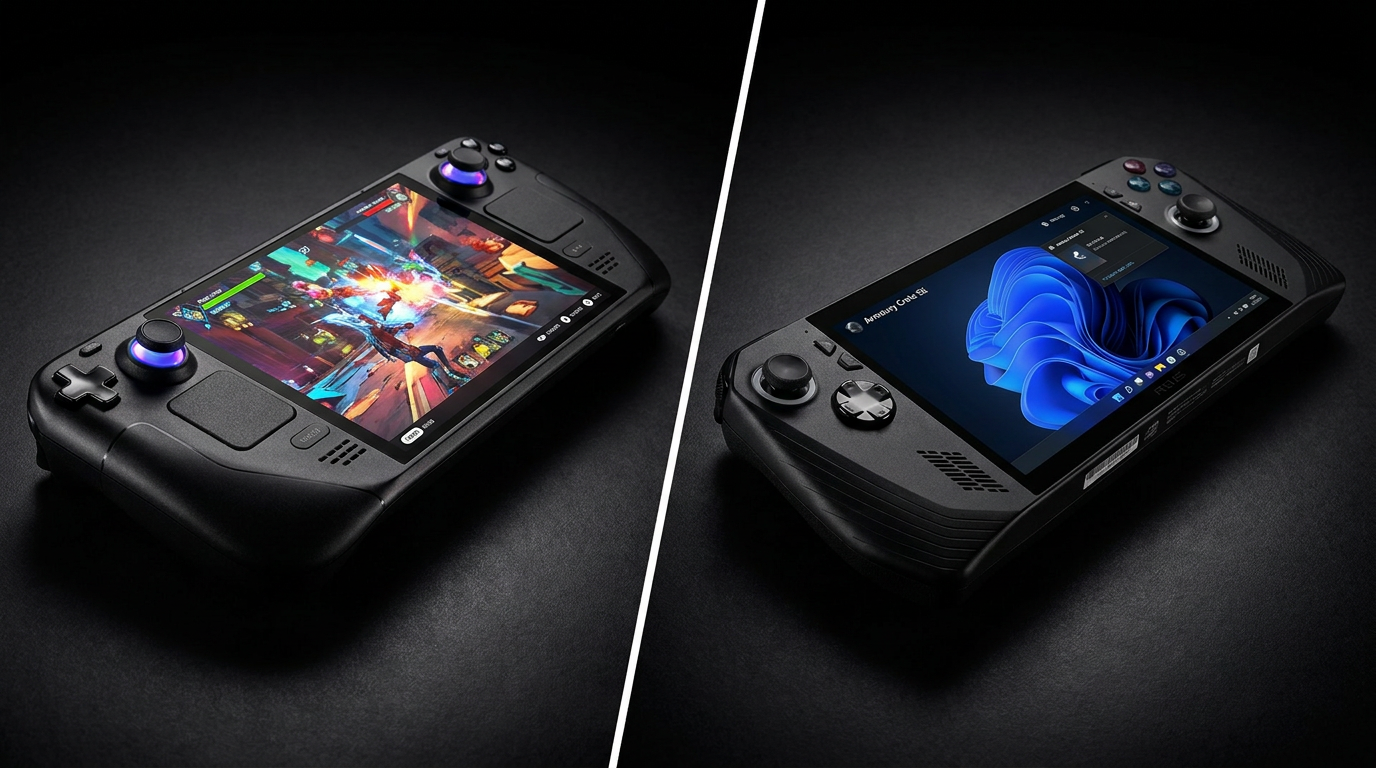
A comprehensive side-by-side comparison of the two leading handheld gaming PCs, weighing the console-like perfection of the Steam Deck OLED against the brute-force Windows power of the ROG Ally X.
By Factlen Editorial Team
- Console Purists
- Values a seamless, frictionless user interface and battery efficiency over raw processing power.
- Performance Enthusiasts
- Prioritizes high framerates, 1080p resolution, and the freedom to run any Windows-compatible game or launcher.
- Value & Pragmatism Analysts
- Focuses on the long-term viability, price-to-performance ratio, and hardware versatility of the devices.
What's not represented
- · Game developers optimizing specifically for handheld architectures
- · Budget-conscious gamers priced out of the premium tier
Why this matters
With premium handheld PCs costing upwards of $800, choosing the right device dictates whether you get a seamless console experience or a powerful, flexible Windows machine. Understanding these trade-offs ensures buyers invest in the hardware that actually matches their gaming habits.
Key points
- The Steam Deck OLED excels in battery efficiency, console-like usability, and visual contrast thanks to its HDR screen.
- The ASUS ROG Ally X dominates in raw performance, offering 1080p resolution and a 120Hz refresh rate for demanding games.
- Windows 11 on the Ally X provides unmatched compatibility for Game Pass and anti-cheat titles, but introduces desktop-level friction.
- Valve's SteamOS offers a seamless, pick-up-and-play experience but struggles with non-Steam storefronts and kernel-level anti-cheat software.
- Despite a smaller battery, the Steam Deck OLED outlasts the Ally X when playing lightweight indie games due to its highly optimized APU.
The portable PC gaming market has matured significantly by mid-2026, leaving buyers with a difficult choice between the two undisputed heavyweights of the category. On one side sits Valve’s Steam Deck OLED, a masterclass in optimization that prioritizes a seamless, console-like experience. On the other side is the ASUS ROG Ally X, a brute-force Windows powerhouse designed to push handheld performance to its absolute limits. Choosing between them is no longer a simple question of budget; it is a fundamental decision about how, where, and what a person plays. Both devices command premium prices and offer distinct visions for the future of mobile gaming, making a side-by-side trade-off analysis essential for prospective buyers.[1][3][5]
The argument for the Steam Deck OLED centers entirely on friction-free usability and visual brilliance. Its custom Linux-based SteamOS provides an interface that just works, allowing players to suspend games instantly and navigate their libraries without the jarring interruptions of desktop pop-ups. The evidence for its dominance lies in its 7.4-inch HDR OLED display, which delivers inky blacks and vibrant colors that an IPS panel simply cannot match. However, the argument against Valve’s machine is its hard performance ceiling. With an older APU and a 1280x800 resolution capped at 90Hz, it struggles to maintain high framerates in the most demanding 2026 AAA titles, and its Linux architecture inherently blocks certain multiplayer games that rely on kernel-level anti-cheat software.[5][6]
Conversely, the argument for the ASUS ROG Ally X is rooted in raw, unadulterated power and universal compatibility. Equipped with the Ryzen Z1 Extreme processor and a massive 24GB of RAM, it easily outpaces the Steam Deck in benchmark tests. The evidence is clear when running heavy titles: the Ally X can push 1080p resolutions at a 120Hz refresh rate, utilizing AMD’s Variable Refresh Rate technology to keep gameplay buttery smooth even when framerates fluctuate. The argument against the Ally X, however, is the very operating system that gives it its flexibility. Windows 11 remains clunky on a seven-inch touchscreen, prone to awkward login screens, background update interruptions, and a sleep mode that occasionally crashes games upon waking.[1][2][4]

When quantifying the display trade-offs, buyers must weigh cinematic contrast against competitive smoothness. The Steam Deck OLED’s panel can reach a blinding 1,000 nits of peak brightness during HDR content, making it exceptional for visually rich, atmospheric games like Cyberpunk 2077 or Hades II. The ROG Ally X tops out at 500 nits and lacks HDR, meaning colors will not pop with the same intensity. Yet, the Ally X’s 1080p resolution offers a noticeably sharper image, and its 120Hz refresh rate is a tangible advantage for fast-paced shooters or racing games where split-second responsiveness is more critical than shadow detail.[2][6]
Battery life presents the most fascinating contradiction between the two devices. The ROG Ally X boasts a staggering 80-watt-hour battery—the largest in its class—compared to the Steam Deck OLED’s 50-watt-hour cell. On paper, ASUS should win easily. The evidence, however, shows that the Ally X’s powerful internals demand significantly more wattage. When pushed to its 30-watt turbo mode for heavy gaming, the Ally X will drain its massive battery in roughly two hours. The Steam Deck OLED, tuned for extreme efficiency at lower wattages, can stretch its smaller battery to an astonishing six to eight hours when playing indie titles or older games, though it too will tap out around the two-hour mark under maximum load.[2][5][6]
Battery life presents the most fascinating contradiction between the two devices.
Ergonomics and control precision also reveal distinct design philosophies. Valve opted for a wider, 1.4-pound chassis that includes dual trackpads, which are invaluable for playing strategy games or navigating desktop mode. ASUS redesigned the Ally X to feature much deeper, console-style grips and Hall effect joysticks that eliminate the risk of stick drift. While the Ally X is slightly heavier at 1.5 pounds, many users find its traditional Xbox-style layout more comfortable for extended sessions, especially since it ditches the trackpads to keep the footprint slightly more compact than the Deck.[1][4][6]

Storage and connectivity further separate the casual player from the hardware enthusiast. The ROG Ally X comes standard with a 1TB drive and features two USB-C ports, including USB 4 support, allowing users to charge the device while simultaneously connecting it to an external GPU or a high-speed dock. The Steam Deck OLED offers 512GB and 1TB tiers but limits users to a single USB-C port. For players who want their handheld to double as a docked desktop replacement, the Ally X provides the necessary bandwidth and port selection, whereas the Steam Deck remains stubbornly focused on being a dedicated portable.[2][6]
Ultimately, the Steam Deck OLED fits well when a buyer wants a frictionless, console-like experience, prioritizes battery life for indie games, and values the unmatched visual contrast of an OLED screen. It is the definitive choice for players with massive existing Steam libraries who have zero interest in tinkering with settings, updating drivers, or fighting with a desktop operating system. It does not fit well when a user relies heavily on Xbox Game Pass natively, plays competitive shooters requiring anti-cheat software, or demands 1080p resolutions in the latest, most graphically intensive releases.[3][5]

The ASUS ROG Ally X fits well when a user wants the ultimate portable powerhouse, demands access to every PC storefront including Game Pass and Epic, and values the smoothness of a 120Hz VRR display. It is the ideal machine for enthusiasts willing to tolerate the occasional quirks of Windows 11 in exchange for the freedom to mod games, run abandonware, and push framerates to their absolute limit. It does not fit well when a buyer wants to simply press a power button and play without ever seeing a desktop screen, or when they prioritize lightweight portability and deep, inky black levels for cinematic single-player adventures.[1][4]
There is no single winner in the 2026 handheld landscape; the victor is entirely conditional on the player's tolerance for friction and their specific gaming diet. If the goal is to disappear into a beautifully optimized, vibrant world for hours on a single charge, Valve’s hardware remains undefeated. But if the objective is to carry a legitimate, uncompromised Windows gaming PC in a backpack, ASUS has built the most capable machine on the market.[3][5][6]
How we got here
Feb 2022
Valve releases the original Steam Deck, proving the viability of the modern handheld PC market.
Jun 2023
ASUS launches the original ROG Ally, introducing a powerful Windows-based competitor.
Nov 2023
Valve releases the Steam Deck OLED, featuring a vastly improved screen, better battery, and refined thermals.
Jul 2024
ASUS releases the ROG Ally X, doubling the battery capacity and fixing the ergonomic flaws of the original model.
Viewpoints in depth
Console Purists' view
Advocating for the seamless, pick-up-and-play nature of SteamOS.
This camp argues that a handheld device should feel like a dedicated console, not a miniaturized desktop. They point to the Steam Deck OLED's ability to instantly suspend and resume games without crashing as the gold standard for portable play. For these users, the deep blacks of the OLED screen and the extreme battery efficiency at lower wattages far outweigh the inability to natively play certain multiplayer titles, as the sheer convenience of SteamOS eliminates the friction that plagues Windows handhelds.
Performance Enthusiasts' view
Championing the raw power and open ecosystem of Windows 11.
Enthusiasts maintain that if you are paying premium prices for a portable PC, it should actually function as a full PC. They highlight the ROG Ally X's 24GB of RAM and Ryzen Z1 Extreme chip as necessary tools for brute-forcing modern AAA games at 1080p. This camp embraces the quirks of Windows 11 because it grants them unrestricted access to Xbox Game Pass, Epic Games, emulation, and modding communities, arguing that the Steam Deck's locked-down Linux environment is ultimately too restrictive for power users.
Value & Pragmatism Analysts' view
Weighing the hardware longevity against the asking price.
Analysts focus on the hardware-to-dollar ratio, noting that the ROG Ally X's dual USB-C ports, 80Wh battery, and easily upgradeable storage make it a more future-proof investment. However, they also acknowledge that the Steam Deck OLED's lower entry price and Valve's relentless software optimization mean it will continue to punch above its weight class for years. This camp generally concludes that buyers must accurately assess their own gaming habits, as overpaying for power you won't use is just as wasteful as buying a cheaper device that can't run your favorite games.
What we don't know
- Whether Microsoft will release a truly optimized, handheld-native version of Windows to fix the Ally X's software friction.
- When Valve plans to release a true 'Steam Deck 2' with upgraded processing power to match the Z1 Extreme.
Key terms
- APU (Accelerated Processing Unit)
- A single chip that combines both the central processor (CPU) and graphics processor (GPU), used in both handhelds to save space.
- VRR (Variable Refresh Rate)
- A display technology on the ROG Ally X that syncs the screen's refresh rate with the game's framerate, eliminating screen tearing and stuttering.
- Hall Effect Joysticks
- Joysticks that use magnetic sensors instead of physical electrical contacts, preventing the wear and tear that causes stick drift.
- TDP (Thermal Design Power)
- The maximum amount of heat generated by a computer chip that the cooling system is designed to dissipate, often used to describe how much wattage a handheld is drawing.
Frequently asked
Can the Steam Deck OLED play Xbox Game Pass games?
Not natively. You can stream Game Pass titles via cloud gaming, but installing them directly requires dual-booting Windows, which removes the seamless SteamOS experience.
Does the ROG Ally X suffer from stick drift?
No, ASUS upgraded the ROG Ally X with Hall effect joysticks, which use magnets instead of physical contacts, effectively eliminating stick drift.
Which handheld has better battery life?
It depends on the game. The Steam Deck OLED lasts much longer (up to 8 hours) on lightweight indie games, while the ROG Ally X's massive 80Wh battery gives it a slight edge when running heavy AAA games at maximum power.
Can I use these devices as a regular desktop PC?
Yes. Both can be docked to a monitor, keyboard, and mouse. The ROG Ally X runs Windows 11 naturally, while the Steam Deck has a dedicated Linux desktop mode.
Sources
Source coverage
6 outlets
3 viewpoints surfaced






[1]PCMagPerformance Enthusiasts
Asus ROG Xbox Ally X Review
Read on PCMag →[2]Trusted ReviewsValue & Pragmatism Analysts
Asus ROG Ally X vs Steam Deck OLED
Read on Trusted Reviews →[3]NoobFeedValue & Pragmatism Analysts
Steam Deck OLED vs. Xbox ROG Ally X in 2026: Performance, Price and Value Compared
Read on NoobFeed →[4]Pure XboxPerformance Enthusiasts
Review ROG Xbox Ally X - An Amazing Handheld PC With Plenty Of Console-Like Potential
Read on Pure Xbox →[5]Bachynski BlogConsole Purists
The Handheld PC Renaissance: Which One Deserves Your Money in 2026
Read on Bachynski Blog →[6]TechTuber AnalysisConsole Purists
Steam Deck OLED vs ROG Ally X Comparison 2026
Read on TechTuber Analysis →
Every angle. Every day.
Get shopping stories with full source coverage and perspective breakdowns delivered to your inbox.