
STB Review Begins for $85 Billion Union Pacific-Norfolk Southern Merger to Create First Transcontinental Freight Railroad
The Surface Transportation Board has officially commenced its formal review of the proposed $85 billion merger between Union Pacific and Norfolk Southern. The regulatory process moves forward as the railroads submit unprecedented customer protections to counter fierce opposition from rival carriers, shippers, and state attorneys general.

The Surface Transportation Board (STB) has officially initiated its formal review of the proposed $85 billion merger between Union Pacific and Norfolk Southern, a landmark transaction that would create the first single-line transcontinental freight railroad in United States history. The regulatory clock is now ticking on a deal that promises to reshape the North American supply chain, with a final decision expected in mid-2027.[1][6]
The STB's review process began after the two Class I railroads submitted a massive tranche of supplemental information in late July 2026, responding to the agency's earlier demands for more granular data on market impacts. To address regulatory skepticism, Union Pacific and Norfolk Southern unveiled a suite of binding customer protections, including expanded Committed Gateway Pricing (CGP) and guarantees to preserve rail options for shippers who currently have access to multiple carriers.[1][4]
For the merging railroads, the value proposition rests on eliminating the structural inefficiencies of the current U.S. rail network. By combining Union Pacific's expansive western footprint with Norfolk Southern's dense eastern network, the new entity—dubbed The Union Pacific Transcontinental Railroad—would operate 50,000 route miles across 43 states. Proponents argue this seamless, single-line service will bypass congested mid-continent interchanges like Chicago, reducing transit times, lowering carbon emissions, and allowing rail to compete more aggressively with long-haul trucking.[1][6]
However, the sheer scale of the $250 billion combined enterprise has galvanized a formidable opposition bloc. The "Stop the Rail Merger Coalition" unites rival railroads, including BNSF and CPKC, with major shipping groups like the American Chemistry Council and the American Farm Bureau Federation. This alliance argues that the merger will inevitably reduce competition, restrict access for captive shippers, and inject new vulnerabilities into the national supply chain.[2][5]
The opposition extends beyond industry stakeholders. A coalition of seven Republican state attorneys general recently filed a letter urging the STB to reject the merger outright. They contend that the railroads' proposed pricing remedies, such as the CGP arrangement, would preserve only a narrow slice of existing competitive options and could perversely incentivize higher rates on the traffic lanes used to calculate benchmark prices.[4]
The merger's impact on the rail workforce has also become a central flashpoint. While Union Pacific and Norfolk Southern have made an unprecedented pledge that every union employee working at the time of the merger will have a job for life, critics point to preliminary analyses projecting over 1,000 layoffs and 500 transfers as operations consolidate. Some labor groups have defended the legally binding labor protections, while others warn of long-term workforce destabilization.[1][3]
Unlike most corporate mergers, which are evaluated by the Department of Justice or the Federal Trade Commission under standard antitrust laws, rail mergers fall under the exclusive jurisdiction of the STB. Under rules adopted in 2001, the STB requires applicants to demonstrate that a major merger not only preserves but actively enhances competition and serves the public interest—a high bar that no transcontinental merger has attempted to clear in a quarter-century.[3][6]
As the STB wades through the thousands of pages of economic modeling, public comments, and competitive analyses, the freight rail industry remains in a state of suspended animation. The board's ultimate ruling will dictate whether the U.S. rail network undergoes its most significant consolidation in decades, or whether the current regional balance of power remains the permanent architecture of American freight.[3][6]
Perspectives explored
The Proponents' View
A unified transcontinental network will eliminate the historic inefficiencies of mid-continent handoffs, allowing rail to compete effectively with long-haul trucking while reducing supply chain emissions.
Union Pacific and Norfolk Southern maintain that the current balkanized rail system artificially inflates transit times and costs. By creating a single 50,000-mile network, the companies argue they can bypass congested interchange points like Chicago and St. Louis, transforming 10,000 existing interline lanes into seamless single-line service. Proponents emphasize that this efficiency will not only lower carbon emissions by diverting freight from highways to rail, but will also generate enough volume growth to create 1,200 net new union jobs within three years.
The Shippers' View
Consolidating control over half of the nation's rail traffic will inevitably reduce competitive routing options, leaving agricultural and industrial shippers captive to higher rates and degraded service.
Organizations representing the chemical, agricultural, and manufacturing sectors argue that the U.S. rail industry is already too consolidated following decades of mergers. The Stop the Rail Merger Coalition contends that creating a $250 billion behemoth will eliminate the competitive tension that currently keeps pricing in check at key interchange gateways. Shippers express deep skepticism that the projected cost savings will be passed on to consumers, warning instead that captive customers will bear the brunt of higher rates and potential service disruptions during the complex integration process.
The Regulatory Skeptics' View
The proposed customer protections and pricing remedies are too narrow to offset the massive concentration of market power, failing the STB's mandate that major mergers must actively enhance competition.
State attorneys general and rival carriers argue that the voluntary commitments offered by Union Pacific and Norfolk Southern—such as the Committed Gateway Pricing (CGP) arrangement—are structurally flawed. Critics point out that the CGP formula sets rate protections at the 70th percentile of comparable traffic rates rather than a median benchmark, potentially locking in higher prices for eligible shippers. Consequently, these skeptics are urging the Surface Transportation Board to rule that the applicants have failed to meet the 2001 statutory requirement that a major merger must proactively enhance rail-to-rail competition.
Key points
- The Surface Transportation Board has begun its formal review of the $85 billion merger between Union Pacific and Norfolk Southern.
- The combined entity would create the first single-line transcontinental freight railroad in the United States, spanning 50,000 route miles.
- A broad coalition of rival railroads, shipping groups, and state attorneys general has mobilized to oppose the transaction over competition concerns.
- The merging railroads recently submitted binding customer protections and pricing remedies to address regulatory skepticism.
Timeline
July 2025
Union Pacific and Norfolk Southern announce their agreement for an $85 billion merger.
December 2025
The railroads file their initial 7,000-page merger application with the Surface Transportation Board.
January 2026
The STB unanimously rejects the initial application as incomplete, citing missing market impact analyses.
May 2026
Regulators accept a revised application but pause the formal review process to demand extensive supplemental data.
July 2026
Union Pacific and Norfolk Southern submit the requested data alongside new binding customer protections, clearing the way for the review.
- Rival Carriers & Shippers
- Warn that the unprecedented consolidation will reduce competitive options, drive up shipping rates for agricultural and chemical products, and destabilize the national supply chain.
- Merging Railroads
- Argue that a single-line transcontinental network will eliminate interchange delays, reduce emissions, and provide faster service that competes with long-haul trucking.
- State Regulators
- Contend that the proposed pricing remedies are insufficient and that the merger fails to meet the statutory requirement to enhance competition in the public interest.
- Labor Unions
- Divided between those emphasizing the security of binding lifetime job guarantees and those concerned about projected layoffs, transfers, and long-term workforce reductions.
Perspectives this story doesn't cover
- Local communities along the proposed high-density freight corridors who may face increased train traffic and blocked crossings.
- Long-haul trucking companies that stand to lose market share if the transcontinental rail service successfully diverts freight from the highway system.
Sources
Source coverage
6 outlets
4 viewpoints surfaced






- [1]Union Pacific / Norfolk SouthernMerging Railroads
Binding Agreements, Not Fear, Should Guide the Union Pacific-Norfolk Southern Merger Debate
Read on Union Pacific / Norfolk Southern → - [2]BNSF RailwayRival Carriers & Shippers
Stop the Rail Merger Coalition launches to oppose Union Pacific–Norfolk Southern merger
Read on BNSF Railway → - [3]The American ProspectLabor Unions
Regulators Finally Poised to Review America's Biggest Rail Merger
Read on The American Prospect → - [4]FreightWavesState Regulators
Mega rail deal under fire: 7 State AGs warn UP-NS merger could drive up shipping costs
Read on FreightWaves → - [5]American Chemistry CouncilRival Carriers & Shippers
Stop the Rail Merger Coalition Launches to Oppose Union Pacific–Norfolk Southern Merger
Read on American Chemistry Council → - [6]Wikipedia
Proposed merger between Union Pacific and Norfolk Southern
Read on Wikipedia →
More in Transportation
See all →Cross-Border Rail
Deutsche Bahn Restores High-Speed Rail to Brussels Airport in New Cologne-Antwerp Route
6 sources
Track Engineering
Absorbing the Expansion: The Physics of Continuous Welded Rail on High-Speed Networks
8 sources
Rail Infrastructure
UK Government Sets 40% Rail Freight Growth Target by 2040 for Great British Railways
3 sources
Italian Rail
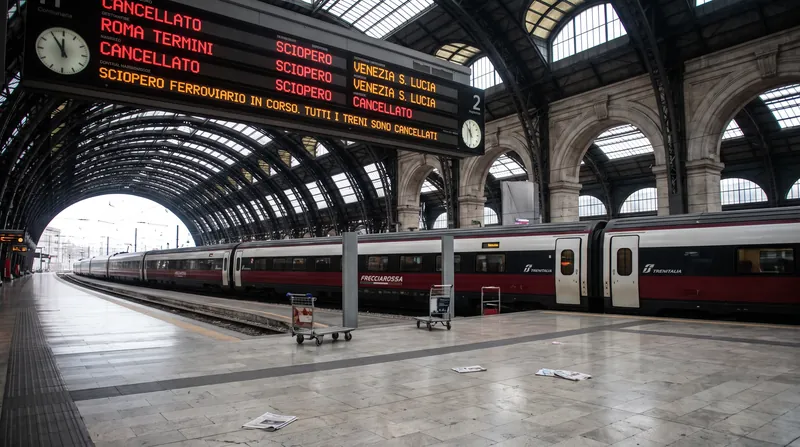
National Rail Strike Halts Train Services Across Italy Following Summer Ban Expiration
5 sources
Comments
Every angle. Every day.
Get Transportation stories with full source coverage and perspective breakdowns, free every day.