
SpaceX's Historic $75 Billion IPO Opens the Space Economy to Retail Investors
SpaceX has officially entered the public markets with a record-shattering $1.75 trillion valuation, transforming space infrastructure into a mainstream asset class. The listing, alongside index inclusions for peers like Rocket Lab, forces passive funds to buy in, though massive debt and AI cash-burn pose near-term risks.
By Factlen Editorial Team
- Retail & Institutional Bulls
- Investors focused on the unprecedented scale and multi-sector dominance of the newly public company.
- Cautious Fundamentalists
- Analysts warning about extreme capital intensity, corporate governance, and debt loads.
- Ecosystem & Policy Watchers
- Strategists tracking the broader space sector and government procurement shifts.
What's not represented
- · Legacy aerospace contractors facing disruption from commercial space entities.
- · Environmental groups concerned about the atmospheric impact of high-frequency rocket launches.
Why this matters
For decades, the financial returns of the space race were locked behind private venture capital doors. With SpaceX and its peers now entering major public indices, everyday retirement accounts and retail portfolios will automatically gain exposure to the multi-trillion-dollar orbital economy.
Key points
- SpaceX raised $75 billion at a $1.75 trillion valuation, surpassing Saudi Aramco as the largest IPO in history.
- The company allocated an unprecedented 30% of its initial shares directly to retail investors.
- SpaceX will join the Nasdaq 100 in just 15 trading days, triggering billions in forced passive buying.
- The February 2026 merger with xAI gives investors exposure to AI compute, but introduces heavy cash burn.
- Peer company Rocket Lab is also joining the Nasdaq 100, signaling broader maturity for the space economy.
- Analysts warn that a tiny 4.3% public float and a $20 billion bridge loan could drive near-term volatility.
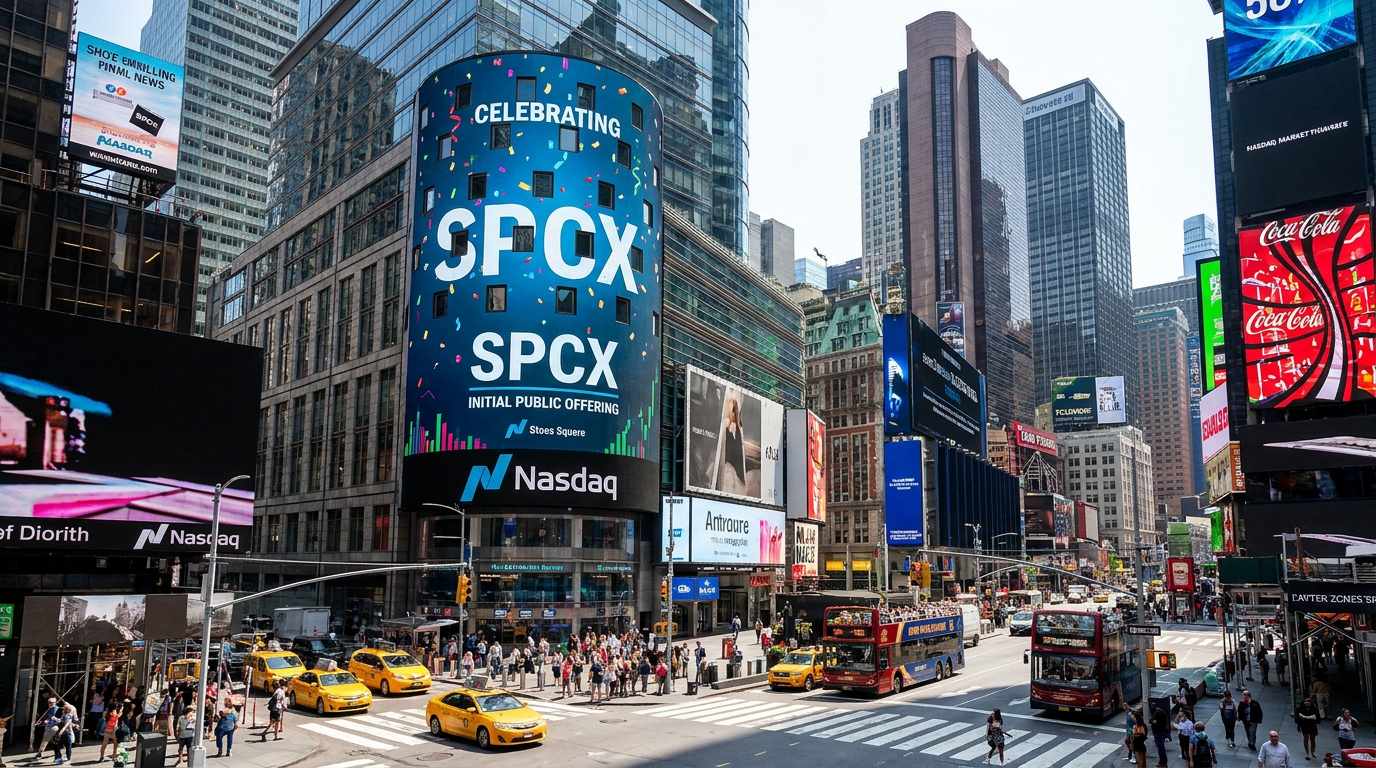
June 12, 2026. SpaceX rang the opening bell at the Nasdaq Stock Market, completing the most highly anticipated initial public offering in Wall Street history. Trading under the ticker symbol SPCX, the aerospace giant raised a staggering $75 billion at a $1.75 trillion valuation, easily surpassing Saudi Aramco to become the largest public listing on record. Shares opened at $150, an 11% jump above the initial offering price, minting thousands of new millionaires among the company's early employees and long-term backers.[2][3]
For nearly a quarter of a century, the financial returns of the modern space race were locked strictly behind the doors of private venture capital and institutional wealth. Today's listing fundamentally alters that dynamic, transforming the orbital economy into a public market reality. In a highly unusual move for a mega-cap listing, SpaceX allocated up to 30% of its initial shares directly to retail investors through standard brokerages, roughly triple the standard industry allotment.[7]
To understand what investors are actually buying, one must look past the rockets. According to the company's S-1 registration filing, SpaceX is no longer a pure aerospace manufacturer; it is a three-engine conglomerate. The first pillar remains its foundational launch infrastructure. Powered by the workhorse Falcon 9 and the next-generation Starship, the company currently commands roughly 90% of the global commercial launch market by mass-to-orbit, effectively monopolizing access to space.[4][6]

The second pillar, and the company's primary financial engine, is Starlink. The satellite broadband division provides high-speed internet to millions of users globally through a massive constellation of low-Earth orbit satellites. This segment generated the lion's share of the company's $18.67 billion in total revenue last year, providing a highly lucrative, recurring subscription model that helps offset the immense capital expenditures required for rocket development.[3][6]
The third pillar is the most unprecedented: artificial intelligence. In February 2026, SpaceX formally absorbed xAI, the artificial intelligence venture previously operated as a standalone entity by CEO Elon Musk. By purchasing SPCX shares, investors are now simultaneously acquiring exposure to the Grok large language model, the gigawatt-scale Colossus data center, and the company's long-term ambitions to establish AI data center networks directly in Earth's orbit.[4][7]
However, the true market earthquake lies not in the retail enthusiasm, but in the mechanical plumbing of the stock market. In a highly irregular accommodation, Nasdaq altered its listing rules specifically to allow SpaceX to join the prestigious Nasdaq 100 index after just 15 trading days, bypassing the traditional three-month waiting period.[3][7]
However, the true market earthquake lies not in the retail enthusiasm, but in the mechanical plumbing of the stock market.
This fast-track inclusion triggers a phenomenon known as passive buying. Every index fund, exchange-traded fund, and 401(k) retirement plan that tracks the Nasdaq 100 will be contractually forced to purchase shares of SpaceX to accurately reflect the index's new composition. Financial analysts estimate this mandate will generate up to $8 billion in forced passive buying within the first month of trading alone, creating a massive artificial floor for the stock price.[7]
SpaceX is not entering the mainstream indices alone; it is pulling the broader space ecosystem up with it. Rocket Lab, the second-largest U.S. orbital launch provider, is also joining the Nasdaq 100 this month. This simultaneous elevation of two pure-play space companies signals to Wall Street that the space sector has matured from a speculative venture category into a standardized, investable industry.[1]
This massive migration of public capital is heavily supported by federal policy tailwinds. In December 2025, the White House signed an executive order formally integrating space into the United States' core economic and national security architecture. The directive established a framework designed to drive at least $50 billion of private investment into U.S. space markets by 2028, prioritizing commercial procurement and fixed-price contracts over bespoke government programs.[5]
Despite the overwhelming demand and policy support, the SpaceX IPO carries severe structural risks. Chief among them is the company's microscopic public float—the percentage of shares actually available for trading. SpaceX floated just 4.3% of its equity to the public. This extreme artificial scarcity, combined with billions in forced index buying, is expected to create violent price volatility in the coming months as demand vastly outstrips the available supply of shares.[7]

The company's underlying fundamentals also carry heavy gravity. While the core space and Starlink segments were profitable in 2024, the absorption of xAI has radically altered the balance sheet. The immense cost of building AI compute infrastructure resulted in a staggering $4.94 billion net loss in 2025. Furthermore, the S-1 filing reveals that SpaceX is carrying a $20 billion short-term bridge loan that must be repaid within six months of the listing.[6][7]
This financial strain has prompted analysts to raise serious corporate governance questions. Skeptics argue that intertwining two of the most capital-intensive industries in human history—orbital spaceflight and generative artificial intelligence—under a single corporate roof creates unprecedented systemic risk. The AI segment is currently consuming Starlink's profits in their entirety, forcing the space division to subsidize terrestrial data centers.[4][7]

History also suggests that retail investors should tread carefully. Major technology IPOs frequently experience a 'pop' on their first day of trading, only to suffer significant drawdowns in their first year as initial hype cools and insider lock-up periods expire. While the stock opened strong at $150, maintaining a $1.75 trillion valuation while burning billions in cash will require flawless execution across all three of the company's distinct business lines.[2][7]
Regardless of near-term price action, today's listing marks a permanent paradigm shift in global finance. Governments and capital markets alike now treat space not as a frontier for exploration, but as critical operational infrastructure—no different than railroads, telecommunications, or cloud computing. Whether through direct shares, ecosystem peers, or broad index funds, the space economy has officially landed in the everyday investor's portfolio.[5][7]
How we got here
2002
Elon Musk founds Space Exploration Technologies Corp. (SpaceX) with the goal of reducing space transportation costs.
2019
SpaceX begins launching its Starlink satellite constellation, creating a recurring revenue broadband business.
Dec 2025
The White House signs an Executive Order establishing a framework to drive $50 billion of private investment into U.S. space markets.
Feb 2026
SpaceX acquires xAI, merging Musk's artificial intelligence venture and its Grok model into the aerospace company.
Jun 12, 2026
SpaceX goes public on the Nasdaq under the ticker SPCX, raising a record $75 billion.
Viewpoints in depth
Retail & Institutional Bulls
Investors focused on the unprecedented scale and multi-sector dominance of the newly public company.
Bullish investors view SpaceX not as a single aerospace company, but as a monopolistic infrastructure play spanning three distinct mega-industries: orbital logistics, global telecommunications (Starlink), and artificial intelligence (xAI). They argue that the $1.75 trillion valuation is justified by the company's 90% market share in commercial launch mass and its rapid inclusion into the Nasdaq 100. For these buyers, the IPO represents a rare opportunity to own the foundational layer of the next digital economy.
Cautious Fundamentalists
Analysts warning about extreme capital intensity, corporate governance, and debt loads.
Fundamental analysts urge caution, pointing to the severe financial strain introduced by the February 2026 merger with xAI. They note that the AI division's gigawatt-scale data center ambitions have consumed Starlink's profits, flipping the company from a net profit in 2024 to a nearly $5 billion loss in 2025. Furthermore, with a $20 billion short-term bridge loan looming and a microscopic 4.3% public float, skeptics warn that the stock is priced for perfection and highly susceptible to post-IPO volatility.
Ecosystem & Policy Watchers
Strategists tracking the broader space sector and government procurement shifts.
Ecosystem watchers argue the real story is the maturation of the entire space sector, not just one company. They point to Rocket Lab's simultaneous elevation to the Nasdaq 100 and the December 2025 White House Executive Order—which mandates $50 billion in private space investment—as proof that space is now a core defense and economic domain. For this camp, the SpaceX IPO is simply the anchor that forces capital markets to finally classify space as standard operational infrastructure.
What we don't know
- How the massive capital requirements of the xAI division will impact Starlink's long-term profitability.
- Whether the stock will suffer the traditional 'IPO dip' once initial retail enthusiasm cools and lock-up periods expire.
- How traditional index funds will manage the extreme volatility associated with such a small public float.
Key terms
- Initial Public Offering (IPO)
- The process by which a private company offers shares of its stock to the public for the first time.
- Public Float
- The portion of a company's shares that are freely available for trading by the public, excluding locked-in shares held by insiders.
- Passive Buying
- Automatic stock purchases made by index funds (like those in a 401k) that are required to hold shares of every company in a specific index, such as the Nasdaq 100.
- S-1 Filing
- The initial registration document a company must file with the SEC before going public, detailing its business model and financials.
- Space Economy
- The full range of activities and resources that create value in space, including rocket launches, satellite broadband, and orbital research.
Frequently asked
Can I buy SpaceX stock right now?
Yes. As of June 12, 2026, SpaceX trades on the Nasdaq exchange under the ticker symbol SPCX and can be purchased through any standard retail brokerage.
Why is the SpaceX IPO considered historic?
It raised $75 billion at a $1.75 trillion valuation, making it the largest public offering in global financial history, surpassing the 2019 Saudi Aramco IPO.
Does owning SpaceX mean I own X (formerly Twitter)?
Yes. Through the February 2026 acquisition of xAI, SpaceX absorbed the AI operations, the Grok model, and the social media network X into its corporate structure.
How does this affect my retirement account?
Because SpaceX and Rocket Lab are joining the Nasdaq 100 index, any passive index funds or 401(k) plans tracking that index will automatically purchase shares of these space companies.
Sources
Source coverage
7 outlets
3 viewpoints surfaced







[1]MarketWatchEcosystem & Policy Watchers
Rocket Lab and these four stocks are joining the Nasdaq 100, with SpaceX waiting in the wings
Read on MarketWatch →[2]CBS NewsRetail & Institutional Bulls
SpaceX shares open at $150, 11% above offering price after historic IPO
Read on CBS News →[3]Nasdaq NewsroomRetail & Institutional Bulls
SpaceX (SPCX): Rocket Company Launches Historic IPO
Read on Nasdaq Newsroom →[4]MorningstarCautious Fundamentalists
What Is SpaceX? Valuation, xAI Merger, and IPO Prospects
Read on Morningstar →[5]DIY InvestorEcosystem & Policy Watchers
The Space Economy in 2026: White House Executive Order and Market Catalysts
Read on DIY Investor →[6]Securities and Exchange CommissionEcosystem & Policy Watchers
Space Exploration Technologies Corp. Form S-1 Registration Statement
Read on Securities and Exchange Commission →[7]Factlen Editorial TeamCautious Fundamentalists
Synthesis by Factlen editorial team
Read on Factlen Editorial Team →

More in finance
See all 120 stories →Behavioral Finance
The 'Echo Chamber Penalty': How Political Polarization is Costing Retail Investors
6 sources

Behavioral Finance
The 'Political Penalty': How Partisan Bias is Costing Retail Investors
6 sources

Annuities
Do Fixed-Index Annuities Outperform the Market? The Evidence Behind the Pitch
6 sources

Retirement Planning
The Truth About Fixed Index Annuities: How the 'Zero Risk' Retirement Pitch Actually Works
7 sources

Every angle. Every day.
Get finance stories with full source coverage and perspective breakdowns delivered to your inbox.