
SpaceX Prices Historic $75 Billion IPO as the Commercial Space Economy Matures
SpaceX has priced its initial public offering at a $1.8 trillion valuation, signaling a massive structural shift as the commercial space sector transitions into a foundational global industry.
By Factlen Editorial Team
- Space Infrastructure Bulls
- Argue that the space economy is the next foundational layer of global commerce, combining logistics, communications, and AI.
- Retail & Institutional Investors
- Focused on the immediate financial opportunity, index inclusion, and portfolio diversification into pure-play space assets.
- Market Pragmatists
- Acknowledge the technological achievements but warn about extreme valuations, execution risks, and high capital intensity.
What's not represented
- · Legacy aerospace defense contractors
- · Astronomers concerned about light pollution from satellite constellations
Why this matters
The public debut of SpaceX and the inclusion of space companies in major indices means the space economy is now embedded in everyday retirement portfolios. Understanding how launch economics and satellite revenue work is essential for investors navigating this new trillion-dollar sector.
Key points
- SpaceX priced its IPO at $135 per share, raising $75 billion at a $1.8 trillion valuation.
- Retail investors alone accounted for more than $100 billion of the $350 billion in total demand.
- Rocket Lab will join the Nasdaq-100 index on June 22, highlighting the sector's maturation.
- Reusable rockets have slashed launch costs by 95%, enabling massive satellite internet constellations.
- The global space economy is projected to reach $1.8 trillion by 2035, driven by broadband and AI data infrastructure.
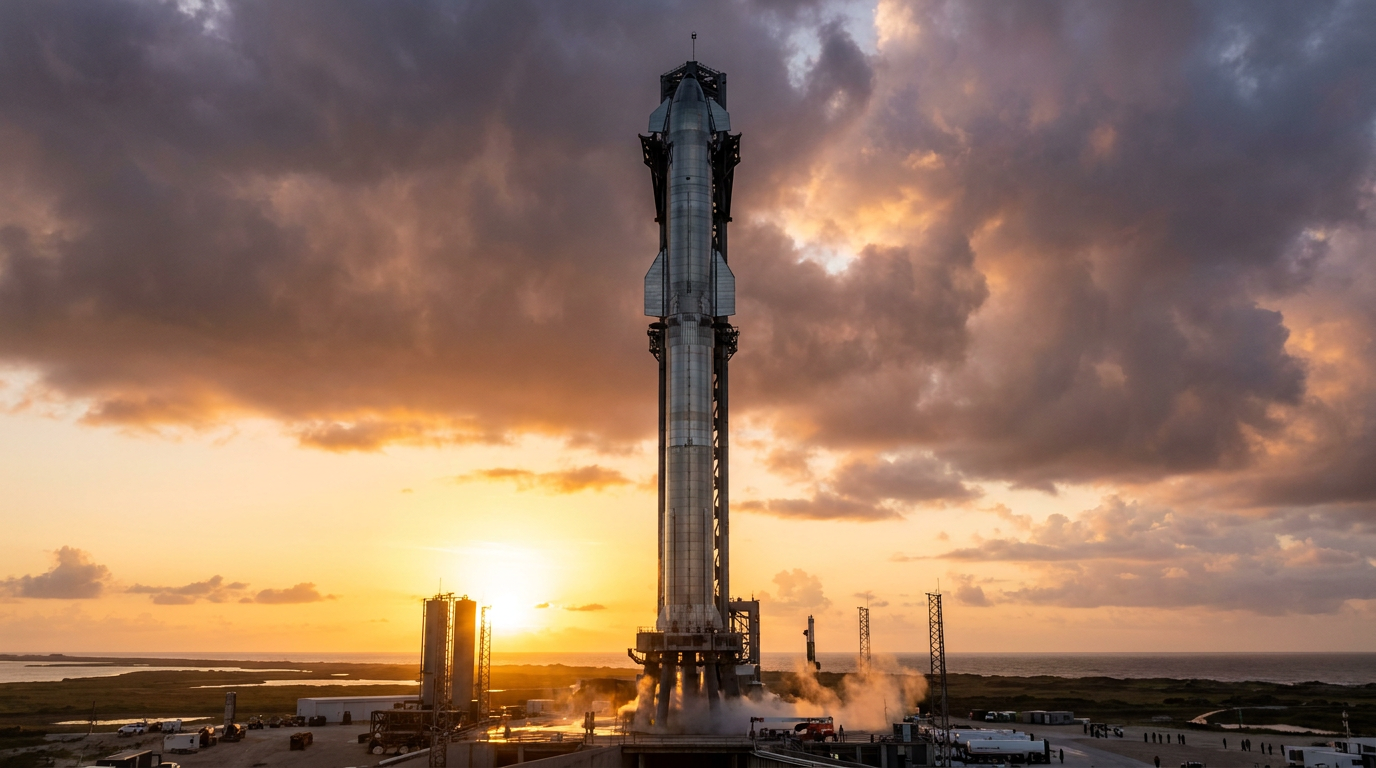
The dawn of the public space age has arrived. Space Exploration Technologies Corp., universally known as SpaceX, has officially priced its initial public offering at $135 per share, raising a staggering $75 billion in capital.[2]
The offering values the aerospace giant at approximately $1.8 trillion, cementing its status as one of the largest public debuts in financial history. Shares commence trading today on the Nasdaq under the ticker symbol SPCX.[2][3]
Investor appetite for the listing has been unprecedented. Institutional and retail investors combined to place over $350 billion in orders, with everyday retail investors alone accounting for more than $100 billion of that demand.[3]

But the historic SpaceX IPO is merely the loudest signal of a much broader structural shift. The commercial space sector is rapidly transitioning from a speculative, government-subsidized frontier into a mature, foundational industry.[8]
This maturation is evident across the broader market. Rocket Lab, a leading provider of small-satellite launches, will officially join the prestigious Nasdaq-100 index on June 22, placing it among the world's largest non-financial companies.[6][8]
To understand how the space economy reached this inflection point, one must examine the fundamental mechanism of launch economics. For decades, accessing orbit was prohibitively expensive, strictly the domain of national governments and massive defense contractors.[8]
The advent of reusable launch vehicles shattered that paradigm. By successfully landing and refurbishing rocket boosters, the cost per kilogram to orbit has plummeted by an estimated 95% over the past decade.[8]
Cheaper access to space unlocked the second phase of the commercial space economy: Low Earth Orbit, or LEO, constellations. LEO refers to an orbit relatively close to Earth's surface, which is ideal for minimizing communication latency.[8]

Companies capitalized on this orbital real estate by deploying networks of thousands of satellites to provide global broadband internet. This innovation transformed launch providers from transportation companies into telecommunications giants with recurring subscription revenue.[4][8]
Companies capitalized on this orbital real estate by deploying networks of thousands of satellites to provide global broadband internet.
This recurring revenue model is a primary driver of today's astronomical IPO valuations. Investors are not merely buying a rocket manufacturer; they are buying a global internet service provider that operates entirely outside traditional terrestrial infrastructure.[4]
Furthermore, the integration of artificial intelligence is expanding the sector's horizon. Analysts note that the intersection of space infrastructure and AI data processing could generate hundreds of billions in new revenue over the coming decade.[4]
The vision increasingly involves orbital data centers and space-based computing. By moving processing power into orbit, satellite networks could become the backbone for global AI infrastructure, free from terrestrial energy constraints.[4]

The ripple effects of this infrastructure build-out are already benefiting traditional financial institutions. Wall Street banks are reaping substantial underwriting fees from the mega-IPOs, and the influx of capital is expected to spur further investment across the supply chain.[1]
The broader space economy, which encompasses satellite manufacturing, Earth observation, and defense applications, is projected by the World Economic Forum to grow from roughly $630 billion today to $1.8 trillion by 2035.[5]
Earth observation companies, for instance, are leveraging cheaper launch costs to deploy advanced sensors. These sensors monitor agriculture yields, track global supply chains, and analyze climate patterns, selling that critical data to enterprise customers.[5][8]
However, the transition to public markets introduces intense new scrutiny. A trillion-dollar valuation demands flawless execution and massive future profits to justify the premium, leaving little room for error.[4][8]

Market pragmatists warn that the capital intensity of space operations remains exceptionally high. The success of next-generation, heavy-lift rockets—designed for deep space exploration and massive payload delivery—is critical to sustaining long-term financial models.[4]
Additionally, governance and key-man risks are prominent. The trajectory of these mega-caps is often deeply tied to their visionary founders, and public shareholders will now have a voice in companies previously shielded from quarterly earnings pressures.[4]
Despite these risks, the structural shift is undeniable. The inclusion of space companies in major indices forces institutional capital to allocate resources to the sector, embedding the space economy into millions of everyday retirement portfolios.[6][8]
As trading begins today, the commercial space sector has crossed a definitive threshold. It is no longer just a scientific endeavor; it is a core pillar of the 21st-century global market, offering unprecedented tools for connectivity, computing, and commercial expansion.[8]
How we got here
2021
Rocket Lab goes public on the Nasdaq, marking an early milestone for commercial space pure-plays.
2023-2024
Reusable rocket technology matures, with launch costs dropping by up to 95% compared to legacy systems.
2025
Satellite internet proves the viability of space-based consumer broadband, scaling to millions of subscribers globally.
June 11, 2026
SpaceX officially prices its IPO at $135 per share, raising $75 billion.
June 12, 2026
SpaceX begins trading on the Nasdaq under the ticker SPCX.
June 22, 2026
Rocket Lab officially joins the Nasdaq-100 index.
Viewpoints in depth
Space Infrastructure Bulls
Argue that the space economy is the next foundational layer of global commerce.
Proponents of this view see launch vehicles not as the end product, but as the delivery mechanism for high-margin, recurring-revenue businesses. They argue that global broadband constellations and orbital data centers will become as essential to the 21st-century economy as terrestrial fiber optics and cell towers were to the 20th century. By moving data processing and connectivity into orbit, they believe the space sector will capture hundreds of billions in new revenue.
Retail & Institutional Investors
Focused on the immediate financial mechanics of the sector's maturation.
For the financial community, the massive IPOs and index inclusions represent a long-awaited opportunity to diversify portfolios with pure-play space assets. Institutional investors are forced to buy into the sector as companies like Rocket Lab join major indices like the Nasdaq-100. Meanwhile, retail investors, who placed over $100 billion in orders for the SpaceX IPO, view the sector as a generational wealth-building opportunity akin to the early days of the internet.
Market Pragmatists
Acknowledge the technological triumphs but caution against extreme valuations.
Pragmatists emphasize the high capital intensity and unforgiving nature of space operations. They warn that a $1.8 trillion valuation requires flawless execution and massive future profits that have yet to materialize. Furthermore, they highlight the execution risks associated with unproven next-generation rockets and the unique governance challenges of founder-led mega-caps, noting that public markets are far less forgiving of delays than private venture capital.
What we don't know
- Whether the massive valuations can be sustained if next-generation heavy-lift rockets face significant development delays.
- How regulatory bodies will manage the increasingly crowded orbital environment and spectrum allocation.
- The exact timeline for when orbital AI data centers will become commercially viable.
Key terms
- Initial Public Offering (IPO)
- The process by which a private company offers its shares to the public for the first time, allowing anyone to invest.
- Low Earth Orbit (LEO)
- An orbit close to Earth's surface (typically under 1,200 miles) that allows satellites to provide high-speed, low-latency internet.
- Reusable Launch Vehicle
- A rocket designed to return to Earth intact after delivering its payload, drastically reducing the cost of subsequent launches.
- Nasdaq-100
- A stock market index made up of 100 of the largest non-financial companies listed on the Nasdaq exchange.
Frequently asked
What is the ticker symbol for SpaceX?
SpaceX trades on the Nasdaq exchange under the ticker symbol SPCX.
How much is the space economy expected to grow?
The World Economic Forum projects the global space economy will expand from roughly $630 billion today to $1.8 trillion by 2035.
What is Low Earth Orbit (LEO)?
LEO is an orbit relatively close to Earth's surface, typically used for satellite constellations because it minimizes communication delay for internet services.
Why is Rocket Lab joining the Nasdaq-100 important?
It signals the maturation of the commercial space sector, placing a pure-play space company among the 100 largest non-financial companies and forcing index funds to buy its stock.
Sources
Source coverage
8 outlets
3 viewpoints surfaced








[1]MarketWatchRetail & Institutional Investors
JPMorgan says investors are overlooking the upside to Wall Street banks that comes from SpaceX and other mega IPOs
Read on MarketWatch →[2]SpaceXSpace Infrastructure Bulls
Space Exploration Technologies Corp. Announces Pricing of Initial Public Offering
Read on SpaceX →[3]The Business TimesRetail & Institutional Investors
SpaceX's record IPO said to draw over US$350 billion in demand
Read on The Business Times →[4]Saxo BankMarket Pragmatists
The SpaceX IPO is bigger than rockets: a new test for public markets
Read on Saxo Bank →[5]World Economic ForumSpace Infrastructure Bulls
Space Economy Emerges as Trillion-Dollar Growth Sector in Global Economy
Read on World Economic Forum →[6]Investing.comRetail & Institutional Investors
Rocket Lab to join Nasdaq-100 index effective June 22
Read on Investing.com →[7]TradingViewRetail & Institutional Investors
RKLB Stock Rallies After Earning Nasdaq 100 Spot – SpaceX Could Be Next Under New Rules
Read on TradingView →[8]Factlen Editorial Team
Synthesis by Factlen editorial team
Read on Factlen Editorial Team →

More in finance
See all 120 stories →Behavioral Finance
The 'Echo Chamber Penalty': How Political Polarization is Costing Retail Investors
6 sources

Behavioral Finance
The 'Political Penalty': How Partisan Bias is Costing Retail Investors
6 sources

Annuities
Do Fixed-Index Annuities Outperform the Market? The Evidence Behind the Pitch
6 sources

Retirement Planning
The Truth About Fixed Index Annuities: How the 'Zero Risk' Retirement Pitch Actually Works
7 sources

Every angle. Every day.
Get finance stories with full source coverage and perspective breakdowns delivered to your inbox.