
SpaceX Completes Historic $75 Billion IPO, Reaching $2 Trillion Valuation on First Day
SpaceX debuted on the Nasdaq in the largest initial public offering in history, raising $75 billion and minting Elon Musk as the world's first trillionaire. The $2 trillion valuation hinges on the continued success of Starlink and upcoming orbital refueling tests for its Starship rocket.
By Factlen Editorial Team
- Bullish Investors
- Believes the $2 trillion valuation is justified by SpaceX's monopolistic lead in launch and satellite internet.
- Aerospace Realists
- Focuses on the massive technical hurdles still standing between Starship's current state and its lunar ambitions.
- Market Skeptics
- Highlights the financial risks of a $2 trillion valuation for a company still operating at a multi-billion dollar net loss.
What's not represented
- · Legacy Aerospace Competitors
- · Astronomers affected by Starlink
Why this matters
This IPO opens the commercial space economy to public markets and provides SpaceX with an insurmountable capital moat to fund its Mars ambitions. It also ties a significant portion of the US stock market's growth to the high-risk, high-reward aerospace sector.
Key points
- SpaceX debuted on the Nasdaq with a fixed share price of $135, raising a record-breaking $75 billion.
- The stock surged nearly 20% on its first day, pushing the company's market capitalization past $2 trillion.
- The IPO instantly made CEO Elon Musk the world's first trillionaire and minted over 4,400 employee millionaires.
- The massive valuation is driven by Starlink's $11.4 billion revenue and the long-term potential of the Starship rocket.
- SpaceX must still prove its unverified orbital refueling technology to fulfill its NASA Artemis contracts.
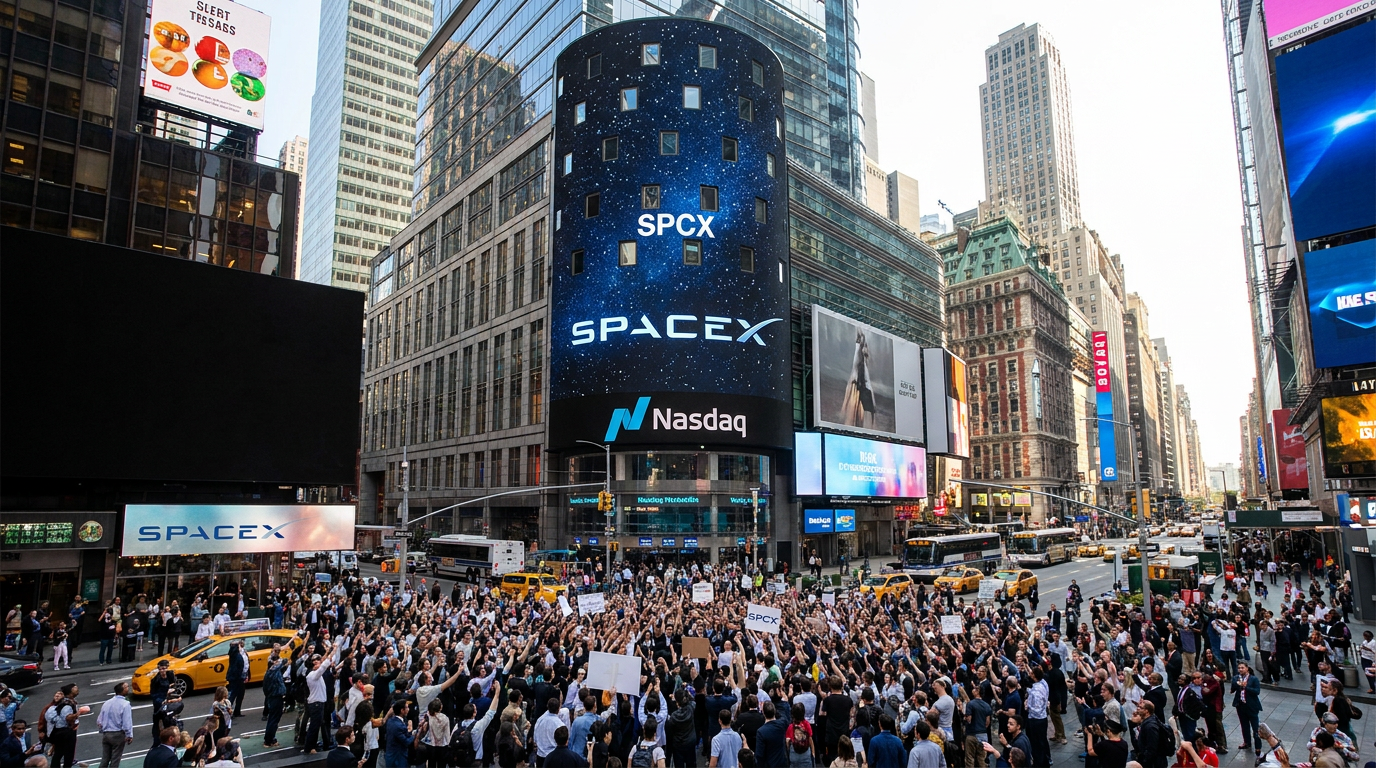
On the morning of June 12, 2026, the commercial space age entered a new financial stratosphere. To the tune of Elton John's "Rocket Man," SpaceX executives rang the opening bell at the Nasdaq, marking the largest initial public offering in history. Trading under the ticker symbol SPCX, the aerospace giant debuted with a fixed share price of $135, successfully raising an unprecedented $75 billion in capital. The sheer scale of the offering immediately reshaped the American stock market, cementing SpaceX's transition from a disruptive startup to a foundational pillar of the global economy.[2][4]
The market's reaction was swift and euphoric. Public trading commenced just before noon with shares opening at $150, well above the pre-open price. By the closing bell, the stock had surged nearly 20% to settle just above $161. This first-day pop catapulted SpaceX's market capitalization past the $2 trillion mark, making it the seventh-largest company in the world—eclipsing legacy titans like Saudi Aramco and even Elon Musk's other flagship enterprise, Tesla.[1][2][3]
The historic listing triggered a massive, instantaneous wealth transfer. The IPO officially minted Elon Musk as the world's first trillionaire, with his net worth estimated at $1.1 trillion due to his vast holdings of Class B shares. Beyond the chief executive, the public offering transformed the financial realities of the company's workforce. More than 4,400 current and former SpaceX employees became millionaires overnight, with roughly 400 individuals securing stakes worth $100 million or more.[1][2][3]
But how does a rocket manufacturer justify a $2 trillion valuation, especially one that reported a $4.9 billion net loss in 2025? The answer lies in the company's S-1 filing, which revealed that SpaceX is no longer just a launch provider. It has evolved into a three-pillar conglomerate: the Starlink satellite internet monopoly, the Starship deep-space architecture, and the newly integrated artificial intelligence division following its all-stock merger with xAI.[1][5]

The immediate economic engine driving the valuation is Starlink. What began as a beta program in 2021 has exploded into a global telecommunications juggernaut. By March 2026, Starlink boasted 10.3 million active subscribers across more than 155 countries. This rapid adoption curve translated to $11.4 billion in revenue in 2025, representing a 50% year-over-year growth rate.[5]
Starlink's physical infrastructure is equally staggering. SpaceX now operates over 10,000 satellites in low-Earth orbit, accounting for roughly two-thirds of all active satellites globally. With the upcoming deployment of larger V3 satellites and direct-to-cell technology designed to eliminate mobile dead zones worldwide, investors are pricing in a future where SpaceX controls the backbone of global internet routing.[5][6]

Yet, Starlink is only the cash-flow mechanism for SpaceX's ultimate ambition: Starship. Described by industry analysts as a "Trillion-Dollar Option," Starship is the fully reusable, super-heavy lift vehicle designed to make humanity multiplanetary. The market's $2 trillion valuation includes a massive speculative premium betting that Starship will successfully unlock the solar system for commercial and scientific exploitation.[2][5]
Yet, Starlink is only the cash-flow mechanism for SpaceX's ultimate ambition: Starship.
Starship's most immediate and high-stakes test is NASA's Artemis program. SpaceX holds the primary contract for the Human Landing System (HLS), tasked with returning American astronauts to the lunar surface. However, getting a vehicle as massive as Starship to the Moon requires solving one of the most complex engineering challenges in aerospace history: orbital refueling.[5]
Because Starship burns the vast majority of its propellant just reaching Earth orbit, it cannot proceed to the Moon without filling its tanks in space. This requires launching multiple "tanker" Starships to rendezvous and dock with a primary vessel, transferring thousands of tons of cryogenic liquid oxygen and liquid methane in the vacuum of space. While SpaceX has demonstrated small-scale internal transfers, large-scale ship-to-ship refueling remains entirely unproven.[5][6]
The physics of orbital refueling are notoriously unforgiving. In microgravity, cryogenic fuels do not settle neatly at the bottom of a tank; instead, they form unpredictable, floating blobs. To transfer the liquid, the docked ships must apply a continuous "settling thrust"—a tiny amount of acceleration to push the fuel to the pumps. Furthermore, the system must manage "boil-off," the rapid vaporization of super-chilled liquids when exposed to the thermal radiation of the sun.[5]

SpaceX is racing to demonstrate this critical capability. The company plans to conduct its first large-scale ship-to-ship propellant transfer test in Earth orbit using its upgraded Starship V3 architecture later in 2026. Success in this test is the absolute linchpin for the Artemis III mission and any future Mars expeditions. Failure, or significant delays, could severely compress the speculative premium currently buoying the company's stock.[5][6]
Adding fuel to the valuation fire is SpaceX's third pillar: artificial intelligence. In early 2026, the company finalized a merger with xAI, signaling a strategic pivot toward "orbital intelligence." By integrating advanced AI models with Starlink's global data network and Starship's heavy-lift capabilities, SpaceX aims to build space-based data centers, capturing a slice of the multi-trillion-dollar AI infrastructure market.[1][5]
Despite the historic IPO, significant risks loom on the horizon. The Artemis timeline is under severe pressure. In early 2026, NASA publicly acknowledged that SpaceX was behind schedule, prompting the agency to reframe Artemis III as an Earth-orbit rendezvous mission rather than a guaranteed lunar landing. NASA has also begun hedging its bets, opening lunar lander contracts to competitors like Blue Origin to mitigate the risk of Starship delays.[5]

Economists are also raising alarms about the broader societal implications of the IPO. The sudden consolidation of capital—minting a trillionaire and tying a massive portion of the stock market's growth to a single aerospace firm—introduces unprecedented systemic risk. If Starship's orbital refueling tests fail, or if the xAI integration stumbles, the resulting market correction could be violent.[2][5]
For now, however, Wall Street has fully bought into Elon Musk's vision. The $75 billion raised provides SpaceX with an almost insurmountable capital moat, ensuring it has the runway to iterate, fail, and rebuild as it pushes toward the Moon and Mars.[1][3]
The June 2026 IPO will be remembered as the moment the commercial space age matured from a speculative venture into a dominant macroeconomic force. By pricing the future of interplanetary transport and orbital internet at $2 trillion, the market has declared that the final frontier is officially open for business.[2][3]
How we got here
May 2026
SpaceX files its S-1 paperwork with the SEC, revealing plans to go public and detailing its xAI merger.
June 11, 2026
SpaceX finalizes its IPO price at a fixed $135 per share, locking in a $75 billion capital raise.
June 12, 2026
SpaceX debuts on the Nasdaq under the ticker SPCX, with shares surging 19% to push the company's valuation past $2 trillion.
Late 2026
SpaceX is targeted to conduct its first large-scale ship-to-ship orbital refueling test with Starship V3.
Viewpoints in depth
Bullish Investors
Believes the $2 trillion valuation is justified by SpaceX's monopolistic lead in launch and satellite internet.
Proponents argue that SpaceX is no longer just a rocket company, but the foundational infrastructure for the next century of human progress. By combining the cash-flow engine of Starlink with the transformative potential of xAI and Starship, they see a conglomerate that will dominate space-based data centers, global telecommunications, and interplanetary transport. The $75 billion raised provides an insurmountable capital moat against legacy aerospace competitors.
Aerospace Realists
Focuses on the massive technical hurdles still standing between Starship's current state and its lunar ambitions.
Industry analysts caution that the market is pricing in a flawless execution of Starship, which remains a highly experimental vehicle. The critical path to the Moon requires mastering cryogenic orbital refueling—a feat never before achieved at scale. With NASA already hedging its bets by bringing Blue Origin into the Artemis architecture, realists warn that any significant failure in the upcoming ship-to-ship transfer tests could violently compress the stock's speculative premium.
Market Skeptics
Highlights the financial risks of a $2 trillion valuation for a company still operating at a multi-billion dollar net loss.
Financial skeptics point to the company's $4.9 billion net loss in 2025 as evidence that the valuation is detached from traditional fundamentals. Furthermore, economists warn about the societal implications of such extreme wealth concentration, noting that the IPO instantly minted a trillionaire and thousands of centimillionaires. They argue that tying so much of the US stock market's growth to a single, highly volatile aerospace and AI venture introduces systemic risk.
What we don't know
- Whether SpaceX can successfully demonstrate large-scale cryogenic orbital refueling in microgravity by the end of 2026.
- How the integration of xAI into SpaceX's hardware will materialize into actual space-based data centers.
- If the Artemis III lunar landing timeline will hold, or if NASA will fully pivot to an Earth-orbit rendezvous.
Key terms
- Orbital Refueling
- The transfer of liquid propellants between spacecraft in microgravity, essential for deep-space missions that require more fuel than a single launch can provide.
- Cryogenic Propellants
- Gases like oxygen and methane that are chilled to extremely low temperatures to remain liquid, making them dense enough to use as rocket fuel.
- Settling Thrust
- A small amount of acceleration applied to a spacecraft in microgravity to push floating liquid propellants to the bottom of their tanks, allowing them to be pumped.
- Boil-off
- The process where cryogenic liquids slowly warm up and turn back into gas, which must be vented to prevent tanks from overpressurizing in space.
- Human Landing System (HLS)
- The spacecraft designed to carry astronauts from lunar orbit down to the surface of the Moon; SpaceX's Starship is contracted for NASA's Artemis III mission.
Frequently asked
What was the SpaceX IPO price?
SpaceX priced its initial public offering at a fixed $135 per share, raising $75 billion. The stock quickly jumped on its first day of trading, closing near $161.
What is orbital refueling?
Orbital refueling is the process of transferring cryogenic propellants (like liquid oxygen and methane) between two spacecraft in orbit. It is a critical, yet unproven, technology required for Starship to reach the Moon and Mars.
Why did SpaceX merge with xAI?
In early 2026, SpaceX completed an all-stock merger with Elon Musk's artificial intelligence startup, xAI. The move aims to integrate advanced AI into SpaceX's operations and develop space-based data centers.
How many subscribers does Starlink have?
As of March 2026, Starlink reported having 10.3 million active subscribers across more than 155 countries, generating over $11 billion in annual revenue.
Sources
Source coverage
6 outlets
3 viewpoints surfaced






[1]ForbesBullish Investors
SpaceX IPO Shatters Records, Making Elon Musk World's First Trillionaire
Read on Forbes →[2]The GuardianMarket Skeptics
SpaceX makes biggest stock market debut in history
Read on The Guardian →[3]ZacksBullish Investors
SpaceX IPO Breaks Records, Valuing Company at $1.77 Trillion
Read on Zacks →[4]TechCrunchBullish Investors
TechCrunch Mobility: SpaceX rockets past Tesla
Read on TechCrunch →[5]SubstackAerospace Realists
The Trillion-Dollar Option: Deconstructing the SpaceX IPO
Read on Substack →[6]SpaceXAerospace Realists
Starship V3 and the Future of Interplanetary Flight
Read on SpaceX →

More in technology
See all 5 stories →

Every angle. Every day.
Get technology stories with full source coverage and perspective breakdowns delivered to your inbox.