
SpaceX and OpenAI End Wall Street's Era of Stock Scarcity With Historic IPO Wave
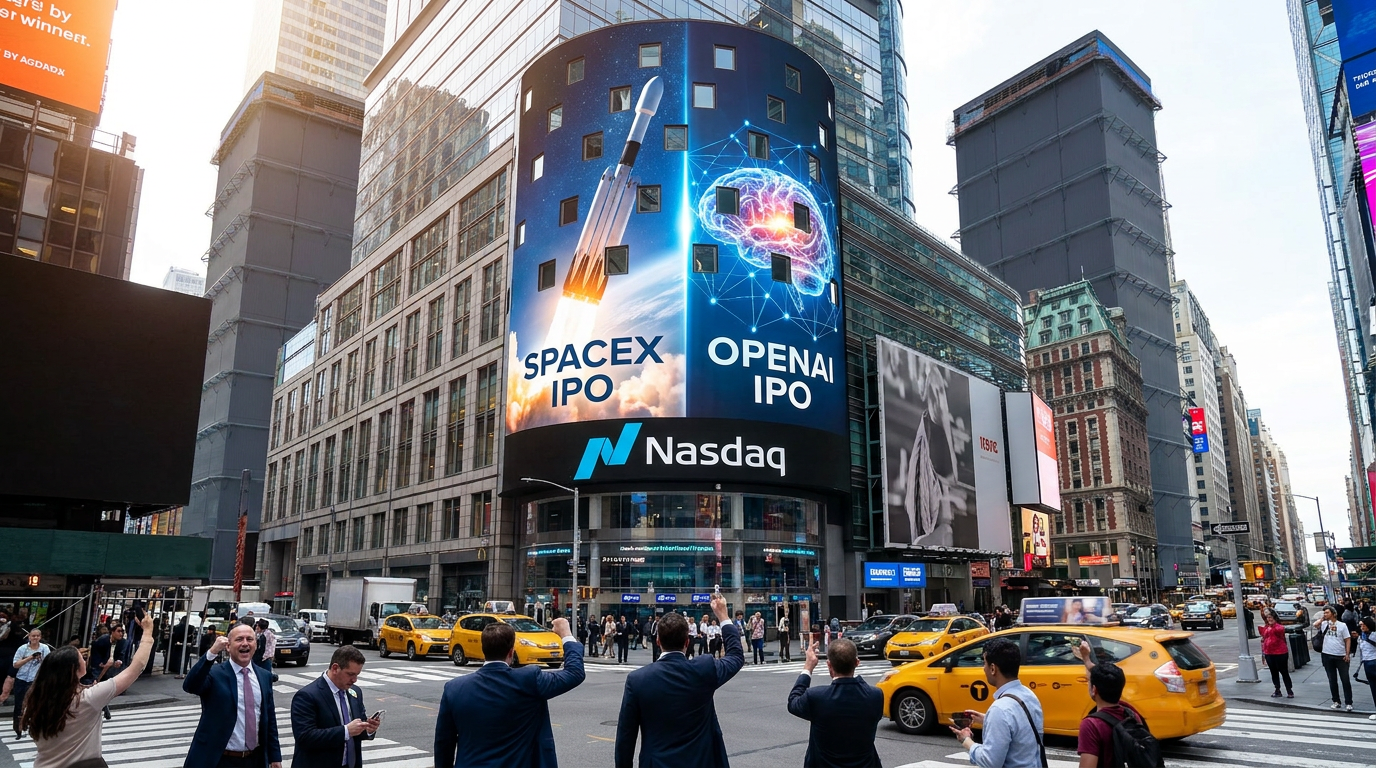
SpaceX's record-shattering $75 billion market debut and OpenAI's confidential IPO filing are poised to inject nearly $3 trillion into public equities, giving everyday investors access to the tech industry's steepest growth curves.
By Factlen Editorial Team
- Public Market Optimists
- Investors who view the mega-IPOs as a democratization of tech wealth.
- Valuation Skeptics
- Analysts warning about the risks of trillion-dollar valuations for unprofitable companies.
- Tech Industry Leaders
- Executives who see public markets as the only viable funding source for AGI.
What's not represented
- · Retail Investors
- · Venture Capitalists
Why this matters
For over a decade, the most explosive growth in the technology sector was gatekept by private venture capital, locking everyday investors out of the gains. The public debuts of SpaceX, OpenAI, and Anthropic fundamentally democratize access to the defining companies of the AI and space age, while injecting nearly $3 trillion of fresh opportunity into retirement accounts and public index funds.
Key points
- SpaceX executed the largest IPO in history on June 12, raising $75 billion and reaching a $2.1 trillion valuation.
- OpenAI and Anthropic have both confidentially filed for their own public listings, expected later this year.
- The three companies combined could add nearly $3 trillion in new market capitalization to public equities.
- The listings end an era of 'stock scarcity,' allowing retail investors direct access to high-growth AI and space ventures.
- Analysts warn that the AI companies' massive compute costs and lack of profitability could introduce volatility to index funds.
The era of the shrinking stock market is officially over. In a historic week for Wall Street, the defining companies of the current technology cycle moved decisively into the public markets, ending a long drought of stock scarcity that had frustrated public investors.[1][5]
On Friday, Elon Musk's SpaceX executed the largest initial public offering in history, debuting on the Nasdaq under the ticker symbol SPCX.[2][5]
The rocket and satellite internet giant raised a staggering $75 billion, blowing past previous records like Saudi Aramco's $29.4 billion listing in 2019. The company offered an unusual accept-it-or-leave-it share price of $135 before trading began, which was reportedly up to four times oversubscribed by eager institutional and retail buyers.[2][5]
When the opening bell rang, shares opened at $150 and surged 19% to close at $160, cementing a historic $2.1 trillion valuation. The massive debut officially made Musk, who commands roughly 85% of SpaceX's voting shares, the world's first trillionaire.[2][4]

But SpaceX is not arriving on Wall Street alone. Just days earlier, ChatGPT maker OpenAI announced it had confidentially filed an S-1 prospectus with the U.S. Securities and Exchange Commission, signaling its own imminent market debut.[3][8]
OpenAI, which was last valued at $852 billion in private markets following a massive funding round, expects to go public later this year or early 2027. "We have not decided on timing yet; it may be a while because there are things we want to do that are likely easier as a private company," the company noted in a public statement acknowledging the filing.[3][7]
OpenAI, which was last valued at $852 billion in private markets following a massive funding round, expects to go public later this year or early 2027.
OpenAI's chief rival, Anthropic, also confidentially filed for an IPO on June 1, setting up a powerhouse trio of artificial intelligence and space technology listings that will define the financial year.[3][8]
Together, these three companies are poised to inject nearly $3 trillion in new market capitalization into public equities within a matter of months. This influx represents more capital than all U.S. listings combined since 2022, fundamentally expanding the footprint of the stock market.[5][6]

For years, everyday investors have been locked out of the steepest growth curves of the tech industry, as companies stayed private longer and relied on venture capital to fund their expansion. This wave of mega-listings fundamentally shifts that dynamic, giving retail investors and public pension funds direct access to the AI boom and the commercial space economy.[1][4]
The sheer scale of the offerings is testing Wall Street's infrastructure. Market makers spent weeks preparing for the SpaceX debut to avoid the technical glitches that marred previous high-profile IPOs, successfully processing unprecedented order volumes without major disruptions.[2]
The flawless execution of the SpaceX listing has bolstered confidence that the market can absorb OpenAI and Anthropic without blinking. However, the transition from private hype to public scrutiny brings new challenges for the AI giants.[5]
OpenAI and Anthropic are currently burning billions on compute infrastructure, with OpenAI reporting significant operating losses as it chases artificial general intelligence. Public market investors will now have to weigh the massive revenue momentum of these AI models against their steep path to profitability.[4][7]

OpenAI's Chief Financial Officer Sarah Friar recently noted that the company is already acting with the "good hygiene" of a public firm, emphasizing that public markets offer the vast capital required to maintain a competitive advantage in AI compute.[8]
Ultimately, the arrival of these generational companies on public exchanges marks a credentializing moment for the AI and space sectors. They are transforming from Silicon Valley experiments into the foundational pillars of the modern stock market, offering a new era of opportunity for public equities.[1][6][8]
How we got here
March 2026
OpenAI closes a private funding round valuing the company at $852 billion.
June 1, 2026
AI startup Anthropic confidentially files for an initial public offering.
June 8, 2026
OpenAI announces it has confidentially submitted an S-1 filing to the SEC.
June 12, 2026
SpaceX debuts on the Nasdaq, raising $75 billion and reaching a $2.1 trillion valuation on its first day.
Viewpoints in depth
Public Market Optimists
Investors who view the mega-IPOs as a democratization of tech wealth.
For years, the most lucrative gains in the technology sector were captured by venture capitalists and private equity firms while companies stayed private for a decade or more. Optimists argue that the public debuts of SpaceX, OpenAI, and Anthropic finally reverse this trend. By injecting nearly $3 trillion in fresh market capitalization into public equities, these listings allow retail investors, index funds, and public pensions to participate directly in the explosive growth of artificial intelligence and the commercial space economy. Proponents see this as a structural expansion of the stock market that will drive broad-based wealth creation.
Valuation Skeptics
Analysts warning about the risks of trillion-dollar valuations for unprofitable companies.
While the sheer scale of the IPOs is historic, skeptics urge caution regarding the underlying financials. OpenAI and Anthropic are currently burning billions of dollars annually on compute infrastructure and data centers, with OpenAI reporting operating margins as low as negative 122%. Furthermore, analysts point out that SpaceX's $2.1 trillion valuation is heavily tied to the personal brand and control of Elon Musk, who holds 85% of the voting shares. Skeptics warn that once these companies are absorbed into major index funds, everyday retirement accounts could be exposed to extreme volatility if the AI hype cycle cools or if the companies fail to chart a clear path to profitability.
Tech Industry Leaders
Executives who see public markets as the only viable funding source for AGI.
For the leadership teams at OpenAI and Anthropic, going public is less about cashing out and more about securing the staggering amounts of capital required to train next-generation AI models. OpenAI executives have explicitly stated that public markets are vastly larger than private markets, providing the necessary liquidity to maintain a competitive advantage in the race toward artificial general intelligence (AGI). Industry leaders view the transition to public benefit corporations and the subsequent IPOs as a credentializing moment—subjecting their balance sheets to SEC oversight while securing the war chests needed to build out global AI infrastructure.
What we don't know
- When exactly OpenAI and Anthropic will begin trading, as their confidential filings leave the exact IPO dates open to market conditions.
- How quickly these mega-cap tech stocks will be integrated into major index funds like the S&P 500, which dictates passive investment flows.
- Whether OpenAI and Anthropic can achieve profitability before public market investors lose patience with their massive infrastructure spending.
Key terms
- Initial Public Offering (IPO)
- The process by which a private company offers shares of its stock to the public for the first time.
- S-1 Prospectus
- A registration document required by the SEC that provides details about a company's business operations and financials before it goes public.
- Market Capitalization
- The total dollar market value of a company's outstanding shares of stock, calculated by multiplying the current share price by the total number of shares.
- Free Float
- The portion of a company's shares that are in the hands of public investors and available to be traded on the open market.
Frequently asked
When did SpaceX go public?
SpaceX officially began trading on the Nasdaq on Friday, June 12, 2026, under the ticker symbol SPCX.
Is OpenAI a publicly traded company yet?
Not yet. OpenAI confidentially filed its preliminary IPO paperwork with the SEC on June 8, 2026, but has not set an official date for its trading debut.
How much did SpaceX raise in its IPO?
SpaceX raised $75 billion, making it the largest initial public offering in history, far surpassing Saudi Aramco's previous record.
Why are these IPOs significant for regular investors?
For years, high-growth tech companies stayed private, limiting access to venture capitalists. These listings allow everyday investors to buy shares in the leading AI and space companies.
Sources
Source coverage
8 outlets
3 viewpoints surfaced








[1]BloombergPublic Market Optimists
SpaceX and OpenAI Are Ending Wall Street's Era of Stock Scarcity
Read on Bloomberg →[2]The GuardianValuation Skeptics
SpaceX makes biggest stock market debut in history, minting Musk as first trillionaire
Read on The Guardian →[3]PBSTech Industry Leaders
OpenAI files preliminary SEC paperwork for IPO, opening the door to a Wall Street debut
Read on PBS →[4]The Motley FoolPublic Market Optimists
SpaceX, Anthropic, or OpenAI: Which IPO Is the Better Buy?
Read on The Motley Fool →[5]Investing.comValuation Skeptics
The $3 Trillion Test: SpaceX, OpenAI and the IPO Wave That Will Price the AI Boom
Read on Investing.com →[6]IGPublic Market Optimists
SpaceX, OpenAI, Anthropic and more: 2026's IPO deals reshaping markets
Read on IG →[7]CBCTech Industry Leaders
ChatGPT maker OpenAI files preliminary paperwork for IPO
Read on CBC →[8]Los Angeles TimesTech Industry Leaders
ChatGPT maker OpenAI filed preliminary paperwork for IPO
Read on Los Angeles Times →

Every angle. Every day.
Get business stories with full source coverage and perspective breakdowns delivered to your inbox.