
Solid-State EV Batteries Move From Lab to Public Roads in 2026
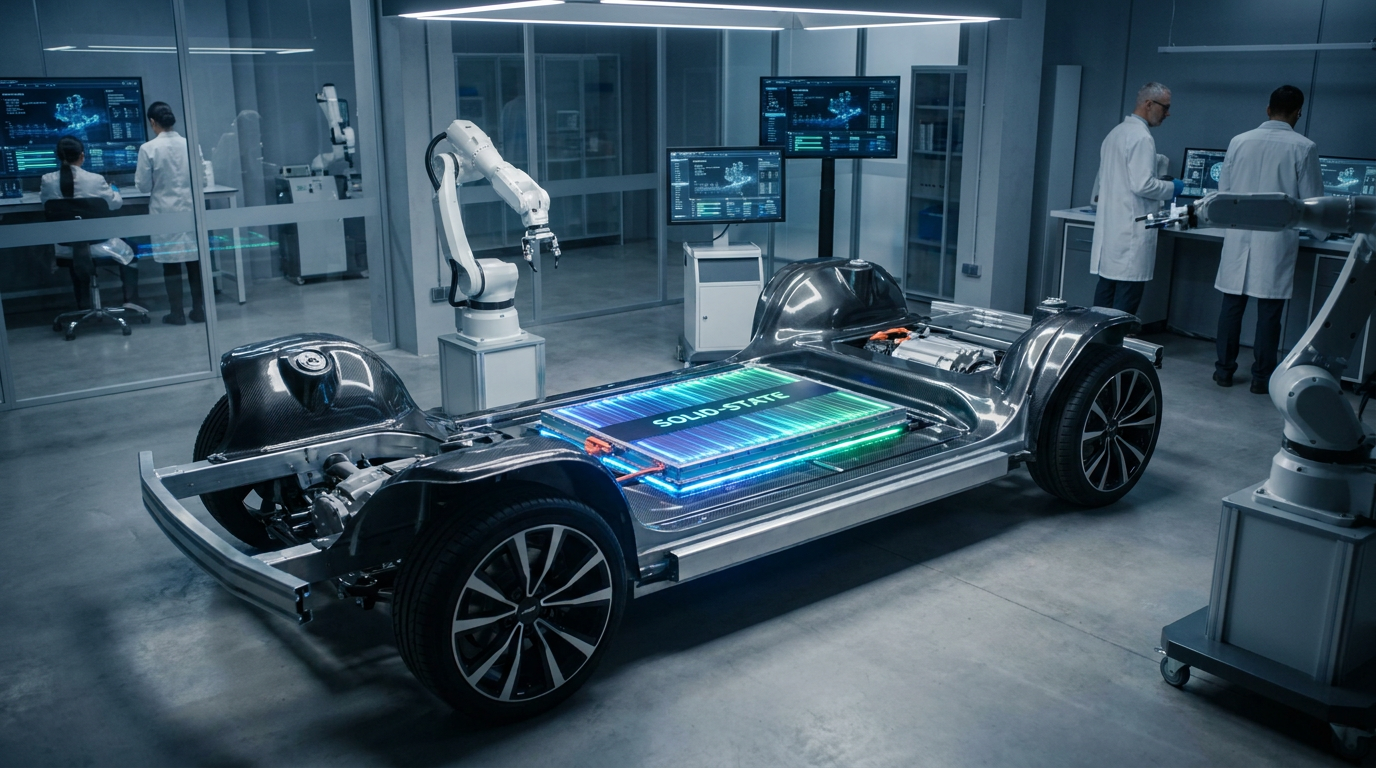
After years of development, next-generation solid-state and semi-solid batteries are finally powering real-world electric vehicles, promising 600-mile ranges and 15-minute charge times.
By Factlen Editorial Team
- Battery Innovators
- Focus on the massive leaps in energy density, rapid charging times, and the successful transition from lab chemistry to road-ready prototypes.
- Manufacturing Realists
- Emphasize the severe challenges of scaling production, noting that early 2026 deployments are largely 'semi-solid' compromises rather than pure solid-state.
- Automotive Strategists
- View solid-state as a long-term play, planning to introduce the technology in premium luxury vehicles first to absorb the high initial manufacturing costs.
What's not represented
- · Raw Material Miners
- · EV Consumers
Why this matters
Solid-state batteries eliminate the three biggest hurdles to electric vehicle adoption: range anxiety, long charging times, and fire risks. As this technology scales, EVs will become capable of driving further and charging faster than traditional gas-powered cars.
Key points
- Stellantis and Factorial Energy have begun road-testing solid-state EV batteries in North America.
- Solid-state technology replaces flammable liquid electrolytes with stable solid materials, enabling pure lithium-metal anodes.
- The new chemistry promises to deliver over 600 miles of range and charge from 10% to 80% in roughly 12 minutes.
- Many 2026 deployments are actually 'semi-solid' batteries, a manufacturing compromise that retains a small amount of liquid to speed up commercialization.
For over a decade, the electric vehicle industry has chased a singular "holy grail": the solid-state battery. Promised as the revolutionary technology that would finally cure range anxiety, slash charging times to the length of a coffee break, and eliminate the risk of battery fires, it has perpetually felt five years away. But in the summer of 2026, the narrative is definitively shifting from laboratory hype to asphalt reality. Across the globe, major automakers and battery startups are crossing critical milestones, moving next-generation chemistry out of controlled testing environments and into real-world vehicles.[8]
In June 2026, Stellantis and US-based Factorial Energy began road-testing a Dodge Charger Daytona development vehicle across North America. This marked the first time advanced solid-state cells have been integrated into a drivable electric vehicle on the continent, signaling a massive leap in commercial viability. Moving the technology from a pristine lab environment into a heavy, high-performance vehicle required advanced engineering solutions to optimize the battery pack's control systems and thermal management under real-world stress. The road tests are designed to validate the battery's durability across varying climates and driving conditions, proving that the chemistry can survive the daily abuse of consumer driving.[1]
Days later, Japanese automaker Honda cemented a multi-year joint research agreement with QuantumScape, moving the battery developer's technology out of the benchmarking phase and into pilot production. Honda, which had already begun pilot production of its own solid-state designs at its Sakura plant in early 2025, evaluated QuantumScape's platform through an in-depth, hands-on technical study. The successful completion of these rigorous tests gave Honda the confidence to integrate the technology into its future roadmap, which spans not just passenger cars, but motorcycles and power equipment.[2]
To understand why the automotive world is pouring billions of dollars into this specific transition, one must look inside the microscopic architecture of the cell. Traditional lithium-ion batteries rely on a liquid electrolyte—a chemical solvent that shuttles lithium ions back and forth between the anode and cathode during charging and discharging. While this liquid is highly effective at conducting ions, it is also highly flammable and fundamentally limits how much energy the battery can safely store before risking thermal runaway.[3]

Solid-state batteries replace this volatile liquid solvent with a stable, non-flammable solid material, such as advanced ceramics, polymers, or sulfides. This single material substitution unlocks a cascade of engineering advantages, fundamentally altering the physics and safety profile of energy storage. By eliminating the flammable components, the battery can operate safely at much higher temperatures, drastically reducing the need for heavy, complex liquid cooling systems that weigh down modern electric vehicles. This inherent thermal stability means that even in the event of a severe crash or puncture, the battery is highly unlikely to catch fire.[3]
The most critical breakthrough enabled by the solid electrolyte is the ability to use a pure lithium-metal anode. In conventional liquid batteries, using pure lithium tends to form 'dendrites'—microscopic, needle-like metallic growths that slowly pierce the battery's internal separator over repeated charge cycles, eventually causing catastrophic short circuits. A solid electrolyte acts as a rigid physical barrier, suppressing dendrite growth and allowing engineers to safely harness lithium metal. Because pure lithium is incredibly energy-dense, this allows the battery to store significantly more power in a much smaller physical footprint.[2][3]
The resulting performance gains are staggering, pushing electric vehicles past the capabilities of internal combustion engines. Factorial's FEST (Factorial Electrolyte System Technology) cells, currently powering the Stellantis test vehicles, have been validated at an energy density of 375 watt-hours per kilogram (Wh/kg). For the consumer, this translates to a projected driving range of over 600 miles on a single charge, effectively eliminating the range anxiety that has historically deterred buyers from transitioning to electric mobility. Furthermore, these cells maintain their performance in extreme temperatures ranging from -22°F to 113°F, solving the notorious cold-weather range drop that plagues current lithium-ion cars.[1]
The resulting performance gains are staggering, pushing electric vehicles past the capabilities of internal combustion engines.
Charging speeds are equally transformative, addressing the second major hurdle of EV adoption. QuantumScape's QSE-5 cells, which are currently being evaluated by both Honda and Volkswagen, have demonstrated the ability to fast-charge from 10% to 80% capacity in just 12.2 minutes. By bringing the charging experience closer to the time it takes to fill a gas tank and grab a coffee, solid-state technology promises to make long-distance electric road trips seamless and dramatically reduce congestion at public charging stations.[2]

However, the 2026 solid-state landscape carries a crucial, often-misunderstood caveat. Manufacturing experts caution that many of the batteries hitting the road today are not true 'all-solid-state' systems, but rather 'semi-solid' or hybrid designs. While the marketing materials frequently tout the solid-state label, the reality of scaling up production has forced battery developers to embrace a transitional chemistry that bridges the gap between the laboratory and the assembly line. These hybrid cells represent a massive leap forward in safety and density, but they are a pragmatic compromise rather than the final destination.[4]
Scaling up the production of true, 100% solid-state cells requires entirely new manufacturing infrastructure. Building these batteries demands ultra-dry cleanroom chambers and heavy structural presses to ensure the solid materials maintain perfect, microscopic contact as they expand and contract during use. If the solid layers separate even slightly, the battery's performance plummets. Transitioning the global battery supply chain to this new manufacturing paradigm is an incredibly capital-intensive process that will take years to fully realize. The challenge is no longer discovering the right chemistry, but inventing the machines capable of building millions of flawless cells at high speed.[3][4]
To bypass this immediate manufacturing bottleneck, companies are deploying semi-solid batteries that retain a small fraction of liquid electrolyte—typically between 5% and 15% by weight. This small amount of liquid acts as a chemical bridge, ensuring good contact between the internal layers without requiring extreme manufacturing pressures. Crucially, this allows manufacturers to use existing lithium-ion assembly lines with only a 10% to 15% equipment upgrade cost, bringing the next-generation technology to market years faster than a pure solid-state approach would allow.[4]
Industry analysts note that while solid-state batteries represent a higher energy density ceiling and a fundamentally different failure-physics regime, achieving these advantages at scale requires solving mechanical and interfacial challenges that are still actively being engineered. The semi-solid compromise delivers roughly a 50% improvement in thermal safety margins and easily passes strict zero-thermal-propagation tests, making it the most viable and scalable solution ready for vehicle deployment in 2026. It is a necessary stepping stone that allows automakers to deliver better vehicles today while funding the research required for tomorrow's pure solid-state breakthroughs.[3]

Because of these ongoing manufacturing hurdles, true 0% liquid all-solid-state batteries currently carry a massive production cost premium. Consequently, conservative automakers like Toyota are targeting the 2027 to 2028 timeframe for their first commercial solid-state vehicles. When these true solid-state models do arrive, they will likely debut under premium luxury brands, such as Lexus, where higher vehicle pricing can absorb the early battery costs before economies of scale eventually bring the technology to mass-market models. Toyota's internal roadmap projects that production will scale to over a million solid-state vehicles annually by the end of the decade.[7]
While passenger cars dominate the headlines, the high energy density and lightweight nature of solid-state chemistry are unlocking entirely new modes of transportation. In early 2026, Donut Lab unveiled an all-solid-state battery designed specifically for Verge Motorcycles, boasting 400 Wh/kg and a five-minute recharge time. Because motorcycles have incredibly limited physical space for battery packs, the volumetric efficiency of solid-state cells is a game-changer for the two-wheeled EV market. The Verge TS Pro and TS Ultra models are scheduled to reach customers with these advanced packs, proving that the technology can survive the exposed, high-vibration environment of a motorcycle.[6]
The technology is even taking to the skies. Recent tests in modified motorized gliders utilized solid-state packs achieving 410 Wh/kg, allowing the aircraft to reach altitudes of 24,000 feet. While commercial electric flight remains a distant goal, the drastic weight savings provided by solid-state chemistry are an absolute prerequisite for decarbonizing the aviation industry. Traditional lithium-ion batteries are simply too heavy to lift themselves and a commercial payload off the ground efficiently. By nearly doubling the energy density, solid-state cells provide the first realistic pathway toward electric regional flights and advanced air mobility networks.[5]

The transition unfolding in 2026 mirrors the early days of the lithium-ion revolution. The technology has definitively left the laboratory, and the race is no longer about proving the chemistry works, but about mastering the brutal economics of mass production. Companies that can successfully navigate the junction between advanced materials science and high-yield manufacturing will dictate the future of global transportation for the next half-century. The geopolitical stakes are equally high, with European, American, and Asian manufacturers racing to secure the intellectual property and supply chains required to dominate this new era of energy storage.[3][6]
As semi-solid stepping stones normalize 600-mile ranges and 15-minute charge times, consumer expectations will permanently shift, making the compromises of early electric vehicles a thing of the past. The true all-solid-state era may not fully arrive until the early 2030s, but the vehicles testing on public roads today prove that the ultimate battery breakthrough is finally within reach. The internal combustion engine's long reign is facing its most formidable technological challenger yet. For drivers, the promise of an electric vehicle that charges as fast as a gas car and drives further on a single charge is no longer a distant dream—it is rolling off the assembly line.[1][4][8]
How we got here
Early 2024
Volkswagen confirms QuantumScape's solid-state cells retain 95% capacity after 1,000 charge cycles in lab tests.
Jan 2025
Honda begins pilot production of solid-state batteries at its Sakura plant in Japan.
Early 2026
Donut Lab unveils an all-solid-state battery for Verge Motorcycles, marking one of the first commercial applications.
June 2026
Stellantis begins real-world road testing of Factorial's solid-state batteries in a Dodge Charger Daytona.
Viewpoints in depth
Battery Innovators
Startups and researchers focused on pushing the boundaries of chemistry and performance.
For battery developers like QuantumScape and Factorial, the narrative is entirely about the physics of the breakthrough. They point to validated testing data showing energy densities approaching 400 Wh/kg and charge times dropping near the 10-minute mark. To these innovators, the solid-state transition is the most significant leap in energy storage since the commercialization of the lithium-ion battery in the 1990s, fundamentally solving the range and charging anxieties that have held back global EV adoption.
Manufacturing Realists
Engineers and analysts focused on the brutal economics of scaling battery production.
Manufacturing experts warn that the hype surrounding solid-state batteries often ignores the reality of the factory floor. They argue that building a perfect cell in a laboratory is vastly different from producing millions of flawless cells at a gigafactory. Because true all-solid-state batteries require ultra-dry cleanrooms and immense structural pressure to manufacture, realists emphasize that the industry will rely heavily on 'semi-solid' hybrid batteries—which contain 5% to 15% liquid—for the remainder of the 2020s to keep costs manageable.
Automotive Strategists
Legacy automakers balancing the promise of new technology with the realities of consumer pricing.
Companies like Toyota and Honda view solid-state batteries as a long-term strategic advantage rather than an immediate mass-market solution. Because the early production costs of true solid-state cells are significantly higher than traditional lithium-ion, these automakers plan to introduce the technology in premium luxury vehicles first. By debuting solid-state batteries in high-margin brands like Lexus, they can absorb the initial financial hit while slowly building the economies of scale required to eventually bring the technology to affordable, everyday cars.
What we don't know
- Exactly how quickly the manufacturing costs of true 0% liquid solid-state batteries will fall to match current lithium-ion prices.
- How the solid-solid interfaces inside the batteries will hold up after a decade of real-world vibration and extreme weather exposure.
- Whether the supply chain for the specific solid electrolytes (like sulfides and advanced ceramics) can scale fast enough to meet global automotive demand.
Key terms
- Solid-State Battery
- A battery that uses a solid electrolyte instead of a liquid or polymer gel, improving safety and energy density.
- Electrolyte
- The medium that allows ions to flow between the cathode and anode during charging and discharging.
- Dendrites
- Microscopic, needle-like metallic structures that can grow inside lithium batteries, potentially causing short circuits and fires.
- Semi-Solid Battery
- A transitional battery design that uses a mostly solid framework but retains a small percentage of liquid electrolyte to aid in manufacturing.
- Energy Density (Wh/kg)
- A measure of how much energy a battery can store relative to its physical weight.
Frequently asked
Can I buy a car with a solid-state battery today?
Not quite yet. While test vehicles are on the road in 2026, the first commercial applications are expected in premium models around 2027 to 2028.
Why are solid-state batteries safer?
They replace the flammable liquid electrolyte found in traditional lithium-ion batteries with a stable solid material, drastically reducing the risk of fire or thermal runaway.
What is a semi-solid battery?
It is a transitional hybrid technology hitting the market in 2026 that uses a mostly solid structure but keeps a small amount of liquid electrolyte (5-15%) to make mass manufacturing easier and cheaper.
Sources
Source coverage
8 outlets
3 viewpoints surfaced








[1]ElectrekBattery Innovators
Factorial, Stellantis test solid-state EV batteries in real life
Read on Electrek →[2]EV Infrastructure NewsBattery Innovators
QuantumScape signs Honda as solid-state battery partner
Read on EV Infrastructure News →[3]BatteryTech OnlineManufacturing Realists
Lithium solid-state batteries promise higher energy density and safety, but manufacturing challenges delay commercialization
Read on BatteryTech Online →[4]Bonnen BatteriesManufacturing Realists
Don't Get Fooled by Solid-State Hype: In 2026, Only Semi-Solid Batteries Are Hitting the Road!
Read on Bonnen Batteries →[5]HackadayManufacturing Realists
Solid-State Batteries Take To The Sky
Read on Hackaday →[6]Engineer LiveBattery Innovators
Solid-state batteries are steadily transitioning from laboratory promise to transport-ready technology
Read on Engineer Live →[7]EV WorldAutomotive Strategists
Toyota's solid-state battery program is progressing steadily
Read on EV World →[8]Factlen Editorial TeamAutomotive Strategists
Synthesis by Factlen editorial team
Read on Factlen Editorial Team →

More in technology
See all 6 stories →Authentication Tech
The End of the Password: The Evidence Behind the Global Shift to Passkeys
8 sources

Right to Repair
Right to Repair Laws Take Effect Across the US, Saving Consumers Billions and Slashing E-Waste
7 sources
Digital Wellness
Why Consumers Are Ditching Smartwatches for Screen-Free Wearables
8 sources

RISC-V Adoption
How the Open-Source RISC-V Architecture Captured 25% of the Global Chip Market
6 sources

Every angle. Every day.
Get technology stories with full source coverage and perspective breakdowns delivered to your inbox.