
Rocket Lab Wins $397M Space Force Contract to Build and Launch SB-AMTI Satellite Fleet
The U.S. Space Force has awarded Rocket Lab a $397 million contract to design, build, launch, and operate a constellation of threat-tracking satellites. The agreement highlights a strategic military shift toward resilient orbital surveillance and validates the company's vertically integrated business model.
By Hao Li

- Space Force Acquisition Strategists
- Prioritizing vendor diversity and architectural resilience over reliance on single prime contractors.
- Aerospace Financial Analysts
- Weighing the massive revenue influx against the execution risks of unproven launch hardware.
- Defense Operations Planners
- Emphasizing the tactical necessity of moving critical sensor networks out of vulnerable airspace.
Common questions
What is the SB-AMTI program?
The Space-Based Airborne Moving Target Indicator is a U.S. Space Force initiative designed to track airborne threats in real time using a network of satellites, replacing vulnerable radar aircraft.
What are Flatellites?
Flatellites are Rocket Lab's next-generation spacecraft designed to pack flat and stack on top of one another inside a rocket fairing, allowing for the efficient deployment of large satellite constellations.
How much is the Rocket Lab contract worth?
The firm-fixed-price contract is valued at $397 million and covers the design, manufacturing, launch, and operation of the satellites.
What rocket will launch these satellites?
The satellites are slated to launch on Rocket Lab's upcoming Neutron medium-lift rocket, which is currently in development and expected to make its debut flight soon.
The short answer
- Rocket Lab secured a $397 million U.S. Space Force contract to design, build, launch, and operate a constellation of threat-tracking satellites.
- The award is part of the Space-Based Airborne Moving Target Indicator (SB-AMTI) program, which aims to replace vulnerable radar aircraft with resilient orbital networks.
- The satellites, dubbed 'Flatellites,' are designed to stack efficiently inside a rocket fairing and will utilize AI to filter tracking data.
- The Space Force distributed a total of $615 million across Rocket Lab, STR LLC, and an undisclosed third company to ensure vendor diversity.
- The execution of the contract relies heavily on the successful debut of Rocket Lab's upcoming Neutron medium-lift rocket.
When a commercial space company announces a major defense contract, the immediate assumption is often that it has secured a logistics deal—a straightforward agreement to ferry government hardware into orbit. But the U.S. Space Force's latest $397 million award to Rocket Lab fundamentally breaks that mold. The contract is not merely a launch agreement; it is an end-to-end infrastructure mandate. Under the Space-Based Airborne Moving Target Indicator (SB-AMTI) program, Rocket Lab will not just provide the ride. The company will design the spacecraft, manufacture them, launch them on its own upcoming Neutron rocket, and operate the resulting constellation from the ground.[1][3][5]
The award places Rocket Lab at the center of a profound architectural shift within the Pentagon. The $397 million firm-fixed-price contract tasks the company with deploying a fleet of next-generation "Flatellites"—spacecraft specifically optimized to stack efficiently inside a rocket fairing for large-scale constellation deployment. Once in orbit, these satellites will utilize advanced space-based sensors and low-latency, high-bandwidth communication links to detect and track airborne threats in real time. The resulting data will be fed directly to the Space Force, providing persistent surveillance over contested environments.[1][5][6]
This contract is part of a broader $615 million task order issued by the Space Systems Command under its Space-Based Sensing and Targeting portfolio. While Rocket Lab secured the largest disclosed portion, Systems & Technology Research (STR LLC) and an unnamed third company—kept confidential for operational security reasons—also received awards. This tranche of funding builds upon an earlier, massive rapid-acquisition task order awarded to SpaceX in June, which was valued at up to $4.16 billion. Together, these investments signal a rapid acceleration in the military's push to move critical tracking capabilities into orbit.[2]
To understand the significance of the SB-AMTI program, one must look at the vulnerabilities of the legacy systems it is designed to replace. For decades, the U.S. military has relied heavily on terrestrial radar and airborne sensor platforms—such as the E-3 Sentry Airborne Warning and Control System (AWACS) aircraft—to monitor moving targets in the air. These highly modified Boeing 707s, with their massive rotating radar domes, have served as the eyes of the fleet, coordinating air traffic and detecting incoming threats across vast theaters of operation.[1][5]
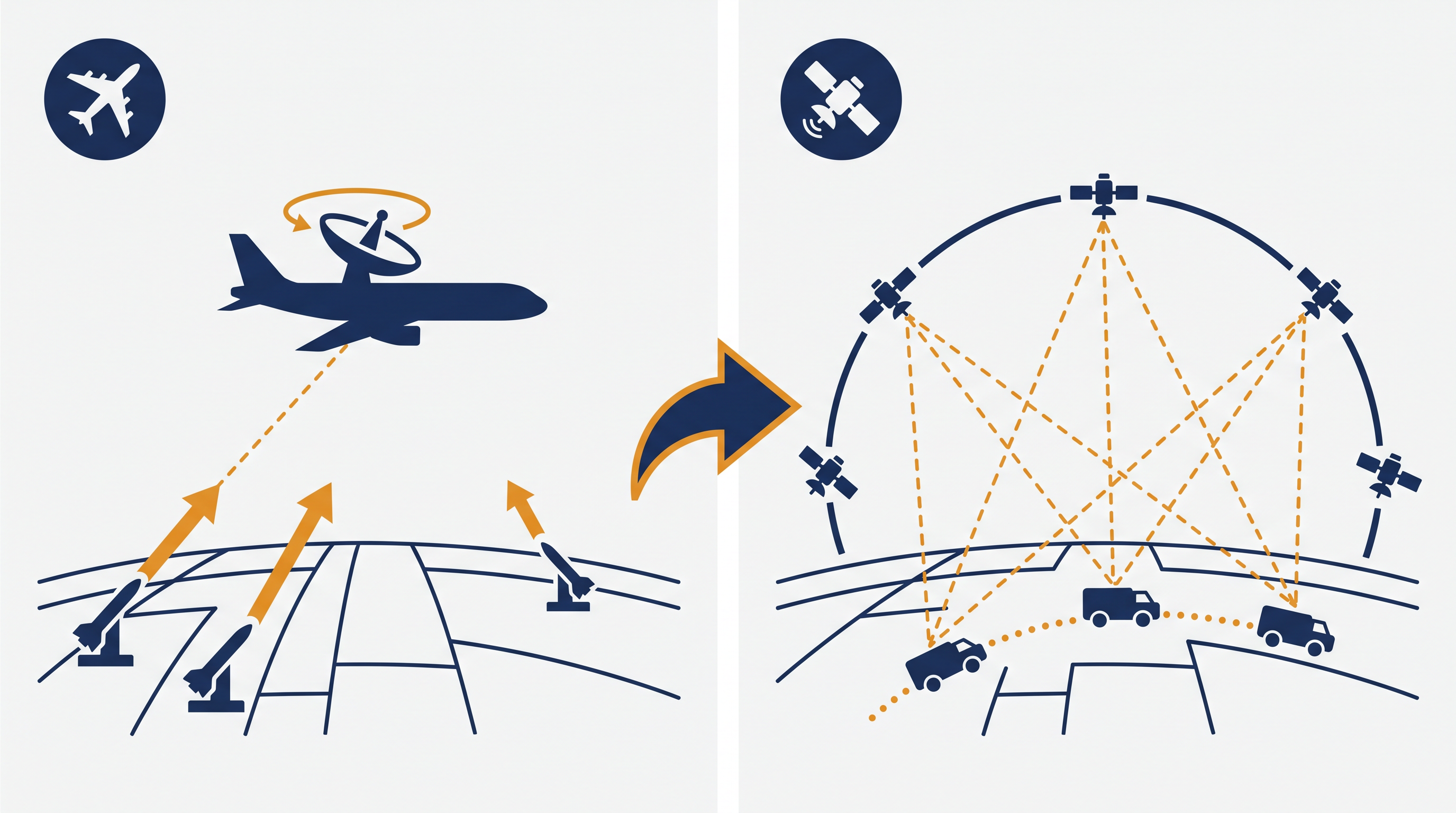
However, the modern battlefield has rendered these legacy aircraft increasingly vulnerable. In contested airspace, advanced anti-access and area-denial (A2/AD) systems, including long-range surface-to-air missiles and sophisticated electronic warfare capabilities, can push airborne sensor platforms hundreds of miles away from the front lines. If an AWACS aircraft cannot safely approach a hostile border, its radar cannot penetrate deep enough into enemy territory to track moving targets. This creates operational blind spots that adversaries can exploit.[3][5]
The SB-AMTI program solves this geometry problem by moving the sensors to the ultimate high ground: low Earth orbit. A resilient network of satellites can continuously pass over contested territory without the risk of being shot down by conventional anti-aircraft fire. By deploying a distributed constellation rather than relying on a handful of high-value aircraft, the Space Force ensures that even if one node is compromised or experiences a technical failure, the broader network continues to provide uninterrupted, real-time battlespace awareness to commanders on the ground.[3][5][7]
The SB-AMTI program solves this geometry problem by moving the sensors to the ultimate high ground: low Earth orbit.
Rocket Lab's specific technical approach relies on its newly unveiled "Flatellite" architecture. As the company's fifth spacecraft design, the Flatellite is purpose-built for high-performance sensing and telecommunications constellations. The flat-packed design allows multiple satellites to be stacked directly on top of one another inside the payload fairing of a launch vehicle. This maximizes the number of spacecraft that can be deployed in a single mission, drastically lowering the per-unit deployment cost and allowing the constellation to be populated rapidly.[1]
Hardware is only half of the SB-AMTI equation; the other half is data processing. A constellation of radar-equipped satellites generates an overwhelming volume of telemetry, capturing everything from commercial airliners to weather patterns and ground clutter. To make this data actionable, the architecture relies heavily on artificial intelligence. AI-driven ground processing systems will filter out the noise, identifying the specific signatures of moving airborne targets hidden within massive data streams, and delivering refined tracking intel to warfighters with minimal latency.[1][5]
For the Space Force, distributing these contracts across multiple commercial vendors is a deliberate strategic choice. Colonel Ryan Frazier, the acting Space Force portfolio acquisition executive for space-based sensing and targeting, noted that the core focus of this task order is diversifying capabilities to avoid reliance on a single technical solution. By funding different sensing approaches from companies like Rocket Lab, STR LLC, and SpaceX, the military is hedging its bets, ensuring that it fields the most robust and varied technology available while fostering a competitive industrial base.[2]
For Rocket Lab, the SB-AMTI award is a validation of its long-term corporate strategy. CEO Peter Beck has consistently pushed the company to evolve beyond its origins as a provider of small-lift launches for niche payloads. By vertically integrating—bringing satellite design, component manufacturing, launch services, and mission operations under one roof—Rocket Lab captures a much larger share of the space value chain. This end-to-end capability allows the company to bid on comprehensive defense programs that would traditionally require a consortium of legacy prime contractors.[1][5]
The financial momentum for the company is substantial. The $397 million SB-AMTI award arrived just eight days after Rocket Lab announced a separate $266 million contract with the Space Force's Rocket Systems Launch Program. That earlier deal covers at least 12 suborbital launches from a new facility in Kodiak, Alaska, utilizing the company's HASTE vehicle—a derivative of its proven Electron rocket. Together, these two contracts inject over $660 million into Rocket Lab's backlog, providing high-visibility defense revenue that smooths out the volatility of the commercial launch market.[1][4]
However, the SB-AMTI contract carries a significant execution dependency: the Neutron rocket. While the suborbital HASTE missions rely on hardware that is already flying successfully, the Flatellites are slated to launch on Neutron, Rocket Lab's upcoming medium-lift vehicle. Neutron is designed to compete directly with SpaceX's Falcon 9, but it has not yet completed its maiden flight, which is currently targeted for the end of the year. The timeline for deploying the Space Force constellation is therefore inextricably linked to the successful development and testing of a brand-new launch vehicle.[1][4]

Furthermore, the firm-fixed-price nature of the Other Transaction Authority (OTA) agreements shifts the financial risk of development onto the commercial vendors. Unlike traditional cost-plus defense contracts, where the government covers unexpected overruns, a fixed-price structure means that any delays in the Neutron program or technical hurdles in the Flatellite manufacturing process will directly impact Rocket Lab's bottom line. The company must execute flawlessly to realize the full margin of the $397 million award.[2][4]
Ultimately, the SB-AMTI program represents a maturation of the relationship between the Pentagon and the commercial space sector. The military is no longer just buying rockets; it is buying integrated, turnkey data architectures. As these constellations come online, they will fundamentally alter how the Joint Force monitors the globe, replacing the vulnerable, crewed radar planes of the Cold War era with autonomous, AI-filtered orbital networks that provide unblinking vigilance over the most contested airspace on Earth.[1][5]
Why it matters
This contract marks a fundamental shift in how the U.S. military monitors global threats, moving critical surveillance out of vulnerable aircraft and into resilient satellite networks. For the commercial space industry, it proves that vertically integrated companies can now capture end-to-end defense programs that were once the exclusive domain of legacy prime contractors.
Competing readings
Space Force Acquisition Strategists
Prioritizing vendor diversity and architectural resilience over reliance on single prime contractors.
For military planners, the SB-AMTI awards reflect a deliberate pivot away from monolithic, single-vendor defense programs. By distributing $615 million across Rocket Lab, STR LLC, and an undisclosed third company—following a massive award to SpaceX—the Space Force is actively cultivating a competitive industrial base. This approach ensures that if one technical solution encounters hurdles, alternative sensing architectures are already in development, guaranteeing that the Joint Force receives the most robust orbital tracking capabilities available.
Aerospace Financial Analysts
Weighing the massive revenue influx against the execution risks of unproven launch hardware.
Market analysts view the back-to-back defense contracts as a massive validation of Rocket Lab's vertically integrated business model, effectively securing the company's revenue pipeline for years. However, they caution that the $397 million SB-AMTI award is structurally tethered to the Neutron rocket, a medium-lift vehicle that has yet to complete its maiden flight. Because the Other Transaction Authority agreements are firm-fixed-price, any developmental delays or cost overruns associated with Neutron or the Flatellite manufacturing process will directly compress the company's profit margins.
Defense Operations Planners
Emphasizing the tactical necessity of moving critical sensor networks out of vulnerable airspace.
From an operational perspective, the transition to space-based tracking is driven by the stark realities of modern anti-access and area-denial (A2/AD) environments. Legacy airborne sensor platforms, such as AWACS aircraft, are increasingly vulnerable to long-range surface-to-air missiles and advanced electronic warfare. Operations planners argue that deploying a distributed, AI-filtered satellite constellation is the only viable way to maintain persistent, real-time battlespace awareness deep inside contested territory without risking high-value crewed assets.
The sequence
June 2026
The Space Force awards an initial rapid-acquisition task order worth up to $4.16 billion to SpaceX for the SB-AMTI program.
July 27, 2026
Rocket Lab announces a $266 million contract for 12 suborbital HASTE launches from a new facility in Kodiak, Alaska.
August 4, 2026
The Space Force awards a second SB-AMTI task order totaling $615 million, distributed among Rocket Lab, STR LLC, and an unnamed vendor.
August 5, 2026
Rocket Lab publicly confirms its $397 million share of the task order to build and operate the Flatellite constellation.
Jargon, explained
- Space-Based Airborne Moving Target Indicator (SB-AMTI)
- A military program focused on deploying satellites equipped with advanced sensors to detect and track moving aircraft and missiles from orbit.
- Flatellite
- A spacecraft architecture designed with a flat profile, allowing multiple units to be stacked efficiently inside a launch vehicle for mass deployment.
- Anti-Access/Area-Denial (A2/AD)
- Military strategies and systems, such as long-range missiles, designed to prevent an adversary's forces from entering or operating safely within a specific geographic area.
- Other Transaction Authority (OTA)
- A streamlined contracting mechanism used by the Department of Defense to bypass traditional procurement regulations, allowing for faster acquisition of commercial technologies.
- Firm-Fixed-Price Contract
- An agreement where the contractor is paid a set amount regardless of the actual costs incurred, shifting the financial risk of overruns from the government to the company.
What’s still unclear
- The exact number of Flatellites Rocket Lab is contracted to build and launch under the $397 million award remains classified.
- The identity of the third company that received a portion of the $615 million task order has been withheld for operational security reasons.
- It is unclear how potential delays in the maiden flight of the Neutron rocket might impact the deployment schedule for the Space Force constellation.
Sources
Source coverage
7 outlets
3 viewpoints surfaced







[1]Payload SpaceDefense Operations Planners
Rocket Lab Wins $397M Contract to Build and Launch Threat-Tracking 'Flatellites'
Read on Payload Space →[2]GovCon WireSpace Force Acquisition Strategists
Space Force Awards $615M in SB-AMTI Task Orders to Rocket Lab, STR
Read on GovCon Wire →[3]Defence Industry EuropeSpace Force Acquisition Strategists
Rocket Lab wins $397 million U.S. Space Force contract to build and launch Flatellites for real-time airborne threat tracking
Read on Defence Industry Europe →[4]The Motley FoolAerospace Financial Analysts
Rocket Lab won a $397 million Space Force contract
Read on The Motley Fool →[5]Rocket LabDefense Operations Planners
Rocket Lab Awarded $397 Million Contract to Build and Launch Flatellites for U.S. Space Force's Space-Based Airborne Moving Target Indicator Program
Read on Rocket Lab →[6]Investing.comAerospace Financial Analysts
Rocket Lab wins $397M Space Force contract for satellites
Read on Investing.com →[7]SpaceWatch.GlobalDefense Operations Planners
Rocket Lab Wins $397 Million Contract to Build and Launch 'Flatellites' for the U.S. Space Force's SB-AMTI Program
Read on SpaceWatch.Global →
Comments
Every angle. Every day.
Get transportation stories with full source coverage and perspective breakdowns delivered to your inbox.