
Premier League Summer Spending Shatters Records with Multiple £100M+ Transfers as Deadline Approaches
English Premier League clubs have broken the all-time summer transfer window spending record, driven by multiple £100 million-plus acquisitions as teams finalize their rosters ahead of the 2026/27 season.
By Ryder James


- Premier League Executives
- View the spending as a natural byproduct of the league's global entertainment value and commercial success.
- European Rivals
- Express concern over competitive imbalance and the financial unsustainability of competing with English wealth.
- Financial Analysts
- Focus on the accounting mechanisms, such as long-term amortization, that enable clubs to bypass spending constraints.
- Supporter Groups
- Balance excitement for new signings with fears that the financial burden will be passed to match-going fans.
Why this matters
The unprecedented financial outlay highlights the growing economic chasm between the Premier League and other European divisions, reshaping the global soccer market and raising the stakes for domestic success.
Key points
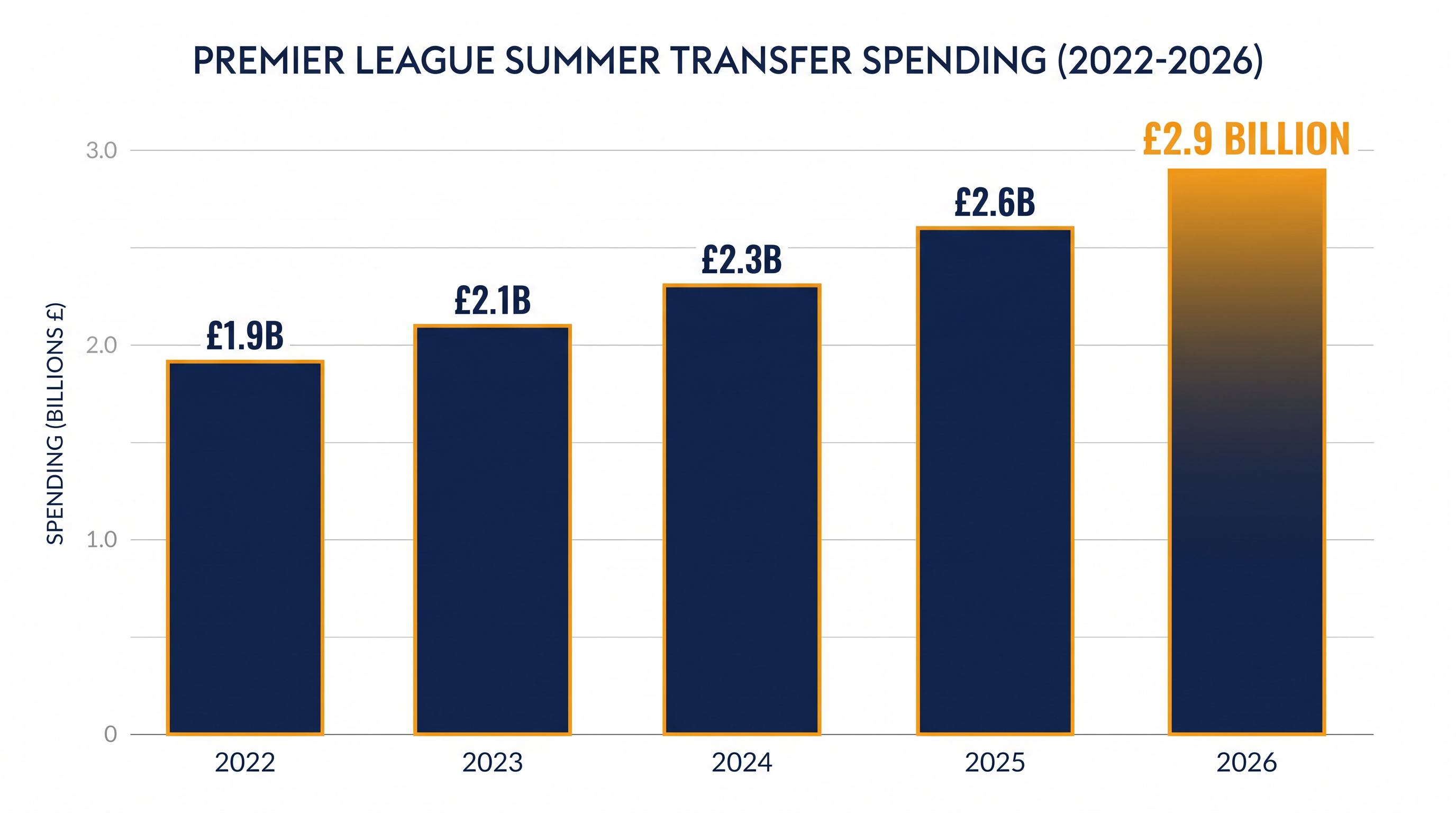
- Premier League clubs have broken the all-time summer transfer spending record, surpassing £2.9 billion.
- Three separate transfers exceeding £100 million have been completed ahead of the 2026/27 season.
- Clubs are using long-term contract amortization to remain compliant with Profitability and Sustainability Rules.
- European rivals are increasingly pivoting to talent development models as they cannot compete financially.
- Total spending could cross the £3.2 billion threshold before the window closes on August 31.
English Premier League clubs have officially shattered the all-time summer transfer spending record, collectively eclipsing the £2.9 billion mark with nearly a month still remaining before the window closes. The unprecedented financial outlay is headlined by three separate transfers exceeding £100 million, a milestone that underscores the league's immense broadcasting wealth and global commercial dominance. As the 2026/27 season approaches, the arms race among England's elite has reached a fever pitch, with traditional powerhouses and ambitious challengers alike committing staggering sums to secure top-tier talent.
The spending surge has been catalyzed by a fiercely competitive top half of the table, where the financial rewards of UEFA Champions League qualification have never been higher. Chelsea, Manchester United, and Arsenal have led the charge, each breaking their own club transfer records to overhaul their squads. Chelsea's £115 million acquisition of a marquee European midfielder set the tone early in the summer, prompting immediate responses from their direct rivals who felt compelled to match the ambition.
Manchester City and Liverpool, while historically more measured in their approach to the market, have also been drawn into the fray, finalizing nine-figure deals to replace aging stalwarts and maintain their championship pedigree. This concentration of wealth has created a hyper-inflated domestic market, where even mid-table Premier League clubs are routinely outspending the reigning champions of Italy, Spain, and Germany. The sheer volume of capital flowing through English front offices has fundamentally altered how players are valued globally.[1][4]
Across the continent, the reaction to the Premier League's financial flexing has been a mixture of resignation and strategic adaptation. Executives in La Liga, Serie A, and the Bundesliga have increasingly positioned their clubs as premium talent incubators, recognizing that competing directly with English financial packages is mathematically impossible. Many historic European giants are now optimizing their scouting networks to identify emerging stars, developing them for a few seasons before selling them to English clubs at an immense premium.[3]
Across the continent, the reaction to the Premier League's financial flexing has been a mixture of resignation and strategic adaptation.
Domestically, the spending spree has raised fresh questions about the efficacy of the Premier League's Profitability and Sustainability Rules (PSR). Despite recent points deductions for financial breaches, clubs have found creative accounting mechanisms to remain compliant while still deploying massive capital. By amortizing massive transfer fees over unprecedented seven- or eight-year contracts, front offices can spread the accounting hit over nearly a decade, allowing for aggressive short-term squad building.[2]
For the players and their representatives, the Premier League has solidified its status as the ultimate destination. The combination of elite sporting competition, state-of-the-art facilities, and unmatched wage structures has made England the default choice for the world's premier talent. Agents note that the financial packages offered by even newly promoted English sides often dwarf the salaries available at established Champions League clubs on the continent.[1][3]
Supporters have largely embraced the influx of world-class talent, with season ticket renewals and merchandise sales hitting all-time highs across the division. The excitement surrounding marquee unveilings has dominated social media and sports broadcasting throughout the summer. However, some fan advocacy groups have voiced concerns that the astronomical transfer fees will inevitably be passed down to match-going supporters through increased ticket prices, premium seating expansions, and more expensive television subscription packages.
With the transfer deadline looming at the end of August, sporting directors anticipate a frantic final few weeks of negotiations. Several high-profile international stars remain unsettled at their current clubs, and the availability of late-window bargains could push the Premier League's total summer expenditure well past the £3.2 billion threshold. As the ink dries on these historic contracts, the 2026/27 season is poised to be the most expensive—and highly anticipated—campaign in the history of the sport.[4]
How we got here
June 2026
The summer transfer window officially opens with immediate high-value bids from top clubs.
July 2026
Chelsea completes the first £115 million signing of the summer, setting a new market rate.
Early August 2026
Total league spending crosses the historic £2.9 billion threshold with weeks remaining.
August 31, 2026
The scheduled close of the summer transfer window across major European leagues.
Viewpoints in depth
The Premier League's View
Emphasizes the league's global entertainment value and commercial success.
League executives and domestic broadcasters argue that the unprecedented spending is a natural byproduct of the Premier League's status as the world's most popular sporting competition. They point to record-breaking international television rights deals as proof that global audiences demand to see the world's best players concentrated in a single, highly competitive division. From this perspective, the £100 million transfers are necessary investments to maintain the league's premium entertainment value.
Continental Europe's View
Highlights concerns over competitive imbalance and the financial unsustainability of the current market.
Executives from La Liga, Serie A, and the Bundesliga view the Premier League's financial dominance as an existential threat to European sporting parity. They argue that the influx of English broadcasting wealth has artificially inflated player valuations, making it impossible for historic continental giants to compete for top talent without risking financial ruin. This camp frequently lobbies UEFA for stricter continental spending caps to level the playing field.
What we don't know
- Whether UEFA will introduce stricter financial regulations to curb the growing wealth gap between the Premier League and the rest of Europe.
- If the massive investments will translate into English dominance in the upcoming Champions League campaign.
Key terms
- Amortization
- The accounting practice of spreading a player's transfer fee over the length of their contract to comply with financial regulations.
- Profitability and Sustainability Rules (PSR)
- Premier League financial regulations designed to prevent clubs from sustaining massive financial losses over a three-year rolling period.
Frequently asked
When does the Premier League transfer window close?
The summer transfer window officially closes on August 31, 2026.
How are clubs affording these record fees?
Clubs are leveraging record-breaking global broadcasting revenues and utilizing long-term contract amortization to spread the accounting costs over several years.
Will this affect ticket prices?
While clubs have not explicitly linked transfer spending to ticket costs, supporter groups have expressed concerns that the financial burden will eventually be passed to match-going fans.
Sources
Source coverage
4 outlets
4 viewpoints surfaced




[1]ESPNPremier League Executives
Premier League's financial dominance reshapes global soccer market
Read on ESPN →[2]Financial TimesFinancial Analysts
The accounting maneuvers behind the Premier League's record transfer window
Read on Financial Times →[3]KickerEuropean Rivals
Bundesliga talent drain accelerates as English clubs flex financial muscle
Read on Kicker →[4]Reuters
Transfer deadline approaches with Premier League spending set to cross £3.2 billion
Read on Reuters →
Comments

More in sports
See all 10 stories →AL East Dynamics
Inside the Blockbuster: Why the Orioles Traded Adley Rutschman to a Division Rival
3 sources

McLaren Resurgence
McLaren's Hungarian GP Victory Blows Open 2026 Formula 1 Championship Race
3 sources

Injury
Chess Health Report: World Champion Gukesh Withdraws From Tata Steel India to Focus on Mental Recovery
8 sources

Standings
18-Year-Old Bazakutsa Leads British Chess Championship as 11-Year-Old Prodigy Joins Chasing Pack
6 sources

Every angle. Every day.
Get sports stories with full source coverage and perspective breakdowns delivered to your inbox.