
First Workforce Pell Program Approved in Iowa, Unlocking Federal Aid for 14-Week EMT Course
The U.S. Department of Education has approved the nation's first short-term training program eligible for federal Pell Grants, signaling a major shift in higher education funding. The 14-week EMT course at Iowa Central Community College will allow students to train for high-demand jobs without taking on debt.


- Vocational Training Advocates
- Supporters argue that the economy needs rapid, debt-free pathways to skilled trades.
- Rural Healthcare Providers
- Local officials view subsidized short-term training as a critical lifeline to keep emergency services operational.
- Traditional Higher Education Defenders
- Critics worry that short-term credentials lack long-term value and may drain resources from degree-seeking students.
Why this matters
This approval fundamentally changes how the federal government funds higher education, unlocking billions of dollars for rapid, debt-free vocational training. For millions of Americans, it means the ability to acquire high-demand trade skills—like emergency medical response, welding, or commercial driving—without taking on student loans.
Key points
- The U.S. Department of Education approved a 14-week EMT program at Iowa Central Community College as the first Workforce Pell recipient.
- The new federal policy allows Pell Grants to be used for short-term vocational programs lasting between 8 and 15 weeks.
- Eligible students can receive prorated federal aid to cover the cost of training, allowing them to enter the workforce debt-free.
- Programs must meet strict accountability standards, including a 70% completion rate and graduate earnings above the state high school median.
For decades, the federal government’s primary tool for helping low-income students access higher education—the Pell Grant—came with a strict time limit. To qualify for the aid, a student had to enroll in an academic program lasting at least 15 weeks and comprising no fewer than 600 clock hours of instruction. That rule, designed to ensure federal funds supported substantial educational endeavors, effectively locked out millions of Americans seeking rapid, short-term vocational training to enter high-demand trades. But on Tuesday, that long-standing barrier officially fell. The U.S. Department of Education approved a 14-week Emergency Medical Technician (EMT) program at Iowa Central Community College as the first in the nation eligible for the newly established "Workforce Pell" funding.[1][2]
The announcement, made at the college's Fort Dodge campus by Education Secretary Linda McMahon, Acting Labor Secretary Keith Sonderling, and Iowa Governor Kim Reynolds, marks a fundamental shift in federal education policy. By unlocking federal financial aid for short-term credentials, the government is signaling a departure from the traditional "college-for-all" ethos, moving toward a model that equally subsidizes rapid workforce entry. "It’s a shift that recognizes what learners and workers have been saying for years: they need faster, more-practical routes into real jobs," McMahon told the gathered crowd of students and local officials.[1][3]
The Pell Grant program, originally established in 1972, was built around the architecture of the traditional two-year or four-year college degree. It assumed that the best path to economic mobility was a prolonged period of academic study. However, as the American economy evolved and severe labor shortages emerged in skilled trades, healthcare, and logistics, employers began demanding specific, targeted competencies rather than broad academic degrees. Industry leaders and community college administrators have spent years lobbying Congress to modernize the Pell Grant system to reflect this new reality, arguing that the 15-week minimum was an arbitrary metric that penalized working-class students.[2][6]
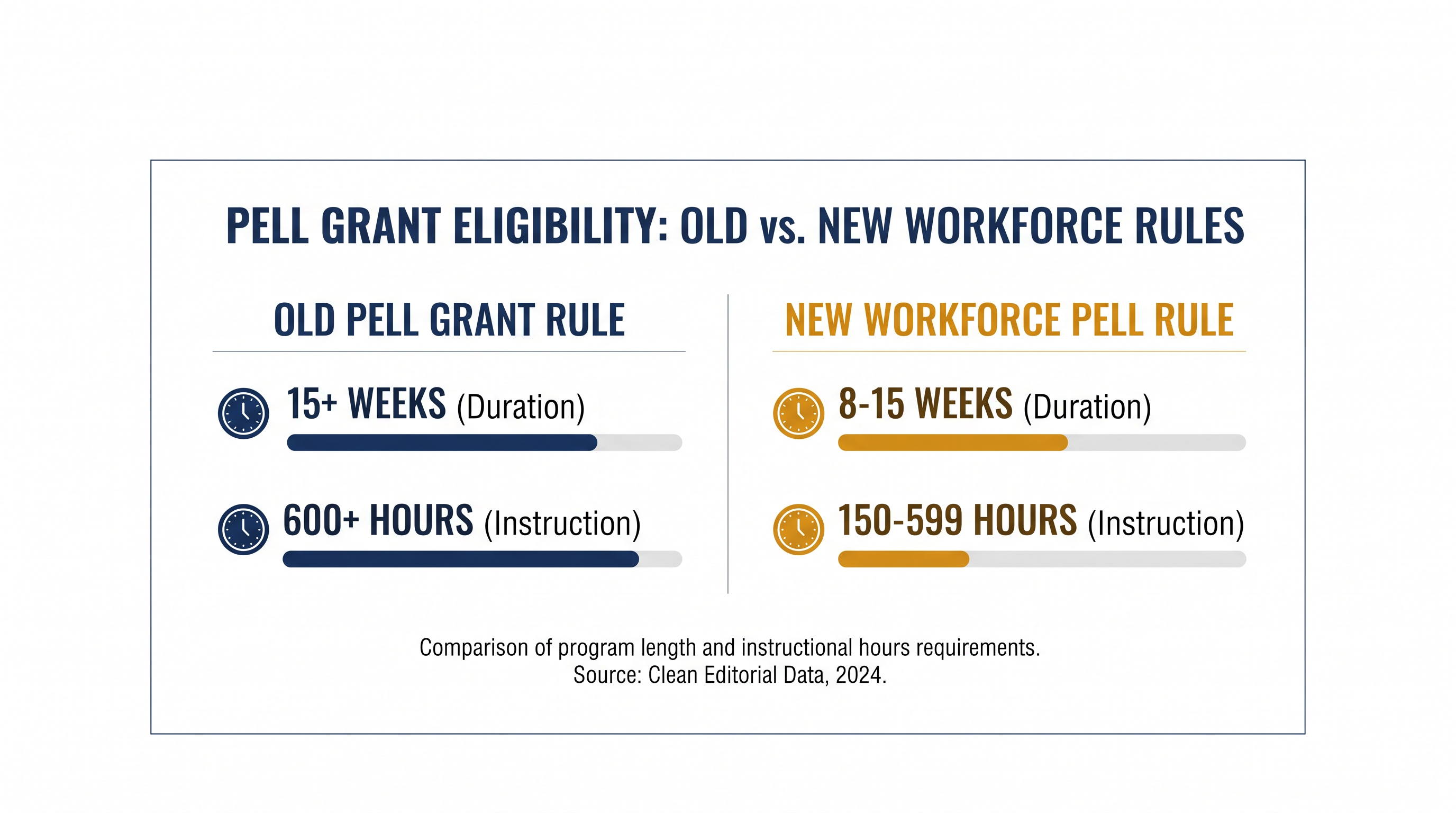
The mechanism behind this historic change traces back to the sweeping federal legislation passed in July 2025, which finally authorized the expansion of Pell Grants to shorter-term workforce programs. Under the new statutory framework, programs lasting between eight and 15 weeks—and containing between 150 and 599 hours of instruction—can now qualify for federal student aid. The goal is to help low-income students access career-focused training in sectors like healthcare, manufacturing, and information technology without needing to commit to a multi-year degree or take on crippling private debt.[4][6]
Iowa Central’s EMT program serves as the ideal test case for this new federal paradigm. The 14-week course combines eight credits of rigorous classroom instruction with hands-on laboratory work, clinical rotations, and prehospital field experience. Upon successful completion, students are eligible to sit for the National Registry of Emergency Medical Technicians certification examination. The curriculum is intense and highly specialized, designed to take a student with zero medical background and transform them into a certified first responder in just over three months.[2][5]
Historically, the out-of-pocket cost for such training has deterred many prospective students, particularly working adults who cannot afford to abandon their current income streams while paying tuition. While an EMT course is significantly cheaper than a four-year degree, a bill of a few thousand dollars remains an insurmountable hurdle for a low-income family. Now, eligible students can receive prorated Pell Grants—drawn from the maximum annual award of $7,395—to cover the cost entirely. Because Pell Grants do not need to be repaid, these students will enter the workforce with zero educational debt.[2][3]
While an EMT course is significantly cheaper than a four-year degree, a bill of a few thousand dollars remains an insurmountable hurdle for a low-income family.
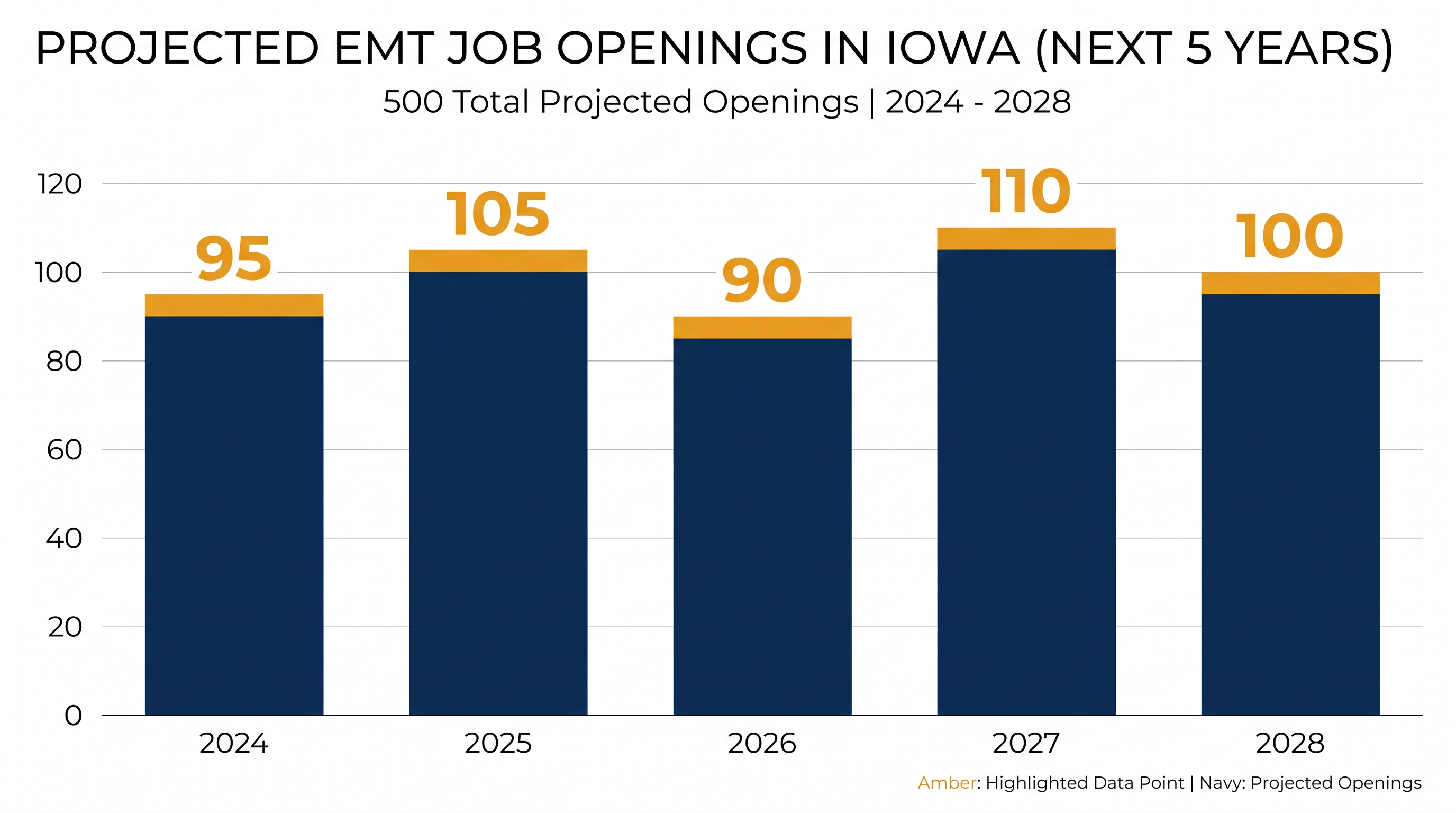
The stakes for local communities, particularly in rural areas, are remarkably high. Governor Reynolds noted that Iowa anticipates more than 500 EMT job openings over the next five years, a shortage that directly threatens emergency response times across the state's sprawling agricultural counties. When rural ambulance services cannot find certified personnel, response times to heart attacks, farm accidents, and highway collisions inevitably stretch, often with fatal consequences. By eliminating the financial barrier to entry, state officials hope to rapidly populate the talent pipeline. "This opportunity only increases our capacity to serve Iowans in emergency situations, and it also can just literally save lives," Reynolds stated.[1][3]
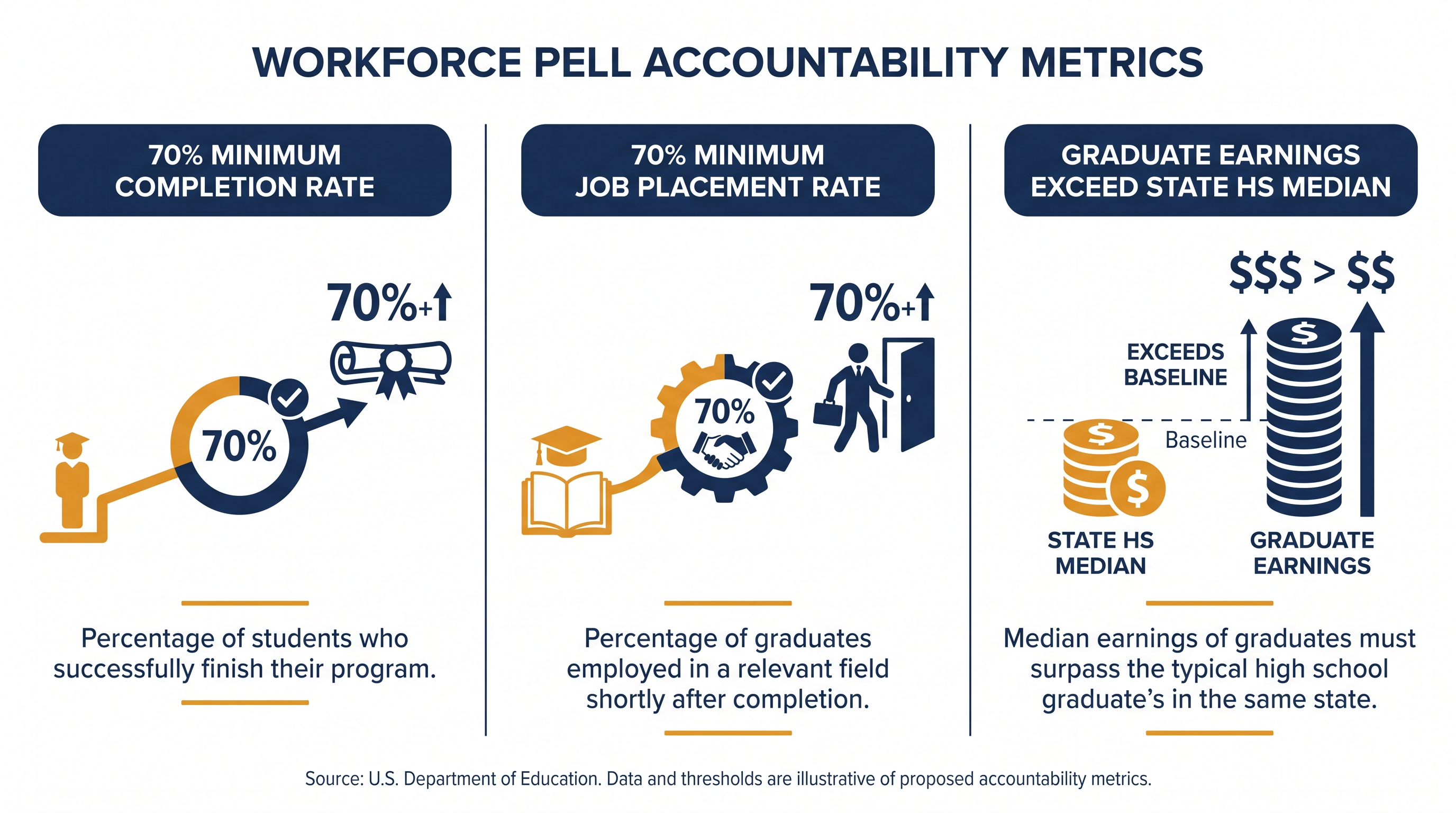
However, the expansion of federal aid to short-term programs is not a blank check. To prevent the proliferation of low-quality "diploma mills" that consume federal dollars without delivering real-world value, the Workforce Pell legislation includes stringent accountability metrics. Programs must prove their return on investment (ROI) before they can receive a single dollar of federal funding. This represents a significant departure from traditional higher education funding, where federal aid flows freely to universities regardless of whether their graduates actually secure gainful employment in their field of study.[2][4]
Specifically, an eligible short-term program must demonstrate completion and job placement rates of at least 70 percent. Furthermore, the median earnings of the program's graduates must exceed the median earnings of a high school graduate in the state where the institution is located. If a program fails to meet these benchmarks, it loses its eligibility to accept Workforce Pell funds. This "value test" ensures that taxpayer dollars are only subsidizing training that genuinely lifts students out of poverty and into family-sustaining careers.[2][4]
Implementing these accountability standards has required significant administrative overhauls at the state level. In Iowa, the Department of Education previously lacked access to the granular, unit-level wage data necessary to comply with the new federal reporting mandates. To bridge this gap, the state legislature passed a bill earlier this year establishing enhanced wage data tracking, incorporating specific elements like occupation, hours worked, and geographic location. This data integration ensures that the state can accurately track whether graduates of programs like Iowa Central's EMT course are actually achieving the promised wage premiums in the workforce.[5][6]
The national rollout of the Workforce Pell program is expected to be massive in scale. The Department of Education projects that the expanded eligibility will support approximately 190,000 students annually across the United States. The Congressional Budget Office estimates the cost of this expansion at $3.2 billion over the next decade. As the program scales, state workforce boards will be tasked with evaluating thousands of short-term programs—from commercial truck driving (CDL) and phlebotomy to advanced welding and cybersecurity—to ensure they align with high-skill, high-wage, or in-demand industry sectors.[1][4]
Despite the bipartisan enthusiasm, some uncertainty remains regarding the long-term economic outcomes for students who pursue short-term credentials in lieu of traditional degrees. Earlier federal experiments with expanding Pell Grants to short-term programs successfully increased enrollment and completion rates in vocational courses. However, those pilot programs yielded mixed results regarding participants' long-term employment stability and lifetime earnings trajectories. Critics caution that while rapid credentialing fills immediate labor shortages, it may not provide workers with the adaptable, broad-based skills necessary to navigate future economic disruptions or technological shifts.[2][6]
There is also ongoing debate within the higher education sector about the allocation of federal resources. The traditional Pell Grant program is already facing a projected $5.5 billion funding shortfall by the end of fiscal year 2026. Some higher education advocates worry that siphoning billions of dollars toward short-term training programs could eventually force cuts to the grants that support low-income students pursuing bachelor's degrees. Balancing the immediate need for skilled trades workers against the long-term societal benefits of a highly educated populace remains a delicate political tightrope.[1][6]
Nevertheless, the approval in Fort Dodge represents a watershed moment for the American community college system. For institutions like Iowa Central, the ability to offer federal financial aid for rapid credentialing fundamentally alters their value proposition to the surrounding community. It transforms the community college from a stepping stone toward a four-year university into a direct, debt-free conduit to the local workforce. As three more Iowa community colleges await federal approval for their own programs, the 14-week EMT course stands as the vanguard of a new era in federal education funding—one that prioritizes immediate, practical skills over traditional academic timelines.[3][6]
How we got here
1972
The Pell Grant program is established to help low-income students access traditional college degrees.
July 2025
Federal legislation is passed authorizing the expansion of Pell Grants to short-term workforce programs.
April 2026
Iowa becomes the first state to open applications for postsecondary institutions seeking Workforce Pell approval.
July 1, 2026
The new Workforce Pell Grant program officially takes effect nationally.
August 4, 2026
The U.S. Department of Education approves Iowa Central Community College's EMT program as the first eligible course.
Viewpoints in depth
Vocational Training Advocates
Supporters argue that the economy needs rapid, debt-free pathways to skilled trades.
Proponents of the Workforce Pell expansion argue that the traditional higher education model has failed a significant portion of the American workforce. By restricting federal aid to programs lasting 15 weeks or longer, the government effectively penalized working-class students who could not afford to step away from their jobs for a full semester. Advocates emphasize that in high-demand fields like healthcare, manufacturing, and logistics, employers value specific competencies over broad academic degrees. They view the new 8-to-15-week eligibility window as a long-overdue modernization that aligns federal funding with the realities of the modern labor market.
Traditional Higher Education Defenders
Critics worry that short-term credentials lack long-term value and may drain resources from degree-seeking students.
While acknowledging the immediate need for skilled workers, defenders of the traditional university model caution against over-indexing on rapid credentialing. They point to earlier federal pilot programs where short-term vocational training increased initial employment but failed to deliver sustained, long-term wage growth. Furthermore, with the traditional Pell Grant program facing a projected $5.5 billion shortfall by the end of fiscal year 2026, there is deep concern that siphoning billions of dollars toward 14-week courses will eventually force cuts to the grants that support low-income students pursuing bachelor's degrees, potentially widening the educational divide.
Rural Healthcare Providers
Local officials view subsidized short-term training as a critical lifeline to keep emergency services operational.
For rural communities, the Workforce Pell approval is less about abstract educational philosophy and more about immediate public safety. Across agricultural states like Iowa, recruiting EMTs has become a crisis, with the upfront cost of training acting as a massive deterrent for potential recruits. When rural ambulance services are understaffed, response times to critical emergencies stretch to dangerous lengths. Local healthcare administrators argue that removing the financial barrier to EMT certification is the only viable way to rapidly rebuild the emergency response pipeline in sparsely populated counties.
What we don't know
- Whether the rapid expansion of short-term credentialing will lead to sustained, long-term wage growth for graduates compared to traditional degree holders.
- How the $3.2 billion projected cost of the Workforce Pell expansion will impact the funding pool for traditional degree-seeking Pell Grant recipients.
Key terms
- Pell Grant
- A form of federal financial aid awarded to undergraduate students who display exceptional financial need, which does not have to be repaid.
- Workforce Pell
- A newly authorized expansion of the Pell Grant program that covers short-term vocational and technical training programs.
- Clock Hours
- A measurement of educational instruction time; traditional Pell Grants previously required a minimum of 600 clock hours.
- Unit-Level Wage Data
- Detailed, individualized employment data used by states to track the specific earnings and job placement outcomes of program graduates.
Frequently asked
What is a Workforce Pell Grant?
It is an expansion of the traditional federal Pell Grant program that allows low-income students to use federal financial aid to pay for short-term, career-focused training programs lasting between 8 and 15 weeks.
Who is eligible for the new grants?
Low-income students who meet standard Pell Grant eligibility requirements can apply, provided they are enrolled in an approved short-term program that meets strict federal accountability standards for completion and post-graduation earnings.
Do Workforce Pell Grants need to be repaid?
No. Like traditional Pell Grants, Workforce Pell funds are federal financial aid that does not require repayment, allowing students to enter the workforce without educational debt.
Why was the Iowa Central EMT program chosen first?
Iowa was the first state to submit an application under the new rules, and the 14-week EMT program perfectly aligned with the federal requirements for high-demand, high-wage skills training.
Sources
Source coverage
6 outlets
3 viewpoints surfaced






[1]Iowa Public RadioTraditional Higher Education Defenders
Iowa training course is first federally approved program that's part of the country's new Workforce Pell Grant program
Read on Iowa Public Radio →[2]TechEd MagazineVocational Training Advocates
Workforce Pell Becomes Real: What the First Approval Means for CTE
Read on TechEd Magazine →[3]EMS1Rural Healthcare Providers
Iowa Central Community College becomes first in nation approved for Workforce Pell EMT program
Read on EMS1 →[4]U.S. House Committee on Education & the WorkforceVocational Training Advocates
Bipartisan Workforce Pell Act Fact Sheet
Read on U.S. House Committee on Education & the Workforce →[5]State of IowaRural Healthcare Providers
Preparing to Implement Workforce Pell and Administrative Clean-up
Read on State of Iowa →[6]Factlen Editorial TeamVocational Training Advocates
Synthesis by Factlen editorial team
Read on Factlen Editorial Team →
Comments

Every angle. Every day.
Get education stories with full source coverage and perspective breakdowns delivered to your inbox.