
Physical Chess: The Neuroscience of Martial Arts and Cognitive Longevity
Emerging research reveals that complex martial arts like Brazilian Jiu-Jitsu and Tai Chi actively rewire the aging brain, boosting neuroplasticity and combating cognitive decline.
By Factlen Editorial Team
- Neuroscientists & Researchers
- Focuses on the empirical data showing structural brain changes, neuroplasticity, and the elevation of BDNF through complex motor learning.
- Martial Arts Instructors
- Emphasizes the lived experience of 'physical chess,' stress inoculation, and the psychological transformation observed in older students.
- Public Health Advocates
- Highlights the urgent need for scalable, engaging lifestyle interventions to combat the rising societal costs of Alzheimer's and dementia.
What's not represented
- · Traditional fitness trainers advocating for purely aerobic or strength-based routines for seniors.
- · Healthcare providers focusing strictly on pharmacological interventions for cognitive decline.
Why this matters
As the global population ages and dementia rates climb, finding effective ways to preserve brain health is critical. Martial arts offer a scalable, engaging intervention that protects memory and executive function far better than traditional stationary brain games.
Key points
- Traditional aerobic exercise and stationary brain games are insufficient for maximizing long-term neuroplasticity.
- Martial arts like BJJ and Tai Chi require complex motor learning, acting as 'physical chess' that deeply engages the brain.
- Training elevates BDNF levels, a crucial protein that promotes the growth of new neurons and synapses.
- The intense problem-solving required in grappling helps preserve the hippocampus and prefrontal cortex against age-related shrinkage.
- Controlled physical adversity in martial arts builds stress inoculation, improving emotional regulation in daily life.
For decades, the standard prescription for cognitive longevity has been neatly divided into two distinct categories: physical maintenance and mental stimulation. Aging adults are routinely advised to walk on treadmills for cardiovascular health and solve crossword puzzles or Sudoku to keep their minds sharp. While these activities offer undeniable baseline benefits, neuroscientists and longevity researchers are increasingly pointing to a critical limitation in this bifurcated approach. Monotonous, repetitive exercise routines do very little to stimulate cognitive expansion, and stationary brain games fail to engage the body's complex motor networks. True neuroplasticity—the brain's ability to rewire itself and form new connections—thrives on novelty, unpredictability, and the simultaneous integration of physical and mental demands.[7]
This realization is driving a paradigm shift in how we approach brain health, leading researchers to investigate an unexpected frontier: martial arts. Practices ranging from the slow, meditative movements of Tai Chi to the high-intensity, dynamic grappling of Brazilian Jiu-Jitsu (BJJ) are emerging as powerful interventions against age-related cognitive decline. Unlike traditional aerobic workouts, martial arts demand continuous cognitive engagement, requiring practitioners to process visual information, execute complex cross-lateral movements, and adapt to shifting physical realities in real time. This synthesis of physical exertion and mental gymnastics creates a unique neurological stimulus that isolated exercises simply cannot replicate.[1][3]
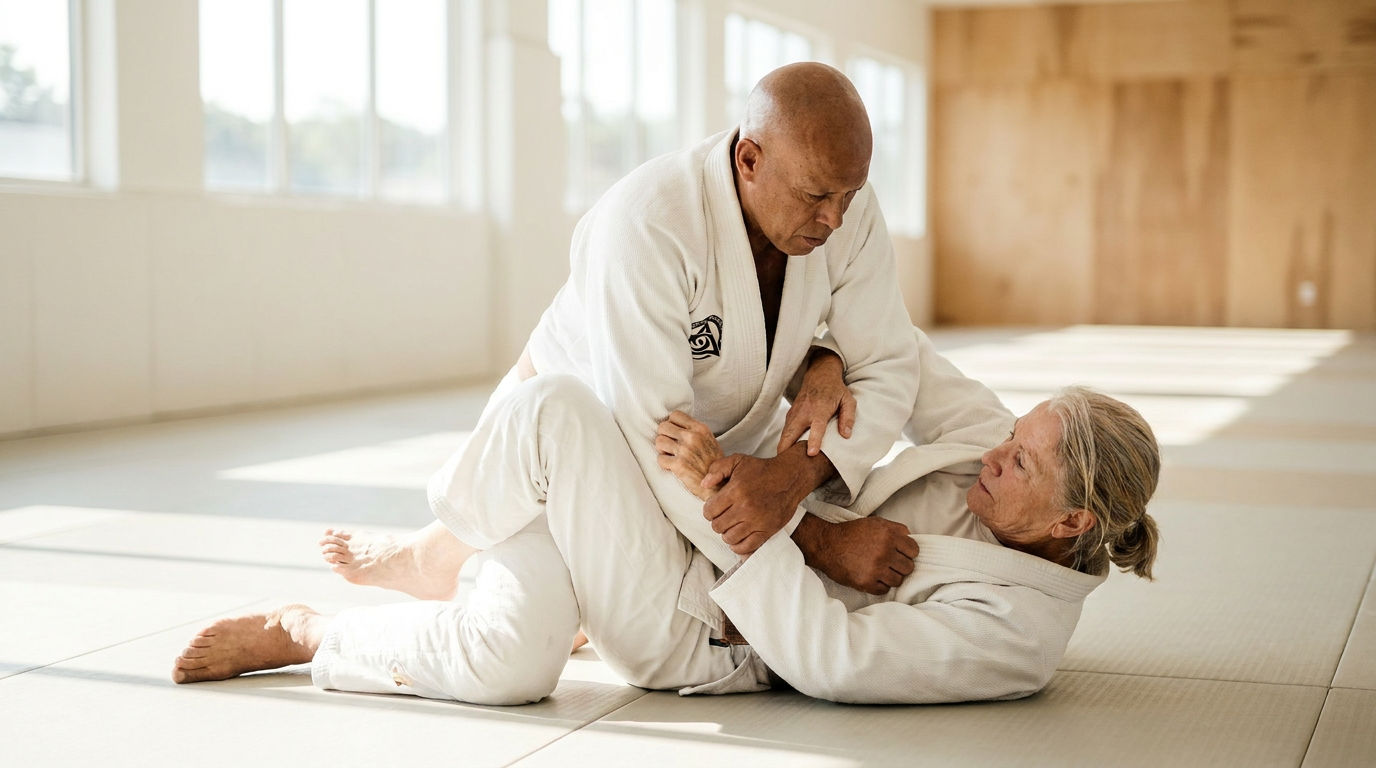
Within this landscape, Brazilian Jiu-Jitsu has garnered particular attention from cognitive researchers, earning the moniker of "physical chess." Every sparring session, or "roll," is a dynamic, real-time puzzle. Practitioners must constantly analyze their opponent's leverage, anticipate their next move, and calculate the precise spatial geometry required to defend or advance a position. There is no opportunity to zone out or let the mind wander, as a single second of distraction allows the opponent to compromise the practitioner's structural integrity. This total cognitive immersion forces the brain into an intense state of problem-solving under physical pressure.[4][5]
The neurological demands of this physical chess match are profound. Mastering the infinite positional variations of grappling forces the brain to establish entirely new neural pathways, directly promoting long-term neuroplasticity. When a practitioner learns a new technique—such as a complex sweep or a submission escape—they are not just building muscle memory; they are actively engaging the prefrontal cortex, the brain's executive control center responsible for planning, decision-making, and cognitive flexibility. By continuously challenging the brain to adapt to unpredictable physical threats, BJJ acts as a high-intensity workout for the mind's executive functions.[4][6]

At the cellular level, the benefits of this complex motor learning are driven by a crucial protein known as Brain-Derived Neurotrophic Factor (BDNF). Often described by neuroscientists as "Miracle-Gro for the brain," BDNF plays a vital role in neuronal survival, the growth of new synapses, and overall cognitive function. Natural BDNF levels tend to decline as we age, a reduction that is closely associated with memory loss and the onset of neurodegenerative conditions. While all aerobic exercise provides a modest boost to BDNF, studies indicate that the combination of physical exertion and complex cognitive challenges yields a significantly higher neurochemical response.[1][7]
Research published in Frontiers in Aging Neuroscience highlights how martial arts participation actively elevates these critical BDNF levels in older adults. The continuous need to analyze, anticipate, and adapt during training triggers positive neurochemical changes that facilitate synaptic growth. This elevated BDNF expression not only supports the retention of existing cognitive functions but actively promotes the generation of new neurons. By creating an environment where the brain is forced to learn and adapt, martial arts provide a robust biological defense against the natural neural pruning that accompanies aging.[1][4]
These neurochemical changes eventually manifest as structural adaptations within the brain itself. Medical imaging studies of martial arts practitioners have demonstrated increased gray matter density and enhanced connectivity in several key regions, most notably the hippocampus and the cerebellum. The hippocampus is the brain's primary hub for memory consolidation and spatial navigation, and it is typically one of the first areas to suffer atrophy in patients with Alzheimer's disease and other forms of dementia. The cerebellum, meanwhile, governs balance, coordination, and fine motor control.[1][2]
These neurochemical changes eventually manifest as structural adaptations within the brain itself.
The rigorous demands of martial arts training provide targeted stimulation to these vulnerable regions. Memorizing the intricate, predetermined sequences of a Tai Chi form or the multi-step mechanics of a Jiu-Jitsu technique requires intense hippocampal engagement. The brain must encode these complex physical patterns, store them, and retrieve them on demand. Simultaneously, the constant weight shifting, cross-lateral movements, and balance corrections required in martial arts heavily recruit the cerebellum. This dual stimulation helps preserve the structural integrity of these brain regions, slowing the rate of age-related shrinkage and maintaining cognitive sharpness.[2][6]

Beyond the mechanics of memory and coordination, martial arts offer a unique psychological benefit known as stress inoculation. In disciplines like BJJ, practitioners are routinely placed in physically uncomfortable and disadvantageous positions. The natural human instinct when pinned or restricted is to panic, which triggers the sympathetic nervous system's fight-or-flight response. However, surviving and escaping these positions requires the exact opposite reaction: the practitioner must suppress panic, regulate their breathing, and remain completely analytical to execute a technical escape.[5][7]
This repeated exposure to controlled adversity fundamentally rewires the brain's stress response. By forcing the practitioner to stay calm under intense physical pressure, martial arts training activates the parasympathetic nervous system, shifting the brain from a state of reactive panic to one of focused relaxation. Over time, this conditions the nervous system to handle real-world, off-the-mat stressors with greater emotional resilience and clarity. Practitioners learn to detach from the immediate sensation of anxiety and approach problems with a measured, strategic mindset, a skill that is invaluable for navigating the complexities of modern life.[4][5]
This intense focus also facilitates a state of "active meditation," a psychological phenomenon that is increasingly sought after by adults looking to manage cognitive overload. During a sparring session or a complex forms practice, the sheer volume of sensory data and the immediate physical stakes make it impossible to ruminate on external worries. The practitioner cannot stress about a looming work deadline or a financial obligation while actively defending a chokehold or balancing on one leg. This total immersion effectively clears the brain's processing cache, providing a profound mental reset and reducing the baseline levels of cortisol and anxiety.[5][7]

Furthermore, the neurocognitive benefits of martial arts are heavily amplified by the social dynamics of the training environment. Humans are fundamentally social creatures, and isolation is a well-documented risk factor for accelerated cognitive decline in older populations. Unlike solitary gym routines, martial arts require constant partner interaction. This engagement develops what neuroscientists refer to as "social cognition"—the ability to read a partner's physical cues, understand their intentions, and adjust one's own energy and skill level accordingly.[3][7]
This partner-based training fosters a deep sense of community, trust, and shared vulnerability. Working through complex physical puzzles with a peer creates positive emotional stimuli and releases oxytocin, further enhancing the brain's neurochemical profile. The dojo or academy becomes a vital social hub, providing older adults with a sense of belonging and purpose that extends far beyond the physical workout. This combination of cognitive challenge, physical exertion, and social connection creates a holistic defense mechanism against the multifaceted threats of aging.[3][5]
The implications of this research are particularly urgent given the looming public health crisis posed by neurodegenerative diseases. Alzheimer's disease currently stands as the sixth leading cause of death in the United States, and it remains the only leading cause of death for which there is no effective pharmacological cure. With the medical costs associated with dementia projected to exceed one trillion dollars annually by 2050, the need for scalable, preventative lifestyle interventions has never been greater.[2][7]

As the scientific consensus solidifies, the cultural perception of martial arts is undergoing a necessary evolution. These practices are no longer viewed exclusively as the domain of young, hyper-competitive athletes. Instead, they are being recognized as sophisticated tools for longevity and mental health. Whether through the gentle, flowing neuro-motor challenges of Tai Chi or the rigorous, high-stakes physical chess of Brazilian Jiu-Jitsu, older adults are discovering that the most effective way to protect the mind is to challenge it through the body. True cognitive resilience requires more than just isolated puzzles; it demands the dynamic, unpredictable integration of movement, strategy, and breath.[1][3][7]
How we got here
Early 2000s
Cognitive longevity research primarily focuses on aerobic exercise and stationary brain games like crosswords.
2010s
Studies begin highlighting the unique neuroprotective benefits of mindful movement practices like Tai Chi for older adults.
2020
Comprehensive reviews demonstrate that complex motor learning in martial arts outperforms aerobic-only training for executive function.
2024-2026
Neuroimaging confirms that high-intensity grappling sports like BJJ actively stimulate neuroplasticity and elevate BDNF levels.
Viewpoints in depth
Neuroscientists & Researchers
Focuses on the empirical data showing structural brain changes and the elevation of BDNF through complex motor learning.
For the scientific community, the appeal of martial arts lies in the measurable biological changes they produce. Researchers point to functional MRI scans and blood panels showing that the combination of physical exertion and complex cognitive problem-solving yields a significantly higher neurochemical response than aerobic exercise alone. By elevating Brain-Derived Neurotrophic Factor (BDNF), these practices actively promote the growth of new synapses, offering a robust defense against the neural pruning that accompanies aging.
Martial Arts Instructors
Emphasizes the lived experience of 'physical chess' and the psychological transformation observed in older students.
Instructors on the mats witness the cognitive benefits of martial arts in real time. They emphasize that the true value of practices like Brazilian Jiu-Jitsu lies in 'stress inoculation'—forcing students to remain calm and analytical while in physically disadvantageous positions. This daily practice of overriding the panic response builds profound emotional resilience, which instructors note frequently translates into their students' ability to handle off-the-mat stressors with greater clarity and focus.
Public Health Advocates
Highlights the urgent need for scalable, engaging lifestyle interventions to combat the rising societal costs of dementia.
From a public health perspective, the looming crisis of Alzheimer's disease necessitates interventions that people will actually stick with. Advocates argue that while stationary brain games and treadmill walking suffer from high dropout rates due to boredom, the community aspect and infinite learning curve of martial arts keep older adults engaged for years. They view the dojo not just as a fitness center, but as a vital social hub that combats the isolation known to accelerate cognitive decline.
What we don't know
- The exact minimum effective dose—how many hours of training per week are required to trigger significant neuroplastic changes—remains under investigation.
- Longitudinal studies tracking martial arts practitioners over multiple decades are still needed to definitively quantify the reduction in Alzheimer's risk.
Key terms
- Neuroplasticity
- The brain's ability to reorganize itself by forming new neural connections throughout life in response to learning and experience.
- BDNF (Brain-Derived Neurotrophic Factor)
- A protein that promotes the survival of nerve cells and the growth of new synapses, often described as 'Miracle-Gro' for the brain.
- Prefrontal Cortex
- The region at the front of the brain responsible for complex cognitive behavior, decision making, and moderating social behavior.
- Hippocampus
- A complex brain structure embedded deep into the temporal lobe that has a major role in learning and memory.
- Stress Inoculation
- The process of building psychological resilience by exposing individuals to manageable levels of stress in a controlled environment.
Frequently asked
Am I too old to start Brazilian Jiu-Jitsu?
No. Many academies now offer classes specifically tailored for older adults or beginners, focusing on technique, mobility, and safety rather than high-impact competition.
Do I have to spar to get the cognitive benefits?
While live sparring (rolling) provides the highest level of unpredictable problem-solving, simply learning and drilling the complex movements still significantly boosts neuroplasticity and memory.
How is this different from just doing a crossword puzzle?
Crosswords only engage mental recall, whereas martial arts require the simultaneous integration of physical movement, spatial awareness, and real-time strategic adaptation.
Is Tai Chi as effective as BJJ for brain health?
They offer overlapping but distinct benefits. Tai Chi excels at balance, mindful breathing, and memory retention, while BJJ provides intense executive function training and stress inoculation.
Sources
Source coverage
7 outlets
3 viewpoints surfaced







[1]Frontiers in Aging NeuroscienceNeuroscientists & Researchers
Neurocognitive benefits of martial arts in aging: enhanced BDNF, improved executive functions, and strengthened brain connectivity
Read on Frontiers in Aging Neuroscience →[2]Natural Health Research InstituteNeuroscientists & Researchers
Tai Chi and Baduanjin Improve Memory in the Elderly
Read on Natural Health Research Institute →[3]Pretty Deadly Self DefenseMartial Arts Instructors
Martial Arts and Memory: Slowing Cognitive Decline Through Movement
Read on Pretty Deadly Self Defense →[4]The Jiu-Jitsu FoundryMartial Arts Instructors
The Neuroscience of Grappling: More Than Just a Workout
Read on The Jiu-Jitsu Foundry →[5]Gracie Lake NormanMartial Arts Instructors
What Does Neuroscience Say About BJJ?
Read on Gracie Lake Norman →[6]Zeco BJJMartial Arts Instructors
Brazilian Jiu-Jitsu and Cognitive Growth
Read on Zeco BJJ →[7]Factlen Editorial TeamPublic Health Advocates
Synthesis by Factlen editorial team
Read on Factlen Editorial Team →



Every angle. Every day.
Get fitness stories with full source coverage and perspective breakdowns delivered to your inbox.