
Nutritional Psychiatry: How the Gut Microbiome Shapes Mental Health
Emerging research reveals that the trillions of microbes in the human digestive system actively produce neurotransmitters and regulate inflammation, offering a new frontier for treating anxiety and depression through diet and targeted psychobiotics.
By Factlen Editorial Team
- Nutritional Psychiatrists
- Advocate for dietary interventions and psychobiotics as primary or adjunctive treatments for mental health.
- Clinical Microbiologists
- Focus on the mechanistic pathways, emphasizing that strain-level specificity is required before making broad clinical claims.
- Traditional Psychiatrists
- Maintain that while diet is important, severe psychiatric conditions still primarily require established pharmacological and psychological therapies.
What's not represented
- · Patients with severe, treatment-resistant depression
- · Gastroenterologists treating functional bowel disorders
Why this matters
For decades, mental health treatment has focused almost exclusively on brain chemistry. Understanding the gut-brain connection empowers individuals to use diet and targeted probiotics as tangible, daily tools to build psychological resilience and improve their mood.
Key points
- The gut microbiome operates as a chemical factory, producing neuroactive compounds that directly influence mood and cognition.
- Approximately 90% of the body's serotonin is synthesized in the digestive tract, not the brain.
- Psychobiotics are specific bacterial strains that have been shown to lower cortisol, reduce anxiety, and improve stress resilience.
- Systemic inflammation, often triggered by a compromised gut lining, is increasingly recognized as a driver of depressive symptoms.
- Clinical trials demonstrate that dietary interventions, such as increasing fiber and fermented foods, can yield measurable improvements in mental health.
The phrase "gut feeling" is older than modern medicine, but neuroscience is finally proving it literal. For decades, psychiatry treated the brain as an isolated organ, locked away behind the blood-brain barrier, where chemical imbalances dictated mood and cognition. But a paradigm shift is rewriting the textbooks. The emerging field of nutritional psychiatry has identified a bustling, 100-trillion-member community of microorganisms in the human digestive tract as a primary architect of mental health.[4][6]
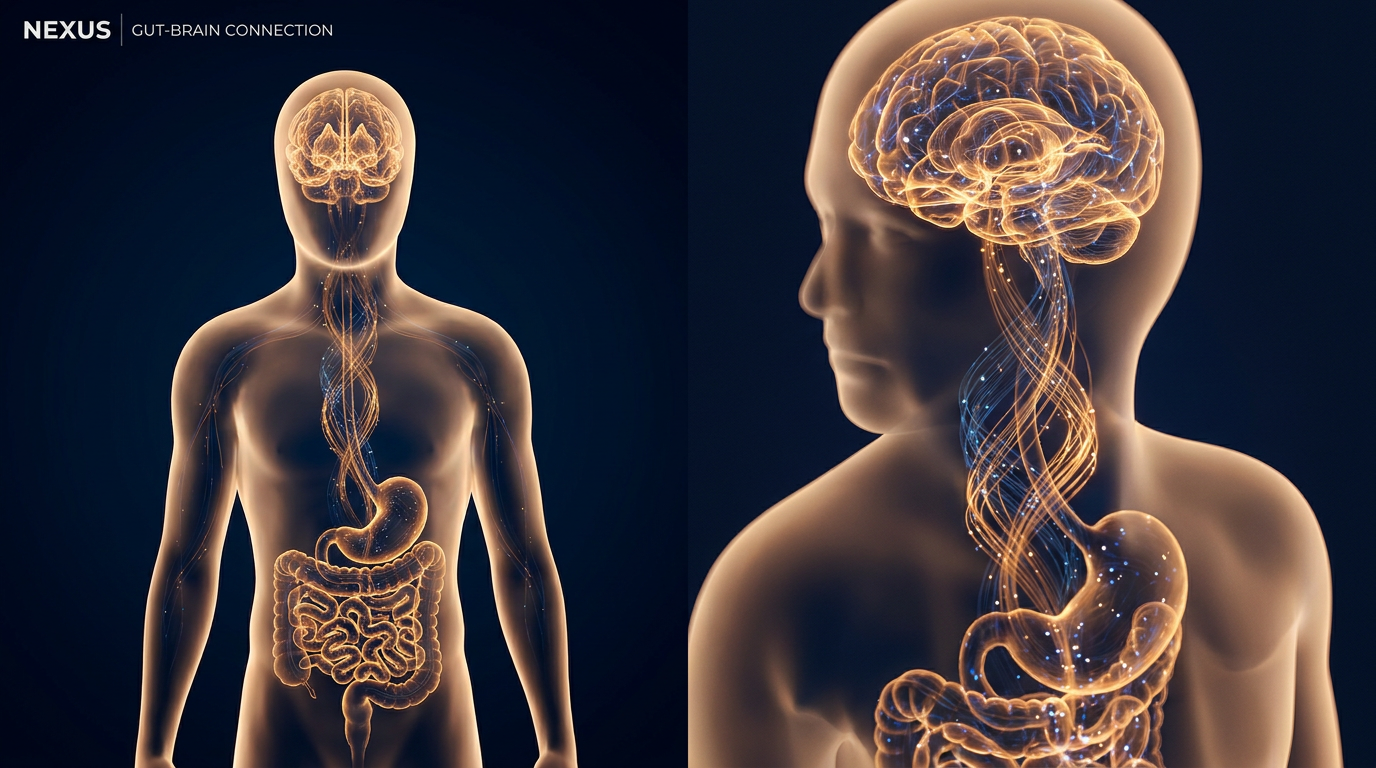
This microscopic ecosystem, weighing roughly one to two kilograms—about the same as the human brain—does far more than break down food. It operates as a chemical factory, producing neuroactive compounds that directly influence how we feel, think, and cope with stress. The realization that the gut and the brain are in constant, bidirectional communication has sparked a wave of research into "psychobiotics"—live bacteria that, when ingested, confer mental health benefits.[2][3]
To understand how a microbe in the colon alters a mood in the mind, researchers map the microbiota-gut-brain axis (MGBA). This complex network relies on several communication highways. The fastest is the vagus nerve, a thick cable of neurons running directly from the abdomen to the brainstem. Gut bacteria release molecules that stimulate the vagus nerve, sending rapid-fire signals about the intestinal environment straight to the brain's emotional centers.[2][3][4]
But the communication is also chemical. The gut microbiome is responsible for manufacturing a staggering proportion of the body's neurotransmitters. Approximately 90 percent of the body's serotonin—the "feel-good" chemical targeted by common antidepressant medications—is synthesized in the gut, not the brain. While gut-derived serotonin does not cross the blood-brain barrier directly, it regulates intestinal movements and sends secondary signals that profoundly impact central nervous system function.[2][3][4]

Beyond serotonin, gut bacteria produce short-chain fatty acids (SCFAs) like butyrate, acetate, and propionate by fermenting dietary fiber. These SCFAs are metabolic powerhouses. They strengthen the intestinal lining, enter the bloodstream, and can cross the blood-brain barrier. Once in the brain, SCFAs regulate the expression of brain-derived neurotrophic factor (BDNF), a crucial protein that acts like fertilizer for the brain, promoting the growth of new neurons and supporting neuroplasticity.[1][3]
In patients with depression and chronic anxiety, neuroplasticity is often impaired, and BDNF levels are typically low. By increasing SCFA production through diet or targeted psychobiotics, researchers have observed corresponding increases in BDNF, offering a biological mechanism for how a high-fiber diet might physically rebuild resilience in the brain.[1][3][6]
In patients with depression and chronic anxiety, neuroplasticity is often impaired, and BDNF levels are typically low.
The immune system provides a third pathway. A healthy microbiome trains immune cells to distinguish between harmless compounds and dangerous pathogens. However, when the microbial balance is disrupted—a state known as dysbiosis—the intestinal lining can become compromised. This "leaky gut" allows toxins and partially digested food particles to slip into the bloodstream, triggering a systemic immune response.[4][5]
This systemic inflammation is increasingly viewed as a core driver of certain psychiatric conditions. Inflammatory cytokines travel to the brain, where they can alter neurotransmitter metabolism and induce "sickness behavior"—symptoms that closely mirror clinical depression, such as lethargy, social withdrawal, and anhedonia. Harvard researchers recently identified specific bacterial strains whose metabolic byproducts directly activate this inflammatory cascade, strengthening the argument that some cases of major depressive disorder may actually be autoinflammatory conditions.[4][5]

Enter psychobiotics. The term, coined just over a decade ago, refers to specific strains of bacteria—most commonly within the Lactobacillus and Bifidobacterium families—that yield measurable psychiatric benefits. In experimental models, these targeted probiotics have been shown to lower cortisol levels, dampen the reactivity of the hypothalamic-pituitary-adrenal (HPA) axis (the body's primary stress response system), and reduce anxiety-like behaviors.[1][6]
Translating these animal findings to humans is complex, but early clinical trials are promising. Human studies typically lasting four to twelve weeks have reported small to moderate improvements in affective and stress-related outcomes among participants taking well-characterized psychobiotic strains. These benefits are most pronounced when psychobiotics are used as an adjunct to traditional therapies rather than a standalone cure.[1][6]
The broader dietary context is equally critical. The landmark SMILES trial, one of the first randomized controlled trials to test dietary intervention for clinical depression, found that shifting patients to a Mediterranean-style diet—rich in vegetables, whole grains, legumes, and fermented foods—resulted in significant mood improvements compared to a social support control group. The diet effectively fed the beneficial microbes, allowing them to outcompete inflammatory strains.[6]

Despite the enthusiasm, clinical microbiologists urge caution against viewing psychobiotics as a panacea. The effects of these bacteria are highly strain-specific; a generic probiotic off a supermarket shelf is unlikely to treat clinical anxiety. Furthermore, the human microbiome is as unique as a fingerprint, meaning a bacterial strain that alleviates depression in one individual might have no effect on another.[1][4][6]
The future of nutritional psychiatry lies in precision medicine. Researchers are developing microbiome- and metabolomics-informed approaches to map an individual's gut flora, identify specific metabolic deficits, and prescribe customized psychobiotic interventions. While we are not yet at the point of replacing standard medications with customized yogurts, the integration of gut health into psychiatric care represents a profound shift.[1][5][6]

By recognizing the gut as the "second brain," science is offering patients a new, highly modifiable tool for mental wellness. We cannot easily change our genetics, and changing our environment can be difficult, but we can change what we feed our microbiome. In the quest to treat the mind, the most effective first step might simply be healing the gut.[2][4][6]
How we got here
19th Century
Early physicians first hypothesize a link between gastric function and melancholia, though the mechanisms remain unknown.
2004
A landmark study on germ-free mice demonstrates that the gut microbiome directly influences the development of the brain's stress response system.
2013
The term 'psychobiotics' is coined to describe live organisms that, when ingested, produce health benefits in patients suffering from psychiatric illness.
2017
The SMILES trial publishes results showing that dietary intervention can effectively treat major depressive episodes.
2025
Advances in metabolomics allow researchers to identify the specific bacterial byproducts that trigger neuroinflammation.
Viewpoints in depth
Nutritional Psychiatrists
Advocate for dietary interventions and psychobiotics as primary or adjunctive treatments for mental health.
This camp views the gut microbiome as a highly modifiable risk factor for psychiatric conditions. They point to landmark studies like the SMILES trial, which demonstrated that dietary changes can yield clinical improvements in major depressive disorder comparable to some medications. Nutritional psychiatrists argue that modern Western diets, characterized by ultra-processed foods and low fiber, are starving beneficial microbes and driving a population-level increase in neuroinflammation. They advocate for prescribing dietary changes and targeted psychobiotics alongside, or sometimes before, traditional psychopharmacology.
Clinical Microbiologists
Focus on the mechanistic pathways, emphasizing that strain-level specificity is required before making broad clinical claims.
While enthusiastic about the underlying science, microbiologists caution against the commercial hype surrounding generic 'probiotics for mood.' They emphasize that bacterial effects are highly strain-specific—meaning a generic Lactobacillus supplement will not necessarily reduce anxiety just because a specific, patented strain of Lactobacillus rhamnosus did so in a lab trial. This camp argues that until we can map an individual's unique microbiome and prescribe precise, metabolomics-informed bacterial strains, psychobiotics should be viewed as an experimental adjunct rather than a reliable standalone treatment.
Traditional Psychiatrists
Maintain that while diet is important, severe psychiatric conditions still primarily require established pharmacological and psychological therapies.
Traditional psychiatric practitioners acknowledge the gut-brain link but worry that the focus on nutrition might inadvertently stigmatize patients or downplay the severity of neurochemical and genetic factors. They caution that while a high-fiber diet and psychobiotics might alleviate mild to moderate symptoms, severe conditions like bipolar disorder, schizophrenia, or severe major depressive disorder require established treatments like SSRIs, antipsychotics, and cognitive behavioral therapy. They view nutritional psychiatry as a supportive lifestyle intervention rather than a replacement for standard medical care.
What we don't know
- Which specific combinations of bacterial strains are most effective for different psychiatric conditions.
- How to reliably map an individual's baseline microbiome to predict their response to a specific psychobiotic.
- The exact mechanisms by which gut-derived short-chain fatty acids alter gene expression in the human brain.
Key terms
- Microbiota-Gut-Brain Axis (MGBA)
- The bidirectional communication network linking the central nervous system with the intestinal microbiome, utilizing neural, endocrine, and immune pathways.
- Short-Chain Fatty Acids (SCFAs)
- Metabolic byproducts produced when gut bacteria ferment dietary fiber, which help reduce inflammation and promote brain health.
- Brain-Derived Neurotrophic Factor (BDNF)
- A crucial protein that supports the survival of existing neurons and encourages the growth of new neurons and synapses in the brain.
- Dysbiosis
- An imbalance in the microbial communities of the gut, often associated with inflammation, digestive issues, and mood disorders.
- Vagus Nerve
- A major cranial nerve that acts as the primary information superhighway between the digestive system and the brain.
Frequently asked
What are psychobiotics?
Psychobiotics are specific strains of live bacteria (probiotics) that, when ingested in adequate amounts, confer mental health benefits by interacting with the gut-brain axis.
Can changing my diet actually treat depression?
Clinical trials have shown that shifting to a Mediterranean-style diet rich in fiber and fermented foods can significantly improve mood and reduce depressive symptoms, often working best alongside traditional therapies.
Do generic probiotics from the store improve mood?
Not necessarily. The mental health benefits of bacteria are highly strain-specific, meaning a generic probiotic may not contain the exact strains proven to lower anxiety or inflammation.
How does the gut communicate with the brain?
The gut and brain communicate via the vagus nerve, through immune system signaling (inflammation), and via chemical messengers like neurotransmitters and short-chain fatty acids produced by gut bacteria.
Sources
Source coverage
6 outlets
3 viewpoints surfaced






[1]PubMed CentralClinical Microbiologists
Psychobiotics and the microbiota-gut-brain axis: Emerging paradigms in mental health modulation
Read on PubMed Central →[2]Frontiers in NeuroscienceClinical Microbiologists
The microbiota-gut-brain axis and central nervous system diseases: from mechanisms of pathogenesis to therapeutic strategies
Read on Frontiers in Neuroscience →[3]MDPI NutrientsClinical Microbiologists
The Microbiota–Gut–Brain Axis Across the Lifespan: From Neurodevelopment to Neurodegeneration
Read on MDPI Nutrients →[4]National Health and Medical Research CouncilNutritional Psychiatrists
Trust your gut: how the microbiome impacts mental health
Read on National Health and Medical Research Council →[5]Harvard Medical SchoolTraditional Psychiatrists
Drawing a Line From the Gut Microbiome to Inflammation and Depression
Read on Harvard Medical School →[6]Factlen Editorial TeamNutritional Psychiatrists
Synthesis by Factlen editorial team
Read on Factlen Editorial Team →

Every angle. Every day.
Get health stories with full source coverage and perspective breakdowns delivered to your inbox.