
Next-Generation Heat Pumps Are Finally Ready for Old, Drafty Homes
Following a multi-year federal technology challenge, a new class of cold-climate heat pumps has hit the market in 2026, capable of heating older homes efficiently even at 15 degrees below zero.
By Factlen Editorial Team
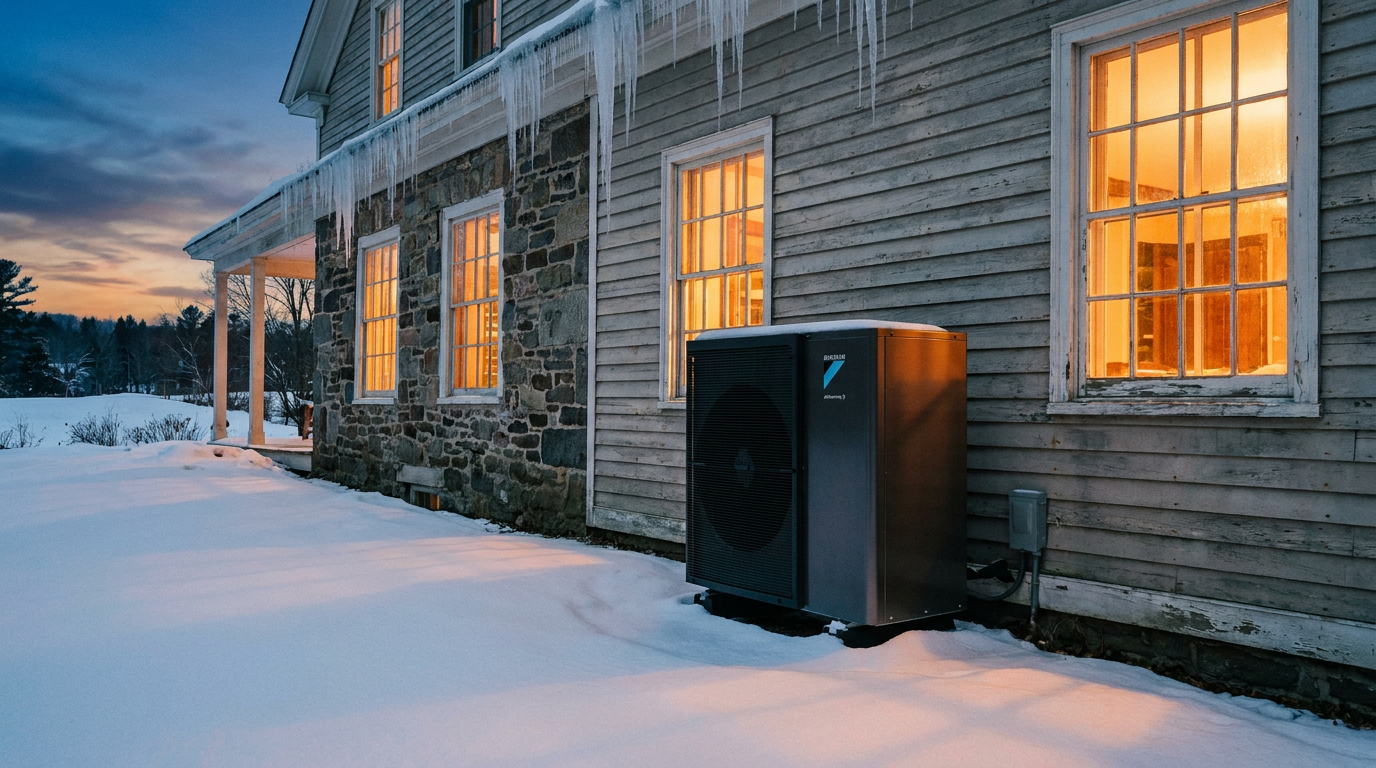
- Electrification Advocates
- Argue that the technology is fully mature and fossil fuel heating should be phased out immediately.
- HVAC Traditionalists
- Caution that upfront costs and home-specific variables still make dual-fuel systems necessary in some cases.
- Industry Manufacturers
- Focus on the engineering breakthroughs and commercial readiness of the new equipment.
Why this matters
Heating and cooling account for over 40% of residential energy use. For millions of homeowners in northern climates, this new generation of technology finally makes it possible to ditch expensive heating oil and propane without freezing during winter cold snaps.
For decades, the conventional wisdom in home improvement was simple: heat pumps are great for mild climates like Florida or California, but if you live where it snows, you absolutely need a furnace. Older heat pumps extracted warmth from the outside air, but as temperatures dropped below freezing, they rapidly lost capacity and relied on expensive, energy-hogging electric resistance backup strips to keep the house warm. That fundamental limitation kept millions of northern homeowners tethered to natural gas, heating oil, and propane, unable to fully electrify their homes without risking a freezing living room during a January polar vortex.[7]
By 2026, that conventional wisdom is officially obsolete. A multi-year push by the U.S. Department of Energy (DOE), combined with rapid breakthroughs in compressor technology and the introduction of new refrigerants, has fundamentally rewritten the rules of residential heating. The new generation of Cold Climate Heat Pumps (CCHPs) can now extract ambient heat from the air even when the thermometer plunges to 15 degrees below zero, providing reliable, efficient warmth without the need for fossil fuels. This shift is not just a minor efficiency bump; it represents a complete transformation of the HVAC industry, allowing homes in New England, the Midwest, and Canada to fully decarbonize their heating systems.[1][7]
The turning point for this technological leap was the DOE's Cold Climate Heat Pump Technology Challenge, launched in 2021 to accelerate the development of sub-zero heating solutions. The federal government partnered with eight major HVAC manufacturers—including industry giants like Carrier, Lennox, Bosch, and Trane—to develop and field-test prototypes that could maintain high efficiency in extreme cold without relying on backup heat. The results of that rigorous field validation, published by the Pacific Northwest National Laboratory (PNNL) in early 2025, proved definitively that the technology was ready for mass deployment across the coldest regions of North America.[1][2]
In the PNNL field tests, the prototype units consistently outperformed traditional systems, shattering the old limitations of air-source heating. Even in the bitter 0 to 5°F temperature bin, the heat pumps maintained a median Coefficient of Performance (COP) of 1.9—meaning they produced nearly twice as much heat energy as the electrical energy they consumed. Manufacturers moved quickly from successful prototypes to full-scale production. By mid-2025, Carrier announced its flagship unit could operate reliably down to -23°F while maintaining 100% of its rated heating capacity at 0°F, a milestone that previously seemed impossible for an air-source unit.[2][3]
Lennox followed suit shortly after, successfully passing commercial lab validation for heavy-duty rooftop units in the 15-to-25-ton category. This achievement signaled that the technology was scaling beyond single-family residential homes and into larger commercial buildings, solving long-standing defrost limitations that had plagued commercial heat pumps. These manufacturing milestones marked the definitive end of the "hybrid" era, where northern homes and businesses required a gas furnace as a mandatory backup system just to survive the winter. With these units now widely available in 2026, the transition to fully electric heating is accelerating rapidly.[4]
So, how exactly do these new systems pull heat out of sub-zero air? The breakthrough relies on three distinct mechanical upgrades working in tandem. The first and most crucial is the variable-speed inverter compressor. Unlike older single-speed heat pumps that simply blast on at 100% power and then shut off, an inverter compressor acts like a car's accelerator pedal. It can ramp up to maximum capacity during a blizzard to capture every available unit of heat, or cruise at low power during a mild autumn afternoon. This prevents short-cycling, maintains a perfectly steady indoor temperature, and drastically improves overall efficiency.[6][7]
The second major upgrade is a process known as enhanced vapor injection. This technology diverts a small amount of the system's refrigerant, passes it through a secondary expansion valve, and injects it back into the compressor at a warmer temperature. This internal "boost" allows the system to achieve a much broader operating temperature range. While it sacrifices a tiny fraction of peak efficiency during mild weather, it drastically improves the system's low-ambient performance, ensuring the heat pump can continue extracting thermal energy even when the outside air feels bone-chillingly cold to human skin.[7]

The second major upgrade is a process known as enhanced vapor injection.
The third piece of the puzzle is the 2026 refrigerant transition. Federal regulations mandated a nationwide shift away from older, high-global-warming-potential (GWP) chemicals like R-410A, forcing the industry to innovate. Manufacturers have moved to low-GWP alternatives like R-32, R-454B, and R-290, which is highly refined propane. R-290 is particularly transformative for the residential market because of its unique thermodynamic properties, which allow it to absorb and release heat much more effectively at extreme temperature differentials than legacy refrigerants. This shift not only makes the units more environmentally friendly if a leak occurs, but actively improves their cold-weather heating performance.[3][5]
Retrofitting a 100-year-old house presents unique challenges that these new refrigerants help solve. Older homes are often drafty, under-insulated, and lack the expansive ductwork required for modern forced-air systems. Furthermore, historic homes that rely on traditional cast-iron radiators require water to be heated to much higher temperatures than standard heat pumps can typically provide. R-290 heat pumps solve this exact problem by producing flow temperatures up to 167°F. This allows homeowners to keep their beautiful historic radiators while completely ditching the dirty, fossil-fuel boiler in the basement, bridging the gap between 19th-century architecture and 21st-century technology.[5][7]
For older homes without existing ductwork or hydronic radiators, ductless mini-splits have become the standard, non-invasive solution. These systems require only a small, three-inch hole in the wall to connect an outdoor compressor to individual indoor air-handling heads mounted in various rooms. This architecture allows for precise zoned heating—meaning you can keep the living room at a cozy 72°F while letting an unused guest bedroom stay cooler. By only heating the occupied spaces of a drafty older home, homeowners can further reduce their winter energy consumption without undertaking massive, wall-destroying renovations.[6]

The economics of retrofitting have also shifted favorably in recent years, making the transition more accessible to the middle class. While the upfront cost remains a significant hurdle—typically ranging from $8,000 to $15,000 for a whole-home ducted system, or $4,000 to $10,000 for a multi-zone ductless setup—federal and state incentives heavily subsidize the installation. The Inflation Reduction Act (IRA) provides a non-refundable tax credit of up to $2,000 for qualifying high-efficiency heat pumps, and many states and local utility companies offer additional point-of-sale rebates that can shave thousands more off the final invoice.[6][7]
The return on investment is most dramatic for homes currently heating with delivered fuels like heating oil or propane, which are subject to massive price spikes. In Maine, which serves as the nation's premier testing ground for cold-climate electrification, the state successfully hit its aggressive goal of installing 100,000 heat pumps by 2024. Data from Efficiency Maine showed that homeowners reduced their heating costs by 40% to 60% compared to oil, with an overwhelming 89% satisfaction rate—even after enduring a brutal -15°F cold snap in February 2023 that put the systems to the ultimate test.[6]

Despite these technological triumphs, the transition is not without friction on the ground. Many veteran HVAC contractors remain biased toward the gas furnaces they have installed for decades, sometimes steering homeowners away from heat pumps due to a lack of familiarity with the new cold-climate specifications. Proper installation is absolutely critical; accurate load calculations, deep system vacuums, and precise refrigerant charging are far more important for complex inverter-driven heat pumps than for traditional, simple gas furnaces. A poorly installed heat pump will underperform and cost more to run, making contractor education the next major hurdle for the industry.[7]
Furthermore, older homes often require significant electrical panel upgrades to handle the new 240-volt circuits required by the powerful outdoor compressors. A historic home with a legacy 100-amp service panel may need a $2,000 to $3,000 electrical upgrade before a heat pump can even be legally installed, adding to the initial friction and upfront cost of electrification. This hidden cost often catches homeowners by surprise when they receive their initial quotes. Addressing this electrical bottleneck is crucial for scaling the technology in older neighborhoods.[7]
To mitigate this electrical bottleneck, smart electrical panels and load-shedding devices are increasingly being deployed in older homes. These intelligent systems monitor the home's total power draw and can automatically pause a water heater or electric vehicle charger for a few minutes while the heat pump cycles on, allowing homes to safely operate heavy electric loads without triggering a costly utility service upgrade. As these peripheral smart-home technologies mature alongside the heat pumps themselves, the barrier to entry continues to fall for average homeowners.[7]
Ultimately, the 2026 heating landscape proves that the core technological barriers to decarbonizing residential heating have been successfully dismantled. The challenge is no longer whether a heat pump can keep a drafty old house warm in a blizzard—the engineering has definitively answered that question. The focus now shifts to how quickly the workforce can be trained to install them properly, and how seamlessly older homes can be adapted to embrace the electric future of home comfort. For homeowners ready to make the leap, the technology is finally waiting for them.[7]
Viewpoints in depth
Electrification Advocates
Argue that the technology is fully mature and fossil fuel heating should be phased out immediately.
Environmental groups and electrification proponents point to the DOE Challenge results and real-world data from states like Maine as proof that the "cold weather" argument against heat pumps is officially dead. They argue that continuing to install gas furnaces locks in decades of carbon emissions and exposes homeowners to volatile fossil fuel prices. From this perspective, the focus should shift entirely to expanding rebates, training installers, and updating building codes to mandate heat pumps in all new construction and major retrofits.
HVAC Traditionalists
Caution that upfront costs and home-specific variables still make dual-fuel systems necessary in some cases.
Many veteran HVAC contractors and industry skeptics acknowledge the massive improvements in inverter technology but warn against a one-size-fits-all approach. They note that in poorly insulated, drafty older homes, a heat pump alone might struggle to keep up during a polar vortex without relying heavily on expensive electrical resistance backup. This camp often advocates for "dual-fuel" or hybrid systems—pairing a new heat pump with a gas furnace that only kicks on when temperatures drop below 15°F—as a safer, more comfortable bridge technology for extreme climates.
Energy Policymakers
Focus on grid readiness and the logistical hurdles of mass adoption.
For utility regulators and government officials, the success of cold-climate heat pumps is a double-edged sword. While it solves the emissions problem of home heating, it massively increases winter electrical demand. Policymakers are focused on ensuring the local power grids can handle millions of homes simultaneously drawing high amperage during a January freeze. They advocate for "grid-interactive" heat pumps that can be slightly dialed back by the utility during peak demand events, and emphasize the need for simultaneous investments in home insulation to lower the overall energy burden.
What we don't know
- How local electrical grids in northern states will handle the surge in winter peak demand as mass adoption accelerates.
- Whether the shortage of trained HVAC technicians familiar with low-GWP refrigerants and inverter systems will bottleneck installations.
- How long the federal and state rebate programs will remain funded at their current levels.
Sources
Source coverage
7 outlets
3 viewpoints surfaced







[1]U.S. Department of EnergyElectrification Advocates
Residential Cold Climate Heat Pump Technology Challenge
Read on U.S. Department of Energy →[2]Pacific Northwest National LaboratoryElectrification Advocates
Performance Results from DOE Cold Climate Heat Pump Challenge Field Validation
Read on Pacific Northwest National Laboratory →[3]Facilities DiveIndustry Manufacturers
Carrier completes DOE cold climate heat pump challenge
Read on Facilities Dive →[4]LennoxIndustry Manufacturers
Lennox Commercial HVAC's cold climate heat pump rooftop unit is the first to pass lab validation
Read on Lennox →[5]EcohomeElectrification Advocates
The 2026 Heat Pump Guide: Low-GWP Refrigerants and Cold Climate Tech
Read on Ecohome →[6]The Daily ExplainerHVAC Traditionalists
Is a heat pump right for your home? Complete 2026 guide
Read on The Daily Explainer →[7]Factlen Editorial TeamIndustry Manufacturers
Synthesis by Factlen editorial team
Read on Factlen Editorial Team →
Every angle. Every day.
Get home stories with full source coverage and perspective breakdowns delivered to your inbox.