
Brain-Computer Interfaces Cross the Threshold to Independent, Wireless Home Use
Two major clinical milestones in June 2026 have transitioned speech neuroprosthetics from lab-bound experiments to independent, fully wireless medical devices capable of restoring fluent communication to paralyzed patients.
By Factlen Editorial Team
- Neurotechnology Researchers
- Focus on the transition from lab-bound experiments to robust, real-world medical devices.
- Patient Advocates
- Emphasize the restoration of autonomy, dignity, and personal connection.
- Commercial Developers
- Focus on FDA pathways, safety standards, and the race to scale the technology.
What's not represented
- · Health Insurance Providers
- · Bioethicists
Why this matters
For decades, brain-computer interfaces required teams of engineers and tethered lab equipment to function. These breakthroughs prove the technology is finally ready to operate independently in patients' homes, offering a scalable path to restore autonomy and connection for millions suffering from severe paralysis.
Key points
- A man with ALS successfully used a brain-computer interface independently at home for over 3,800 hours.
- The BrainGate2 system achieved 99% decoding accuracy across a 125,000-word vocabulary, allowing communication at 56 words per minute.
- University of Michigan neurosurgeons completed the first human implant of the Paradromics Connexus, a fully wireless BCI.
- The Connexus system uses 421 microelectrodes and a chest transceiver to eliminate the need for external cranial hardware.
- These dual milestones signal the transition of speech neuroprosthetics from lab-bound experiments to viable medical devices.
In mid-June 2026, the field of neuroprosthetics crossed a critical threshold, transitioning from lab-bound experiments to independent, real-world medical devices. Two major milestones—a peer-reviewed demonstration of long-term, unassisted home use, and the first human implantation of a fully wireless, high-bandwidth array—have fundamentally altered the timeline for restoring speech to patients with severe paralysis.[1][3]
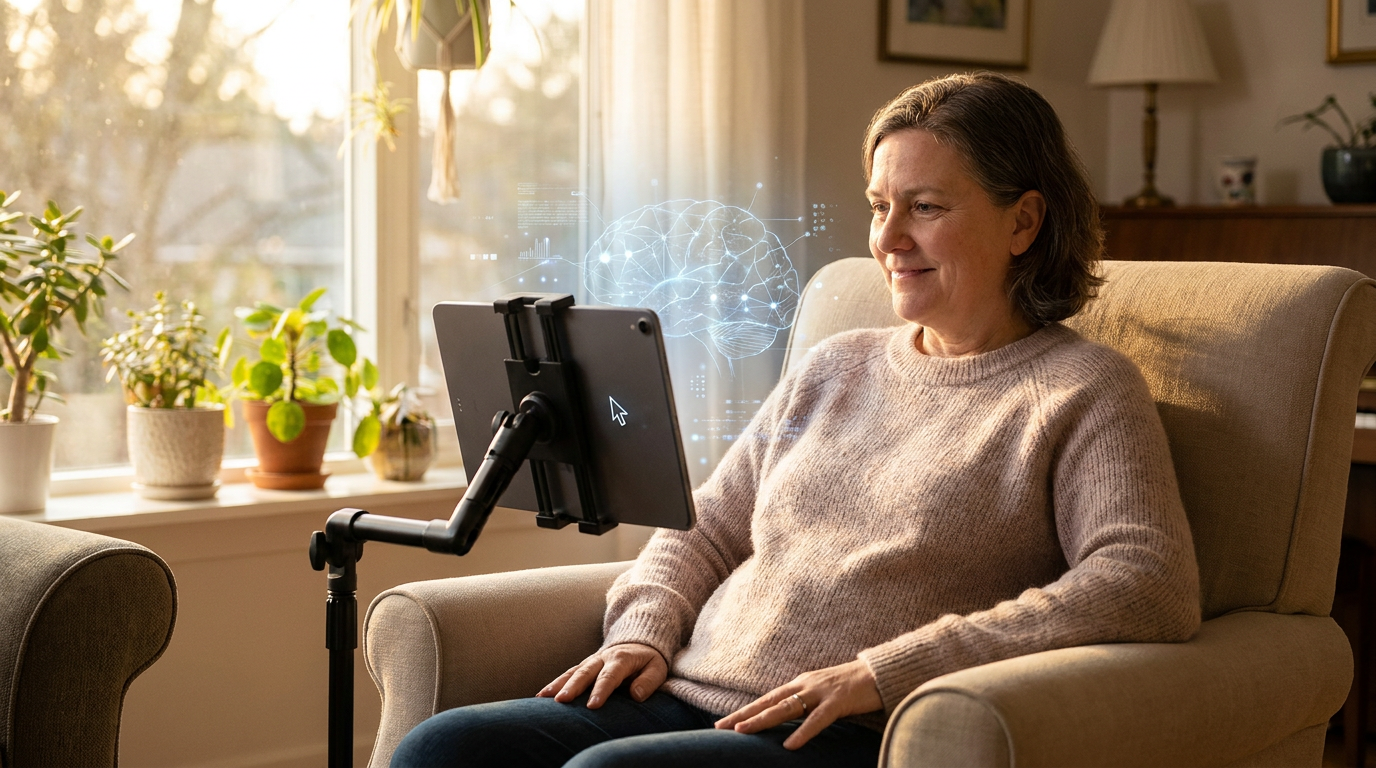
The most robust evidence for this shift was published in Nature Medicine on June 15, detailing the outcomes of the BrainGate2 clinical trial. The study tracked Casey Harrell, a 47-year-old man with amyotrophic lateral sclerosis (ALS), who used an investigational brain-computer interface (BCI) in his home for more than 3,800 hours over a two-year period.[1][2][4]
Historically, BCI trials have been constrained to highly controlled research sessions, requiring teams of engineers to calibrate the system and monitor the hardware. The BrainGate2 data represents a paradigm shift: Harrell operated the system independently, relying only on his standard care team, to browse the internet, send emails, and hold in-person conversations for up to 12 hours at a time.[2][4][6]
The performance metrics recorded during this two-year window set a new benchmark for the field. The system achieved a 99% accuracy rate across a working vocabulary of 125,000 words—essentially the entire functional lexicon of an English-speaking adult. Harrell’s communication speed averaged 56 words per minute, approaching the cadence of natural, slow conversation.[2][4][6]

The mechanism underlying this accuracy relies on decoding motor intent rather than internal monologue. The UC Davis surgical team implanted four microelectrode arrays—totaling 256 electrodes—into Harrell’s left precentral gyrus, the brain region responsible for coordinating speech. When Harrell attempts to speak, the electrodes intercept the neural commands intended for his paralyzed facial and vocal muscles.[1][2][6]
Machine-learning algorithms then translate these firing patterns into phonemes—the basic units of sound—and assemble them into text. A text-to-speech engine, trained on audio recordings of Harrell from before his ALS diagnosis, vocalizes the words in his natural voice. The emotional and psychological impact of this restoration is profound, allowing Harrell to communicate dynamically with his family and young daughter.[4][6]

While the BrainGate2 trial proved the software and decoding algorithms are ready for real-world use, the hardware has remained a bottleneck. Early BCI systems, including the one used by Harrell, rely on physical pedestals protruding through the skull, which carry infection risks and tether the user to external computers.[3][5]
While the BrainGate2 trial proved the software and decoding algorithms are ready for real-world use, the hardware has remained a bottleneck.
On June 17, a second breakthrough addressed this hardware limitation. Neurosurgeons at University of Michigan Health completed the first-in-human implantation of the Connexus BCI, developed by Austin-based neurotechnology company Paradromics. This procedure marks the beginning of the FDA-approved Connect-One Early Feasibility Study.[3][5][8]
The Connexus system is fully implantable and wireless, designed to eliminate the need for external cranial hardware. The device utilizes a high-density array of 421 microelectrodes—each thinner than a human hair—implanted directly into the cortex.[5][8]
The neural signals captured by these electrodes are routed beneath the skin to a discrete transceiver implanted in the patient's chest. This chest unit then broadcasts the data wirelessly to an external digital interface. By moving the transmission hardware away from the scalp, the system drastically reduces the risk of infection and improves the user's daily comfort.[3][5][7]

Beyond its wireless architecture, the Paradromics system is engineered for unprecedented data bandwidth. Preclinical data indicates the Connexus implant can achieve an information transfer rate exceeding 200 bits per second. For context, transcribed human speech typically occurs at roughly 40 bits per second, suggesting the hardware has the capacity to support highly complex, real-time decoding.[7]
The Connect-One trial will rigorously test these claims in humans. The study will follow the initial participant—a Michigan woman with motor neuron disease—for six years to evaluate the long-term bio-compatibility, safety, and recording integrity of the device. The primary endpoint is proving that the microelectrodes can survive the brain's immune response without degrading over a multi-year timeline.[3][5][8]
These dual milestones highlight an accelerating commercial and scientific race. Paradromics is now advancing alongside competitors like Neuralink, which utilizes a robotic surgical insertion method, and Synchron, which deploys a stent-like electrode array through the blood vessels to avoid open brain surgery. Each approach carries distinct trade-offs between data resolution and surgical invasiveness.[7]

Despite the overwhelming success of the recent trials, transparent uncertainties remain. The longevity of intracortical microelectrodes is still a primary engineering challenge, as the brain's natural glial scarring can encapsulate the sensors and degrade signal quality over a decade. Furthermore, the cost and scalability of these bespoke, surgically implanted systems remain unknown.[4][5][7]
Nevertheless, the evidence gathered in June 2026 confirms that the fundamental science of speech neuroprosthetics is sound. By proving that paralyzed individuals can communicate fluently, independently, and wirelessly in their own homes, researchers have moved BCIs out of the laboratory and into the realm of viable, life-altering medicine.[2][3]
How we got here
July 2023
Casey Harrell receives the BrainGate2 investigational BCI implant at UC Davis Health.
August 2024
Initial BrainGate2 results are published, demonstrating 97% accuracy in controlled lab settings.
November 2025
The FDA grants Paradromics an Investigational Device Exemption to begin human trials for its wireless Connexus implant.
June 15, 2026
Nature Medicine publishes data showing Harrell successfully used the BCI independently at home for 3,800 hours.
June 17, 2026
Neurosurgeons at the University of Michigan complete the first-in-human permanent implant of the wireless Paradromics Connexus BCI.
Viewpoints in depth
Neurotechnology Researchers
Focus on the transition from lab-bound experiments to robust, real-world medical devices.
For the scientific community, the 3,800-hour dataset generated by the BrainGate2 trial is the holy grail. Researchers argue that proving a system can operate without a team of engineers constantly recalibrating it is the definitive threshold for clinical viability. They view the combination of high-density arrays and advanced machine learning as the foundation for a new era of neuroprosthetics.
Patient Advocates
Emphasize the restoration of autonomy, dignity, and personal connection.
Advocacy groups for ALS and other motor neuron diseases focus on the profound psychological impact of these devices. The ability to speak in one's own synthesized voice, crack jokes, and communicate independently at home is seen as a restoration of fundamental human dignity. Advocates stress that the ultimate goal is not just technological novelty, but returning patients to their families and society.
Regulatory & Commercial Developers
Focus on FDA pathways, safety standards, and the race to scale the technology.
Companies like Paradromics, Neuralink, and Synchron are focused on the commercial and regulatory hurdles of bringing BCIs to market. Their primary concerns are proving long-term bio-compatibility—ensuring the brain's immune system doesn't degrade the electrodes over time—and developing surgical techniques that are safe and scalable. They view the FDA's IDE approvals as a signal that the regulatory framework is ready for commercial neurotechnology.
What we don't know
- The maximum lifespan of intracortical microelectrodes before the brain's natural immune response degrades their signal quality.
- The final commercial cost of these bespoke, surgically implanted systems and whether insurance will broadly cover them.
- How the technology will perform in patients whose speech motor cortex has been more severely degraded by advanced disease progression.
Key terms
- Brain-Computer Interface (BCI)
- A system that establishes a direct communication pathway between the brain's electrical activity and an external device, such as a computer.
- Neuroprosthesis
- A device that connects to the nervous system to replace or improve function lost to disease or injury, such as restoring speech or movement.
- Microelectrode Array
- A tiny grid of microscopic sensors implanted into the brain to detect the electrical firing of individual neurons.
- Phoneme
- The distinct units of sound in a specified language that distinguish one word from another, which BCIs decode to build sentences.
- Amyotrophic Lateral Sclerosis (ALS)
- A progressive neurodegenerative disease that affects nerve cells in the brain and spinal cord, eventually leading to severe paralysis and loss of speech.
Frequently asked
How does the brain-computer interface know what the person wants to say?
The BCI does not read internal thoughts. Instead, it intercepts the electrical commands the brain's motor cortex attempts to send to the lips, tongue, and jaw, and translates those specific movement intents into phonemes and words.
Does the user need to be in a hospital to use the device?
No. The latest breakthrough demonstrated that a patient could use the system independently at home for thousands of hours without researchers present to calibrate or monitor the equipment.
Is the implant visible on the outside of the head?
Early models used physical pedestals that protruded through the scalp. However, the newest systems, like the Paradromics Connexus, are fully implantable and wireless, transmitting data through the skin to an external receiver.
How fast can someone communicate using these new BCIs?
Recent trials have achieved speeds of 56 words per minute with 99% accuracy, which is comparable to the pace of a slow, natural conversation.
Sources
Source coverage
8 outlets
3 viewpoints surfaced








[1]Nature MedicineNeurotechnology Researchers
A highly accurate and rapidly calibrating speech neuroprosthesis
Read on Nature Medicine →[2]UC Davis HealthNeurotechnology Researchers
Brain-computer interface enables independent, accurate communication for man living with ALS
Read on UC Davis Health →[3]University of Michigan HealthCommercial Developers
University of Michigan implants first-in-human Paradromics wireless brain-computer interface
Read on University of Michigan Health →[4]The Washington PostPatient Advocates
New brain-computer interfaces are giving paralyzed people their voices back
Read on The Washington Post →[5]Neuroscience NewsNeurotechnology Researchers
Clinical Trial Tests Fully Implantable BCI for Advanced ALS
Read on Neuroscience News →[6]ScienceAlertPatient Advocates
A man with severe paralysis can now 'speak' using an experimental brain implant
Read on ScienceAlert →[7]PharmaphorumCommercial Developers
Paradromics cleared for FDA trial of speech-restoring BCI
Read on Pharmaphorum →[8]ParadromicsCommercial Developers
Paradromics Receives FDA Approval for the Connect-One Clinical Study
Read on Paradromics →
Every angle. Every day.
Get science stories with full source coverage and perspective breakdowns delivered to your inbox.