
Fine-Tuning Forgets, RAG Leaks: Why Hypernetworks Are the Next Era of AI Infrastructure
As enterprise AI agents stall in production due to context limits and retraining costs, a new architecture called hypernetworks is emerging to generate custom model weights dynamically on demand.
By Factlen Editorial Team
- Enterprise Orchestrators
- Focused on the reliability, cost, and latency of deploying autonomous agents in production.
- AI Infrastructure Providers
- Prioritize compute efficiency, memory reduction, and scalable hosting architectures.
- Machine Learning Researchers
- Focused on advancing meta-learning, dynamic architectures, and solving catastrophic forgetting.
What's not represented
- · Hardware Manufacturers
- · Open-Source AI Developers
Why this matters
As AI agents move from experimental sandboxes to handling real enterprise workflows, their inability to reliably remember context has become a critical bottleneck. Hypernetworks solve this by allowing AI to dynamically generate its own custom models on the fly, drastically cutting cloud computing costs and paving the way for truly autonomous, long-running digital workers.
Key points
- Enterprise AI agents frequently stall in production due to the memory limits of RAG and the high costs of fine-tuning.
- Hypernetworks solve this by dynamically generating custom model weights, or adapters, on the fly based on the task.
- Sakana AI's Doc-to-LoRA can compress a document into a lightweight adapter, reducing memory overhead from 12 GB to 50 MB.
- This architecture allows AI agents to instantly adapt to new codebases or policies without human intervention or retraining.
- While training hypernetworks requires significant upfront compute, they drastically reduce inference costs and latency at deployment.
Enterprise software teams are watching a frustrating pattern repeat across the industry. An artificial intelligence agent demos beautifully in a sandbox, gets deployed to production, and quickly stalls. It runs for a short stretch before requiring a human to top up its context, check its output, and correct its hallucinations. The promised efficiency of autonomous agents drains into constant supervision, leaving many pilot programs stuck in purgatory.[1]
The root of this failure is not a lack of orchestration or routing. According to industry analysts, the deeper question is how long an agent can run before a human has to step in, which ultimately comes down to where a company's proprietary knowledge lives relative to the AI model. Currently, enterprises rely on two standard methods to feed business context to an AI: fine-tuning and Retrieval-Augmented Generation (RAG). Both are hitting their structural limits.[1]
Fine-tuning attempts to bake knowledge directly into a model's weights. However, this approach suffers from a decades-old machine learning problem known as catastrophic forgetting. Teaching a model a new policy or dataset tends to erode the information it already knew. To work around this, teams isolate tasks into separate fine-tuned models, creating a sprawling, expensive estate of static models that become stale the moment a company policy changes.[1]
The alternative, Retrieval-Augmented Generation (RAG), skips retraining entirely by fetching relevant documents and stuffing them into the model's prompt at runtime. While currently the industry standard, RAG is fundamentally constrained by the model's context window. As AI firm Chroma recently demonstrated in benchmark tests, even the most advanced frontier models lose accuracy as their input grows—a fundamental property of how attention mechanisms work, not a gap that a stronger model simply closes. Furthermore, stuffing massive prompts drives up cloud inference costs and latency, while a failure in the retrieval step guarantees a confident hallucination.[1]

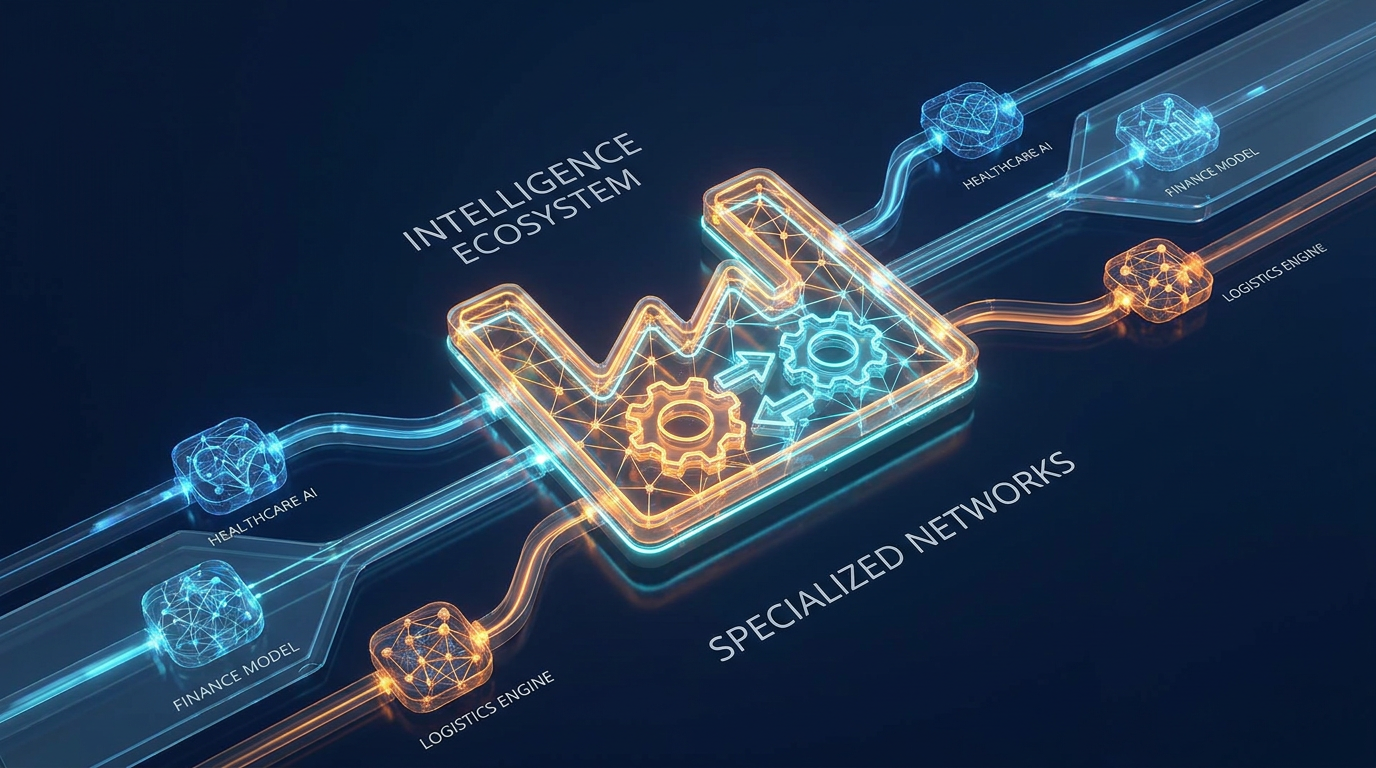
To break this deadlock, the AI infrastructure layer is shifting toward a radically different architecture: hypernetworks. First conceptualized years ago but only now reaching production viability, a hypernetwork is essentially a neural network that generates the parameters for another neural network. Instead of relying on static weights or bloated prompts, hypernetworks build the exact model an agent needs on demand, dynamically generating custom weights for specific tasks.[1][6]
Think of a hypernetwork as a dynamic weight factory. In traditional deep learning, a model is trained once through backpropagation, and its parameters remain fixed during inference. A hypernetwork, by contrast, takes a conditioning signal—such as a task description, a user profile, or a proprietary document—and outputs a tailored set of parameters for a target network. This allows the AI to instantly adapt to new contexts without the slow, expensive loop of traditional retraining.[5][6]
In traditional deep learning, a model is trained once through backpropagation, and its parameters remain fixed during inference.
The theoretical promise of hypernetworks materialized into practical enterprise tools in early 2026. Tokyo-based Sakana AI introduced two groundbreaking systems, Text-to-LoRA and Doc-to-LoRA, which use lightweight hypernetworks to meta-learn the adaptation process. Instead of fine-tuning a model from scratch, these systems generate Low-Rank Adaptation (LoRA) matrices in a single forward pass, effectively creating a custom plug-in for the base model in sub-seconds.[2][3]
The Doc-to-LoRA system specifically targets the weaknesses of RAG. When an enterprise needs an AI agent to understand a massive new technical manual or legal contract, the hypernetwork processes the document and instantly outputs a LoRA adapter. The base model then internalizes this new factual content without ever seeing the raw text in its prompt. It acts as a persistent memory toggle, allowing the agent to answer queries with high accuracy while keeping the context window completely empty.[2]
This architectural shift drastically alters the economics of cloud computing and AI hosting. By internalizing context into parameters rather than prompt tokens, hypernetworks slash the memory required to run complex agents. According to technical reviews of the architecture, Doc-to-LoRA reduces the Key-Value (KV) cache memory consumption for long documents from over 12 gigabytes down to less than 50 megabytes. This massive reduction in overhead allows cloud providers to serve highly personalized, context-aware models at a fraction of the traditional compute cost, fundamentally improving the margins of AI-as-a-Service platforms.[3]

Similarly, Text-to-LoRA eliminates the need for curated datasets and manual training jobs when teaching an agent a new skill. A developer simply provides a natural-language description of the desired task, and the hypernetwork generates a specialized adapter instantly. The per-task adaptation cost disappears, replaced by a one-time upfront meta-training investment in the hypernetwork itself. This enables agents to fluidly adjust their capabilities as they navigate complex, multi-step workflows.[2]
Beyond text generation, hypernetworks are driving breakthroughs in model compression and continuous learning. Recent research into 'Neural Metamorphosis' (NeuMeta) leverages hypernetworks to allow models to dynamically resize and adjust their architecture based on hardware constraints. By treating neural networks as entities capable of self-reflection and change, these systems maintain high performance even at a 75 percent compression rate, outperforming traditional pruning techniques.[4]
For autonomous AI agents, dynamic model generation is the missing link for long-horizon reliability. When an agent encounters an unfamiliar codebase or a novel edge case in a live production environment, it no longer needs to halt and wait for a human developer to fine-tune a new model. Instead, the agent can call upon a hypernetwork to instantly generate a specialized sub-model, complete the task with high precision, and then discard the temporary weights. This achieves a level of fluid adaptability that mimics human cognitive flexibility, allowing digital workers to operate independently for days rather than minutes.[4][5]

Despite the immense potential, deploying hypernetworks at scale introduces new engineering complexities. Training a network to generate weights for another network adds a dense layer of abstraction, making the initial meta-training phase highly resource-intensive. Furthermore, the indirect nature of weight generation can lead to training instability, requiring careful calibration to ensure the generated models do not produce erratic or unsafe outputs in live enterprise environments.[5]
Nevertheless, the transition from static models to dynamic, self-generating architectures marks a fundamental maturation in artificial intelligence. As the limitations of prompt engineering and traditional fine-tuning become undeniable bottlenecks for enterprise adoption, hypernetworks offer a scalable path forward. By building the exact model required at the exact moment it is needed, the AI industry is finally equipping autonomous agents with the durable memory and adaptability required to fulfill their original promise.[1][2]
How we got here
1980s
Catastrophic forgetting is identified as a fundamental flaw in neural network training.
2023-2024
RAG becomes the dominant enterprise method for adding context to Large Language Models.
Late 2025
Researchers highlight the limits of RAG, noting severe context window degradation in production agents.
Feb 2026
Sakana AI introduces Doc-to-LoRA and Text-to-LoRA, proving hypernetworks can instantly generate model adapters.
June 2026
Hypernetworks gain mainstream traction as the solution for stalling enterprise AI infrastructure.
Viewpoints in depth
Enterprise Orchestrators
For software teams deploying agents, hypernetworks solve the 'supervision drain' where AI requires constant human intervention.
Enterprise developers have grown disillusioned with the fragility of RAG pipelines and the overhead of managing thousands of fine-tuned models. From their perspective, hypernetworks represent a shift from 'managing models' to 'managing outcomes.' By generating adapters on the fly, orchestration layers can finally trust agents to run long-horizon tasks overnight without their context windows degrading or their retrieval systems hallucinating.
AI Infrastructure Providers
Cloud hosts view dynamic model generation as a critical path to sustainable scaling and margin improvement.
The economics of hosting AI are currently strained by the massive Key-Value cache memory required to process 128k-token prompts for every user query. Infrastructure providers see hypernetworks as a silver bullet for this bottleneck. By compressing a 12-gigabyte context load into a 50-megabyte LoRA adapter, cloud hosts can serve exponentially more users on the same GPU clusters, fundamentally altering the profitability of AI-as-a-Service.
Machine Learning Researchers
Academics view hypernetworks as a step toward brain-inspired, continuous learning systems.
For researchers, the static nature of traditional neural networks has always been an artificial constraint. The human brain does not freeze its synapses after a training phase; it dynamically reconfigures itself. Researchers view hypernetworks and meta-learning frameworks as the foundation for Artificial General Intelligence (AGI) components, allowing systems to self-reflect, adapt to novel environments, and overcome the decades-old hurdle of catastrophic forgetting.
What we don't know
- How reliably hypernetworks can prevent the generation of unstable or unsafe weights when exposed to adversarial edge cases in production.
- Whether the massive upfront compute cost of meta-training hypernetworks will limit their development to only the largest AI labs.
- How quickly major cloud providers will natively integrate dynamic weight generation into their enterprise AI platforms.
Key terms
- Hypernetwork
- A neural network designed to dynamically generate the weights and parameters for another neural network.
- RAG (Retrieval-Augmented Generation)
- A technique that fetches external documents and inserts them into an AI's prompt to provide context.
- Catastrophic Forgetting
- A phenomenon where a neural network loses previously learned information when trained on new data.
- LoRA (Low-Rank Adaptation)
- A lightweight, plug-in adapter that modifies a base AI model for a specific task without full retraining.
- KV Cache
- The memory an AI model uses to store the context of a conversation or document during generation.
Frequently asked
Why do AI agents stall in production?
Agents often fail because they rely on massive prompts that degrade the model's accuracy over time, or because retraining them is too slow to keep up with changing business logic.
How is a hypernetwork different from fine-tuning?
Fine-tuning permanently alters a model's weights through a slow, expensive training process, whereas a hypernetwork instantly generates a temporary, custom adapter for the model on the fly.
Does this replace RAG?
For many enterprise use cases, yes. Instead of stuffing documents into a prompt (RAG), hypernetworks internalize the document into a lightweight adapter, saving memory and improving accuracy.
Sources
Source coverage
6 outlets
3 viewpoints surfaced






[1]VentureBeatEnterprise Orchestrators
Fine-tuning forgets. RAG leaks context. Hypernetworks build the model your agent needs on demand.
Read on VentureBeat →[2]Sakana AIMachine Learning Researchers
Doc-to-LoRA and Text-to-LoRA: Hypernetworks for LLM Adaptation
Read on Sakana AI →[3]MarktechpostAI Infrastructure Providers
Sakana AI Introduces Doc-to-LoRA and Text-to-LoRA
Read on Marktechpost →[4]TuringPostAI Infrastructure Providers
Neural Metamorphosis (NeuMeta)
Read on TuringPost →[5]arXivMachine Learning Researchers
Hypernetworks in Deep Learning: A Comprehensive Survey
Read on arXiv →[6]MediumMachine Learning Researchers
What Are Hypernetworks? The Future of Dynamic AI
Read on Medium →

More in technology
See all 5 stories →


Every angle. Every day.
Get technology stories with full source coverage and perspective breakdowns delivered to your inbox.