
New Construction vs. Existing Homes: Which is the Better Buy in 2026?
With builder incentives narrowing the price gap and resale inventory remaining tight, the financial math between buying a new build and an existing home has fundamentally shifted in 2026.
By Factlen Editorial Team
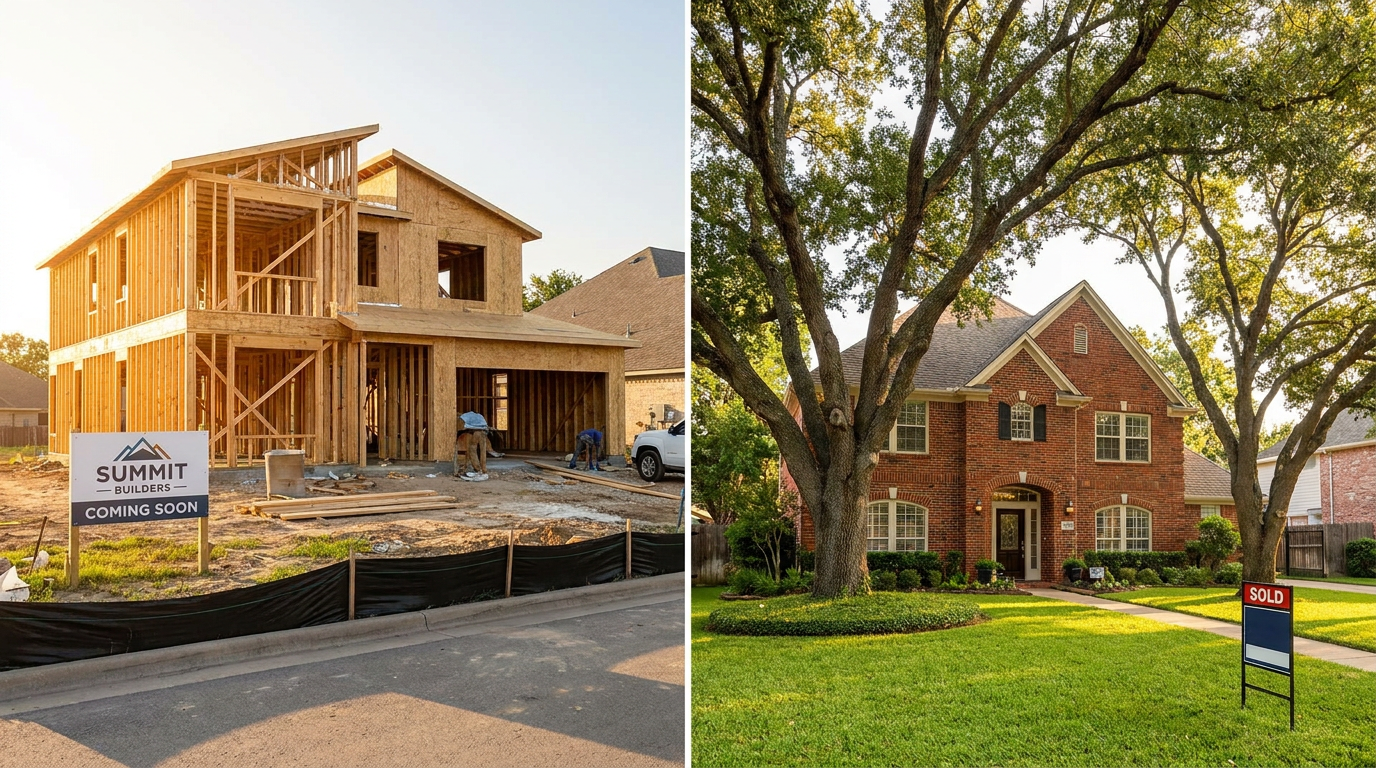
- New Construction Advocates
- Argue that builder incentives and energy efficiency make new homes the smarter financial play in 2026.
- Existing Home Loyalists
- Emphasize the irreplaceable value of mature neighborhoods, fixed purchase prices, and fast closing timelines.
- Market Analysts
- Track the narrowing price gap and inventory metrics to advise buyers on macroeconomic trends.
What's not represented
- · Renters priced out of both markets
- · Custom home builders (non-production)
Why this matters
For buyers navigating high interest rates, choosing the right path can mean the difference between securing a manageable monthly payment through a builder buydown or facing unexpected maintenance costs in an older home.
Key points
- The median list price for a new home in early 2026 is $449,373, carrying a 15.1% premium over existing homes.
- Over 60% of home builders are offering sales incentives, including mortgage rate buydowns that lower monthly payments.
- Existing homeowners are staying put to keep their low mortgage rates, severely restricting the supply of resale homes.
- New homes average just $5,000 in maintenance over the first five years, compared to $15,000 for older homes.
- The price per square foot between new and existing homes has nearly equalized at $217 and $216, respectively.
Buyers entering the 2026 real estate market face a unique landscape where the traditional math of homeownership has fundamentally flipped. Historically, purchasing a brand-new home carried a steep financial premium, often pricing out average buyers who defaulted to older, existing housing stock. Today, that gap has narrowed significantly, and in a handful of regional markets, existing homes are actually selling for more than their newly built counterparts. This convergence has transformed the age-old debate between building new and buying resale from a simple question of preference into a complex financial calculation. Buyers are no longer just comparing floor plans; they are weighing upfront purchase prices against subsidized mortgage rates, and balancing immediate move-in timelines against long-term maintenance costs.[2][5]
The root cause of this market anomaly is the persistent "lock-in effect" that continues to strangle the supply of existing homes. With 30-year fixed mortgage rates hovering near 6.5 percent throughout early 2026, homeowners who secured 3 percent or 4 percent rates in previous years are staunchly refusing to sell. Industry data reveals that over 43 percent of mortgaged homes in the United States are currently equity-rich, giving owners the financial flexibility to stay put rather than trade up and take on a much higher monthly payment. This dynamic has choked off the supply of resale inventory, leaving prospective buyers to fight over a limited, aging pool of available homes and keeping existing home prices artificially elevated despite broader economic cooling.[4]
Enter the home builders, who have capitalized on this lack of resale inventory to capture a larger share of the market. Sitting on an elevated 9.4-month supply of new homes, production builders are aggressively courting buyers with financial incentives that individual sellers simply cannot match. Recent surveys indicate that 61 percent of builders are currently offering sales incentives, marking more than a year of sustained concessions. Furthermore, nearly a third of builders have outright cut their base prices, with average reductions hovering around 6 percent. For a buyer looking at a median-priced new build, that price cut alone can translate to over $24,000 in upfront savings, fundamentally altering the affordability equation.[1][4]

When comparing the two paths, the most critical financial trade-off lies between the upfront purchase price and the ongoing monthly payment. On paper, new construction still carries a national premium; the median list price for a new home sits at $449,373, representing a 15.1 percent premium over the median existing home price of $390,550. However, builders are leveraging their corporate financial resources to offer mortgage rate buydowns, effectively subsidizing the buyer's interest rate for the first two to three years of the loan. This means that a buyer might purchase a more expensive new build but actually secure a lower monthly mortgage payment than they would on a cheaper existing home financed at the current market rate.[3][5]
Beyond the mortgage payment, the five-year cost of ownership provides compelling evidence in favor of new construction. Industry analyses comparing near-term maintenance costs reveal a stark contrast between the two options. New homes, protected by comprehensive builder warranties and featuring brand-new mechanical systems, typically require only $5,000 in repairs over the first five years of ownership. In contrast, buyers of existing homes face an average of $15,000 in near-term maintenance costs as they replace aging roofs, update failing HVAC systems, and repair outdated plumbing. When these hidden costs are factored into the total price, the initial savings of buying an older home can quickly evaporate.[7]

Energy efficiency serves as another major financial advantage for new builds in 2026. Modern building codes mandate strict energy standards that older homes simply cannot meet without expensive retrofitting. Newly constructed homes feature advanced insulation, high-efficiency HVAC units, better-sealed windows, and often come pre-wired for solar panels and electric vehicle charging stations. These modern construction techniques translate into tangible monthly savings, with estimates showing that new homeowners save between $100 and $200 per month on utility bills compared to those living in older housing stock. Over a 30-year mortgage, these utility savings can offset a significant portion of the new-construction price premium.[7]
Energy efficiency serves as another major financial advantage for new builds in 2026.
However, the case for existing homes remains incredibly strong when evaluating location and neighborhood infrastructure. New construction is overwhelmingly concentrated in suburban and exurban ZIP codes where land is cheap and plentiful enough to support large-scale development. Buyers who prioritize established, highly-rated school districts, mature tree canopies, walkable urban centers, and short commutes to downtown job hubs will find that existing homes are often their only viable option. You cannot easily replicate the character and community feel of a neighborhood that has been established for decades, and for many buyers, that geographic advantage outweighs any financial incentive a builder can offer.[5][6]
Timeline and urgency also heavily favor the existing home market. Purchasing a resale property typically allows buyers to close the loan and move in within 30 to 60 days, providing certainty for those dealing with expiring leases or sudden job relocations. Building a new home from scratch, by contrast, requires immense patience. In 2026, the average timeline to construct a home from the ground up ranges from seven to fourteen months. While buyers can sometimes find "quick move-in" spec homes that builders have already completed, those seeking to fully customize their new build must be prepared to weather potential construction delays, supply chain hiccups, and shifting completion dates.[6][7]
The debate over customization versus compromise is another critical factor in the 2026 market. Building new allows buyers to select floor plans that reflect modern lifestyles—featuring open-concept kitchens, dedicated home offices, and flexible multipurpose rooms—without the need for messy, expensive renovations. However, buyers must approach new builds with caution; the base price advertised by the builder rarely includes the high-end finishes showcased in the model home. Selecting premium cabinetry, upgraded flooring, and prime lot locations can quickly inflate the final purchase price by 10 to 20 percent, turning an affordable base model into a budget-breaking luxury purchase.[1][6]

Conversely, purchasing an existing home offers a "what you see is what you get" proposition that provides financial certainty. While buyers may have to compromise on an outdated layout or live with cosmetic finishes they don't love, the purchase contract locks in a fixed price. This eliminates the risk of cost overruns that frequently plague new construction projects. Furthermore, existing homes often come with valuable additions that builders charge extra for, such as mature landscaping, installed window treatments, and fully fenced backyards, all of which represent thousands of dollars in hidden savings for the resale buyer.[6]
Interestingly, when evaluating the underlying value of the real estate, the price per square foot between the two options has nearly equalized. Recent market data shows that new homes are currently commanding $217 per square foot, while existing homes sit just one dollar lower at $216 per square foot. This parity is a significant departure from previous years and underscores how much the market has shifted. Buyers are now able to evaluate both options on relatively equal footing, making the decision less about raw price and more about which set of trade-offs best aligns with their specific lifestyle and financial capabilities.[5]
Ultimately, choosing the new construction path fits well when a buyer has a flexible move-in timeline, prioritizes energy efficiency, and wants to avoid the stress of near-term maintenance. It is an especially strong choice for buyers who can leverage builder financing incentives to secure a lower monthly payment in today's high-rate environment. However, this path does not fit well for buyers who need to relocate immediately, require a central urban location, or have a strict budget that cannot absorb the inevitable cost creep of design upgrades and lot premiums.[3][7]

On the other hand, purchasing an existing home fits well when a buyer demands a specific, established neighborhood, values architectural character, and needs the certainty of a 30-day closing window. It is the better choice for those who prefer a fixed purchase price and have the cash reserves to handle potential repairs or renovations over time. It does not fit well for buyers who are stretching their budget to the absolute limit just to cover the down payment, as the unexpected failure of an aging roof or HVAC system could quickly lead to financial distress.[4][6]
How we got here
2021-2022
Supply chain shortages and high demand drive new construction costs to record highs.
2024-2025
Mortgage rates peak, causing existing homeowners to stay put and restricting resale inventory.
Early 2026
Builders aggressively increase sales incentives and rate buydowns to attract buyers squeezed by high rates.
Mid 2026
The price per square foot between new and existing homes reaches near parity at $217 and $216, respectively.
Viewpoints in depth
Production Builders
Focused on moving inventory through financial incentives rather than custom designs.
Large-scale builders argue that their ability to offer mortgage rate buydowns and closing cost credits makes homeownership accessible in a high-rate environment. They emphasize that standardizing floor plans and building in suburban areas allows them to keep costs down, providing buyers with modern, energy-efficient homes that require minimal near-term maintenance.
Resale Home Sellers
Relying on the intrinsic value of established locations and mature neighborhoods.
Sellers of existing homes and their agents argue that you cannot replicate the character, mature landscaping, and central locations of older neighborhoods. They point out that while builders offer flashy financing, existing homes provide a fixed purchase price without the risk of construction delays or expensive upgrade creep, and they often sit in proven, highly-rated school districts.
First-Time Buyers
Balancing upfront affordability with long-term carrying costs.
For many entering the market, the decision comes down to monthly cash flow. This camp often leans toward new construction if the builder's rate buydown makes the monthly payment manageable, but they remain wary of the higher base prices and the hidden costs of lot premiums. Conversely, those with strict move-in timelines or a desire to live close to urban job centers find themselves competing fiercely for the limited supply of existing starter homes.
What we don't know
- Whether mortgage rates will drop enough later in 2026 to unlock existing home inventory and ease the supply crunch.
- How long production builders can sustain aggressive price cuts and rate buydowns before their profit margins force a pullback.
Key terms
- Mortgage Rate Buydown
- A financing incentive where a builder or seller pays a lump sum upfront to lower the buyer's interest rate for the first few years of the loan.
- Spec Home
- A new house constructed by a builder before a specific buyer has been found, designed to be move-in ready quickly.
- Lock-in Effect
- A market dynamic where current homeowners refuse to sell because they do not want to give up their historically low mortgage rates, restricting housing supply.
- Price Per Square Foot
- A real estate metric used to compare the underlying value of different properties by dividing the home's price by its total livable area.
Frequently asked
Are new construction homes cheaper than existing homes in 2026?
While the median list price for new homes is generally higher, builder incentives like mortgage rate buydowns can make the monthly payments cheaper than an existing home.
How long does it take to build a new home?
In 2026, building a home from scratch typically takes 7 to 14 months, though buyers can purchase 'quick move-in' spec homes that are already completed in 30 to 60 days.
Do new homes really save money on utilities?
Yes, modern building codes and energy-efficient systems save homeowners an estimated $100 to $200 per month on utility bills compared to older homes.
Sources
Source coverage
7 outlets
3 viewpoints surfaced







[1]National Association of Home BuildersNew Construction Advocates
Builders Adapt to Market Conditions with Sales Incentives and Flexible Designs
Read on National Association of Home Builders →[2]National Association of RealtorsMarket Analysts
The Narrowing Price Gap Between New and Existing Homes in 2026
Read on National Association of Realtors →[3]ForbesMarket Analysts
How Much Is a New Construction Home in 2026?
Read on Forbes →[4]The CloseExisting Home Loyalists
How New Builds Compare With Resale This Summer
Read on The Close →[5]Realtor.comMarket Analysts
New-Construction Premium Increases as Existing-Home Prices Fall
Read on Realtor.com →[6]OpendoorExisting Home Loyalists
Buying a New Build vs. Existing Home in 2026
Read on Opendoor →[7]AmeriSaveNew Construction Advocates
Buying a House in 2026: 7 Essential Cost Comparisons
Read on AmeriSave →
Every angle. Every day.
Get real estate stories with full source coverage and perspective breakdowns delivered to your inbox.