
Earth's Biosphere Could Survive 500 Million Years Longer Than Previously Estimated
Advanced 3D climate models reveal that Earth's geological carbon cycle is more resilient than previously thought, potentially extending the lifespan of complex life to 1.87 billion years.
By Factlen Editorial Team
- Climate Modelers
- Focuses on the mechanics of the 3D simulations and the negative feedback loop of silicate weathering.
- Astrobiologists
- Focuses on how this extended timeline expands the habitable zone and the search for extraterrestrial life.
- Science Communicators
- Focuses on translating the deep-time resilience of Earth to the public and the philosophical implications of the discovery.
What's not represented
- · Evolutionary biologists studying deep-time adaptation
- · Philosophers of deep time and existential risk
Why this matters
This discovery fundamentally rewrites the timeline of our planet's future and expands the window for complex life to exist in the universe. It proves that Earth's natural climate-regulation systems are far more durable than previously understood, offering a deeply hopeful perspective on the resilience of the living world.
Key points
- Previous models estimated Earth's biosphere would collapse in 1.35 billion years due to carbon starvation.
- New 3D climate models show that silicate weathering slows down as CO2 drops, delaying plant extinction.
- Highly efficient C4 plants could survive for up to 1.87 billion years, keeping the food web intact.
- The 500-million-year extension increases the statistical likelihood of finding complex life on exoplanets.
The existential deadline for complex life on Earth has just been pushed back by half a billion years. For decades, the scientific consensus held that our planet’s biosphere had roughly 1.35 billion years left before a steadily brightening sun triggered a catastrophic collapse of the global food web. But a new generation of advanced three-dimensional climate models has fundamentally altered that timeline. According to recent research, the intricate dance between Earth's climate, its geological processes, and its plant life is far more resilient than previously understood. The updated projections suggest that complex terrestrial ecosystems could persist for up to 1.87 billion years from now. This massive 500-million-year extension not only rewrites the future history of our own planet but drastically expands the statistical window for finding complex, intelligent life elsewhere in the universe.[1][2]
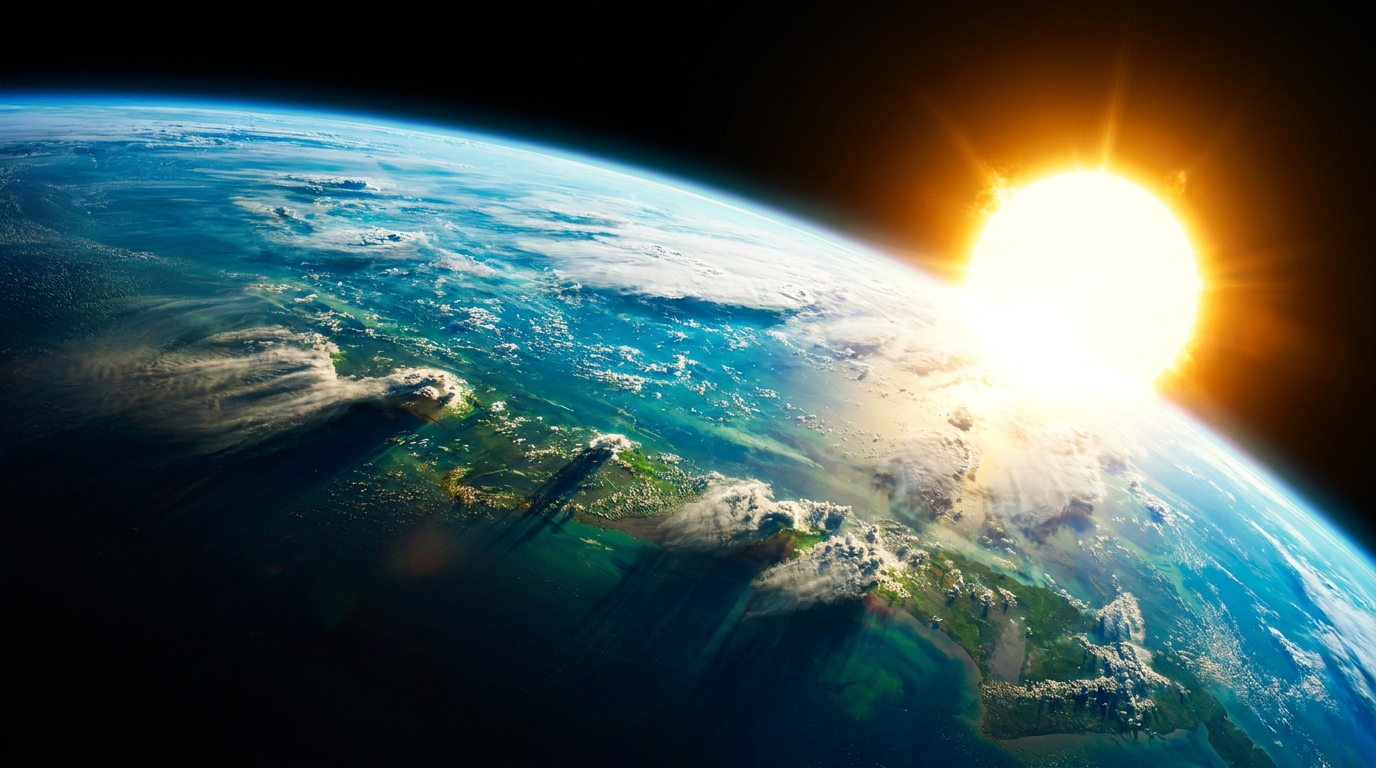
To understand how life on Earth will eventually end, one must look not just at the sun, but at the ground. As our star ages, its core contracts and heats up, causing its luminosity to steadily increase. Over billion-year timescales, this rising solar radiation bombards the Earth, threatening to boil the oceans. However, the planet possesses a built-in geological thermostat known as the carbonate-silicate cycle. As temperatures rise, the weathering of silicate rocks by wind and rain accelerates. This chemical weathering process actively draws carbon dioxide out of the atmosphere, washing it into the oceans where it is eventually buried in the Earth's crust. For years, geophysicists believed this process would act as a relentless, one-way vacuum, cooling the planet but ultimately starving it of the very gas that makes life possible.[3][4]
The prevailing theory held that this accelerated weathering would drive atmospheric carbon dioxide levels below 50 parts per million within the next billion years. At that threshold, C3 plants—which make up the vast majority of the world's forests and vegetation—would lose the ability to perform photosynthesis. Without plants to anchor the food chain and produce oxygen, mass extinction would rapidly follow, leaving behind only simple microbial life. The new evidence, however, challenges the linearity of this doomsday mechanism. By deploying computationally intensive frameworks that couple global climate models with interactive land and dynamic vegetation models, researchers discovered a crucial negative feedback loop that earlier, simpler simulations had missed.[2][7]

The core claim of the new study rests on the finding that silicate weathering is more weakly dependent on temperature than previously assumed. As atmospheric carbon dioxide drops and the global plant biomass begins to shrink, the overall rate of weathering actually slows down. This deceleration creates a bottleneck in the carbon-drawdown process, allowing CO2 levels to temporarily stabilize or even slightly rebound. Instead of a rapid plunge into carbon starvation, the biosphere enters a prolonged, drawn-out twilight. This stabilization provides a massive temporal lifeline for highly efficient vegetation, specifically C4 plants like modern sugarcane and maize, which can continue to photosynthesize at CO2 concentrations as low as 10 parts per million.[1][4]
The survival of these C4 plants is the linchpin of the 500-million-year extension. As long as some form of vegetation can harvest sunlight and carbon, the base of the food web remains intact, allowing complex animal life to persist. The models indicate that while the Earth of 1.5 billion years from now will look vastly different—likely dominated by sparse, hardy vegetation rather than lush forests—it will still be fundamentally alive. The biosphere will not be snuffed out abruptly but will instead undergo a slow, highly adapted retreat. This finding underscores the profound resilience of biological systems when coupled with the planet's deep geochemical cycles.[5][6]
To build this evidence pack, geophysicists had to move beyond the one-dimensional models that dominated the field in the early 2000s. Those early simulations treated the Earth as a uniform sphere, averaging out the complexities of continents, oceans, and atmospheric circulation. By contrast, the new research utilizes a fully coupled three-dimensional global climate model. This allows scientists to simulate how specific landmass configurations and regional weather patterns interact with the carbon cycle over millions of years. The inclusion of an interactive land model means that as the simulated climate changes, the virtual vegetation responds in real-time, migrating to cooler latitudes or dying off, which in turn alters the planet's surface albedo and moisture retention.[2][7]
To build this evidence pack, geophysicists had to move beyond the one-dimensional models that dominated the field in the early 2000s.
The data reveals that as the sun brightens, the equatorial regions will become too hostile for most plant life much earlier than the poles. However, this geographical shift plays a crucial role in extending the biosphere's lifespan. As vegetation retreats toward the higher latitudes, it continues to draw down CO2, but the overall global rate of silicate weathering decreases because the hottest, wettest regions of the planet—where weathering is most intense—are no longer covered by the deep, acid-producing root systems of dense forests. This biological retreat acts as a natural braking mechanism on the carbon vacuum, preserving just enough CO2 in the atmosphere to keep the remaining high-latitude ecosystems alive.[1][4]

Despite the sophistication of these new 3D models, the evidence carries transparent uncertainties that researchers are quick to acknowledge. The most significant unknown in forecasting a billion years of climate evolution is the behavior of cloud feedback loops. Clouds can either reflect solar radiation away from the Earth, cooling the planet, or trap heat beneath them, warming it. The current models struggle to definitively resolve how a hotter, lower-CO2 atmosphere will alter global cloud cover over deep time. If the Earth loses its reflective cloud shield earlier than expected, the rising solar heat could outpace the carbon cycle's ability to regulate the temperature, potentially boiling the oceans before carbon starvation even becomes the primary threat.[2][4]
Another critical area of uncertainty lies in the tectonic carbon cycle. The models assume that the rate of volcanic outgassing—the process by which the Earth releases trapped CO2 back into the atmosphere through volcanic eruptions—remains relatively constant. However, as the Earth's interior slowly cools over the next two billion years, tectonic activity is expected to gradually wind down. If volcanic outgassing slows more rapidly than the models project, the replenishment of atmospheric CO2 will fail, and the 1.87-billion-year deadline could be pulled significantly forward. The interplay between a cooling planetary core and a brightening star remains one of the most complex frontiers in deep-time geophysics.[3][7]
Furthermore, the models must make assumptions about the long-term behavior of the Earth's oceans. As the planet warms, the atmosphere will hold significantly more water vapor, which is itself a potent greenhouse gas. This creates a competing feedback loop: while silicate weathering draws down CO2 to cool the planet, the increasing water vapor traps more of the sun's intensifying heat. The exact tipping point where the water vapor greenhouse effect overpowers the cooling effect of carbon starvation remains a subject of intense debate among climatologists. If the oceans begin to evaporate more rapidly than the models predict, the transition to a moist greenhouse state could sterilize the planet long before the CO2 runs out.[2][3]

Even with these uncertainties, the revised timeline has profound implications for the field of astrobiology and the search for extraterrestrial life. The Earth serves as humanity's only data point for how long a planet can maintain a functioning, complex biosphere. If the window for complex life is 500 million years wider than previously calculated, it suggests that the emergence of intelligent life might be a less statistically improbable event. A longer biosphere lifespan means that exoplanets orbiting older stars have a significantly extended period during which evolutionary processes can experiment, adapt, and potentially produce advanced biological complexity.[1][4]
This realization shifts the philosophical framing of our planet's future. Rather than viewing the Earth's biosphere as a fragile, transient phenomenon destined for a rapid demise, the new data paints a picture of a deeply entrenched, self-regulating system that fights tenaciously to maintain equilibrium. The Earth has already sustained life for nearly four billion years through asteroid impacts, ice ages, and massive volcanic events. The revelation that it has the geochemical tools to stretch its habitable window for nearly two billion more years is a testament to the extraordinary durability of the living world.[5][6]
Ultimately, the research provides a strangely uplifting perspective on deep time. While the eventual end of the biosphere is an unavoidable consequence of stellar evolution, that end is not imminent, nor is it easily achieved. The Earth will not surrender its life without a billion-year fight, utilizing every chemical and biological feedback loop at its disposal to keep the lights on. For a species currently grappling with its own short-term impacts on the planetary climate, understanding the sheer scale and resilience of Earth's long-term life-support systems offers a humbling, awe-inspiring reminder of the planet's enduring power.[1][2][3]
How we got here
4 billion years ago
The first simple microbial life forms appear on Earth.
540 million years ago
The Cambrian explosion brings complex, multicellular animal life to the oceans.
Early 2000s
One-dimensional models predict the biosphere will end in 1.35 billion years due to carbon starvation.
June 2026
New 3D coupled climate models extend the biosphere's deadline to 1.87 billion years.
1.87 billion years from now
The projected final mass extinction of complex life as the sun's luminosity boils the oceans.
Viewpoints in depth
Geophysicists & Climate Modelers
Focuses on the mechanical improvements of the 3D simulations and the negative feedback loop of silicate weathering.
For climate modelers, the breakthrough lies in the transition from 1D to 3D coupled models. By integrating interactive land and dynamic vegetation models, researchers were able to simulate how biological retreat affects geological weathering. They argue that previous models were too aggressive in their assumptions about carbon drawdown. The new data proves that as the planet warms and vegetation migrates, the weathering process inherently slows down, creating a natural braking mechanism that preserves atmospheric carbon dioxide far longer than previously thought.
Astrobiologists
Focuses on the implications for the Drake Equation and the search for complex life on exoplanets.
Astrobiologists view this 500-million-year extension as a massive statistical win for the search for extraterrestrial intelligence. The Earth is our only baseline for planetary habitability. If a biosphere can naturally regulate itself for nearly two billion years longer than expected, the 'habitable window' for exoplanets orbiting older stars is significantly wider. This suggests that the evolutionary leap from simple microbes to complex, intelligent life has a much longer runway to occur across the universe, making the cosmos potentially more crowded than we assumed.
Deep-Time Skeptics
Focuses on the inherent uncertainties of modeling cloud feedback and tectonic outgassing over billion-year scales.
While acknowledging the sophistication of the new models, some researchers emphasize the massive uncertainties involved in deep-time forecasting. They point out that cloud feedback loops—whether clouds will reflect more heat or trap it as the sun brightens—remain poorly understood over billion-year timescales. Furthermore, the models assume a relatively stable rate of volcanic outgassing. If the Earth's core cools faster than expected, tectonic activity could stall, cutting off the planet's carbon supply and rendering the 1.87-billion-year projection overly optimistic.
What we don't know
- How cloud cover will change over a billion years and whether it will reflect or trap the sun's increasing heat.
- The exact rate at which the Earth's interior will cool, which dictates the future of volcanic carbon outgassing.
- The precise tipping point where increased water vapor in the atmosphere will trigger a runaway moist greenhouse effect.
Key terms
- Carbonate-silicate cycle
- The geological process where the weathering of rocks draws carbon dioxide from the atmosphere into the Earth's crust, acting as a planetary thermostat.
- C4 Plants
- A category of highly efficient plants, including maize and sugarcane, that can perform photosynthesis at extremely low carbon dioxide levels.
- Albedo effect
- The measure of how much sunlight is reflected back into space by the Earth's surface and clouds.
- Volcanic outgassing
- The release of trapped gases, including carbon dioxide, from the Earth's interior through volcanic activity.
Frequently asked
Why is the sun getting brighter?
As the sun ages, it fuses hydrogen into helium in its core, causing the core to contract and heat up, which steadily increases its overall luminosity over billions of years.
Why does a brighter sun lead to less carbon dioxide?
Higher temperatures accelerate the chemical weathering of silicate rocks, a process that actively pulls CO2 out of the atmosphere and traps it in the Earth's crust.
Will humans survive this long?
This study models the deep geological future of the biosphere as a whole, not specific species. Human survival over billion-year timescales would depend entirely on advanced technological adaptation.
Sources
Source coverage
7 outlets
3 viewpoints surfaced






[1]New ScientistScience Communicators
Complex life on Earth may last 500 million years longer than expected
Read on New Scientist →[2]Journal of Geophysical Research: AtmospheresClimate Modelers
Revised Estimates for the Lifespan of Earth's Biosphere Under a Brightening Sun
Read on Journal of Geophysical Research: Atmospheres →[3]American Geophysical Union (AGU)Science Communicators
Life on Earth could last hundreds of millions of years longer than once thought
Read on American Geophysical Union (AGU) →[4]ScienceAlertAstrobiologists
Earth's Biosphere Could Survive 500 Million Years Longer Than We Thought
Read on ScienceAlert →[5]Zamin NewsScience Communicators
When Life on Earth Will End: Scientists Recalculate the Biosphere's Deadline
Read on Zamin News →[6]ScienceXAstrobiologists
Complex life on Earth may last 500 million years longer than expected
Read on ScienceX →[7]University of Chicago Department of Geophysical SciencesClimate Modelers
Modeling the Long-Term Carbonate-Silicate Cycle
Read on University of Chicago Department of Geophysical Sciences →

Every angle. Every day.
Get science stories with full source coverage and perspective breakdowns delivered to your inbox.