
New AI Model 'DeCAF-Pearl' Accelerates Drug Discovery by Making Million-Molecule Screening Practical
An international research team has developed DeCAF-Pearl, an AI model that uses 'flow maps' to predict molecular structures five times faster than current state-of-the-art systems. The breakthrough makes it practical to virtually screen up to one million drug candidates in hours, dramatically accelerating pharmaceutical research.
By Factlen Editorial Team
- AI Architecture Innovators
- Focus on the mathematical innovation of flow maps and the computational efficiency gained over traditional diffusion models.
- Biomedical Scientists
- Value the practical application of screening massive molecular libraries to accelerate the discovery of new therapeutics.
- Tech Industry Analysts
- Track the rapid evolution of open-source and proprietary AI tools, noting how efficiency unlocks new commercial possibilities.
What's not represented
- · Pharmaceutical Executives
- · Regulatory Agencies
Why this matters
Finding the right molecule to bind to a disease-causing protein usually requires years of expensive laboratory trial and error. By allowing researchers to digitally screen a million potential drugs in a single day, this AI breakthrough could shave years off the timeline for developing new treatments for cancer, autoimmune diseases, and rare genetic disorders.
Key points
- DeCAF-Pearl is a new AI model for predicting how drugs bind to proteins.
- It uses 'flow maps' to bypass the slow, step-by-step process of traditional diffusion models.
- The model operates five times faster than its predecessor while maintaining high accuracy.
- It can screen one million potential drug molecules in just 18 hours.
- The open-source tool is expected to drastically accelerate pharmaceutical research and synthetic data generation.
For decades, the earliest stage of drug discovery has resembled a search for a microscopic needle in an unimaginably vast haystack. To develop a new medication, scientists must find a small chemical molecule that perfectly binds to a specific disease-causing protein. Historically, this required years of expensive, physical trial-and-error in a wet laboratory. In recent years, artificial intelligence has begun to digitize this process, but the sheer computational power required to simulate millions of complex 3D molecular interactions has remained a severe bottleneck. Now, a breakthrough in AI architecture is removing that roadblock, promising to dramatically accelerate the pace of pharmaceutical research.[7]
An international consortium of researchers—including teams from Genesis Therapeutics, Imperial College London, Carnegie Mellon University, and MIT—has unveiled DeCAF-Pearl, a novel artificial intelligence model designed for molecular screening. Detailed in a new study published on arXiv, the system represents a fundamental shift in how computers predict the physical interactions between drugs and their biological targets. By rethinking the underlying mathematics of structural generation, the researchers have created a tool that operates at unprecedented speeds without sacrificing the accuracy required for medical research.[1][2][3]
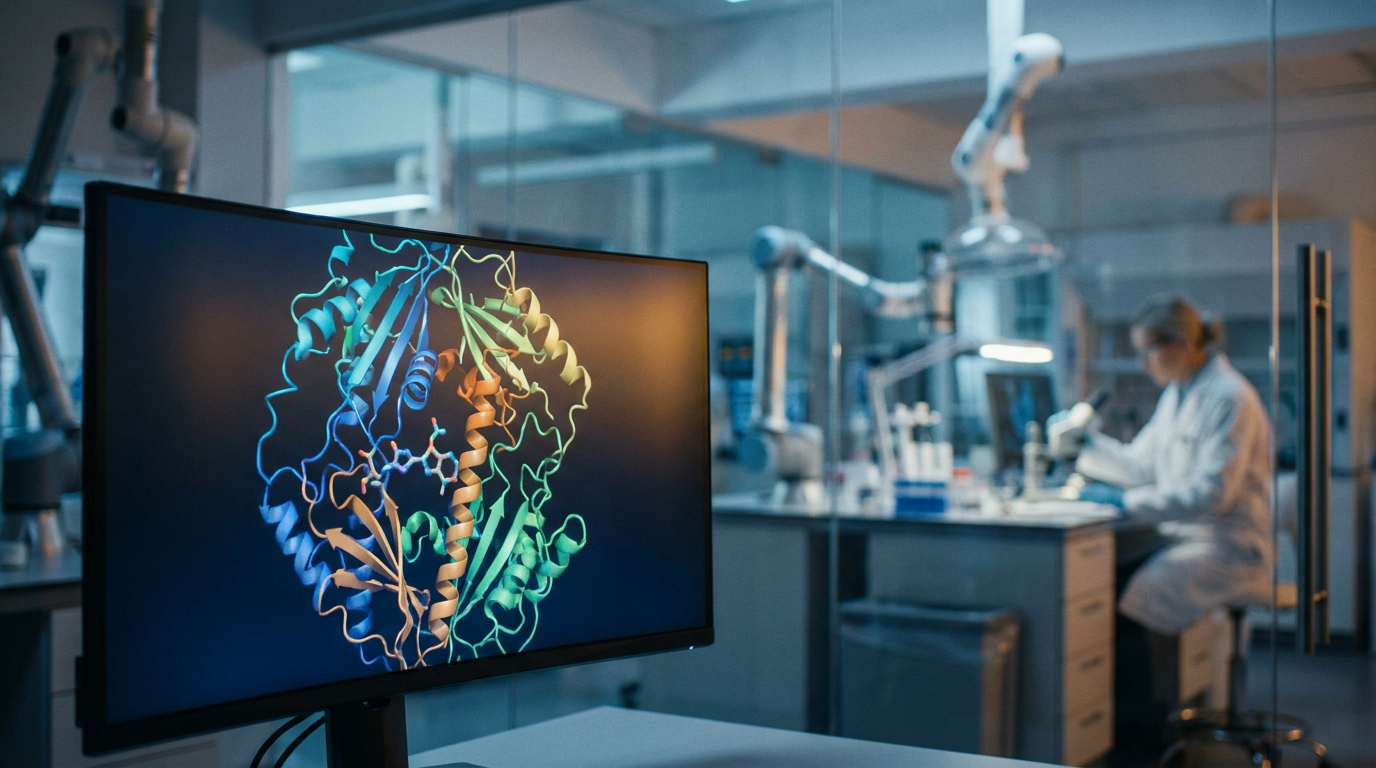
At the heart of this advancement is a computational task known as "cofolding." Cofolding refers to the process of simultaneously generating the precise three-dimensional shape of a protein and the small molecule attempting to bind to it. Understanding this 3D interaction is critical, as a drug's efficacy is entirely dependent on how well it physically fits into the target protein's structural pockets. While modern AI models have become highly adept at this task, their operational mechanics have inherently limited their speed and scalability.[1][2]

Existing state-of-the-art systems, including Google DeepMind's AlphaFold 3 and Genesis Therapeutics' original Pearl model, rely on a technique called diffusion. Diffusion models work by starting with a cloud of random digital noise and refining it through hundreds of tiny, incremental steps until a clear, accurate molecular structure emerges. While this method produces exceptionally high-fidelity results, inching along this denoising trajectory requires massive amounts of time and computing power. This slowness has made it computationally prohibitive to screen entire libraries of millions of potential drug compounds.[1][2][6]
DeCAF-Pearl bypasses this limitation by abandoning the step-by-step diffusion process in favor of a different mathematical framework known as "flow maps." Instead of taking hundreds of tiny steps to refine a structure, a flow map learns the overarching trajectory of the generation process. This allows the model to jump directly from one point in the generation timeline to another, effectively traversing the entire structural prediction process in just a handful of computational steps. The result is a massive reduction in the processing power required to evaluate a single molecule.[1][2][3]
The result is a massive reduction in the processing power required to evaluate a single molecule.
The efficiency gains achieved by this new architecture are staggering. According to the research team, DeCAF-Pearl requires approximately twenty times fewer model calls during the diffusion sampling phase compared to its predecessor. In practical terms, this translates to a five-fold increase in overall inference speed. This acceleration is not merely an incremental software update; it represents a paradigm shift that changes what is physically possible for research laboratories to accomplish within a given timeframe and budget.[2][3][4]

The most immediate and profound impact of this speedup is the realization of high-throughput virtual screening. Previously, cofolding an entire library of chemical compounds against a disease target using full diffusion-based models was too expensive and slow for routine use. With DeCAF-Pearl, researchers can now practically screen up to one million distinct molecules against a protein target in approximately 18 hours, utilizing a cluster of 64 graphics processing units (GPUs). This capability allows scientists to rapidly identify promising "hit" compounds that warrant further physical testing.[1][2]
Beyond direct drug screening, the model's efficiency unlocks a second, equally critical advantage: scalable synthetic data generation. In the modern AI ecosystem, the development of specialized downstream models—such as those that predict binding affinity or score molecular toxicity—is often bottlenecked by a lack of high-quality training data. Because DeCAF-Pearl can generate accurate protein-ligand structures five times faster, researchers can produce vastly more synthetic training data per unit of compute, accelerating the improvement of the entire AI drug discovery pipeline.[1][2][3]
Crucially, DeCAF-Pearl achieves this remarkable speed without compromising on the quality of its predictions. When tested against a held-out benchmark of 196 protein and molecule structures that the model had never encountered during its training phase, DeCAF-Pearl matched the success rate of Pearl, the highly accurate foundation model it was distilled from. Furthermore, the flow map model outperformed other leading frontier tools, including AlphaFold 3 and Boltz-2, on key success metrics, despite utilizing a fraction of the computational steps.[1][2][3]

The release of DeCAF-Pearl highlights a broader transition currently underway in the field of artificial intelligence for biology. As Dr. Joey Bose, an Assistant Professor at Imperial College London and a senior author of the study, noted, the industry is increasingly moving away from merely training massive foundational models. Instead, the new frontier is scaling inference—finding ways to deploy these powerful models efficiently so they can generate the massive volume of samples required to optimize real-world outcomes.[1][4]
By open-sourcing the code for DeCAF-Pearl, the Genesis Research Team and their academic partners are democratizing access to top-tier virtual screening capabilities. Pharmaceutical companies, academic laboratories, and independent researchers worldwide can now leverage this flow map architecture to accelerate their own disease research. As AI continues to integrate into the pharmaceutical sciences, tools that optimize the delicate balance between computational cost and structural accuracy will be the primary engines driving the next generation of medical breakthroughs.[3][5][7]
The collaborative nature of the DeCAF-Pearl project also underscores the increasing convergence of academic institutions and private AI labs in solving biology's hardest problems. By combining the theoretical physics expertise of universities like MIT and Carnegie Mellon with the applied machine learning infrastructure of Genesis Therapeutics, the team was able to rapidly translate a complex mathematical concept into a deployable scientific tool. As these cross-disciplinary partnerships deepen, the timeline from theoretical AI breakthroughs to tangible medical applications is expected to shrink even further.[2][3][7]
Viewpoints in depth
AI Architecture Innovators
Focus on the mathematical innovation of flow maps and the computational efficiency gained over traditional diffusion models.
For computer scientists and AI architects, the significance of DeCAF-Pearl lies in its departure from the standard diffusion paradigm. While diffusion models like AlphaFold 3 have dominated the space by offering high fidelity through hundreds of incremental denoising steps, they are computationally expensive. Innovators in this camp view the implementation of 'flow maps' as a necessary evolution. By teaching the model to learn the overarching trajectory of generation and jump directly to the endpoint, researchers have proven that it is possible to decouple structural accuracy from massive computational overhead.
Biomedical Scientists
Value the practical application of screening massive molecular libraries to accelerate the discovery of new therapeutics.
From the perspective of researchers working in wet labs and pharmaceutical development, the mathematical mechanics of the AI are secondary to its practical output. Biomedical scientists view DeCAF-Pearl as a tool that finally makes high-throughput virtual screening a reality. The ability to screen one million molecules in 18 hours means that the initial 'hit identification' phase of drug discovery—which traditionally takes months or years—can now be completed over a weekend. This allows researchers to focus their physical laboratory resources only on the most promising candidates, drastically reducing the time and cost of developing new treatments.
Open Science Advocates
Focus on the democratization of high-throughput screening and the open-source nature of the release.
Observers tracking the broader tech ecosystem emphasize the importance of making these powerful tools accessible. Because Genesis Therapeutics and its academic partners released the DeCAF-Pearl code openly, they have leveled the playing field between massive pharmaceutical conglomerates and smaller academic or independent labs. Open science advocates argue that by lowering the computational barrier to entry—requiring only 64 GPUs for a massive screen instead of a supercomputer—this breakthrough will spur a wave of decentralized, grassroots medical research across the globe.
What we don't know
- How quickly major pharmaceutical companies will integrate flow map models into their existing, highly regulated R&D pipelines.
- Whether the flow map architecture can be successfully adapted to predict the behavior of even larger, more complex biological systems beyond single protein-ligand interactions.
Key terms
- Cofolding
- Generating the precise three-dimensional shape of a protein and a small binding molecule at the same time.
- Virtual Screening
- Using computer models to evaluate large libraries of chemical compounds to find potential drug candidates.
- Diffusion Model
- An AI approach that generates data by starting with random noise and taking many small steps to refine it into a clear output.
- Flow Map
- A mathematical framework that allows an AI model to jump directly from one point in a generation process to another, skipping intermediate steps.
- Hit Identification
- The initial stage of drug discovery where researchers find molecules that successfully interact with a specific biological target.
Frequently asked
How is DeCAF-Pearl different from AlphaFold 3?
While AlphaFold 3 uses a diffusion process that requires many small computational steps to predict a structure, DeCAF-Pearl uses 'flow maps' to jump across the process, making it significantly faster while maintaining similar accuracy.
What does this mean for patients?
By drastically speeding up the initial stages of drug discovery, this technology could help pharmaceutical companies develop treatments for diseases much faster and potentially at a lower cost.
Is this technology available to the public?
Yes, the researchers have released the code for DeCAF-Pearl on GitHub, allowing scientists worldwide to use it for their own molecular screening projects.
Sources
Source coverage
7 outlets
3 viewpoints surfaced







[1]Imperial College LondonBiomedical Scientists
Researchers develop AI model that makes large-scale molecular screening practical for the first time
Read on Imperial College London →[2]Genesis TherapeuticsAI Architecture Innovators
Distilling Pearl: Flow Maps for Fast All-Atom Cofolding
Read on Genesis Therapeutics →[3]arXivAI Architecture Innovators
DeCAF: Denoiser Cofolding All-Atom Flowmap for Fast Biomolecular Structure Generation
Read on arXiv →[4]Latent SpaceAI Architecture Innovators
Top AI news: DeCAF-Pearl introduced
Read on Latent Space →[5]There's An AI For ThatTech Industry Analysts
DeCAF-Pearl Overview
Read on There's An AI For That →[6]Baker LabBiomedical Scientists
Message boards: DeCAF-Pearl and AlphaFold 3 updates
Read on Baker Lab →[7]Factlen Editorial TeamTech Industry Analysts
Synthesis by Factlen editorial team
Read on Factlen Editorial Team →

More in ai
See all 7 stories →Edge AI
How On-Device AI and Quantization Are Moving LLMs Out of the Cloud
6 sources

Agentic AI
Agentic AI: How Large Action Models Are Automating Digital Chores
7 sources

Global AI Governance
EU Delays Key AI Act Enforcement as 'Brussels Effect' Fractures Under US Deregulation
8 sources

Drug Discovery
New AI Model Accelerates Molecular Simulations 10,000-Fold, Promising Faster Drug Discovery
6 sources
Every angle. Every day.
Get ai stories with full source coverage and perspective breakdowns delivered to your inbox.