
NASA Inspector General Warns Boeing Starliner Certification May Slip to 2027
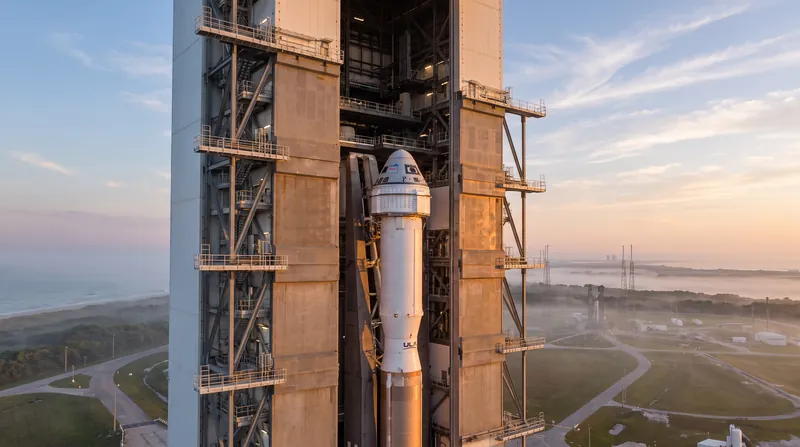
A new audit from NASA's Office of the Inspector General projects that Boeing's CST-100 Starliner may not be certified for operational crew flights until 2027. The delay highlights the agency's rigorous safety protocols as it navigates a narrowing operational window before the International Space Station's planned retirement.
By Aarav Khanna

- NASA Office of the Inspector General
- Focuses on strict oversight, safety compliance, and financial accountability in the Commercial Crew Program.
- Aerospace Industry Analysts
- Emphasizes the financial mechanics of fixed-price contracts and the long-term fleet planning challenges for low Earth orbit.
- Space Exploration Advocates
- Prioritizes the ultimate goal of safe, redundant human spaceflight and views rigorous testing delays as a necessary component of the process.
At a glance
- NASA's Office of the Inspector General projects Boeing's Starliner will not receive operational certification until 2027.
- The delay stems from unresolved helium leaks and thruster anomalies identified during the 2024 Crew Flight Test.
- NASA has modified the next Starliner mission into an uncrewed cargo flight to validate technical fixes.
- The 2027 timeline leaves a narrow three-year window for Starliner operations before the ISS retires in 2030.
- Despite the delays, retaining Boeing remains more cost-effective for NASA than relying solely on SpaceX or Russian Soyuz seats.
Why it matters now
For taxpayers funding the next generation of spaceflight and astronauts relying on commercial vehicles for safe transport, the timeline for a fully operational U.S. orbital fleet is stretching further into the future. Understanding how NASA manages these delays reveals the rigorous, safety-first mechanisms that govern modern space exploration.
The timeline for a fully operational, dual-provider U.S. commercial crew fleet has encountered another significant extension. A newly released audit from NASA's Office of the Inspector General (OIG) projects that Boeing's CST-100 Starliner spacecraft will likely not receive human-rating certification for operational flights to the International Space Station until 2027.[1][2]
The June 2026 report offers a comprehensive look at the cascading effects of the spacecraft's troubled testing history. Declaring Starliner ready for regular crew rotation flights next year places the vehicle approximately a decade behind its original 2017 target, highlighting the immense engineering challenges inherent in developing new human-rated space systems.[2][5]
The delay introduces a complex fleet planning challenge for NASA. The International Space Station is currently scheduled to end its operational life in 2030, though some lawmakers are pushing for an extension to 2032. This hard deadline forces the agency to carefully manage its remaining transportation assets.[1][2]
With certification slipping to 2027, the window for Starliner to provide operational value is narrowing. Crew vehicles require extensive lead time for crew assignment, training, launch scheduling, and recovery support, meaning a compressed three-year operational window limits the number of missions Boeing can practically execute before the station is decommissioned.[2]
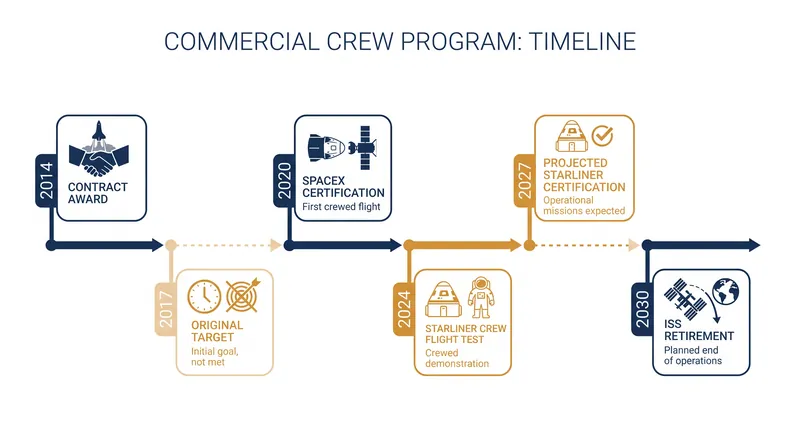
The roots of the current delay trace back to the Commercial Crew Program's inception in 2014. NASA awarded contracts to both Boeing and SpaceX to ensure redundant, domestic access to low Earth orbit following the retirement of the Space Shuttle, intentionally building a system where the failure of one provider would not ground the entire U.S. astronaut corps.[3]
While SpaceX successfully certified its Crew Dragon in 2020 and has since become the operational backstop for the agency, Boeing has faced a series of technical hurdles. The OIG audit notes that flight tests since 2020 have uncovered numerous unexpected issues, resulting in an additional six years of delays for the legacy aerospace manufacturer.[1][3]
The most consequential of these tests occurred in mid-2024, when Starliner launched its first crewed flight test with NASA astronauts Butch Wilmore and Suni Williams. What was intended to be an eight-day mission stretched into a nine-month stay after helium leaks and thruster anomalies compromised the spacecraft's return capability.[1][4]
The most consequential of these tests occurred in mid-2024, when Starliner launched its first crewed flight test with NASA astronauts Butch Wilmore and Suni Williams.
NASA ultimately classified the 2024 mission anomalies as a "Type A mishap"—the agency's most severe designation, indicating a nearly catastrophic event. Prioritizing crew safety over schedule adherence, NASA returned Wilmore and Williams to Earth aboard a SpaceX Crew Dragon and sent Starliner back uncrewed.[1][2]
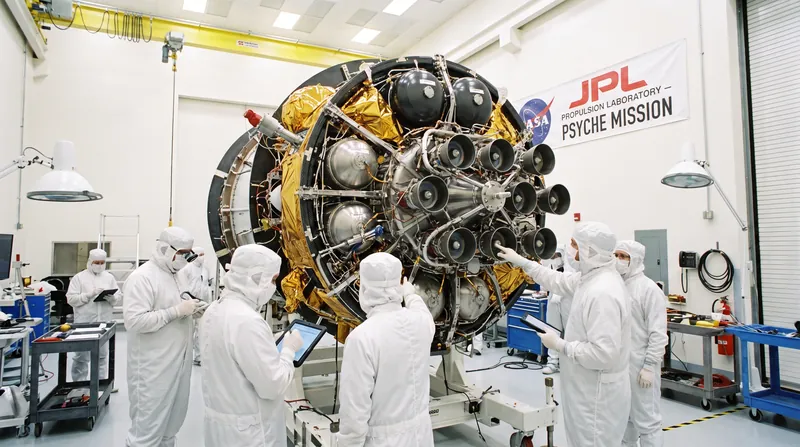
The fallout from that mission has fundamentally altered Boeing's contract. To ensure that the helium leaks and propulsion system failures are fully resolved without risking human passengers, NASA has modified the next Starliner flight, designated Starliner-1, into an uncrewed cargo mission.[1][2]
This modification means Boeing's post-certification mission count has been reduced from six to four. The OIG report highlights that the technical issues from the 2024 flight remain unresolved as of early 2026, leaving NASA uncertain about exactly when the required testing will be completed and verified.[1][2]
Despite the protracted timeline and the reduction in flights, the OIG audit concludes that retaining Boeing in the Commercial Crew Program remains financially advantageous for NASA compared to relying solely on SpaceX or purchasing additional seats on Russian Soyuz spacecraft.[1][6]
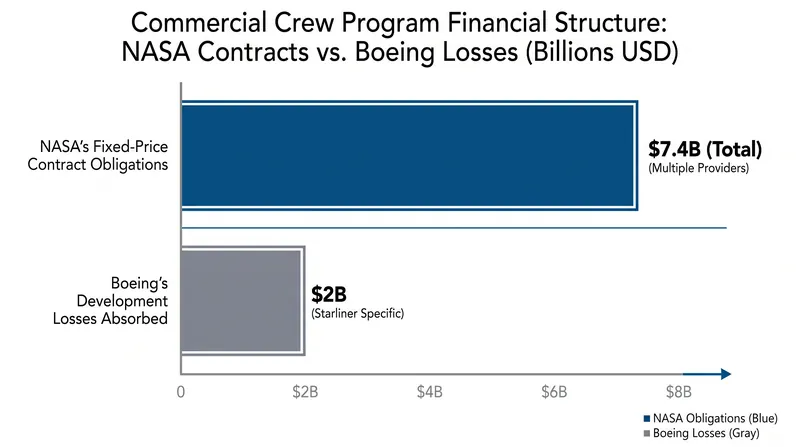
The fixed-price nature of the Commercial Crew contracts has largely shielded American taxpayers from development cost overruns. Boeing has absorbed more than $2 billion in losses on the Starliner program since 2016, while still standing to earn the remainder of its $3.7 billion contract upon successful mission execution.[1][6]
However, the inspector general did criticize NASA's payment structure, specifically questioning $127.9 million in milestone payments made to Boeing since 2019 for the Starliner-3 mission—a flight the audit describes as "far from certain" given the station's impending retirement.[1][2]
To establish a clear path forward, the OIG issued a six-point checklist of recommendations. These include developing a rigorous schedule for the next Starliner flight and ensuring sufficient time is allocated to document and resolve all anomalies from the 2024 test before any human-rating certification is granted.[2][3]
NASA officials have agreed to all six recommendations, committing to complete the necessary documentation and scheduling tasks by December 31, 2026. As the agency and Boeing work through this checklist, the aerospace industry is witnessing a real-time demonstration of the uncompromising safety standards required for human spaceflight.[2][3]
Terms to know
- Human-rating certification
- The rigorous process by which NASA verifies that a spacecraft is safe enough to transport astronauts to and from orbit.
- Type A mishap
- NASA's most severe classification for an incident, indicating a nearly catastrophic event or significant loss of equipment.
- Fixed-price contract
- An agreement where the contractor is paid a set amount for a service, meaning the company, rather than the government, absorbs the cost of delays and overruns.
- Commercial Crew Program
- A NASA initiative that partners with private aerospace companies to develop and operate spacecraft for transporting astronauts to the International Space Station.
The backstory
2014
NASA awards Commercial Crew contracts to Boeing and SpaceX to develop domestic crew transportation systems.
2017
The original target date for Boeing's Starliner to achieve human-rating certification.
2020
SpaceX successfully certifies its Crew Dragon spacecraft for operational missions.
June 2024
Starliner launches its first crewed flight test, which experiences thruster anomalies and helium leaks.
June 2026
NASA's Office of the Inspector General releases an audit projecting Starliner's certification will slip to 2027.
December 2026
The deadline for NASA and Boeing to complete a six-point checklist resolving the spacecraft's technical issues.
Different angles
The Oversight Perspective
Focuses on strict adherence to safety protocols and financial accountability.
From the perspective of the Office of the Inspector General, the primary concern is ensuring that NASA does not compromise safety to meet schedule demands. The OIG's audit underscores that the anomalies experienced during the 2024 Crew Flight Test—specifically the helium leaks and thruster failures—must be definitively resolved and documented before humans are allowed back on board. This viewpoint also heavily scrutinizes the financial mechanics of the program, questioning milestone payments for future flights that remain uncertain given the spacecraft's delayed timeline and the impending retirement of the ISS.
The Industry Economics View
Analyzes the financial trade-offs and the mechanics of fixed-price aerospace contracting.
Aerospace analysts view the Starliner delays through the lens of fixed-price contracting, a model that fundamentally shifted development risk from the government to the private sector. While Boeing has absorbed over $2 billion in losses, this perspective notes that retaining Boeing as a second provider remains economically rational for NASA. Maintaining a dual-provider system prevents a SpaceX monopoly and is still projected to be more cost-effective than purchasing additional seats on Russian Soyuz spacecraft, even with the reduced number of operational flights Starliner will ultimately perform.
Still unresolved
- Whether Congress will extend the International Space Station's operational life from 2030 to 2032, which would expand Starliner's utility window.
- The exact launch date for the uncrewed Starliner-1 cargo mission, which remains under review by NASA.
- How the ongoing delays might impact Boeing's willingness to bid on future fixed-price commercial space contracts.
Questions readers ask
Why is the Starliner certification delayed to 2027?
The delay allows Boeing and NASA to resolve technical issues, including helium leaks and thruster anomalies, identified during the 2024 Crew Flight Test.
What does this mean for the International Space Station?
With the ISS scheduled to retire in 2030, a 2027 certification leaves a narrow three-year window for Starliner to conduct operational crew rotation missions.
Will the next Starliner flight carry astronauts?
No. To ensure safety, NASA has modified the next mission, Starliner-1, into an uncrewed cargo flight to validate technical fixes before humans fly on the spacecraft again.
Who pays for the cost of these delays?
Because NASA uses fixed-price contracts for the Commercial Crew Program, Boeing has absorbed over $2 billion in development losses, shielding taxpayers from the overruns.
Sources
Source coverage
6 outlets
3 viewpoints surfaced






[1]Aviation ProsAerospace Industry Analysts
Boeing Starliner Costly but Cheaper for NASA Than SpaceX Switch, Audit Says
Read on Aviation Pros →[2]New Space EconomyNASA Office of the Inspector General
NASA OIG Commercial Crew Program Audit: Starliner Certification Delayed to 2027
Read on New Space Economy →[3]Universe MagazineSpace Exploration Advocates
NASA Inspector General: Starliner given no permission to fly
Read on Universe Magazine →[4]KeepTrack SpaceSpace Exploration Advocates
Boeing Starliner Grounded Until Mid-2027, NASA Warns | KeepTrack Space Brief
Read on KeepTrack Space →[5]AirGuide BusinessNASA Office of the Inspector General
NASA Report: Boeing Starliner Certification Slips to 2027
Read on AirGuide Business →[6]The Spokesman-ReviewAerospace Industry Analysts
Boeing Starliner costly but cheaper for NASA than SpaceX switch, audit says
Read on The Spokesman-Review →
Comments
Every angle. Every day.
Get transportation stories with full source coverage and perspective breakdowns delivered to your inbox.