
Memory Stocks Are Having Their Best Year Ever. Why Do They Still Look So Cheap?
Driven by the insatiable demand for High-Bandwidth Memory in AI data centers, chipmakers are hitting trillion-dollar valuations. Yet, their forward earnings multiples remain surprisingly low as Wall Street debates whether the boom is a permanent shift or a cyclical peak.
By Factlen Editorial Team
- Structural Bulls
- Believe AI has permanently transformed memory from a cyclical commodity into a high-margin strategic asset.
- Cyclical Skeptics
- Warn that massive capital expenditures will eventually flood the market and compress margins by 2027.
- Value Investors
- Focus on the tension between trailing and forward multiples, viewing the sector as a high-reward but volatile play.
What's not represented
- · Retail hardware consumers
- · Mid-tier cloud providers
Why this matters
Understanding the valuation gap in memory stocks offers a rare window into how Wall Street prices the AI revolution. For investors, it highlights the tension between explosive near-term profits and the historical risks of semiconductor boom-and-bust cycles.
Key points
- Memory chipmakers like Micron and SK Hynix have seen their valuations soar past $1 trillion due to the AI boom.
- Despite record stock prices, these companies trade at single-digit forward P/E ratios, making them look fundamentally cheap.
- The disconnect stems from High-Bandwidth Memory (HBM), a high-margin product that is currently sold out through 2026.
- Bulls argue AI has permanently transformed the sector into a high-margin strategic asset.
- Skeptics warn that massive ongoing investments in new factories could lead to a supply glut and price crash by 2027.
The artificial intelligence boom has minted a new class of trillion-dollar titans. In late May 2026, South Korea's SK Hynix and U.S.-based Micron Technology both crossed the $1 trillion market capitalization threshold, joining an elite club previously reserved for software giants and processor designers. The milestone underscored a widening realization across global markets that the infrastructure required to train and run large language models extends far beyond a single graphics processor.[4]
Their stock charts look like rocket trajectories. Micron shares have surged more than 260% since the start of the year, while SK Hynix has posted similarly staggering returns. They are the undisputed beneficiaries of the massive capital expenditure programs being deployed by hyperscalers like Microsoft, Google, and Meta, who are racing to build the most advanced data centers on the planet.[1]
Yet, a glance at their valuation metrics reveals a bizarre paradox. Despite sitting at all-time highs, these companies look remarkably cheap on paper. Micron, for instance, trades at a forward price-to-earnings ratio of roughly 9x to 11x based on 2026 consensus estimates. This creates a fascinating tension for investors trying to value the hardware layer of the AI ecosystem.[1][6]
To put that multiple in perspective, the broader S&P 500 trades at a forward P/E in the mid-20s, and high-flying tech peers routinely command multiples above 40x. The market is effectively treating the most critical suppliers of the AI revolution like legacy industrial manufacturers, assigning them a valuation that implies their current earnings explosion is a temporary anomaly rather than a permanent baseline.[6]

To understand this valuation disconnect, one must first understand what these companies actually sell. The bottleneck in modern artificial intelligence is no longer just the processor; it is the memory. High-powered chips can only process information as fast as they can access the underlying data, creating a massive traffic jam within the server architecture.[2]
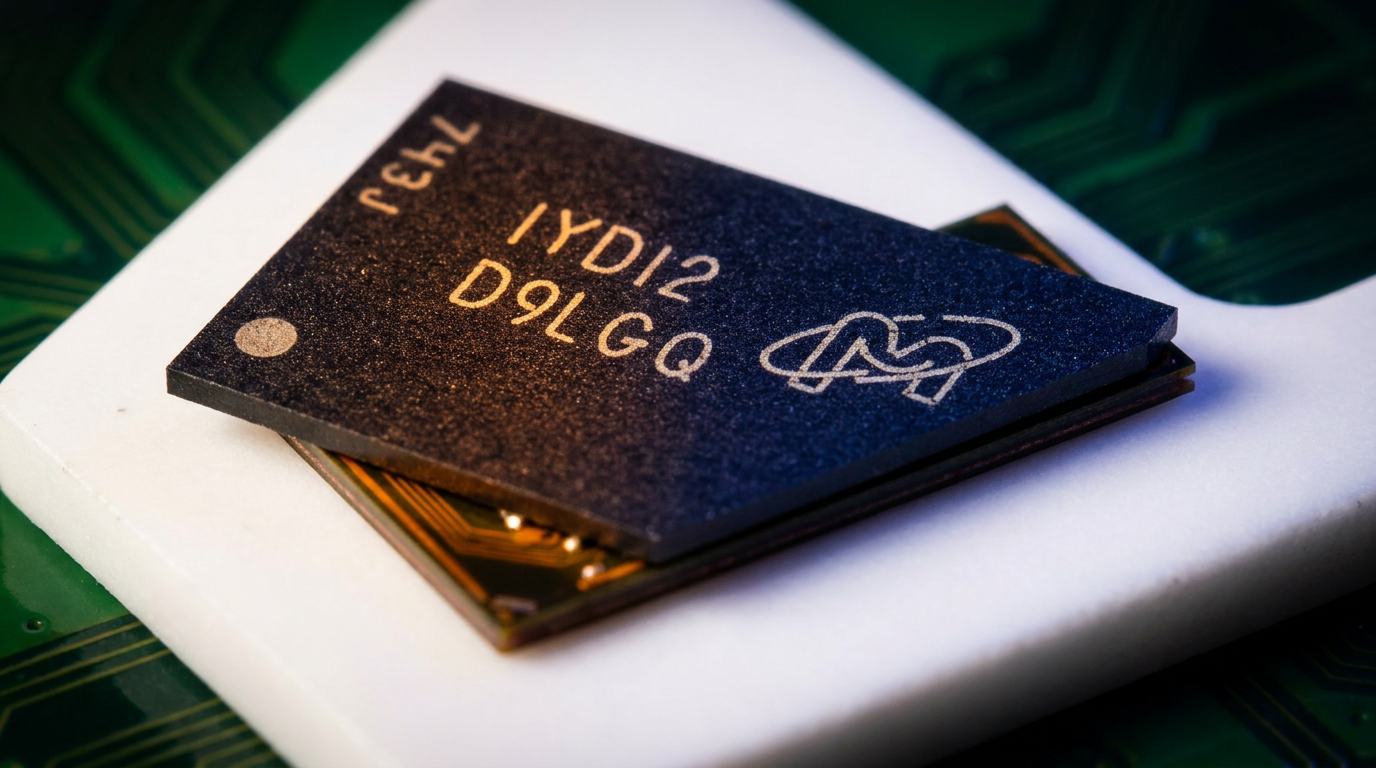
Traditional Dynamic Random Access Memory simply cannot feed data to Nvidia's graphics processing units fast enough to keep them fully utilized. The solution is High-Bandwidth Memory—a highly complex technology that vertically stacks memory chips and connects them directly to the processor via microscopic pathways, drastically reducing latency and power consumption.[6]
This architectural shift has transformed memory makers from commodity suppliers into strategic toll booths. Nvidia's next-generation Vera Rubin architecture requires massive amounts of HBM4, and only three companies on Earth—SK Hynix, Samsung, and Micron—can manufacture it at the required scale and yield.[2][5]
This architectural shift has transformed memory makers from commodity suppliers into strategic toll booths.
The demand for these specialized components is so voracious that the entire industry's HBM capacity is reportedly sold out through the end of 2026. Industry analysts project that the HBM market will nearly triple in size, growing from roughly $35 billion in 2025 to over $100 billion by 2028, driven entirely by AI workload requirements.[1][6]

This unprecedented visibility has birthed the structural supercycle thesis. Bulls argue that AI has permanently altered the economics of the memory business. Because HBM requires complex packaging and is sold via long-term, non-cancellable contracts, it commands vastly higher margins than the boom-and-bust commodity memory of the past, insulating manufacturers from sudden pricing shocks.[1]
The financial results are already validating this optimism. Micron's recent quarterly revenues shattered expectations, driven by a 160% explosion in cloud memory sales. The company's trailing P/E sits at a lofty 48x, but the forward multiple collapses to 9x precisely because Wall Street expects profits to surge exponentially in the coming quarters as these high-margin contracts hit the balance sheet.[3][6]
So why is Wall Street refusing to award these stocks a premium multiple? The answer lies in the industry's deeply ingrained trauma. Historically, the memory chip business has been notoriously cyclical—a brutal pendulum of undersupply and oversupply that has repeatedly burned investors who bought at the top of a cycle.[5]
Skeptics warn that the current windfall is masking a looming glut. To meet the insatiable demand for HBM, memory makers are embarking on historic capital expenditure programs. Micron alone is slated to spend upwards of $25 billion in fiscal 2026 to build new fabrication facilities and expand its advanced packaging capabilities.[3][5]

The fear is that when these new fabs come online in 2027 and 2028, they will flood the market with supply. If AI capital spending by hyperscalers cools at the exact moment this new capacity hits the market, memory prices will crash, taking profit margins down with them in a classic semiconductor bust.[5]
The single-digit forward P/E ratio is essentially a risk premium. Investors are pricing in the probability that the current earnings explosion is a cyclical peak rather than a new permanent reality. They are willing to ride the wave of AI infrastructure spending, but they are keeping one foot near the exit, acutely aware of how quickly the tide can turn.[6]

For now, the memory giants are enjoying the most lucrative environment in their history. They hold the keys to the AI kingdom, dictating terms to the world's largest technology companies. Whether they can finally shed their cyclical baggage remains the trillion-dollar question, but until the supply catches up, they remain the ultimate value play in a growth-obsessed market.[1][2]
How we got here
Late 2022
The launch of ChatGPT sparks the generative AI boom, creating an immediate and unforeseen demand for high-performance computing hardware.
Mid 2023
Traditional memory markets experience a severe downturn, but demand for specialized High-Bandwidth Memory begins to decouple from the broader sector.
Early 2026
Micron begins volume production of its next-generation HBM4 chips, securing its place alongside SK Hynix in Nvidia's supply chain.
May 2026
Both SK Hynix and Micron cross the $1 trillion market capitalization threshold as investors recognize the strategic importance of memory in AI.
Viewpoints in depth
The Structural Bulls
Argue that HBM has fundamentally changed the memory business model.
Structural bulls point to the long-term, non-cancellable contracts that now define HBM sales. Unlike commodity DRAM, which is sold on spot markets and subject to wild price swings, HBM is custom-packaged and deeply integrated into specific GPU architectures like Nvidia's Vera Rubin. This creates a "sticky" customer relationship and insulates manufacturers from sudden price crashes, justifying a higher long-term valuation that the market has yet to fully price in.
The Cyclical Skeptics
Warn that the laws of semiconductor physics and economics haven't changed.
Skeptics look at the massive capital expenditure budgets—tens of billions of dollars—being deployed to build new fabs. History shows that whenever memory makers simultaneously expand capacity, a supply glut inevitably follows 18 to 24 months later. They argue the current tight supply is a temporary bottleneck, not a permanent paradigm shift, and that margins will inevitably compress once the new factories come online.
The Hyperscaler Customers
Focus on securing supply at any cost to maintain AI dominance.
For companies like Microsoft, Meta, and Google, the cost of memory is secondary to the cost of losing the AI arms race. They are willing to pre-pay and sign multi-year agreements to guarantee they have the HBM necessary to power their next-generation data centers, effectively funding the memory makers' expansion plans upfront and driving the current revenue surge.
What we don't know
- Whether the massive capital expenditures planned for 2026 and 2027 will ultimately flood the market and compress profit margins.
- How quickly next-generation AI architectures might evolve to require less memory bandwidth, potentially cooling demand.
- If geopolitical tensions or trade restrictions will disrupt the highly concentrated global supply chain for HBM components.
Key terms
- High-Bandwidth Memory (HBM)
- An advanced type of computer memory that stacks chips vertically to deliver data to processors at ultra-fast speeds, crucial for AI workloads.
- Forward P/E Ratio
- A valuation metric that divides a company's current stock price by its estimated future earnings per share over the next 12 months.
- Capital Expenditure (Capex)
- The money a company spends to buy, maintain, or improve its fixed assets, such as building new semiconductor fabrication plants.
- Hyperscaler
- Massive cloud service providers like Amazon Web Services, Google Cloud, and Microsoft Azure that operate data centers on a global scale.
- DRAM
- Dynamic Random Access Memory, the standard type of memory used in personal computers and servers to store data that is actively being used.
Frequently asked
Why do memory stocks look cheap if they are hitting record highs?
Their stock prices have surged, but their projected earnings have grown even faster. This makes their forward price-to-earnings ratio look very low compared to the rest of the tech sector.
What makes HBM different from regular computer memory?
High-Bandwidth Memory stacks multiple memory chips vertically and connects them directly to the processor. This drastically increases data transfer speeds, which is essential for training artificial intelligence models.
Who are the main companies making HBM chips?
The global HBM market is dominated by just three companies: South Korea's SK Hynix and Samsung, and U.S.-based Micron Technology.
Will the memory chip shortage last?
Industry analysts expect HBM capacity to remain sold out through the end of 2026. However, massive investments in new factories could balance supply and demand by 2027 or 2028.
Sources
Source coverage
6 outlets
3 viewpoints surfaced






[1]MarketWatchStructural Bulls
Memory stocks are having their best year ever. Why do they still look so cheap?
Read on MarketWatch →[2]ForbesStructural Bulls
Stock market outlooks predict strong performance through the rest of 2026
Read on Forbes →[3]U.S. Securities and Exchange CommissionValue Investors
Micron Technology, Inc. Form 10-Q
Read on U.S. Securities and Exchange Commission →[4]Semiconductor Industry AssociationValue Investors
2026 State of the U.S. Semiconductor Industry
Read on Semiconductor Industry Association →[5]Goldman Sachs Global Investment ResearchCyclical Skeptics
Memory Market Outlook 2026-2028: The HBM Bottleneck
Read on Goldman Sachs Global Investment Research →[6]Factlen Editorial TeamValue Investors
Synthesis by Factlen editorial team
Read on Factlen Editorial Team →

More in finance
See all 5 stories →Assumable Mortgages
How Assumable Mortgages Are Unlocking 3% Rates for 2026 Homebuyers
6 sources

Assumable Mortgages
The 2026 Boom in Assumable Mortgages: How Homebuyers Are Bypassing High Rates
6 sources

AI Hardware
Memory Stocks Are Having Their Best Year Ever. Why Are They Trading at Bargain Multiples?
7 sources
Every angle. Every day.
Get finance stories with full source coverage and perspective breakdowns delivered to your inbox.