
Local AI: How to Run Powerful Language Models on Your Own Computer
Advancements in hardware and open-weight models have made it possible to run highly capable AI assistants entirely offline. This shift offers users absolute data privacy and eliminates recurring subscription costs.
By Factlen Editorial Team
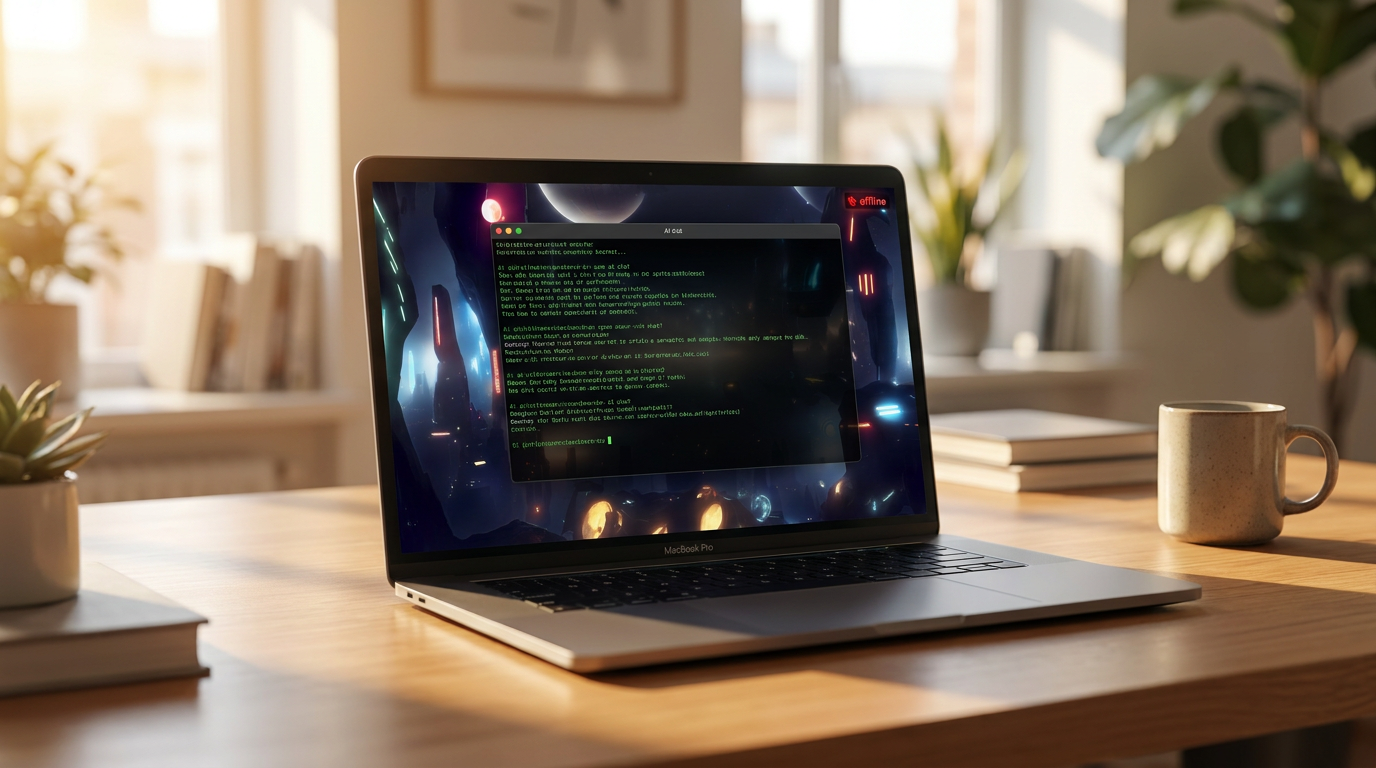
- Privacy-Conscious Professionals
- Argue that data sovereignty and absolute confidentiality are non-negotiable, making local AI the only viable choice for sensitive work.
- Open-Source Developers
- Focus on the rapid hardware and software optimizations that are democratizing access to powerful AI models without corporate gatekeepers.
- Cloud AI Pragmatists
- Maintain that while local AI is useful for privacy, cloud-based frontier models still offer superior reasoning and multimodal capabilities for complex tasks.
What's not represented
- · Hardware manufacturers producing discrete GPUs
- · Regulators drafting AI compliance laws
Why this matters
Running AI locally ensures that your sensitive documents, personal questions, and corporate data never leave your device. It transforms AI from a rented cloud service into a private, permanent tool you own.
Key points
- Local AI allows users to run powerful language models entirely offline, ensuring absolute data privacy.
- Techniques like quantization compress massive models to fit on standard consumer laptops.
- Apple Silicon's unified memory architecture provides a massive hardware advantage for running large models locally.
- Tools like Ollama and LM Studio have made installing and running local AI as easy as downloading a standard app.
- While local models are highly capable, cloud AI still leads in complex reasoning and multimodal tasks.
The era of renting artificial intelligence is giving way to owning it. For the past several years, utilizing a highly capable language model meant paying a monthly subscription to a cloud giant and trusting them with your data. In 2026, running powerful AI directly on your own computer is no longer a weekend project reserved for software engineers—it has become a one-click reality. This shift from cloud-dependent services to local, on-device inference represents one of the most significant democratizations of technology since the advent of the personal computer.[1]
The traditional model of cloud AI operates much like a utility. When a user types a prompt into a service like ChatGPT or Claude, that text is transmitted across the internet to massive, energy-intensive server farms. The remote servers process the request, generate a response, and send it back to the user's screen. While this architecture allows companies to deploy incredibly massive models, it comes with inherent compromises regarding data sovereignty, latency, and recurring financial costs.[4]
The biggest driver pushing professionals toward local AI is the absolute guarantee of privacy. When an AI model runs locally, the data pipeline is entirely severed from the internet. For lawyers drafting confidential case strategies, doctors reviewing sensitive patient notes, or executives analyzing unannounced financial data, transmitting prompts to a third-party server is a severe security risk. Cloud AI asks users to trust a corporate privacy policy; local AI removes the need for trust entirely.[6]
Offline AI enforces privacy through its physical architecture. Because the model's weights and processing power live entirely on the user's local hard drive and processor, there is zero data transmission. Prompts are never logged on an external server, chat histories cannot be accessed by third-party employees, and confidential corporate data cannot accidentally be ingested into a future AI training dataset. For privacy-conscious professionals, the simplest security architecture is the one with no server in the middle.[6]

To understand how this transition became possible, it is necessary to look at the mechanics of "inference"—the computational process of an AI generating a response. Historically, running inference for a large language model required hundreds of gigabytes of memory, necessitating expensive, specialized hardware. However, the open-source community has rapidly developed techniques to shrink these models without destroying their capabilities, allowing them to run efficiently on standard consumer laptops.[1]
The most critical of these compression techniques is called quantization. In simple terms, quantization reduces the mathematical precision of the neural network's internal numbers. By dropping a model from 16-bit precision down to 4-bit precision, developers can squeeze a massive model that once required 100 gigabytes of memory into a highly efficient package that requires only 8 to 16 gigabytes. Remarkably, this aggressive compression results in only a minimal loss of the model's reasoning quality.[1]
While software optimizations have been crucial, the hardware itself has undergone a quiet revolution. Apple's M-series chips—powering Macs from the M1 to the latest M5—have fundamentally changed the math of local AI through a concept known as "unified memory." This architectural choice has inadvertently turned standard MacBooks into some of the most capable local AI workstations on the consumer market.[2][3]
While software optimizations have been crucial, the hardware itself has undergone a quiet revolution.
On a traditional Windows PC, the computer's central processor (CPU) and its graphics card (GPU) maintain separate pools of memory. To run an AI model quickly, the entire model must fit within the graphics card's dedicated Video RAM (VRAM). Because high-end consumer graphics cards typically max out at 24 gigabytes of VRAM, PC users are physically capped in the size of the models they can run, regardless of how much standard system RAM they install.[3]
Apple Silicon bypasses this bottleneck entirely. The CPU and GPU share a single, massive pool of unified memory. This means a MacBook Pro configured with 64 gigabytes of unified memory can seamlessly load massive 70-billion-parameter models that would instantly crash a $1,600 desktop graphics card. Apple has aggressively leaned into this hardware advantage with MLX, a native machine learning framework that allows local models to run up to 60 percent faster than older software backends.[2][3]

The software tooling required to run these models has matured to match the hardware's capabilities. For developers and power users, an open-source tool called Ollama has become the industry standard. Operating much like a package manager, Ollama allows users to open their terminal, type a single command, and instantly download and launch a local chat server. It abstracts away all the complex configuration files that previously made local AI inaccessible.[5][7]
For users who prefer a graphical interface over a command line, applications like LM Studio have bridged the usability gap. LM Studio offers a polished, intuitive desktop application that looks and feels exactly like the web interfaces of popular cloud AI services. Users can browse a built-in library of models, click a download button, and start chatting offline immediately. The software allows users to adjust technical settings through visual sliders rather than code.[5]
The models available for download have also seen a dramatic leap in capability. In 2026, open-weight models—where the underlying architecture is made publicly available—have reached a staggering level of proficiency. Models like Google's Gemma 4, Meta's Llama 4, and Alibaba's Qwen 3.5 offer performance that rivals the absolute frontier cloud models of just a year ago, easily handling complex coding tasks, creative writing, and deep document analysis.[7]

Beyond the clear privacy benefits, the economics of local AI are becoming impossible for heavy users to ignore. Businesses and power users who once spent thousands of dollars a month on API calls to cloud providers are realizing that renting compute power is a losing financial game. By purchasing a dedicated machine for a one-time hardware cost, users can run unlimited queries, process massive batches of documents, and experiment freely with zero recurring fees.[4]
Despite these massive advancements, local AI is not a complete replacement for the cloud. Frontier cloud models, backed by billions of dollars in server infrastructure, still hold a roughly three-to-six-month lead in complex, multi-step reasoning. Furthermore, cloud models remain vastly superior at heavy multimodal tasks, such as processing massive video files or generating high-resolution imagery, which require computational power that still exceeds a single laptop.[4]
Because of this capability gap, many enterprise teams and professionals are adopting hybrid AI workflows. They utilize local models to extract data from highly sensitive documents, ensuring that confidential information remains off third-party servers. Once the sensitive data is sanitized or summarized locally, they route the non-sensitive, high-complexity reasoning tasks to cloud APIs, getting the best of both privacy and raw computational power.[4]
As hardware continues to improve and open-weight models become increasingly efficient, the line separating cloud and local capabilities will only continue to blur. The era of assuming that artificial intelligence must live in a distant data center is over. For everyday users, developers, and privacy-conscious professionals, the ability to have a private, uncensored, and highly capable AI assistant living permanently on their own hard drive is no longer the future—it is the present reality.[1]
How we got here
Late 2023
Apple releases the open-source MLX framework, designed to optimize machine learning on Apple Silicon.
Early 2024
Tools like Ollama and LM Studio gain traction, simplifying the installation of local models for everyday users.
Late 2025
Open-weight models reach parity with early frontier cloud models, making local inference viable for professional work.
Spring 2026
Major updates to MLX and the release of highly optimized models like Gemma 4 cement the Mac as a premier local AI workstation.
Viewpoints in depth
Privacy-Conscious Professionals
For lawyers, doctors, and enterprise executives, the primary appeal of local AI is absolute data sovereignty.
This camp argues that corporate privacy policies are insufficient protections for highly confidential information like patient records or unannounced M&A strategies. By running models locally, they eliminate the data pipeline entirely—ensuring that sensitive prompts never traverse the internet, cannot be intercepted, and are physically impossible to include in future AI training datasets.
Open-Source Developers
This community focuses on the democratization of AI compute and the rapid optimization of consumer hardware.
Developers emphasize how rapid advancements in quantization and hardware frameworks—like Apple's MLX—have broken the monopoly of massive cloud server farms. For this group, tools like Ollama and LM Studio represent a shift in power, allowing individuals to own their AI infrastructure, avoid recurring API costs, and build custom applications without relying on a centralized corporate provider.
Cloud AI Pragmatists
This perspective maintains that cloud-based frontier models remain the gold standard for maximum capability.
While acknowledging the privacy benefits of local inference, this camp points out that cloud providers still hold a multi-month lead in complex reasoning, agentic behavior, and multimodal tasks. For these users, the ideal architecture is often a hybrid approach: using local models to sanitize sensitive data, while routing complex, non-confidential queries to the cloud to leverage maximum computational power.
What we don't know
- How quickly open-weight models will close the remaining reasoning gap with the absolute cutting-edge cloud models.
- Whether future consumer hardware will prioritize dedicated neural processing units (NPUs) over unified memory architectures.
Key terms
- Inference
- The computational process where an AI model analyzes a prompt and generates a response.
- Quantization
- A compression technique that reduces the precision of an AI model's internal numbers, allowing massive models to run on consumer hardware.
- Unified Memory
- A hardware architecture where the computer's central processor and graphics processor share the same pool of RAM, eliminating data bottlenecks.
- Open-weight Model
- An AI model whose underlying architecture and trained parameters are made publicly available for anyone to download and run.
- VRAM (Video RAM)
- Specialized memory located on a discrete graphics card, traditionally required to run high-performance AI models on PCs.
Frequently asked
Do I need an internet connection to use local AI?
No. Once you download the model and the software (like Ollama or LM Studio), the AI runs entirely offline on your device's hardware.
Can my current computer run these models?
Most modern computers can run smaller models. For larger, highly capable models, an Apple Silicon Mac with 16GB+ of unified memory or a PC with a dedicated graphics card is recommended.
Are local models as smart as cloud AI?
Open-weight models are highly capable for everyday tasks like drafting emails and basic coding. However, frontier cloud models still hold an edge in complex reasoning and advanced multimodal tasks.
Sources
Source coverage
7 outlets
3 viewpoints surfaced







[1]Factlen Editorial TeamOpen-Source Developers
Synthesis by Factlen editorial team
Read on Factlen Editorial Team →[2]Apple DeveloperOpen-Source Developers
Core AI and MLX Framework Updates for Apple Silicon
Read on Apple Developer →[3]Towards AIOpen-Source Developers
Apple's MLX Runs Local LLMs 3x Faster Than llama.cpp
Read on Towards AI →[4]MindStudioCloud AI Pragmatists
Local AI vs Cloud APIs: The 2026 Guide to Privacy and Performance
Read on MindStudio →[5]Contabo CloudOpen-Source Developers
Ollama vs LM Studio: Local LLM Runtime Comparison
Read on Contabo Cloud →[6]Coticsy Privacy ResearchPrivacy-Conscious Professionals
Why Privacy-Conscious Users Prefer Local AI in 2026
Read on Coticsy Privacy Research →[7]PinggyOpen-Source Developers
Top 5 Local LLM Tools and Models in 2026
Read on Pinggy →

More in ai
See all 7 stories →Edge AI
How On-Device AI and Quantization Are Moving LLMs Out of the Cloud
6 sources

Agentic AI
Agentic AI: How Large Action Models Are Automating Digital Chores
7 sources

Global AI Governance
EU Delays Key AI Act Enforcement as 'Brussels Effect' Fractures Under US Deregulation
8 sources

Drug Discovery
New AI Model Accelerates Molecular Simulations 10,000-Fold, Promising Faster Drug Discovery
6 sources

Every angle. Every day.
Get ai stories with full source coverage and perspective breakdowns delivered to your inbox.