
Lawmakers Introduce 'Language Access for All Act' to Restore Multilingual Federal Services
New legislation in the House and Senate seeks to permanently codify language access requirements across federal agencies, responding to a 2025 executive order that scaled back multilingual services.
By Joao Marques


- Language Access Advocates
- Argue that multilingual services are a fundamental civil right necessary for equitable access to taxpayer-funded federal programs.
- Assimilation & English-First Proponents
- Maintain that establishing English as the official language promotes national unity and reduces government operational costs.
- Translation Industry & Technologists
- Focus on the practical implementation of language services, specifically advocating for human oversight of AI translation tools.
Why this matters
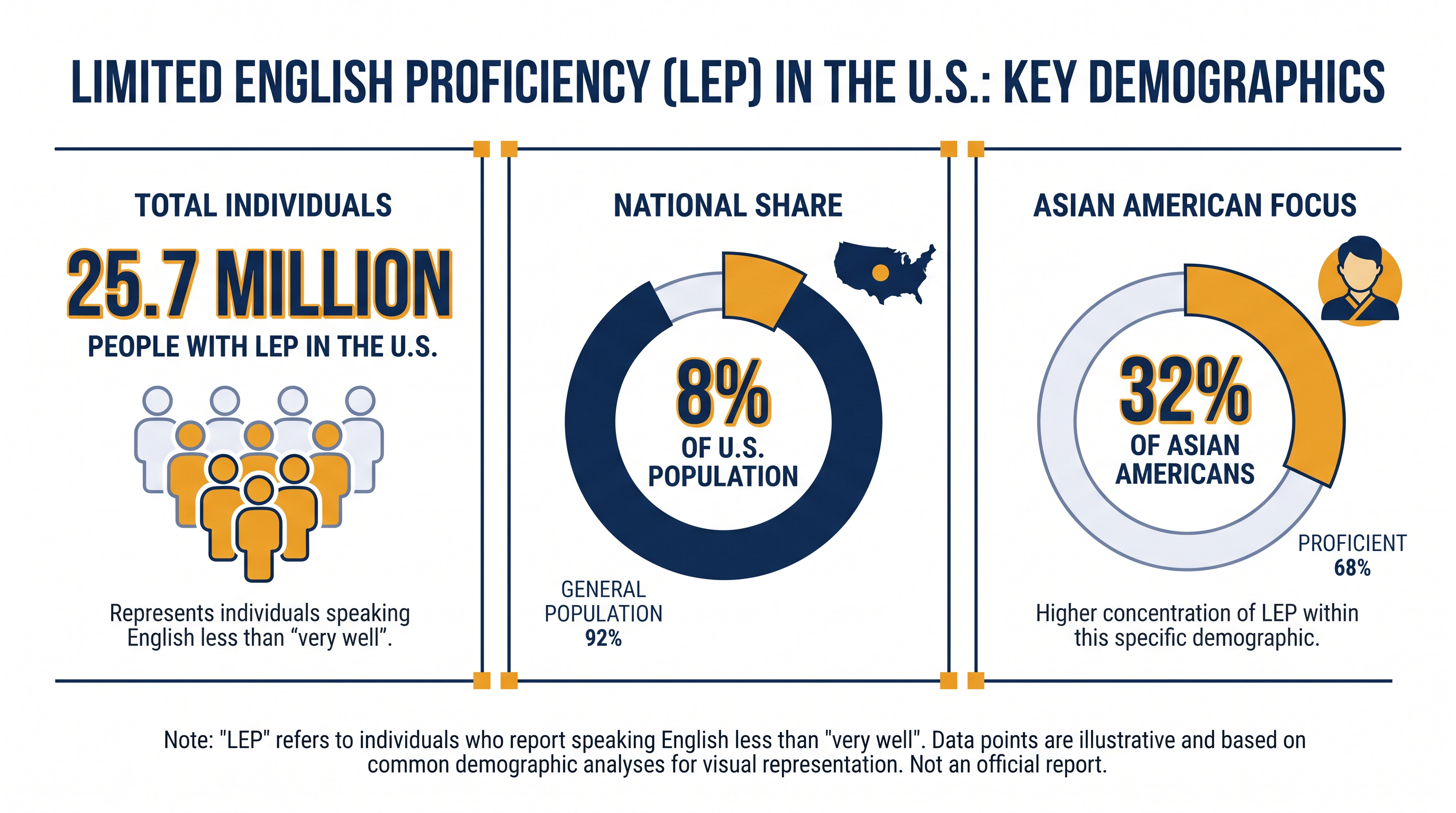
For the nearly 26 million Americans with limited English proficiency, this legislation determines whether they can reliably access Medicare, file taxes, and apply for federal benefits without facing insurmountable language barriers.
Key points
- Senators and Representatives have introduced the Language Access for All Act to permanently codify multilingual federal services.
- The bill responds to a 2025 executive order that declared English the official language and revoked previous language access mandates.
- The legislation requires federal agencies to provide translation and interpretation services for the 25.7 million Americans with limited English proficiency.
- The act establishes strict guardrails for AI translation, prohibiting agencies from fully replacing human interpreters with automated tools.
In July 2026, Senators Andy Kim and Mazie Hirono introduced the Language Access for All Act, a sweeping legislative effort to permanently codify multilingual services across the federal government.[2][9]
The legislation, which mirrors a companion bill introduced in the House earlier in the year by Representatives Judy Chu and Grace Meng, aims to guarantee translation and interpretation services for the estimated 25.7 million Americans with limited English proficiency (LEP).[1][2]
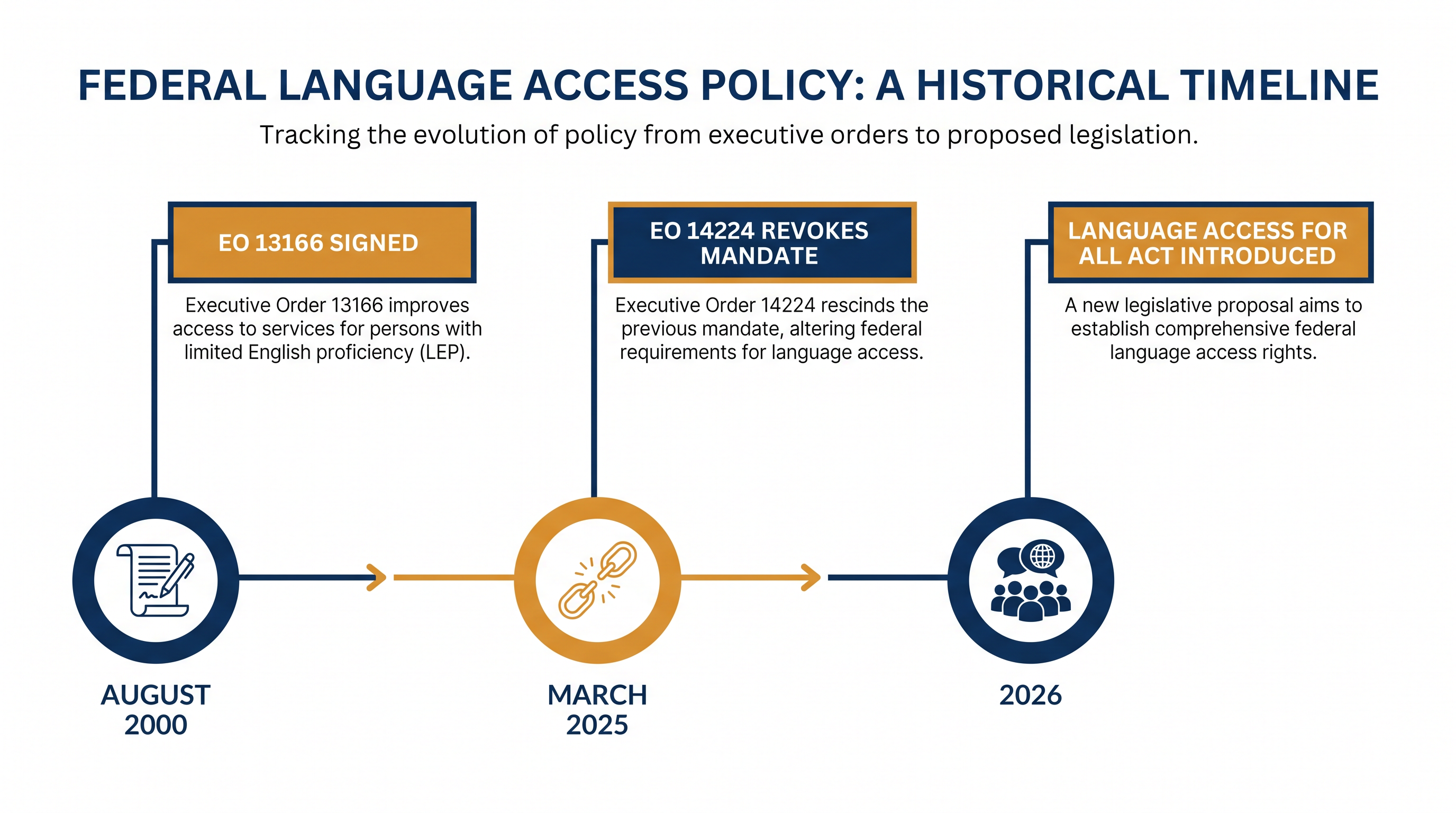
The push for a permanent statutory framework arrives in direct response to a major policy shift. In March 2025, President Donald Trump signed Executive Order 14224, which declared English the official language of the United States government.[3][8]
Crucially, that 2025 executive order revoked Executive Order 13166, a foundational mandate signed by President Bill Clinton in August 2000. For a quarter-century, the Clinton-era directive had required federal agencies and recipients of federal funding to provide meaningful access to their programs for LEP individuals.[3][4]
Following the revocation, the Department of Justice issued new guidance in July 2025 instructing federal agencies to minimize nonessential multilingual services. The administration argued that the shift would redirect resources toward English-language education and assimilation efforts, while streamlining government operations.[3][8]
The policy change had immediate practical effects. According to congressional sponsors of the new bill, agencies began scaling back their multilingual footprints. The Department of Housing and Urban Development moved toward English-only communications, the Small Business Administration removed non-English webpages, and the central repository LEP.gov was taken offline.[1][9]
Advocates argue that these rollbacks created severe bottlenecks for vulnerable populations trying to access essential services. Without translated documents or available interpreters, navigating Medicare coverage, applying for small business loans, or filing taxes became significantly more difficult for millions of taxpayers.[1][2]
The Language Access for All Act seeks to bypass the vulnerability of executive orders by writing these protections directly into federal law. Under the proposed legislation, every federal agency would be legally required to ensure that LEP individuals can meaningfully access their programs and activities.[2][5]
To achieve this, the bill establishes a coordinated, government-wide framework. Agencies would be mandated to develop and maintain comprehensive language access plans, subject to public notice and comment, and submit these blueprints to Congress.[1][5]
To achieve this, the bill establishes a coordinated, government-wide framework.
The legislation also mandates the translation of important public-facing documents into the most commonly spoken languages, based on U.S. Census data. Furthermore, agencies would be required to add multilingual features to their digital portals and websites to better identify and serve user language needs.[5][9]
Beyond written translation, the bill codifies the right to oral interpretation. Federal agencies would be required to provide sight translation, remote phone interpretation, and in-person interpreters for critical interactions, ensuring that language barriers do not impede access to justice or benefits.[5][7]
Accountability is a central pillar of the new framework. The legislation creates a centralized public complaint system, allowing individuals to report barriers to access directly to the Attorney General. Agencies would have 60 days to respond to complaints, and failure to comply would be treated as discrimination under Title VI of the Civil Rights Act of 1964.[5][9]
The bill also addresses the rapid evolution of translation technology, setting strict guardrails around the use of artificial intelligence in government communications. As automated language tools become more sophisticated, the legislation establishes technical standards to ensure accuracy and reliability.[2][6]
Specifically, the act prohibits federal agencies from fully replacing qualified human translators and interpreters with AI-assisted services. All AI-generated translations for critical government communications would require review by human linguists to prevent errors, bias, and discrimination.[6][7]
The translation industry has strongly backed these provisions. The American Translators Association and other language service providers emphasize that while AI can assist in drafting, human oversight remains essential for navigating the cultural nuances and high-stakes terminology of legal and medical federal services.[6][7]
The demographic stakes of the legislation are substantial. Approximately 8 percent of the U.S. population has limited English proficiency. While Spanish speakers constitute the largest share of this group, the impact is acutely felt across diverse communities.[1][2]
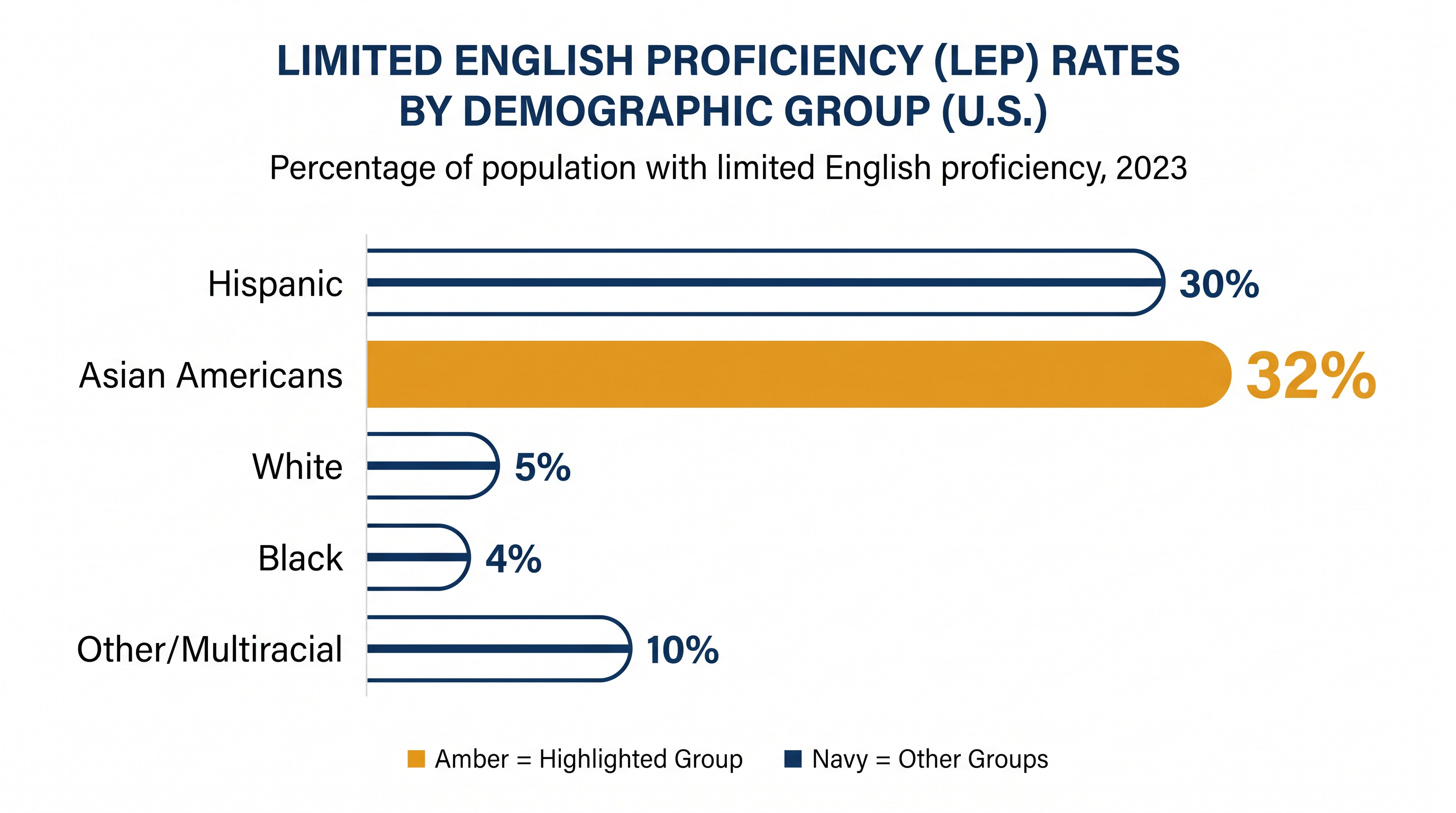
Asian Americans have among the highest rates of limited English proficiency of any racial demographic, at 32 percent. Native Hawaiians and Pacific Islanders also report significant language access needs, making the legislation a major priority for the Congressional Asian Pacific American Caucus.[1][4]
Supporters of the Trump administration's English-first policy maintain that a unified national language is essential for civic cohesion. They argue that the federal government should not bear the immense logistical and financial burden of operating in dozens of languages, and that resources are better spent on English literacy programs.[3][8]
How we got here
Aug 2000
President Clinton signs Executive Order 13166, mandating language access for federally funded programs.
Mar 2025
President Trump signs Executive Order 14224, declaring English the official language and revoking the 2000 mandate.
Jul 2025
The Department of Justice issues guidance instructing federal agencies to minimize nonessential multilingual services.
Jan 2026
House lawmakers introduce the Language Access for All Act to codify multilingual protections into law.
Jul 2026
The Senate companion bill is introduced, establishing a coordinated framework and AI translation guardrails.
Viewpoints in depth
Civil Rights Advocates
Argue that language access is a fundamental right necessary for equitable governance.
Civil rights organizations and the bill's sponsors view language access not as an administrative perk, but as a core civil right protected under the spirit of Title VI. They argue that because all taxpayers fund federal programs, no citizen should be functionally locked out of Medicare, small business loans, or emergency services simply because they are not fully fluent in English. From this perspective, the 2025 revocation of multilingual mandates was a discriminatory policy that disproportionately harmed immigrant communities and minority demographics.
English-First Proponents
Maintain that a unified national language promotes assimilation and reduces government waste.
Supporters of the 2025 executive order argue that establishing English as the official language of the United States is essential for national unity and civic cohesion. They contend that the federal government cannot sustainably operate in dozens of different languages, and that the logistical and financial burden of universal translation diverts resources away from core agency missions. Instead of funding perpetual translation services, this camp argues that government resources are better spent on English literacy and assimilation programs that help immigrants integrate into the broader economy.
Language Professionals
Focus on the practical implementation and the necessary guardrails around AI translation.
The translation and interpretation industry is highly focused on the technological provisions of the new legislation. While acknowledging that artificial intelligence can process massive volumes of routine text, professional linguists warn that AI lacks the cultural context and precision required for high-stakes medical, legal, and financial communications. They strongly support the bill's mandate that AI cannot fully replace human interpreters, arguing that human oversight is the only way to prevent algorithmic bias and catastrophic translation errors in critical government services.
What we don't know
- Whether the legislation can secure enough bipartisan support to pass both chambers of Congress before the end of the session.
- How federal agencies will budget for the comprehensive translation and interpretation services mandated by the bill.
- The exact technical standards the proposed interagency working group will establish for AI-assisted language tools.
Key terms
- Limited English Proficiency (LEP)
- Individuals who do not speak English as their primary language and have a limited ability to read, speak, write, or understand English.
- Executive Order 13166
- A 2000 directive requiring federal agencies to examine their services and provide meaningful access to LEP individuals.
- Executive Order 14224
- A 2025 directive declaring English the official language of the U.S. government and revoking previous multilingual mandates.
- Title VI of the Civil Rights Act
- A federal law prohibiting discrimination on the basis of race, color, and national origin in programs receiving federal financial assistance.
Frequently asked
What does the Language Access for All Act do?
It codifies language access requirements into federal law, mandating that agencies provide translation and interpretation services for individuals with limited English proficiency.
Why was the bill introduced now?
It was introduced in response to a 2025 executive order that declared English the official language of the U.S. and revoked a 25-year-old mandate for multilingual federal services.
Does the bill ban the use of AI for translation?
No, but it establishes strict guardrails. It prohibits agencies from fully replacing human translators with AI and requires human review for critical automated translations.
How many Americans are affected by language access policies?
Approximately 25.7 million people in the United States, or about 8 percent of the population, have limited English proficiency.
Sources
Source coverage
9 outlets
3 viewpoints surfaced








[1]U.S. House of RepresentativesLanguage Access Advocates
Chu, Meng, Goldman, and Vargas Introduce Bill to Protect Multilingual Services in the Federal Government
Read on U.S. House of Representatives →[2]U.S. SenateLanguage Access Advocates
Senators Kim and Hirono Introduce Legislation to Permanently Make Federal Services Language Accessible
Read on U.S. Senate →[3]Migration Policy InstituteAssimilation & English-First Proponents
Life After Executive Order 14224: The Shift in Federal Language Access Policy
Read on Migration Policy Institute →[4]Maui NowLanguage Access Advocates
Hirono introduces bill to protect language access at federal agencies
Read on Maui Now →[5]Quiver QuantitativeTranslation Industry & Technologists
S. 4985: Language Access for All Act of 2026
Read on Quiver Quantitative →[6]American Translators AssociationTranslation Industry & Technologists
Senate Bill Would Codify Language Accessibility Standards Targeted by Trump
Read on American Translators Association →[7]LanguageLine SolutionsTranslation Industry & Technologists
Two Bills Enshrine Language Access Into Law
Read on LanguageLine Solutions →[8]Federal RegisterAssimilation & English-First Proponents
Rescission of Guidance Regarding Title VI Prohibition Against National Origin Discrimination
Read on Federal Register →[9]Factlen Editorial TeamTranslation Industry & Technologists
Synthesis by Factlen editorial team
Read on Factlen Editorial Team →
Comments

Every angle. Every day.
Get culture stories with full source coverage and perspective breakdowns delivered to your inbox.