
OCC and FDIC Propose Major CRA Overhaul, Exempting Banks Under $10B and Narrowing Focus to Credit Services
Federal banking regulators have proposed a sweeping revision to the Community Reinvestment Act, raising the threshold for full compliance to $10 billion in assets. The overhaul aims to refocus evaluations on direct lending while easing data reporting burdens for hundreds of community and regional banks.


- Banking Industry Advocates
- Argue that simplifying the CRA and raising the threshold reduces unnecessary compliance costs for smaller banks.
- Community Advocates
- Warn that exempting intermediate banks from investment tests will devastate funding for rural development and affordable housing.
- Regulatory Proponents
- Believe the overhaul returns the CRA to its core mission of evaluating direct lending rather than broad services.
Why this matters
The Community Reinvestment Act dictates how trillions of dollars in bank capital flow into local neighborhoods. By exempting banks under $10 billion from the most rigorous investment tests, this overhaul significantly reduces compliance costs for smaller banks but fundamentally changes how rural and working-class communities receive funding for affordable housing and economic development.
Key points
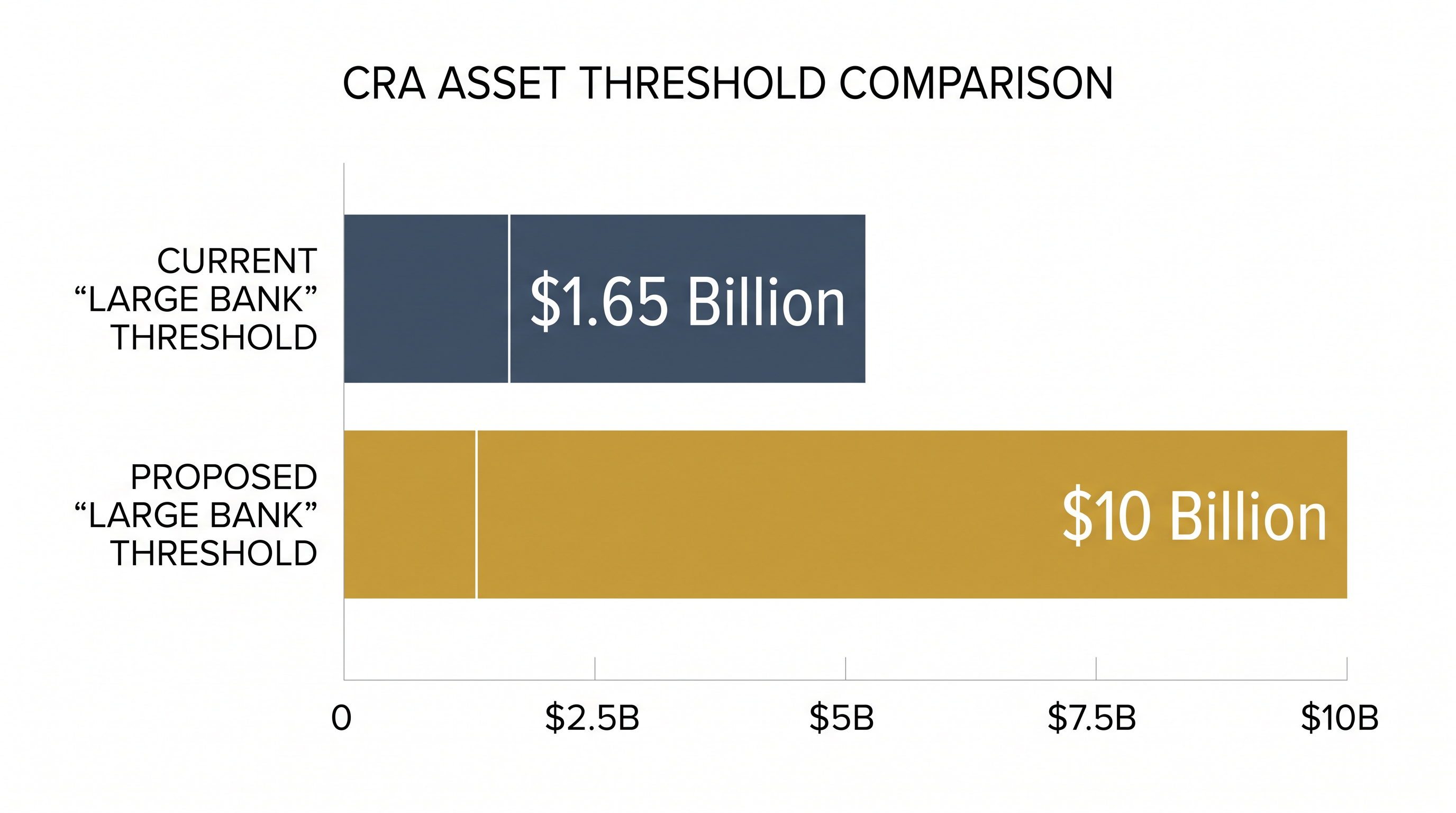
- The OCC and FDIC proposed raising the threshold for large-bank CRA exams from $1.65 billion to $10 billion.
- Banks under $10 billion would be exempt from the most rigorous investment tests and data reporting requirements.
- Only 86 banks would remain in the large-bank category, though they hold over 85% of U.S. banking assets.
- The proposal shifts the examination focus heavily toward direct lending, excluding deposit services from retail evaluations.
- Community development grants would face tighter scrutiny, including a 15% cap on recipient overhead costs.
- The Federal Reserve did not join the proposal, potentially creating a bifurcated regulatory environment for banks.
On July 31, 2026, the Office of the Comptroller of the Currency (OCC) and the Federal Deposit Insurance Corporation (FDIC) jointly unveiled a sweeping proposal to overhaul the Community Reinvestment Act (CRA). The draft rule represents a fundamental shift in how federal regulators evaluate whether financial institutions are meeting the credit needs of their local communities. By raising the asset threshold for the most rigorous examinations and narrowing the focus to direct lending, the agencies aim to simplify a regulatory framework that has grown increasingly complex over the past three decades.[1][4]
Enacted in 1977, the CRA is a landmark civil rights-era law designed to eliminate redlining—the discriminatory practice of denying credit to residents of low- and moderate-income (LMI) neighborhoods. For nearly fifty years, the law has required banks to demonstrate that they serve the financial needs of the entire geographic area in which they are chartered. A bank's CRA rating directly impacts its ability to open new branches, merge with other institutions, or acquire competitors.[4][6]
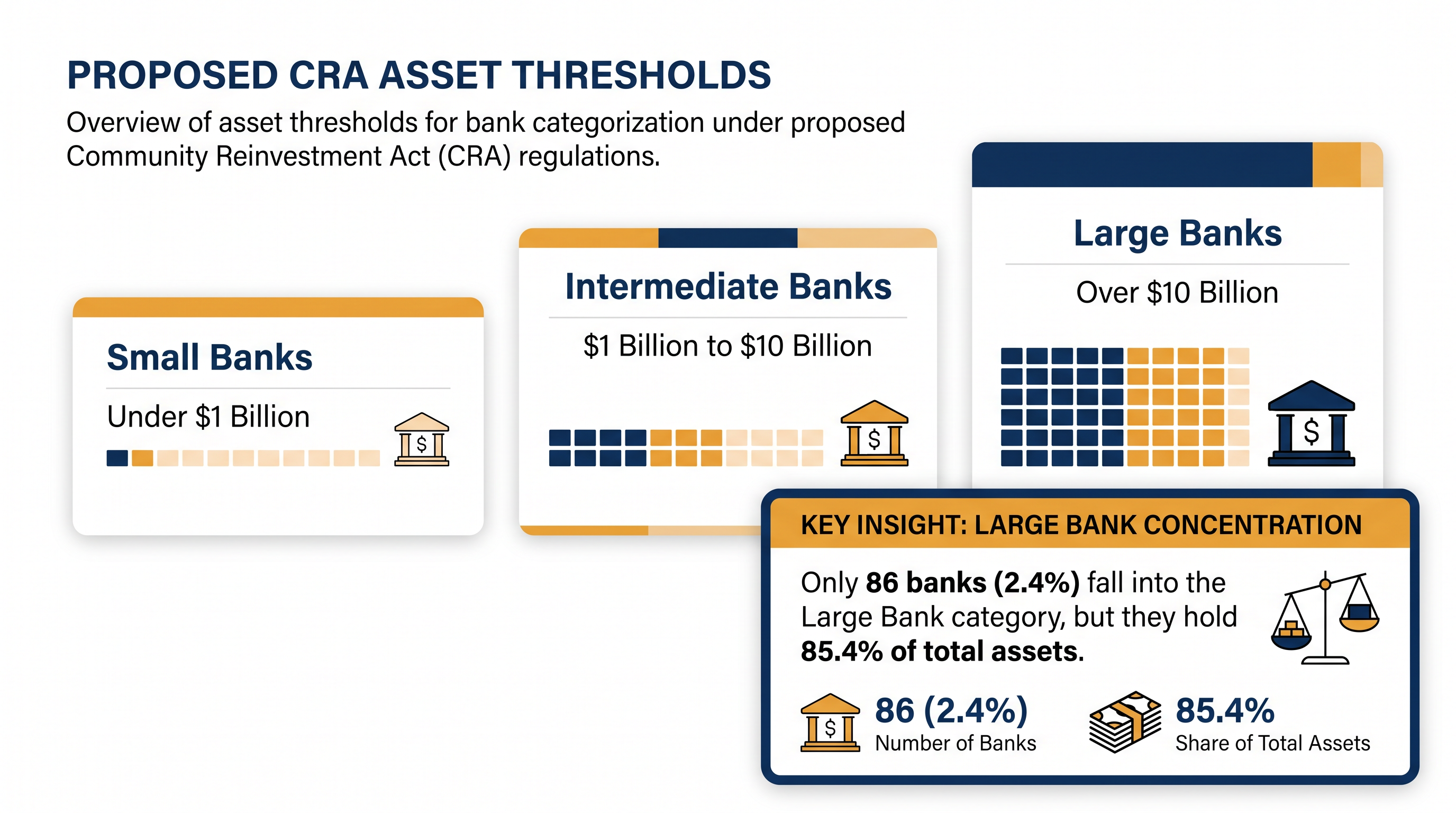
The most immediate and consequential change in the new proposal is the reclassification of bank sizes. Under the current framework, banks with assets over $1.65 billion face the full, comprehensive large-bank CRA examination. The OCC and FDIC proposal would dramatically raise that threshold to $10 billion. Institutions with less than $1 billion in assets would be classified as "small banks," while those holding between $1 billion and $10 billion would fall into a newly defined "intermediate bank" category.[2][5]
This threshold adjustment effectively exempts hundreds of community and regional banks from the most burdensome data collection and reporting requirements. According to regulatory data cited in the proposal, only 86 banks—representing roughly 2.4% of all U.S. depository institutions—would remain in the large-bank category. However, because the banking sector is highly consolidated, those 86 institutions still hold approximately 85.4% of total domestic banking assets.[2][4]
For the hundreds of banks moving below the $10 billion mark, the regulatory relief is substantial. These intermediate banks would no longer be subject to separate, distinct tests for their lending, investments, and retail services. The FDIC estimates that the streamlined requirements will eliminate more than 106,000 hours of annual compliance work, saving the banks it supervises approximately $10 million per year.[2][5]
Beyond threshold changes, the proposal fundamentally alters what activities earn CRA credit. The OCC and FDIC are pivoting the examination focus heavily toward direct credit services—specifically, a bank's major retail lending products, such as mortgages and small business loans. In doing so, the agencies are proposing to exclude deposit services, such as the provision of low-cost checking accounts, from the retail services evaluation.[1][3]
The agencies argue that this shift returns the CRA to its statutory roots: evaluating credit delivery rather than broad banking services. By concentrating on major product lines, examiners will assess whether a bank is actually putting capital into the hands of LMI borrowers and small businesses, rather than simply maintaining a physical branch presence or gathering local deposits.[2][3]
The agencies argue that this shift returns the CRA to its statutory roots: evaluating credit delivery rather than broad banking services.
Another highly scrutinized provision involves how banks receive credit for community development grants and donations. Historically, banks have fulfilled part of their CRA obligations by funding nonprofit organizations, affordable housing initiatives, and community development groups. The new proposal tightens the parameters around these grants, requiring banks to document that the funds are used directly for specific community development projects.[1][4]
Specifically, large banks would be required to prove that no more than 15% of a grant recipient's funding is consumed by indirect or overhead administrative costs. The OCC and FDIC based this cap on standard federal grant guidance, asserting that it will ensure capital reaches the intended communities rather than being absorbed by operating expenses or diverted to broader advocacy efforts.[2][3]
This tightening of grant rules also includes a mandate for banks to collect more granular data on grant recipients, including specific geographic addresses. Regulators state this will increase transparency, ensuring that community development funds are spent locally rather than being distributed to national umbrella organizations that may not have a direct impact on the bank's immediate assessment area.[4][5]
Notably absent from the joint proposal is the Federal Reserve, the third major federal banking regulator. The Fed, which oversees state-chartered member banks, opted not to join the OCC and FDIC in this rulemaking effort. Instead, the central bank appears to be maintaining the existing regulatory framework, creating a fractured landscape where banks could face vastly different CRA expectations depending on their primary federal supervisor.[1][3]
The banking industry has largely welcomed the OCC and FDIC's effort to simplify the rules. Trade groups and industry advocates have long argued that the CRA's complex formulas and subjective investment tests disproportionately burden smaller institutions that lack massive compliance departments. A streamlined, objective framework focused on lending is seen as a necessary modernization that reflects the realities of contemporary banking.[2][5]
Conversely, community advocates and housing organizations have raised alarms about the unintended consequences of the overhaul. Critics argue that exempting intermediate banks from the investment test will lead to a severe drop in funding for affordable housing projects and local economic development initiatives. Because intermediate banks are often the primary financial engines in rural areas, advocates warn that these communities could see a significant reduction in vital grant capital.[3][4]
Furthermore, consumer advocates caution that excluding deposit services from CRA consideration could disincentivize banks from offering accessible, low-cost accounts to LMI individuals. Without regulatory credit for maintaining inclusive deposit products, banks might prioritize higher-margin lending products, potentially pushing vulnerable consumers toward alternative, higher-cost financial services.[1][6]
The proposal marks the latest chapter in a turbulent multi-year effort to modernize the CRA. In 2023, all three banking regulators finalized a massive 1,500-page overhaul, which was subsequently challenged in court and targeted for rescission. This new, streamlined approach underscores the ongoing political and ideological debate over how best to mandate corporate investment in underserved communities.[1][5]
As the proposal enters its public comment period, financial institutions are preparing for a potentially bifurcated regulatory environment. While large banks over $10 billion will continue to navigate rigorous lending and grant-tracking requirements, hundreds of community and regional banks are poised to operate under a significantly lighter compliance burden, reshaping the flow of community reinvestment capital across the country.[2][3]
How we got here
1977
The Community Reinvestment Act is passed to combat redlining and encourage lending in LMI neighborhoods.
1995
Federal regulators implement the last major, lasting interagency overhaul of CRA regulations.
October 2023
The OCC, FDIC, and Federal Reserve finalize a 1,500-page CRA modernization rule, which later faces legal challenges.
July 31, 2026
The OCC and FDIC propose a new, streamlined CRA framework, raising the large-bank threshold to $10 billion.
Viewpoints in depth
Banking Industry Advocates
Focus on reducing compliance burdens and simplifying the regulatory framework.
Industry groups and regional bank executives argue that the CRA has become overly complex and punitive for institutions that lack massive compliance departments. They support the $10 billion threshold, noting that it provides necessary regulatory relief for community and intermediate banks while ensuring that the 86 largest institutions—which hold 85% of all assets—remain fully scrutinized. By focusing on objective lending metrics rather than subjective investment tests, they believe banks can serve their communities more efficiently without spending millions on administrative compliance.
Community and Housing Advocates
Concerned that the overhaul will reduce vital investments in affordable housing and rural development.
Organizations like the National Community Reinvestment Coalition warn that exempting intermediate banks from the investment test removes a critical incentive for funding affordable housing and local nonprofits. Because banks between $1 billion and $10 billion are often the primary financial anchors in rural and mid-sized markets, advocates fear these areas will see a sharp decline in community development grants. They also argue that capping overhead at 15% for grant recipients demonstrates a misunderstanding of the operational realities faced by local nonprofits.
Federal Regulators (OCC & FDIC)
Aiming to return the CRA to its statutory roots of evaluating direct credit delivery.
The OCC and FDIC maintain that the proposal realigns the CRA with its original 1977 mandate: ensuring banks meet the credit needs of their communities. By stripping away evaluations of deposit services and tightening the rules around community grants, regulators want to ensure that capital is directly deployed as loans to low- and moderate-income borrowers and small businesses. The 15% overhead cap on grants is viewed as a necessary safeguard to prevent community funds from being absorbed by administrative costs or diverted to national advocacy campaigns.
What we don't know
- How the Federal Reserve's refusal to join the proposal will impact state-chartered member banks in practice.
- Whether the 15% overhead cap on community grants will force banks to sever ties with long-standing nonprofit partners.
- How the exclusion of deposit services from CRA credit will affect the availability of low-cost checking accounts for LMI consumers.
Key terms
- Community Reinvestment Act (CRA)
- A 1977 federal law intended to encourage depository institutions to help meet the credit needs of the communities in which they operate.
- Redlining
- The discriminatory practice of denying loans or services to residents of certain areas based on their race or ethnicity.
- Assessment Area
- The specific geographic region where a bank operates and is evaluated by regulators for its CRA compliance.
- Low- and Moderate-Income (LMI)
- A demographic classification used by regulators to identify individuals or geographies earning less than 80% of the area median income.
- Intermediate Bank
- Under the new proposal, a bank with assets between $1 billion and $10 billion, which would face streamlined CRA requirements.
Frequently asked
What is the Community Reinvestment Act?
The CRA is a 1977 law that requires federal regulators to evaluate how well banks fulfill the credit needs of their local communities, particularly low- and moderate-income neighborhoods.
How does the new proposal change bank classifications?
It raises the threshold for a 'large bank' from $1.65 billion to $10 billion in assets, exempting hundreds of smaller banks from the most rigorous compliance and investment tests.
Why are community advocates concerned?
Advocates worry that without the strict investment test, intermediate banks will significantly reduce their funding for affordable housing and rural economic development nonprofits.
Why did the Federal Reserve not join the proposal?
The Federal Reserve opted to maintain the existing regulatory framework, meaning state-chartered member banks overseen by the Fed will not be subject to the OCC and FDIC's new rules.
Sources
Source coverage
6 outlets
3 viewpoints surfaced






[1]Credit and Collection NewsRegulatory Proponents
OCC, FDIC propose another CRA revamp
Read on Credit and Collection News →[2]National Mortgage ProfessionalBanking Industry Advocates
Fewer Banks Would Face Full CRA Exams
Read on National Mortgage Professional →[3]American BankerCommunity Advocates
FDIC and OCC release new notice of proposed rulemaking for the CRA
Read on American Banker →[4]The Washington PostCommunity Advocates
Administration announces overhaul to Community Reinvestment Act rules
Read on The Washington Post →[5]IndexBoxBanking Industry Advocates
FDIC and OCC Propose CRA Rule Update: Grant Oversight and $10B Bank Exemption Threshold
Read on IndexBox →[6]Federal Deposit Insurance CorporationRegulatory Proponents
Notice of Proposed Rulemaking: Community Reinvestment Act Regulations
Read on Federal Deposit Insurance Corporation →
Comments

Every angle. Every day.
Get finance stories with full source coverage and perspective breakdowns delivered to your inbox.