
The New Global Law of the Ocean: A Guide to the High Seas Treaty and Marine Genetic Resources
The landmark BBNJ Agreement has officially entered into force in 2026, establishing the first comprehensive legal framework for the high seas. Here is how the treaty governs marine protected areas, environmental assessments, and the commercial use of marine genetic resources.
By Ivan Smirnov


- Conservation Organizations
- Focuses on the treaty's ability to establish marine protected areas and halt biodiversity loss.
- Developing Nations & Equity Proponents
- Prioritizes the equitable sharing of economic benefits derived from marine genetic resources.
- Scientific & Biotech Community
- Seeks clear, workable regulations that facilitate research without imposing prohibitive bureaucratic burdens.
Why this matters
For decades, the high seas were a regulatory wild west, leaving critical ecosystems and lucrative genetic discoveries unmanaged. This treaty creates a binding rulebook that will impact everything from global pharmaceutical supply chains to international shipping and deep-sea conservation.
Key points
- The High Seas Treaty officially entered into force in January 2026 after surpassing 60 ratifications.
- It provides the first legal mechanism to establish Marine Protected Areas (MPAs) in international waters.
- A new Clearing-House Mechanism will track Marine Genetic Resources (MGRs) using unique batch identifiers.
- The treaty mandates equitable benefit-sharing for both physical genetic samples and Digital Sequence Information (DSI).
- Rigorous Environmental Impact Assessments are now required for new commercial activities in the high seas.
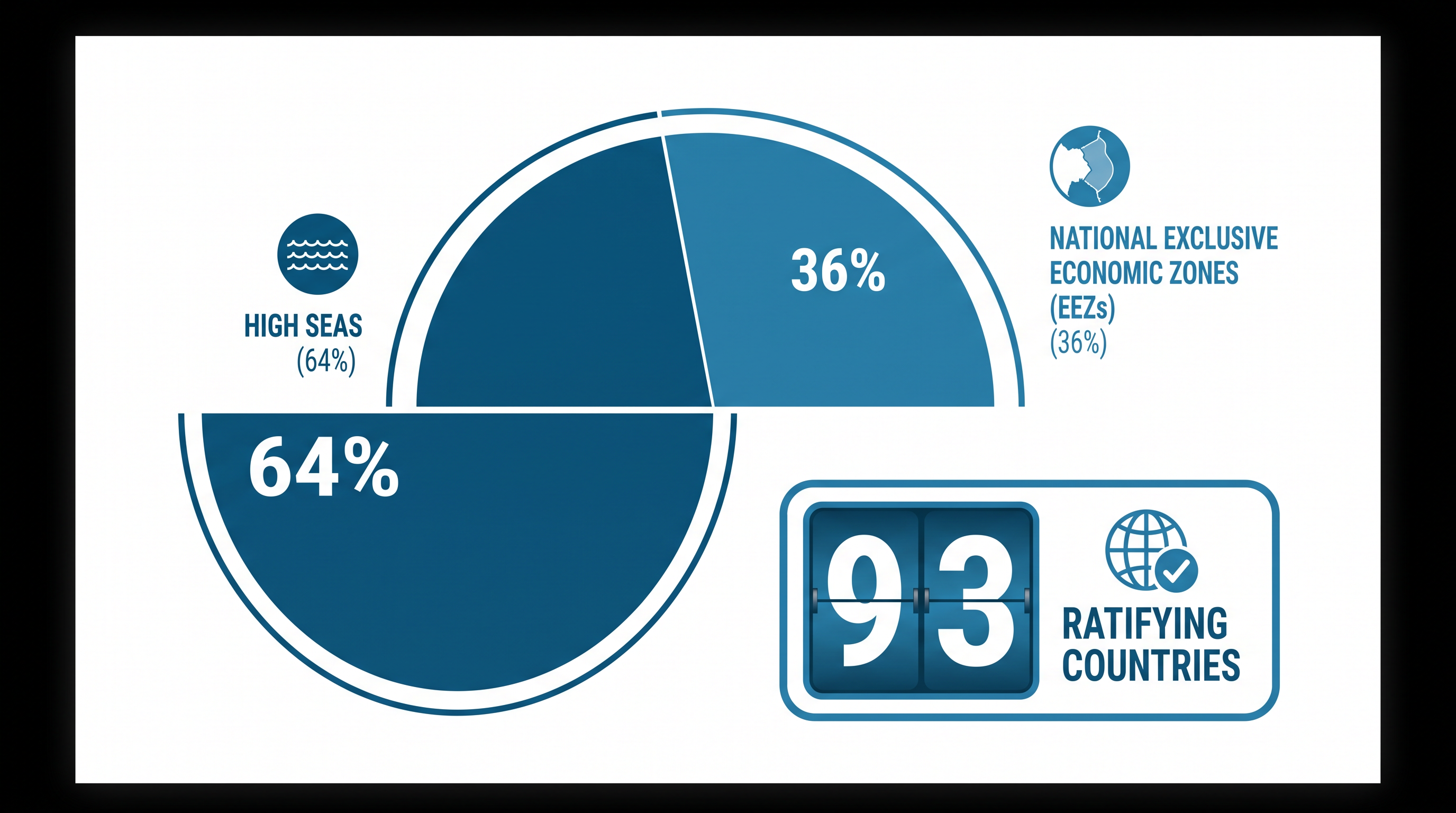
For centuries, the vast expanse of the open ocean has operated under a fragmented, often toothless regulatory regime. Covering nearly two-thirds of the global ocean and half of the Earth's surface, the "high seas" lie beyond the exclusive economic zones of any single nation. Because these waters belong to everyone, they have effectively belonged to no one—a classic tragedy of the commons that has left critical marine ecosystems vulnerable to overexploitation, pollution, and the mounting pressures of climate change. Until recently, less than one percent of this massive global commons was fully protected, and the legal mechanisms to safeguard its biodiversity simply did not exist.[1][3]
That paradigm shifted permanently on January 17, 2026, when the Agreement on the Conservation and Sustainable Use of Marine Biological Diversity of Areas Beyond National Jurisdiction (BBNJ)—widely known as the High Seas Treaty—officially entered into force. Following nearly two decades of grueling United Nations negotiations, the treaty reached its required 60-nation ratification threshold in September 2025, triggering a 120-day countdown to international law. As of mid-2026, over 90 countries have ratified the agreement, legally binding themselves to a new framework that fundamentally rewrites the rules of global ocean governance.[2][4][6]
The BBNJ Agreement is the third implementing agreement under the 1982 United Nations Convention on the Law of the Sea (UNCLOS), but it is arguably the most ambitious. It is built upon four foundational pillars designed to balance environmental conservation with the equitable use of ocean resources. These include the establishment of area-based management tools (primarily marine protected areas), a rigorous regime for environmental impact assessments, mechanisms for capacity building and technology transfer, and—perhaps most complex of all—a comprehensive system for managing marine genetic resources.[3][7]
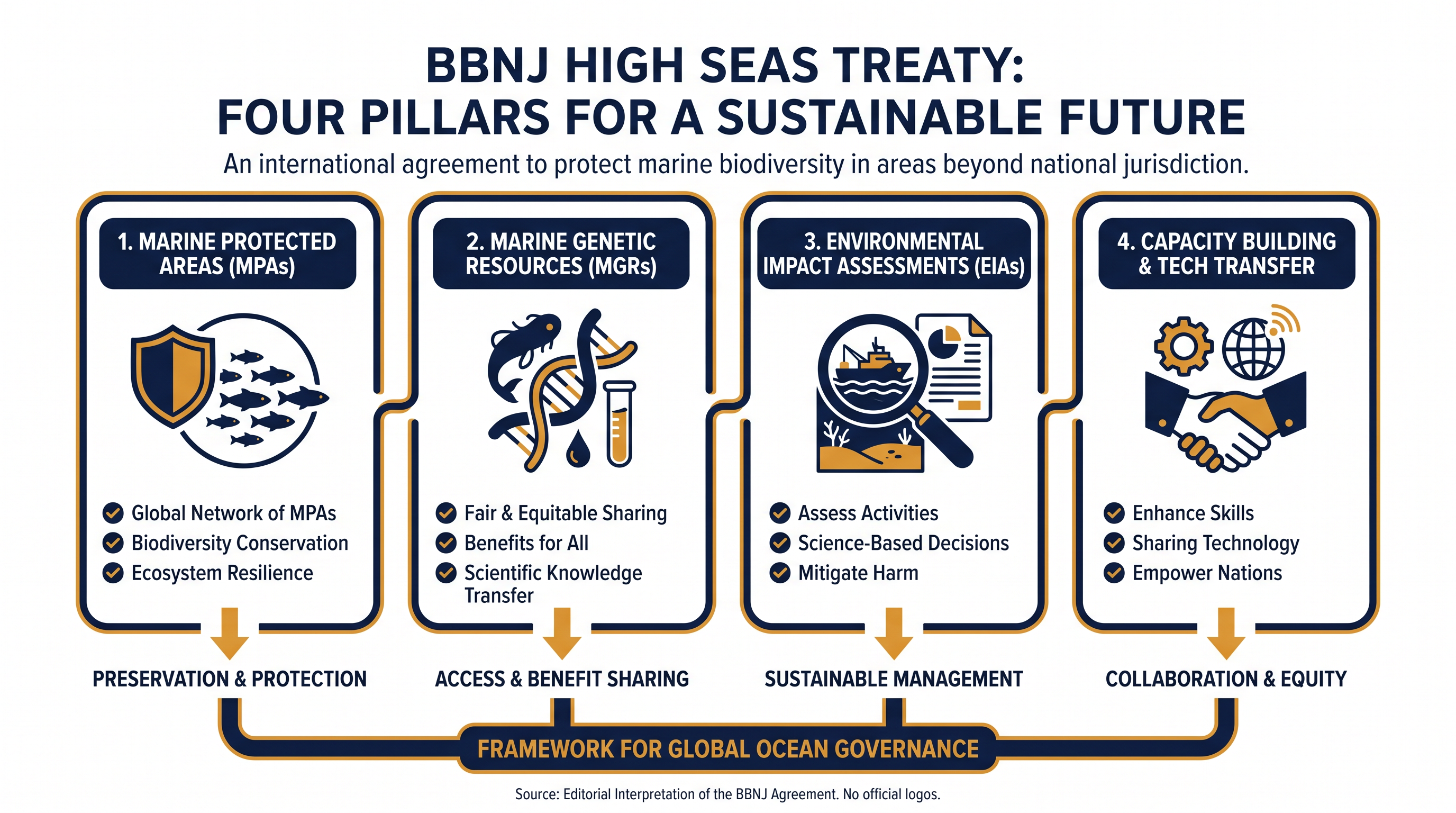
The treaty's provisions for Marine Protected Areas (MPAs) represent its most immediate conservation tool. Prior to the BBNJ Agreement, establishing a protected zone in international waters required navigating a labyrinth of regional fisheries management organizations and sector-specific bodies, none of which had the overarching authority to mandate comprehensive protection. The new treaty provides a unified legal pathway for member states to propose, consult upon, and implement MPAs on the high seas. This mechanism is widely viewed as the only viable route to achieving the Kunming-Montreal Global Biodiversity Framework’s "30x30" target—the goal of conserving 30 percent of the Earth’s surface by 2030.[1][6]
While the conservation elements of the treaty have drawn widespread public attention, the economic and scientific core of the BBNJ Agreement revolves around Marine Genetic Resources (MGRs). The deep ocean is a reservoir of extreme biological diversity. Organisms surviving in the crushing pressures, freezing temperatures, and hydrothermal vents of the abyss have evolved unique biochemical properties. These extremophiles, deep-sea sponges, and marine microbes hold immense potential for the pharmaceutical, cosmetic, and biotechnology industries, offering pathways to novel antibiotics, cancer treatments, and industrial enzymes.[5][8]
Historically, the exploration and commercialization of these genetic resources have been dominated by a handful of wealthy nations and multinational corporations that possess the advanced research vessels and deep-sea submersibles required to access them. Developing nations have long argued that because the high seas are the "common heritage of humankind," the benefits derived from its biodiversity should be shared equitably. The BBNJ Agreement codifies this principle, establishing a mandatory benefit-sharing regime for both monetary and non-monetary gains resulting from the utilization of high-seas MGRs.[3][7]
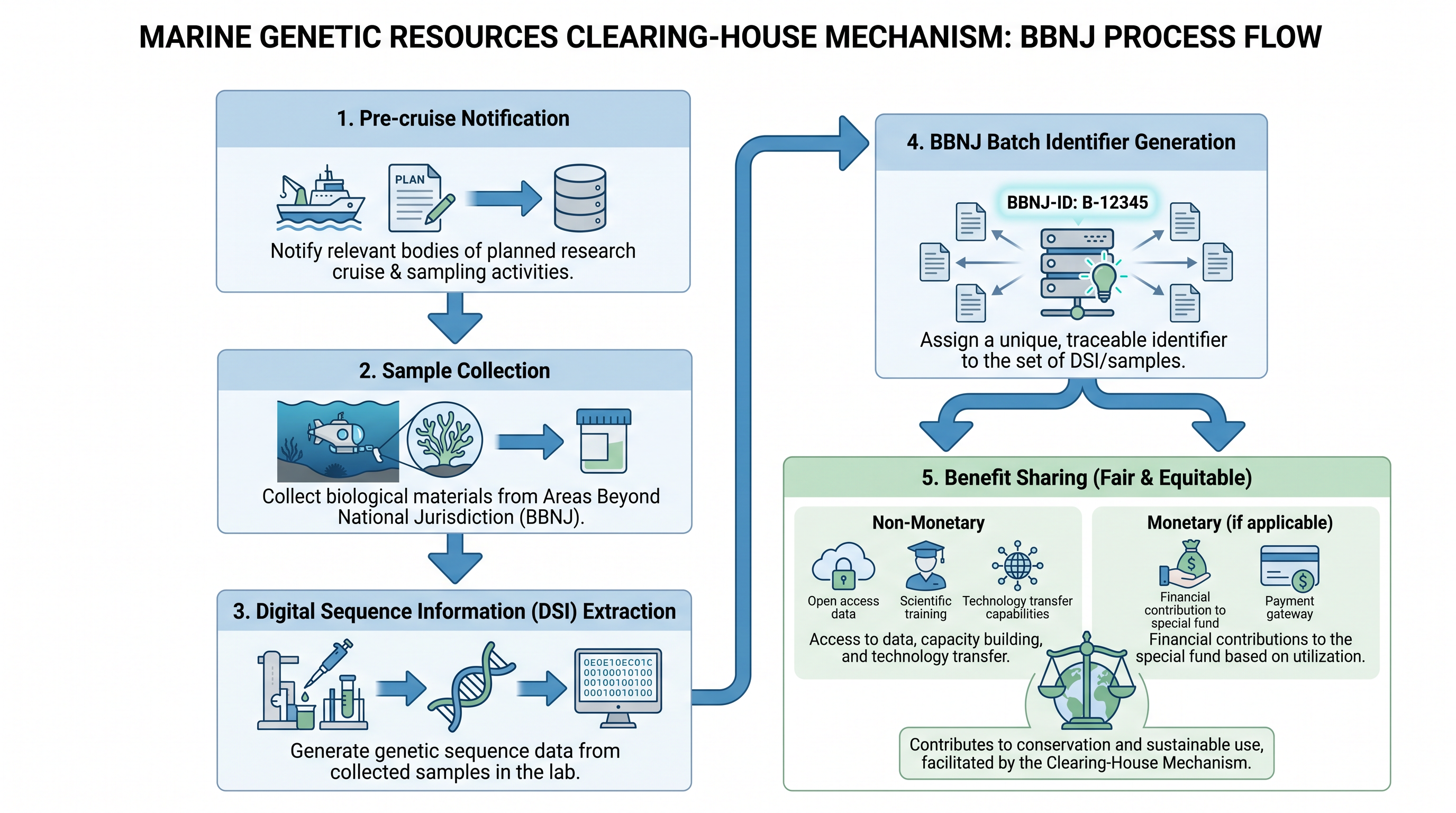
To operationalize this, the treaty creates a centralized Clearing-House Mechanism. Any research expedition planning to collect biological samples in areas beyond national jurisdiction must now submit pre-cruise and post-cruise notifications to this global registry. Upon collection, the mechanism generates a unique "BBNJ batch identifier" that attaches to the physical samples. This identifier is designed to track the genetic material along its entire chain of custody—from the moment it is pulled from the ocean floor to its potential integration into a patented commercial product years later in a corporate laboratory.[5]
To operationalize this, the treaty creates a centralized Clearing-House Mechanism.
Crucially, the treaty's regulatory scope extends beyond physical biological samples to include Digital Sequence Information (DSI). In modern biotechnology, researchers rarely need to transport physical specimens across the globe; instead, they sequence an organism's DNA or RNA and upload the genetic code to global databases. By explicitly incorporating DSI into the benefit-sharing framework, the BBNJ Agreement ensures that the digitization of marine biology does not become a loophole for circumventing equity requirements. Anyone utilizing high-seas DSI for research or commercial development is subject to the treaty's notification and benefit-sharing obligations.[5][8]
The exact financial mechanics of this benefit-sharing remain one of the most intensely debated aspects of the treaty's implementation. The agreement outlines a two-phase process for developed countries, involving assessed contributions and the eventual establishment of specific modalities for monetary benefit-sharing tied to the commercialization of MGRs. These funds are earmarked for a dedicated financial mechanism that will support conservation efforts in the high seas and assist developing nations in building their own marine science capacities.[5]
Beyond genetic resources, the BBNJ Agreement introduces stringent new requirements for Environmental Impact Assessments (EIAs). Any planned activity under a ratifying country's jurisdiction that could cause substantial pollution or significant and harmful changes to the marine environment must now undergo a rigorous evaluation before proceeding. This provision is expected to have profound implications for emerging industries such as deep-sea mining, as well as for novel climate interventions like ocean fertilization or large-scale carbon sequestration projects, ensuring they cannot proceed in the dark.[1][7]
The final pillar of the treaty focuses on capacity building and the transfer of marine technology. Recognizing that a global regulatory framework is only as strong as its weakest link, the agreement mandates that developed nations assist developing countries in acquiring the scientific knowledge, equipment, and institutional frameworks necessary to participate meaningfully in high-seas governance. This includes training scientists, sharing oceanographic data, and facilitating joint research ventures, thereby democratizing access to the ocean's final frontier.[3][7]
With the treaty now in force, the international community is racing to transition from diplomatic negotiation to practical enforcement. The Preparatory Commission is currently laying the groundwork for the first Conference of the Parties (COP1), which is mandated to convene by January 2027. This inaugural summit will be critical, as member states must finalize the institutional architecture of the treaty, including the permanent Secretariat, the Scientific and Technical Body, and the Access and Benefit-Sharing Committee that will oversee the MGR provisions.[1][2]
The success of the BBNJ Agreement will ultimately depend on the willingness of ratifying nations to enforce its provisions against domestic industries and to fund its mechanisms adequately. While the treaty does not supersede existing regional fisheries management organizations or bodies like the International Seabed Authority, it imposes a new overarching obligation for coherence and environmental stewardship. For the first time in human history, the lawless expanse of the high seas has a comprehensive constitution—one that recognizes the deep ocean not just as a resource to be exploited, but as a fragile, shared inheritance that must be actively managed.[4][6][8]
How we got here
June 2023
The BBNJ Agreement is formally adopted at the United Nations after nearly two decades of negotiations.
September 2023
The treaty opens for state signatures, signaling countries' intent to ratify the agreement.
September 2025
The treaty reaches the critical threshold of 60 state ratifications, triggering the countdown to international law.
January 2026
The High Seas Treaty officially enters into force, becoming legally binding for all ratifying nations.
January 2027
The deadline for the first Conference of the Parties (COP1) to convene and finalize the treaty's institutional architecture.
Viewpoints in depth
Conservation Organizations
Focuses on the treaty's ability to establish marine protected areas and halt biodiversity loss.
Environmental groups view the BBNJ Agreement primarily as a rescue mission for the planet's largest ecosystem. They emphasize that without the treaty's legal mechanism for creating high-seas MPAs, the global "30x30" conservation target would be mathematically impossible to achieve. For these advocates, the immediate priority is utilizing the new framework to protect critical migratory corridors and vulnerable deep-sea habitats from overfishing and emerging threats like deep-sea mining.
Developing Nations
Prioritizes the equitable sharing of economic benefits derived from marine genetic resources.
For countries in the Global South, the high seas represent a shared global heritage that has historically been monopolized by a few technologically advanced nations. This perspective focuses heavily on the treaty's Access and Benefit-Sharing Committee and the Clearing-House Mechanism. They argue that any commercialization of deep-sea DNA—whether physical or digitized—must result in tangible monetary contributions and technology transfers that allow developing nations to build their own marine science sectors.
Scientific & Biotech Community
Seeks clear, workable regulations that facilitate research without imposing prohibitive bureaucratic burdens.
Marine researchers and biotechnology firms acknowledge the need for benefit-sharing but are highly focused on the practical implementation of the rules surrounding Digital Sequence Information (DSI) and BBNJ batch identifiers. Their primary concern is ensuring that the new notification requirements and chain-of-custody tracking do not stifle basic scientific research or create a chilling effect on the open sharing of genetic data in global repositories.
What we don't know
- The exact monetary rates and financial mechanisms that developed nations and corporations will be required to pay for utilizing marine genetic resources.
- How strictly the new Environmental Impact Assessment rules will be applied to emerging industries like deep-sea mining by individual ratifying states.
- The specific boundaries and enforcement mechanisms for the first wave of high-seas Marine Protected Areas expected to be proposed at COP1.
Key terms
- BBNJ Agreement
- The formal UN agreement on the conservation and sustainable use of marine biological diversity of areas beyond national jurisdiction.
- Clering-House Mechanism
- A centralized global registry created by the treaty to track marine research expeditions, genetic samples, and benefit-sharing compliance.
- Digital Sequence Information (DSI)
- The digitized genetic code (DNA or RNA) of an organism, which can be shared and analyzed globally without transferring the physical specimen.
- BBNJ Batch Identifier
- A unique tracking code assigned to marine genetic samples collected in the high seas to monitor their chain of custody and commercial use.
- 30x30 Target
- A global environmental goal to conserve 30 percent of the Earth's land and ocean surface by the year 2030.
Frequently asked
What exactly are the "high seas"?
The high seas are areas of the ocean that lie beyond the Exclusive Economic Zone (EEZ) of any single country, typically starting 200 nautical miles from the coastline. They cover roughly 64% of the global ocean.
What is a Marine Genetic Resource (MGR)?
An MGR is any biological material from marine plants, animals, or microbes that contains functional units of heredity with actual or potential value, often used in pharmaceuticals or biotechnology.
How does the treaty handle digital genetic data?
The treaty includes Digital Sequence Information (DSI) in its regulations, meaning researchers who sequence deep-sea DNA and upload it to databases must still comply with the agreement's benefit-sharing and tracking rules.
Does this treaty ban deep-sea mining?
No, the BBNJ Agreement does not outright ban deep-sea mining. However, it requires rigorous Environmental Impact Assessments (EIAs) for any high-seas activity that could cause significant harm to the marine environment.
Sources
Source coverage
8 outlets
3 viewpoints surfaced








[1]World Resources InstituteScientific & Biotech Community
The High Seas Treaty Enters Into Force: What to Know
Read on World Resources Institute →[2]IFAWConservation Organizations
High Seas Treaty enters into force, unlocking new era of ocean conservation
Read on IFAW →[3]London School of EconomicsScientific & Biotech Community
What is the BBNJ Agreement?
Read on London School of Economics →[4]High Seas AllianceConservation Organizations
High Seas Treaty Ratification Tracker
Read on High Seas Alliance →[5]Harvard UniversityScientific & Biotech Community
Marine Genetic Resources under the BBNJ Treaty
Read on Harvard University →[6]The Nature ConservancyConservation Organizations
A Defining Moment for Global Ocean Governance
Read on The Nature Conservancy →[7]United Nations UniversityDeveloping Nations & Equity Proponents
What is the High Seas Treaty and Why is it Important?
Read on United Nations University →[8]Taylor & FrancisScientific & Biotech Community
The BBNJ Agreement and the regulation of marine genetic resources
Read on Taylor & Francis →
Comments
Every angle. Every day.
Get guides stories with full source coverage and perspective breakdowns delivered to your inbox.