
The Safety Trade-Off: 1.5 Million Rechargeable Hand Warmers Recalled After Fatal Fire and Hundreds of Injuries
Following the recall of 1.5 million OCOOPA rechargeable hand warmers linked to a fatality and 350 burns, consumers face a critical choice between the convenience of lithium-ion devices and the inherent safety of traditional chemical warmers.
By Paige Carter


- Consumer Safety Regulators
- Federal agencies prioritize eliminating catastrophic fire hazards from consumer electronics.
- Lithium-Ion Advocates
- Supporters of rechargeable technology emphasize its environmental benefits and performance control.
- Product Liability Advocates
- Legal and consumer watchdogs focus on the severe injuries caused by uncertified imports.
Why this matters
With winter approaching, millions of consumers rely on portable heat to stay comfortable outdoors. This massive recall exposes the severe fire risks of uncertified lithium-ion batteries, forcing buyers to weigh the environmental benefits of rechargeable devices against the zero-fire-risk profile of traditional chemical warmers.
Key points
- The CPSC recalled 1.5 million OCOOPA rechargeable hand warmers following 1,480 overheating reports, 350 burns, and one fatality.
- Lithium-ion warmers offer adjustable heat and reusability but carry severe fire risks if the battery cell is damaged or defective.
- Traditional chemical warmers provide absolute fire safety and a slim profile but generate single-use landfill waste.
- Consumers are urged to check their devices for recalled model numbers and dispose of them at hazardous waste facilities.
The CPSC's sweeping recall of 1.5 million OCOOPA rechargeable hand warmers has forced a sudden re-evaluation of how consumers stay warm outdoors. Following 1,480 reports of the devices overheating, the federal agency documented 15 fires, 350 severe burn injuries, and the tragic death of an 83-year-old consumer in San Diego. The affected models, sold widely across major e-commerce platforms between September 2018 and May 2026, contained lithium-ion batteries that could enter thermal runaway and ignite. This unprecedented safety action has ignited a broader debate over the fundamental technologies we use to generate portable heat.[1][2]
For decades, the portable heat market was dominated by single-use, air-activated chemical packets that relied on simple oxidation. However, the last five years saw a massive consumer shift toward rechargeable lithium-ion devices, driven by the promise of reusability, modern convenience, and long-term cost savings. The sweeping OCOOPA recall now serves as a critical inflection point in this market, forcing buyers to conduct a stark trade-off analysis between the environmental benefits of battery-powered warmth and the absolute fire safety of traditional chemical oxidation.[3][6]
The primary argument for lithium-ion rechargeable hand warmers centers on environmental sustainability and precise performance control. Users benefit immensely from adjustable heat settings, typically ranging from 104 to 140 degrees Fahrenheit, allowing them to dial in exact comfort levels as weather conditions change. Furthermore, these modern devices eliminate the daily accumulation of disposable packets in landfills and offer the highly valued dual utility of acting as portable power banks to charge smartphones and GPS devices during extended outdoor excursions.[6][7]
Against this modern convenience, consumer safety advocates point to the inherent volatility of strapping high-capacity lithium-ion chemistry directly to the human body. When these complex batteries suffer from manufacturing defects, internal electrical shorts, or physical damage from being dropped on hard surfaces, they can rapidly overheat. Unlike a smartphone that sits passively in a pocket, a hand warmer is explicitly designed to generate intense heat, effectively masking the early warning signs of a battery cell entering a dangerous thermal failure state.[1][4]
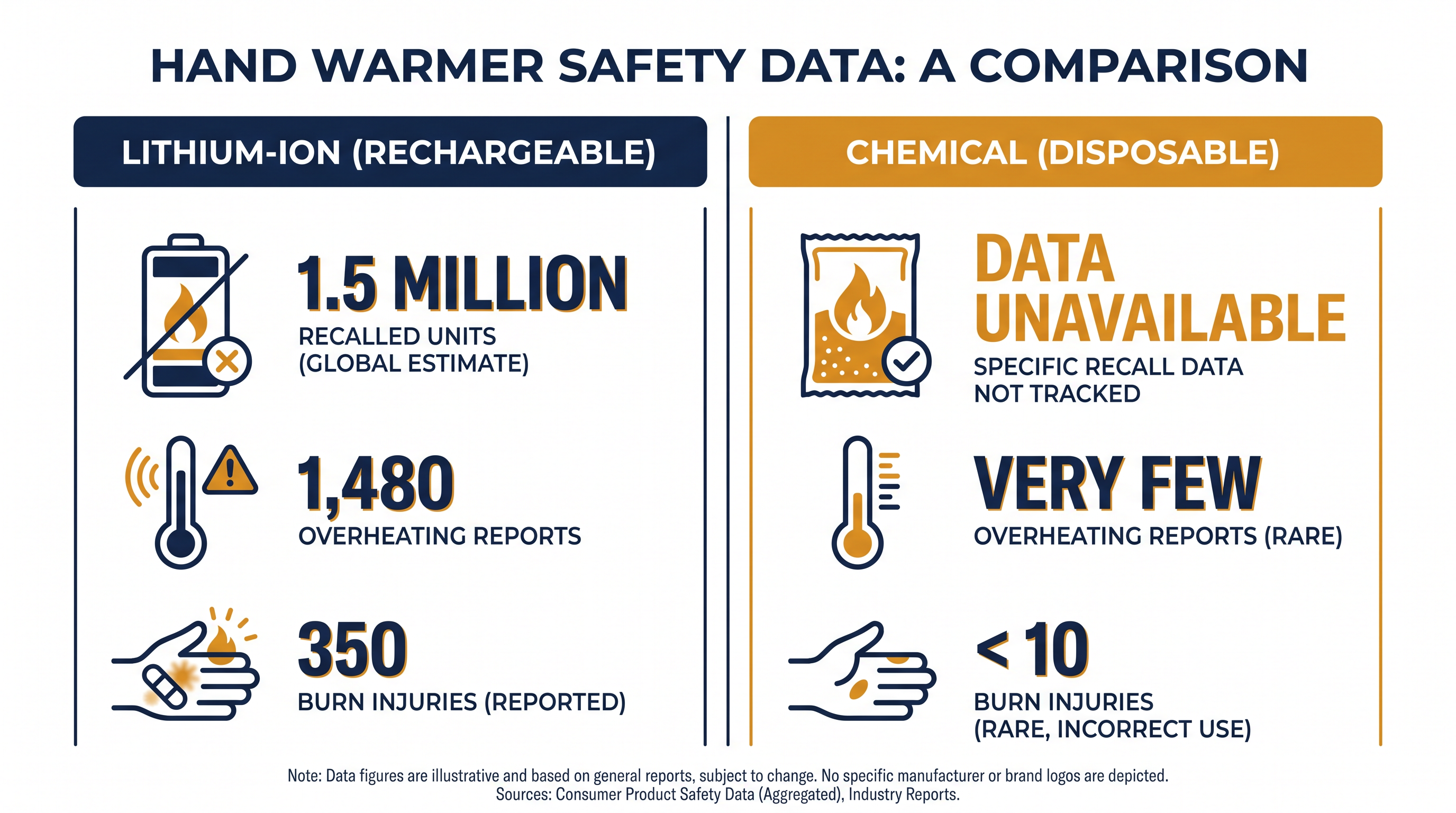
The evidence of this severe risk is starkly quantified in the CPSC's official recall data. With 350 documented burn injuries linked to just one manufacturer's product line, the data demonstrates that when a lithium-ion warmer fails, the physical consequences are immediate and severe. The sheer volume of incidents—nearly 1,500 overheating reports culminating in 15 fires and a tragic fatality—highlights systemic vulnerabilities in the global supply chain of low-cost, uncertified electronics imported directly to consumers through major e-commerce platforms.[1][5]
The evidence of this severe risk is starkly quantified in the CPSC's official recall data.
Ultimately, lithium-ion technology fits well when users require adjustable, on-demand heat for intermittent outdoor activities and are willing to invest in UL-certified devices from reputable brands with rigorous quality control. It does not fit when consumers prioritize budget over safety by purchasing cheap, uncertified imports, or when the device will be subjected to heavy impacts, crushing forces, or extreme moisture that could compromise the battery cell.[1][6]
Conversely, the argument for traditional air-activated chemical warmers centers on absolute safety, analog reliability, and a highly versatile form factor. These packets rely on a simple, predictable exothermic reaction involving iron powder, water, salt, and activated charcoal exposed to oxygen. Because they contain no stored electrical energy or volatile chemicals, they cannot explode, they do not require charging, and they are slim enough to slide comfortably inside tight gloves or ski boots without adding cumbersome bulk to the user's gear.[6]
Against this traditional approach, environmentalists and frequent outdoor workers point to the ongoing financial cost and significant landfill waste. A single-use packet generates trash after just one day of use, and the heat output cannot be adjusted or turned off once the iron oxide reaction begins. While users can temporarily pause the chemical process by sealing the packet in an airtight plastic bag to starve it of oxygen, the overall lifecycle remains inherently disposable.[6]
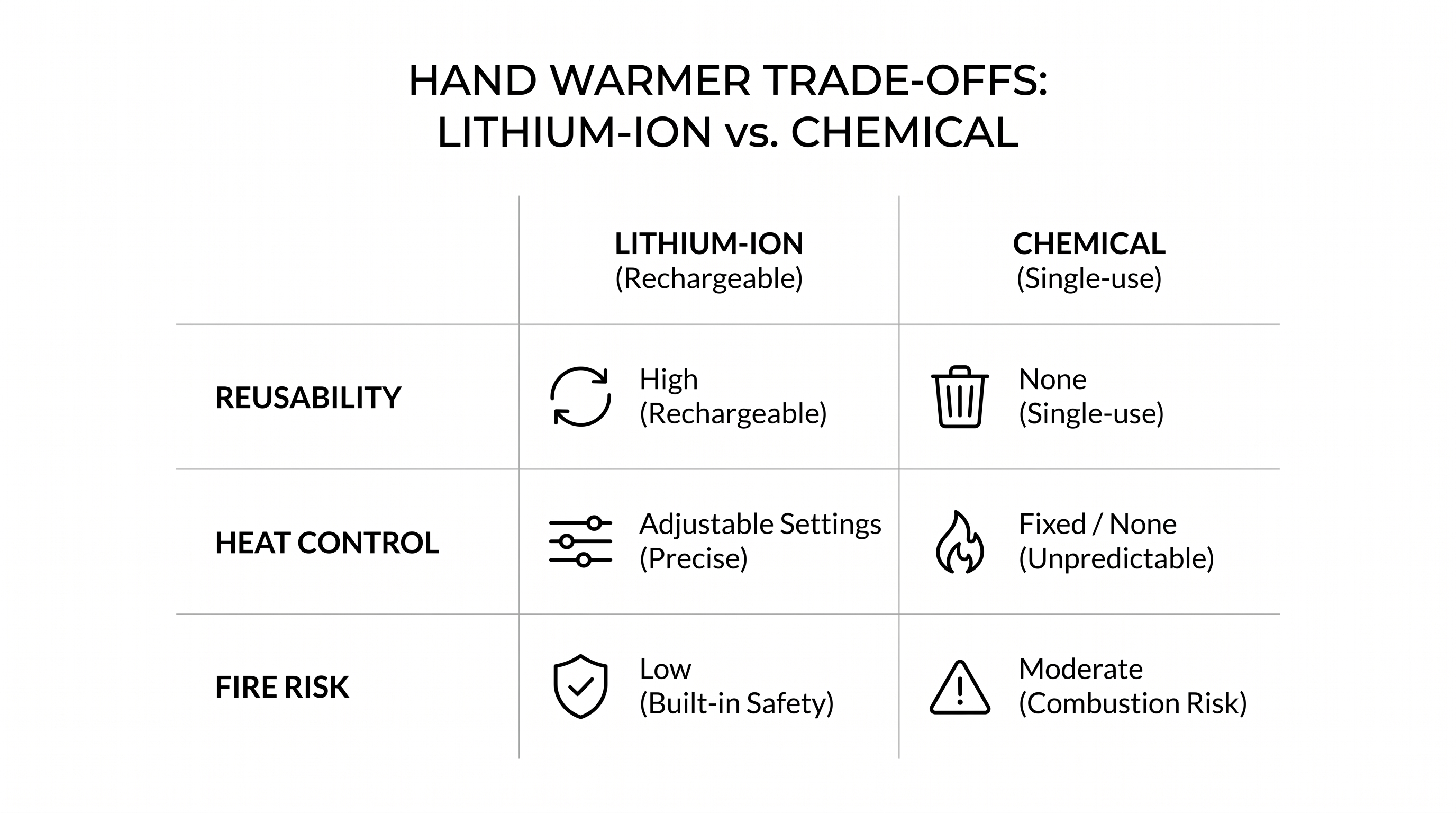
The evidence supporting the safety profile of chemical warmers is built on decades of incident-free global use across extreme environments. While they can occasionally cause mild skin irritation or low-grade burns if placed directly against bare skin for prolonged periods without a fabric barrier, they completely eliminate the catastrophic risks of thermal runaway, sudden fires, and explosive burns associated with defective battery cells. For many outdoor enthusiasts, this proven track record makes them the only acceptable choice for remote travel.[4][6]
Chemical warmers fit well when users need reliable, continuous heat in remote wilderness environments without access to electricity, or when outfitting young children where strict battery safety protocols cannot be guaranteed. They do not fit when users want to minimize their environmental footprint, require short bursts of heat over multiple days, or need the secondary utility of charging other electronic devices. For daily commuters, the recurring cost of purchasing new packets can also outweigh the initial investment of a rechargeable unit.[6]
In the wake of the OCOOPA recall, regulators are urging consumers to immediately check their devices for the recalled model numbers, which include the UT3053, H01, and ZLS-118 series. Owners must stop using them, mark the devices with "RECALLED" in permanent marker, and submit photos to the manufacturer for a refund. Crucially, these defective units must be taken to specialized hazardous waste facilities, as throwing them in household trash risks igniting municipal garbage trucks.[1][2]
As the winter season approaches, the unprecedented recall of 1.5 million units serves as a stark reminder that the energy required to generate sustained heat must always be respected. Whether consumers choose the modern convenience of a certified rechargeable battery or the analog reliability of iron oxidation, understanding the specific trade-offs of each technology is paramount. Ultimately, navigating this market requires balancing environmental consciousness with the undeniable reality that staying warm should never come at the cost of personal safety.[3][4]
How we got here
Sept 2018
OCOOPA begins selling the affected rechargeable hand warmer models across major e-commerce platforms.
Feb 2026
An 83-year-old consumer in San Diego dies in a fire linked to an overheating OCOOPA hand warmer.
July 30, 2026
The CPSC officially announces the recall of 1.5 million units after documenting 15 fires and 350 burn injuries.
August 2026
Consumers are instructed to mark devices as recalled and seek hazardous waste disposal to prevent secondary fires.
Viewpoints in depth
Lithium-Ion Advocates
Supporters of rechargeable technology emphasize its environmental benefits and performance control.
This camp argues that single-use chemical warmers generate unacceptable levels of landfill waste, especially for daily commuters and outdoor workers. They maintain that lithium-ion technology, when properly certified and manufactured with strict quality controls, offers superior performance through adjustable heat settings and the secondary utility of charging mobile devices. They view the OCOOPA recall as a failure of specific manufacturing oversight rather than an indictment of the technology itself.
Consumer Safety Regulators
Federal agencies prioritize eliminating catastrophic fire hazards from consumer electronics.
Regulators like the CPSC focus on the severe consequences of battery failure. They argue that strapping a high-capacity lithium-ion cell to the human body for the express purpose of generating heat creates an inherently dangerous thermal environment. From this perspective, the 350 burn injuries and one fatality demonstrate that uncertified, low-cost imports lack the necessary thermal management circuitry to protect consumers from sudden thermal runaway.
Traditional Chemical Users
Outdoor purists and safety-conscious consumers prefer the absolute reliability of analog heat.
This viewpoint prioritizes fail-safe operation over modern convenience. Proponents argue that the simple exothermic reaction of iron oxide cannot explode, catch fire, or fail due to a software glitch. They emphasize that in remote wilderness environments—or when outfitting young children—the zero-fire-risk profile of chemical packets far outweighs the environmental cost of their disposable nature.
What we don't know
- It remains unclear exactly which manufacturing defect within the lithium-ion battery cells triggered the widespread thermal runaway.
- Regulators have not determined if other uncertified white-label hand warmers from the same overseas factories share the identical battery flaw.
Key terms
- Thermal Runaway
- An unstoppable chain reaction within a battery where rising temperatures cause further heating, often leading to fire or explosion.
- Exothermic Reaction
- A chemical reaction that releases energy in the form of heat, such as the oxidation of iron in traditional hand warmers.
- Lithium-Ion Battery
- A rechargeable energy storage technology that provides high power density but requires strict safety circuitry to prevent overheating.
- UL Certification
- A safety standard indicating a product has been independently tested by Underwriters Laboratories for electrical and fire safety.
Frequently asked
How do I know if my hand warmer is recalled?
Check the underside of the device for the model number. Recalled OCOOPA models include UT3053, UT3056, ZLS-118, H01, and others sold between 2018 and 2026.
Can I throw the recalled hand warmer in the trash?
No. Defective lithium-ion batteries can ignite in garbage trucks or landfills. They must be taken to a specialized household hazardous waste collection center.
Are chemical hand warmers safer than rechargeable ones?
Yes, in terms of fire risk. Chemical warmers rely on iron oxidation and contain no electrical energy, making them immune to explosions or thermal runaway.
Sources
Source coverage
7 outlets
3 viewpoints surfaced






[1]U.S. Consumer Product Safety CommissionConsumer Safety Regulators
OCOOPA Direct Recalls 1.5 Million Rechargeable Hand Warmers Due to Risk of Serious Injury or Death from Fire and Burn Hazards
Read on U.S. Consumer Product Safety Commission →[2]ABC10Consumer Safety Regulators
1.5 million rechargeable hand warmers recalled after 1 death, 350 burn injuries
Read on ABC10 →[3]iHeartProduct Liability Advocates
1.5 Million Hand Warmers Recalled After 100s Of Burn Injuries, One Death
Read on iHeart →[4]Pritzker Hageman LawProduct Liability Advocates
OCOOPA Hand Warmer Recall At a Glance
Read on Pritzker Hageman Law →[5]12 NewsConsumer Safety Regulators
Roughly 1.5 million rechargeable hand warmers are under recall
Read on 12 News →[6]EcoFreekLithium-Ion Advocates
Reusable Hand Warmers: The Ultimate Guide
Read on EcoFreek →[7]OCOOPA
Product Recalls - OCOOPA Direct
Read on OCOOPA →
Comments
Every angle. Every day.
Get shopping stories with full source coverage and perspective breakdowns delivered to your inbox.