
Inside the FBI's 22,000-Square-Foot Replica Town Built to Simulate Cyberattacks
The FBI has unveiled the Kinetic Cyber Range in Alabama, a fully functional mock city designed to train law enforcement in responding to live ransomware attacks and digital forensics.
By Factlen Editorial Team
- Law Enforcement Trainers
- Argue that hands-on, live-fire simulation is the only way to prepare agents for the physical realities of modern cyberattacks.
- Cybersecurity Analysts
- Emphasize the growing financial and infrastructural threat of ransomware, validating the need for advanced defense facilities.
- Privacy & Tech Advocates
- Express concern over law enforcement's use of undisclosed zero-day vulnerabilities to crack encrypted consumer devices during forensic training.
What's not represented
- · Hospital Administrators
- · Municipal IT Directors
Why this matters
As cyberattacks increasingly target physical infrastructure like hospitals and power grids, traditional classroom training is no longer enough for law enforcement. The FBI's new live-fire replica town represents a massive shift in how the U.S. prepares to defend against ransomware, ensuring responders can handle the chaos of a real-world blackout before it happens.
Key points
- The FBI has built a 22,000-square-foot mock city in Huntsville, Alabama, to simulate real-world cyberattacks.
- Known as the Kinetic Cyber Range, the facility includes a hospital, gas station, and a 200-server data center.
- The closed-loop environment allows agents to train against live ransomware without risking public internet exposure.
- Over 1,400 students from the FBI, NASA, the Army, and local police have trained there since February 2025.
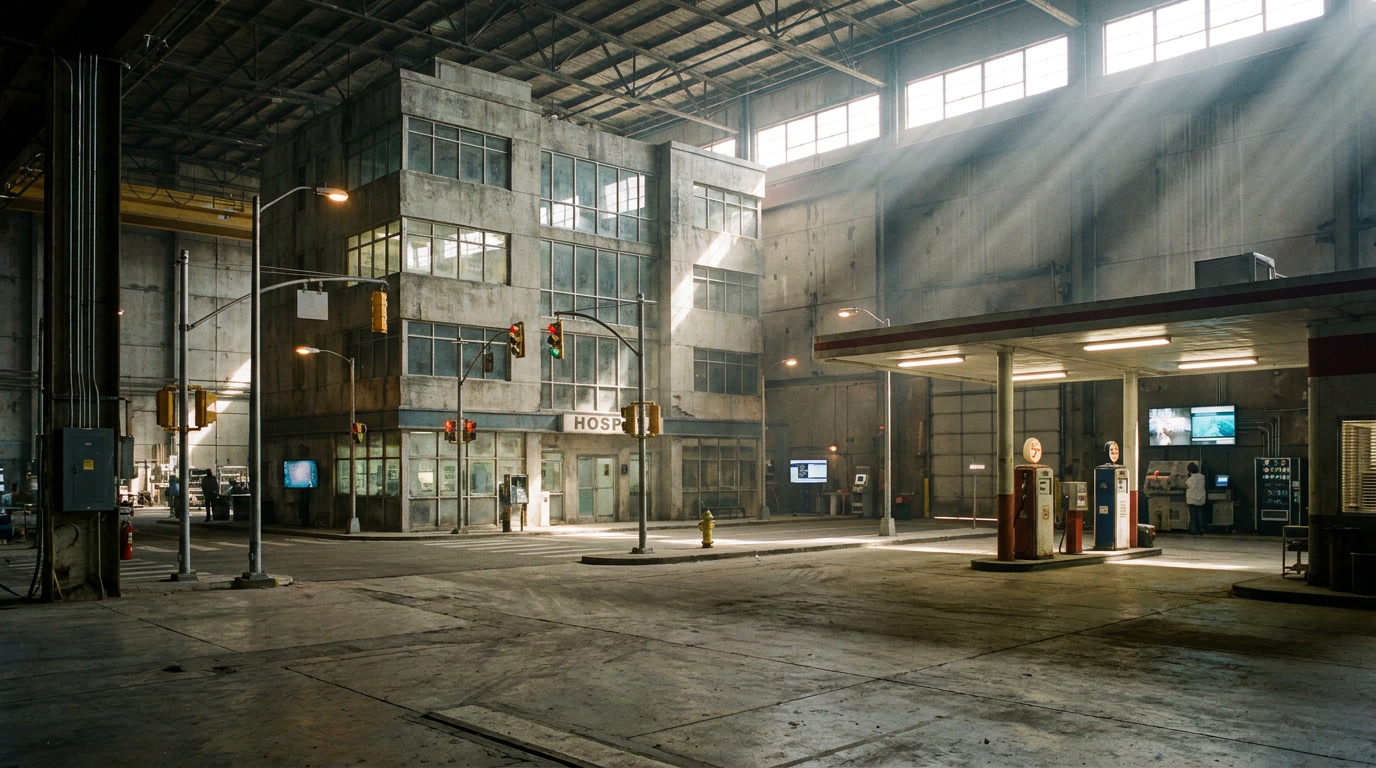
The U.S. Federal Bureau of Investigation has officially unveiled the Kinetic Cyber Range, a massive 22,000-square-foot replica town constructed entirely indoors at its Huntsville, Alabama campus. Designed to simulate the cascading physical effects of digital breaches, the facility serves as a live-fire training ground for law enforcement and cybersecurity professionals.[1][2][5]
The mock city is fully operational, featuring a hospital, a courthouse, a hotel, a gas station, a grocery store, and a power company. It even includes residential homes, a video game arcade, and a network of roads complete with functioning traffic lights. Every building is wired with active devices and systems programmed to behave exactly as they would in a real American community.[3][4][5]
The facility represents a modern, digital evolution of "Hogan's Alley," the famous mock town built at the FBI Academy in Quantico in 1987 to train agents in tactical firearms and physical combat. But instead of actors popping out of windows with prop guns, the Kinetic Cyber Range challenges investigators with invisible threats: ransomware locking down critical infrastructure, compromised IoT devices, and hacked vehicle systems.[1][3][5]
The core evidence driving this shift in training methodology is the inadequacy of traditional classroom learning for modern digital forensics. According to Dave Beachboard, the program manager of the Kinetic Cyber Range, past training relied heavily on theory and isolated device processing at a desk. The new facility forces agents to apply that knowledge in high-stress, real-life situations where physical infrastructure is actively failing.[5]

To replicate the exact conditions investigators face during corporate breach responses, the town includes a fully functional data center housing more than 200 physical servers running both Windows and Linux operating systems.[3][4]
The environmental design of this server room is intentionally hostile. Program managers deliberately engineered the space to be cold, cramped, noisy, dark, and miserable, ensuring that trainees experience the exact physical discomfort and sensory overload they will encounter when executing search warrants in real corporate basements.[3][4]
Safety and containment are critical components of the facility's architecture. Because the training involves deploying live, weaponized malware—including sophisticated ransomware variants—the entire 22,000-square-foot town operates on a closed-loop network. This air-gapped environment ensures that simulated attacks cannot escape the premises and infect the broader internet.[2][3]
Safety and containment are critical components of the facility's architecture.
The primary threat vector modeled at the facility is ransomware targeting critical infrastructure, a focus heavily supported by recent federal data. The FBI's 2025 Internet Crime Report documented a record $20.9 billion in U.S. cybercrime losses, representing a 26 percent increase over the previous year.[3][6]

Within that report, ransomware was identified as the number-one ongoing threat to critical infrastructure sectors, including healthcare, energy, and municipal government. The Kinetic Cyber Range allows the Bureau to simulate these exact scenarios with terrifying realism.[3][6]
In one of the facility's core training modules, agents must respond to a simulated ransomware attack on the mock hospital. As the hospital's network goes dark, trainees are forced to make rapid, high-stakes decisions regarding patient safety and system triage, bridging the gap between technical incident response and physical crisis management.[2][3]
Beyond network defense, the facility serves as a premier laboratory for advanced digital forensics. Trainees practice extracting data from a wide array of modern hardware, including smart home appliances, commercial drones, and industrial control systems.[5]
One specialized module focuses on vehicle forensics, where agents practice extracting a car's electronic control unit (ECU)—the vehicle's digital brain. By analyzing the ECU, investigators can reconstruct a vehicle's location history, operational metrics, and potentially identify who was behind the wheel during a crime.[4][5]

However, the digital forensics training also highlights a transparent area of uncertainty and ongoing debate within the cybersecurity community. To extract data from encrypted consumer devices, investigators often rely on controversial techniques that exploit undisclosed software vulnerabilities.[3]
These "zero-day" exploits allow law enforcement to bypass the security protections built by companies like Apple and Google. While tech companies argue that these vulnerabilities should be disclosed and patched to protect all users, law enforcement maintains that retaining these capabilities is essential for solving severe criminal cases in an era of default end-to-end encryption.[3]
Despite these debates, the scale and impact of the Kinetic Cyber Range are undeniable. Since opening its doors in February 2025, the facility has trained more than 1,400 students.[4][5]
The training is not limited to FBI personnel. The Bureau has opened the facility to a wide range of partners, including NASA, the U.S. Army, and numerous local and federal law enforcement agencies. By standardizing incident response across different jurisdictions, the FBI aims to build a more resilient and cohesive national cyber defense network.[3][5]
How we got here
1987
The FBI opens 'Hogan's Alley' in Quantico, Virginia, a physical mock town for tactical firearms training.
February 2025
The Kinetic Cyber Range officially opens at the FBI's Huntsville, Alabama campus.
Early 2026
The FBI's Internet Crime Report reveals a record $20.9 billion in U.S. cybercrime losses for the previous year.
June 2026
The FBI publicly details the operations of the Kinetic Cyber Range, announcing it has trained over 1,400 interagency students.
Viewpoints in depth
Law Enforcement Trainers
Argue that hands-on, live-fire simulation is the only way to prepare agents for the physical realities of modern cyberattacks.
For decades, federal cyber training was largely theoretical, confining agents to classrooms where they analyzed static hard drives or read case studies. Program managers at the Kinetic Cyber Range argue this approach is fundamentally broken when dealing with modern threats like ransomware, which bridge the digital and physical worlds. By forcing trainees to make life-or-death triage decisions while a mock hospital's systems actively fail around them, instructors believe they are building a workforce capable of handling the sensory overload and high stakes of real-world critical infrastructure breaches.
Privacy & Tech Advocates
Express concern over law enforcement's use of undisclosed zero-day vulnerabilities to crack encrypted consumer devices during forensic training.
While the defensive training at the facility is widely praised, the digital forensics curriculum remains a point of friction between law enforcement and the tech industry. To train agents in device extraction, the FBI utilizes tools that exploit undisclosed vulnerabilities—often called zero-days—in consumer operating systems like iOS and Android. Tech advocates argue that hoarding these vulnerabilities leaves the general public at risk from malicious hackers, while law enforcement maintains that such tools are the only way to recover critical evidence in an era where default encryption is ubiquitous.
What we don't know
- It remains unclear exactly which undisclosed software vulnerabilities the FBI uses during its digital forensics training on consumer devices.
- The FBI has not detailed the specific operational budget required to maintain and constantly update the 22,000-square-foot facility's hardware.
Key terms
- Kinetic Cyberattack
- A digital attack that causes direct physical damage or disruption to real-world infrastructure, such as shutting down a power grid or hospital.
- Ransomware
- Malicious software that encrypts a victim's files or locks their systems, demanding payment to restore access.
- Air-gapped Network
- A computer network that is physically isolated from unsecured networks, such as the public internet, to prevent data leaks or malware spread.
- Zero-day Vulnerability
- A software flaw that is unknown to the vendor, meaning no patch exists, which can be exploited by hackers or law enforcement to access a device.
- Electronic Control Unit (ECU)
- The embedded system in automotive electronics that controls one or more of the electrical systems or subsystems in a vehicle.
Frequently asked
What is the Kinetic Cyber Range?
It is a 22,000-square-foot replica town built inside the FBI's Huntsville, Alabama campus to simulate real-world cyberattacks on physical infrastructure.
When did the facility open?
The facility officially opened in February 2025 and has since trained over 1,400 students.
What kind of attacks do they simulate?
Trainees respond to live malware and ransomware attacks, including scenarios where hospital systems go dark or power companies are compromised.
Can the simulated viruses escape the facility?
No. The entire mock town operates on a closed-loop, air-gapped network to ensure that weaponized malware cannot leak onto the public internet.
Sources
Source coverage
6 outlets
3 viewpoints surfaced






[1]The VergeCybersecurity Analysts
The FBI built a small town to simulate cyberattacks
Read on The Verge →[2]TechCrunchPrivacy & Tech Advocates
The FBI built a 22,000-square-foot mock city to train cyber investigators
Read on TechCrunch →[3]The Next WebPrivacy & Tech Advocates
The FBI built a 22,000 sq ft replica town to train agents on live cyberattacks
Read on The Next Web →[4]NDTVCybersecurity Analysts
In A Bid To Counter Cybercrime, FBI Builds Entirely Fake, Fully Functional Town
Read on NDTV →[5]FBI.govLaw Enforcement Trainers
The Kinetic Cyber Range: A 22,000-Square-Foot Training Environment
Read on FBI.gov →[6]Internet Crime Complaint Center (IC3)Cybersecurity Analysts
2025 Internet Crime Report
Read on Internet Crime Complaint Center (IC3) →

More in technology
See all 5 stories →

Every angle. Every day.
Get technology stories with full source coverage and perspective breakdowns delivered to your inbox.