
Inside the FBI's 22,000-Square-Foot Replica Town Built to Simulate Cyberattacks
The FBI has unveiled the Kinetic Cyber Range, a fully functional mock city in Alabama where law enforcement agents train against live ransomware attacks and practice digital forensics.
By Factlen Editorial Team
- Federal Law Enforcement
- Focuses on the necessity of realistic, high-stress training environments to prepare agents for complex cyber incidents.
- Cybersecurity Analysts
- Highlights the technical sophistication of the range, praising the shift from classroom theory to functional network defense.
- Privacy & Security Advocates
- Raises concerns about digital forensics training that relies on undisclosed vulnerabilities in consumer devices.
What's not represented
- · Local emergency responders who coordinate with the FBI during municipal cyberattacks
- · Device manufacturers whose hardware is targeted in forensic training
Why this matters
As cyberattacks increasingly target the physical infrastructure we rely on daily—from hospitals to power grids—traditional classroom training is no longer enough. The Kinetic Cyber Range ensures that the investigators responding to America's worst digital crises have already practiced saving lives and restoring systems in a high-stakes, realistic environment.
Key points
- The FBI has built a 22,000-square-foot replica town in Alabama to train agents against live cyberattacks.
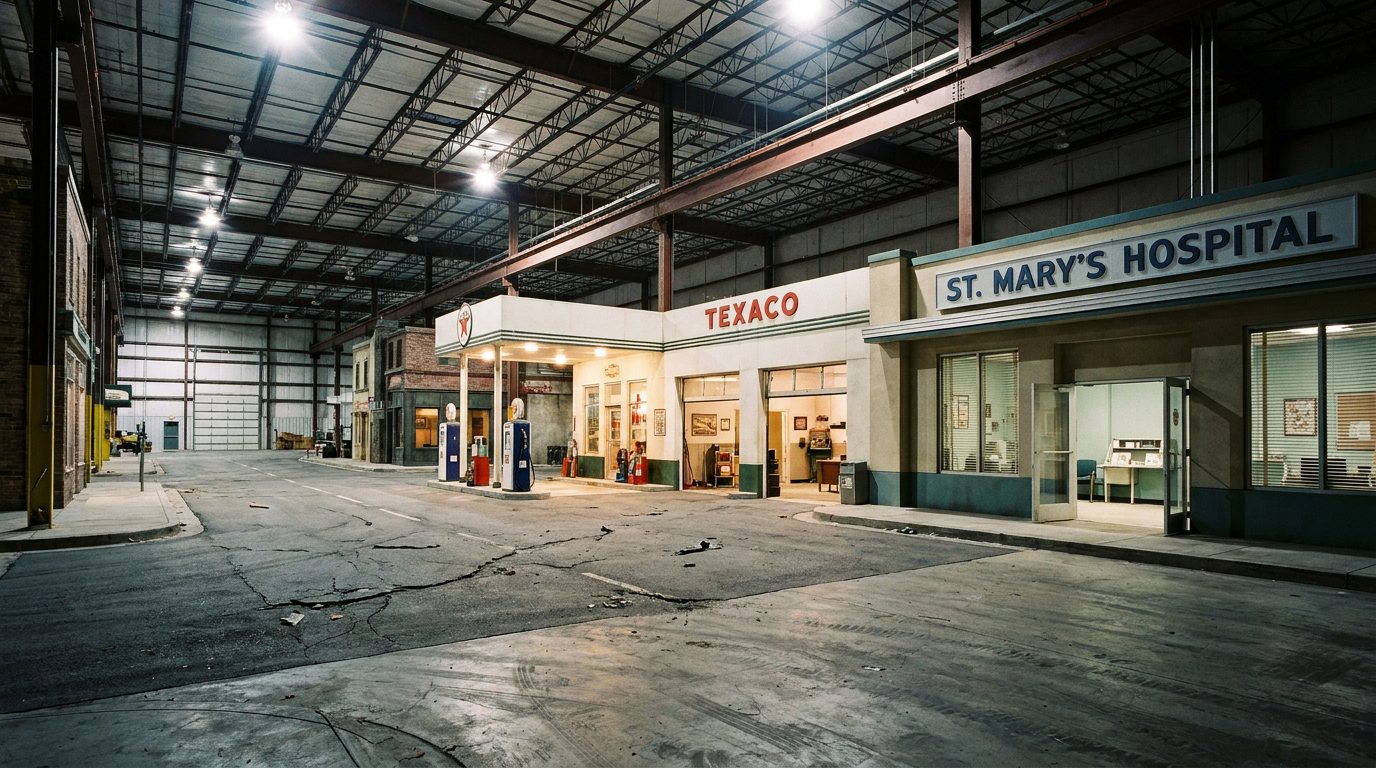
- The facility includes a functional hospital, gas station, and a data center with over 200 physical servers.
- Trainees face high-stress scenarios, such as managing a ransomware attack that shuts down hospital operations.
- The range also teaches digital forensics, including extracting data from smart homes and modern vehicles.
- Over 1,400 students have trained at the facility since it opened in February 2025.
Hidden inside a massive facility on the Redstone Arsenal campus in Huntsville, Alabama, lies a meticulously constructed American town. It features a hospital, a courthouse, a gas station, and a hotel, complete with paved roads and working traffic lights. But this community has no permanent residents, and its local businesses are destined to fail repeatedly. This is the Kinetic Cyber Range, a 22,000-square-foot training environment built by the Federal Bureau of Investigation. Designed as a modern, digital successor to the agency’s famous "Hogan's Alley" firearms training facility, the mock city exists for one purpose: to be relentlessly attacked by simulated ransomware, malware, and digital intrusions.[1][2][3]
The facility, operated by the FBI’s Operational Technology Division, officially opened its doors in February 2025 but was only recently showcased to the public in detail. The core philosophy behind the Kinetic Cyber Range is that modern cybercrime cannot be fully understood or combated from behind a classroom desk. By building a physical town wired with functioning networks, the Bureau aims to plunge its agents, analysts, and forensic specialists into high-stress, realistic scenarios where digital breaches have immediate, tangible consequences in the physical world.[1][3]
While the exterior of the buildings might resemble a Hollywood backlot, the digital infrastructure hidden behind the drywall is entirely authentic. Every building in the replica town is wired with functioning devices, enterprise networks, and security systems that behave exactly as they would in a real U.S. community. "The systems that we have running in these facilities are just as real as the facade on the outside," explained Dave Beachboard, the program manager for the Kinetic Cyber Range. When trainees dive into the network, they encounter live Active Directory environments, enterprise firewalls, and standard corporate email servers.[3][5]
The beating heart of the mock city is a fully operational data center housing more than 200 physical servers. Running a mix of Windows and Linux operating systems, the server room is designed to replicate the exact conditions investigators face when responding to a corporate breach or executing a search warrant. The environment is intentionally designed to be uncomfortable. Beachboard described the data center conditions as "cold, cramped, noisy, dark, and miserable," ensuring that agents learn to extract critical evidence and hunt for threats while battling the sensory overload of a live server farm.[5][6]

The evidence driving the creation of this massive facility is starkly quantified in the FBI’s own data. According to the Bureau's 2025 Internet Crime Report, U.S. cybercrime losses hit a staggering and record-breaking $20.9 billion, representing a 26 percent increase over the previous year. Within that landscape of digital extortion and fraud, ransomware attacks targeting critical infrastructure have emerged as the most pressing operational threat. The Kinetic Cyber Range was explicitly funded and designed to bridge the gap between theoretical cybersecurity knowledge and the chaotic reality of defending those vulnerable systems.[4][6]
Nowhere is this chaos more evident than in the facility’s mock hospital. Healthcare remains the leading target for cybercrime among U.S. critical infrastructure sectors, with hundreds of devastating ransomware attacks recorded annually. During a training scenario at the Kinetic Cyber Range, a simulated ransomware attack will suddenly lock down the hospital’s entire network. As screens go dark and systems freeze, physical alarms begin to blare throughout the building. Role players, acting as doctors and nurses, panic and respond as if actual patient care is at immediate risk.[3][4]
This immersive hospital scenario forces trainees to manage a dual crisis. They must simultaneously execute a highly technical incident response—hunting for the malicious payload, isolating infected servers, and attempting to decrypt data—while also managing the operational fallout of a facility that can no longer function. Agents must make split-second decisions about which systems to prioritize for recovery, knowing that in a real-world equivalent, those choices could directly impact human lives. It is a grueling test of both technical acumen and crisis management.[4][6]

This immersive hospital scenario forces trainees to manage a dual crisis.
Beyond incident response, the Kinetic Cyber Range serves as a premier proving ground for digital forensics. As the Internet of Things (IoT) expands, crime scenes are increasingly littered with connected devices that hold vital evidence. In one training module, students are sent into a fully furnished smart home brimming with internet-connected appliances, security cameras, and personal electronics. The future agents must quickly survey the environment and make critical decisions about which devices to seize, how to preserve their volatile memory, and what hardware to leave behind.[3][5]
The forensic training extends to automotive technology as well. Modern vehicles are essentially rolling computers, and their data can be crucial for reconstructing timelines and locations in criminal investigations. Inside a dedicated vehicle bay at the Huntsville campus, trainees practice peeling back plastic molding and upholstery to locate and extract a car's electronic control unit (ECU). By physically removing the vehicle's digital brain, agents learn how to secure the hardware without corrupting the sensitive location and usage data stored within it.[3]
However, the digital forensics curriculum has not been without controversy, highlighting a persistent tension in the cybersecurity landscape. Industry reporting indicates that the tools used by law enforcement to crack the security of encrypted modern devices often rely on exploiting undisclosed vulnerabilities. These "zero-day" flaws are kept secret from device manufacturers like Apple and Google, allowing investigators to bypass built-in user protections to extract data for criminal cases.[2][6]

Privacy and security advocates argue that this practice creates a systemic risk. By hoarding vulnerabilities rather than reporting them to manufacturers so they can be patched, law enforcement agencies may inadvertently leave the broader public exposed to malicious hackers who could discover and exploit the same flaws. While the FBI has not publicly detailed the specific proprietary tools used at the Kinetic Cyber Range, the facility serves as a primary testing ground for these controversial device-cracking techniques.[2][6]
Despite these debates, the operational value of the facility is widely recognized across federal law enforcement. To ensure that the simulated malware and ransomware attacks do not pose a threat to actual government networks, the entire 22,000-square-foot replica town is strictly air-gapped. The internal networks are completely isolated from the outside internet, creating a secure sandbox where devastating digital weapons can be detonated, studied, and neutralized without any risk of the malicious code escaping the training environment.[1][6]
The shift in pedagogy is already showing significant throughput. For years, cyber training at the Bureau was largely confined to classroom lectures and desktop exercises, where students learned about servers and cell phone extraction in a sterile, theory-based environment. "In the past, you never left the classroom," Beachboard noted. Since the Kinetic Cyber Range opened in early 2025, that model has been entirely inverted.[3]
In just over a year of operation, the facility has trained more than 1,400 students. This cohort includes not only FBI special agents and intelligence analysts but also partners from other federal agencies and local law enforcement departments. By providing a shared, hyper-realistic environment, the Bureau is establishing a standardized, kinetic approach to cyber incident response that ripples out across the broader U.S. law enforcement community.[3][4][6]
As digital threats continue to evolve in complexity and scale, the days of treating cybercrime as a purely virtual problem are over. The Kinetic Cyber Range stands as a physical monument to the reality that digital attacks have profound, real-world consequences. By forcing investigators to practice their craft in the cramped, noisy, and high-stakes environments they will inevitably face in the field, the FBI is betting that a fake town in Alabama will be the key to defending real cities across the country.[1][3]
How we got here
February 2025
The Kinetic Cyber Range officially opens at the FBI's Redstone Arsenal campus in Huntsville, Alabama.
Early 2026
The FBI's Internet Crime Report reveals a record $20.9 billion in U.S. cybercrime losses for the previous year, underscoring the need for advanced training.
June 2026
The FBI publicly unveils detailed footage and operational details of the facility, highlighting its hospital and data center simulations.
Viewpoints in depth
Federal Law Enforcement
Agencies emphasize the critical need for high-fidelity, stressful training environments.
For the FBI and its partner agencies, the Kinetic Cyber Range represents a necessary evolution in investigative readiness. As cybercrime losses surpassed $20 billion in 2025, the Bureau recognized that classroom theory was insufficient for preparing agents to handle the chaos of a live ransomware attack. By forcing trainees to navigate a physical hospital where alarms are blaring due to a network lockdown, law enforcement leadership argues they are building a more resilient and capable workforce that can make life-or-death decisions under pressure.
Privacy & Security Advocates
Critics warn that the forensic techniques taught at the facility may rely on keeping consumer devices vulnerable.
While the defensive training is widely praised, the digital forensics curriculum has sparked debate among privacy advocates. Reports indicate that investigators are trained to crack encrypted devices using tools that exploit undisclosed vulnerabilities in commercial hardware. Security researchers argue that hoarding these 'zero-day' flaws—rather than reporting them to manufacturers like Apple or Google—leaves the broader public at risk, creating a tension between the needs of law enforcement and the baseline security of consumer technology.
What we don't know
- The specific proprietary digital forensics tools the FBI uses to extract data from encrypted devices during training.
- Whether the FBI plans to build additional Kinetic Cyber Ranges in other regions of the United States.
Key terms
- Kinetic Cyber Range
- A physical training facility where digital attacks are simulated in a realistic, physical environment to train responders.
- Digital Forensics
- The process of recovering and investigating material found in digital devices, often used to gather evidence for criminal cases.
- Ransomware
- A type of malicious software designed to block access to a computer system until a sum of money is paid.
- Electronic Control Unit (ECU)
- An embedded system in automotive electronics that controls one or more of the electrical systems or subsystems in a vehicle.
- Zero-Day Vulnerability
- A software vulnerability that is unknown to the vendor, meaning no patch exists, which can be exploited by attackers or forensic investigators.
Frequently asked
What is the Kinetic Cyber Range?
It is a 22,000-square-foot indoor replica town built by the FBI in Huntsville, Alabama, to simulate real-world cyberattacks and train investigators.
Why did the FBI build a physical town for digital training?
The physical environment adds realism and stress, forcing trainees to manage the real-world consequences of cyberattacks, such as a hospital losing power or a compromised smart home.
What kind of technology is inside the mock town?
The town features fully functional networks, a data center with over 200 servers, and connected devices that mimic real corporate and residential environments.
Sources
Source coverage
6 outlets
3 viewpoints surfaced






[1]The VergeCybersecurity Analysts
The FBI built a small town to simulate cyberattacks
Read on The Verge →[2]TechCrunchPrivacy & Security Advocates
The FBI built its own replica small town to simulate cyberattacks
Read on TechCrunch →[3]FBIFederal Law Enforcement
Inside the FBI's 22,000 square-foot indoor technical training environment in Huntsville
Read on FBI →[4]Becker's Hospital ReviewFederal Law Enforcement
FBI stages fake hospital to prepare for ransomware attacks
Read on Becker's Hospital Review →[5]CyberNewsCybersecurity Analysts
Come inside the 'Kinetic Cyber Range'
Read on CyberNews →[6]TNWPrivacy & Security Advocates
The FBI built a 22,000 sq ft replica town to train agents on live cyberattacks
Read on TNW →
More in technology
See all 5 stories →

Every angle. Every day.
Get technology stories with full source coverage and perspective breakdowns delivered to your inbox.