
Inside the FBI's 22,000-Square-Foot Fake Town Built to Simulate Cyberattacks
The FBI has unveiled the Kinetic Cyber Range in Huntsville, Alabama, a massive replica town designed to train law enforcement for cyberattacks on physical infrastructure.
By Factlen Editorial Team
- Federal Law Enforcement
- Argues that classroom theory is insufficient for modern threats, requiring realistic, high-pressure physical simulations.
- Behavioral Researchers
- Emphasizes that immersive, point-of-error simulation is the most effective way to change human responses to cyber threats.
- Tech & Privacy Watchdogs
- Highlights the impressive scale of the facility while noting the controversial nature of some digital forensics tools used.
- Academic Skeptics
- Cautions that the long-term efficacy of simulation training is often overstated, with human error remaining stubbornly persistent.
What's not represented
- · Civil liberties advocates concerned about undisclosed vulnerabilities
- · Local municipal IT directors facing these threats daily
Why this matters
As cyberattacks increasingly target physical infrastructure like hospitals and power grids, law enforcement must move beyond classroom theory. The FBI's new physical simulation city represents a massive shift in how responders prepare for life-or-death digital crises.
Key points
- The FBI's Kinetic Cyber Range is a 22,000-square-foot replica town in Huntsville, Alabama.
- The facility includes a functional hospital, gas station, and a 200-server data center.
- It is designed to train agents for cyberattacks that have physical, real-world consequences.
- Over 1,400 personnel from the FBI, NASA, and local law enforcement have trained there since February 2025.
- The entire mock town operates on a closed loop to prevent simulated malware from escaping.
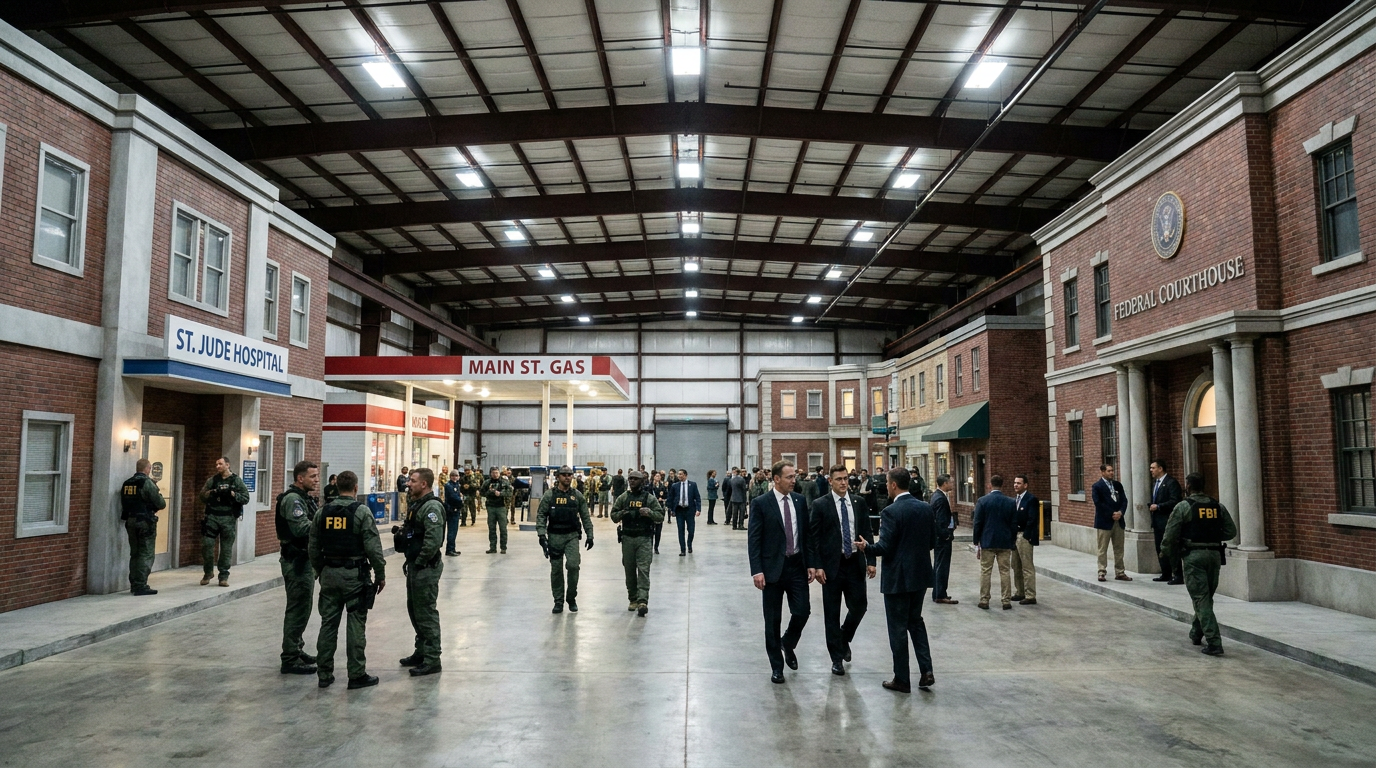
Tucked inside the FBI's Huntsville, Alabama campus is a town that looks entirely ordinary at first glance. It features a hotel, a gas station, a hospital, a courthouse, and even working traffic lights, but nothing here is real.[1][2]
This is the Kinetic Cyber Range, a massive 22,000-square-foot training facility officially opened by the FBI in February 2025.[5]
The purpose of the replica town is to bridge the dangerous gap between digital theory and physical reality. Every building is fully furnished and wired with functioning devices and systems that behave exactly as they would in a real American community.[1][3][4]
For years, federal cyber training was largely confined to classrooms. Agents would process a cell phone at a desk or learn about server architecture through slide presentations and theory-based lectures.[5]

Dave Beachboard, the program manager for the Kinetic Cyber Range, notes that the new model turns that approach inside out. Instead of sitting at a desk, agents now extract electronic control units from physical cars in a vehicle bay to reconstruct digital footprints.[5]
The facility also houses a dedicated data center equipped with over 200 physical servers running both Windows and Linux operating systems.[2][3]
These server rooms are intentionally designed to be cold, cramped, noisy, and miserable—mirroring the exact, high-stress conditions investigators face during corporate breach responses and search warrants.[3][5]
This massive investment is driven by a stark reality: cybercrime is becoming increasingly physical and exponentially more costly. The FBI's 2025 Internet Crime Report logged a record $20.9 billion in U.S. cybercrime losses, representing a 26% jump from the prior year.[3][4]

Ransomware remains the top persistent threat to critical infrastructure. In the mock hospital, agents practice responding to simulated attacks where systems go dark, forcing them to make rapid decisions about patient safety under intense psychological pressure.[3][5]
Ransomware remains the top persistent threat to critical infrastructure.
Behavioral science strongly supports this immersive, high-stress approach to training. Research from security awareness firm SoSafe indicates that point-of-error training—where lessons are applied immediately in a realistic context—reduces human susceptibility to social engineering by 40%.[7]
Similarly, extensive data from KnowBe4, which analyzed over 32 million users, found that organizations conducting frequent, realistic simulations decrease their cyber risk 2.74 times more effectively than those relying on quarterly classroom training.[6]
However, the academic evidence regarding long-term behavioral change remains highly nuanced, with researchers cautioning that human error is stubbornly persistent.[8]
A study by researchers at the University of California San Diego (UCSD) found that embedded training sometimes provides a statistically significant but practically minor reduction in failure rates—as low as 2% in certain environments.[8]
The UCSD research also demonstrated no correlation between how recently a user completed annual awareness training and whether they fell for a simulated attack, suggesting that environmental pressure often overrides theoretical knowledge.[8]
This academic skepticism is exactly why the FBI's facility emphasizes environmental stress over rote memorization. By simulating the chaos of a live breach, the agency hopes to build resilient muscle memory rather than just theoretical awareness.[5]

Beyond incident response, the facility serves as a testing ground for digital forensics. Agents practice the highly technical—and sometimes controversial—process of extracting data from encrypted devices using undisclosed vulnerabilities.[1][3]
To ensure absolute safety during these exercises, the entire mock town operates as a closed loop. All systems are physically disconnected from the outside internet, guaranteeing that no malicious code or simulated malware can escape the container.[1][2]
The Kinetic Cyber Range is not an exclusive asset for the FBI. Since its opening, it has trained over 1,400 personnel, including partners from NASA, the U.S. Army, and various local law enforcement agencies.[5]
How we got here
2024
US cybercrime losses begin accelerating, eventually hitting a record $20.9 billion by 2025.
February 2025
The FBI officially opens the Kinetic Cyber Range at its Huntsville, Alabama campus.
April 2026
The facility conducts major cross-agency exercises, reflecting a broader shift toward digital evidence training.
June 2026
The FBI publicly unveils video footage and details of the facility to the public.
Viewpoints in depth
Federal Law Enforcement
The FBI argues that classroom theory is no longer sufficient for modern digital crime.
Law enforcement agencies maintain that the nature of cybercrime has fundamentally shifted from data theft to physical disruption. By forcing agents to extract data from cars or manage a hospital ransomware crisis in a physical space, the FBI aims to build muscle memory for high-stakes incidents. Program managers argue that the psychological pressure of a simulated environment cannot be replicated at a desk.
Behavioral Science & Industry
Security firms argue that immersive, point-of-error simulation is vastly superior to annual compliance videos.
Industry data strongly supports the move toward realistic simulations. Behavioral scientists note that point-of-error training—where lessons are applied immediately in context—drastically reduces susceptibility to social engineering. Large-scale analyses show that organizations conducting frequent, realistic simulations decrease their cyber risk by nearly three times compared to those relying on infrequent classroom training.
Academic Skeptics
University researchers caution that the long-term efficacy of simulation training is often overstated.
While simulations are popular, academic studies emphasize that human error remains stubbornly persistent. Research indicates that without constant, context-specific reinforcement, the actual reduction in failure rates from embedded training can be as low as 2%. Furthermore, studies show little correlation between how recently a user completed awareness training and whether they fall for an attack, suggesting that environmental pressure often overrides theoretical knowledge.
What we don't know
- It remains unclear exactly which undisclosed vulnerabilities the FBI uses during its digital forensics training on encrypted devices.
- The long-term retention rate of the muscle memory built during these high-stress simulations is still being studied by behavioral scientists.
- It is unknown if the FBI plans to build additional Kinetic Cyber Ranges in other regions of the United States.
Key terms
- Kinetic Cyber Range
- A physical training environment where digital attacks produce real-world physical effects on connected infrastructure.
- Ransomware
- Malicious software that encrypts a victim's files or locks their systems, demanding payment to restore access.
- Digital Forensics
- The process of uncovering and interpreting electronic data for use in a criminal investigation.
- Point-of-error training
- Cybersecurity education delivered immediately after a user makes a mistake, such as clicking a simulated malicious link.
- Electronic Control Unit (ECU)
- An embedded system in automotive electronics that controls one or more of the electrical systems or subsystems in a vehicle.
Frequently asked
What is the Kinetic Cyber Range?
It is a 22,000-square-foot mock town built by the FBI in Huntsville, Alabama, to simulate cyber-physical attacks on infrastructure.
When did the facility open?
The facility became operational in February 2025 and has trained over 1,400 personnel since its launch.
Why is it called 'kinetic'?
The term refers to cyberattacks that have physical, real-world consequences, such as shutting down hospital power or manipulating traffic lights.
Can the simulated malware escape the facility?
No. The entire mock town and its 200-server data center are completely isolated from the outside internet to prevent any malicious code from spreading.
Sources
Source coverage
8 outlets
4 viewpoints surfaced








[1]TechCrunchTech & Privacy Watchdogs
FBI unveils simulation city to train for cyber attacks and investigations
Read on TechCrunch →[2]The VergeTech & Privacy Watchdogs
The FBI built a small town to simulate cyberattacks
Read on The Verge →[3]TNWTech & Privacy Watchdogs
The FBI built a fake town to train agents for cyberattacks. It has a hospital, power company, and 200 servers.
Read on TNW →[4]The News InternationalTech & Privacy Watchdogs
FBI built 22,000-sq-ft town to train cyber investigators
Read on The News International →[5]Federal Bureau of InvestigationFederal Law Enforcement
Inside the FBI's Kinetic Cyber Range
Read on Federal Bureau of Investigation →[6]KnowBe4 ResearchBehavioral Researchers
Data Confirms Value of Security Awareness Training and Simulated Phishing
Read on KnowBe4 Research →[7]SoSafe Behavioral ScienceBehavioral Researchers
What real-world data reveals about the effectiveness of phishing simulations
Read on SoSafe Behavioral Science →[8]University of California San DiegoAcademic Skeptics
Understanding the Efficacy of Phishing Training in Practice
Read on University of California San Diego →

More in technology
See all 5 stories →
Every angle. Every day.
Get technology stories with full source coverage and perspective breakdowns delivered to your inbox.