
Human-Induced Warming Reaches 1.37°C as Carbon Budget Shrinks to Three Years
A major international climate assessment reveals that human activities have pushed global temperatures 1.37°C above pre-industrial levels. At current emission rates, the remaining carbon budget to limit warming to 1.5°C will be exhausted by 2029.
By Factlen Editorial Team
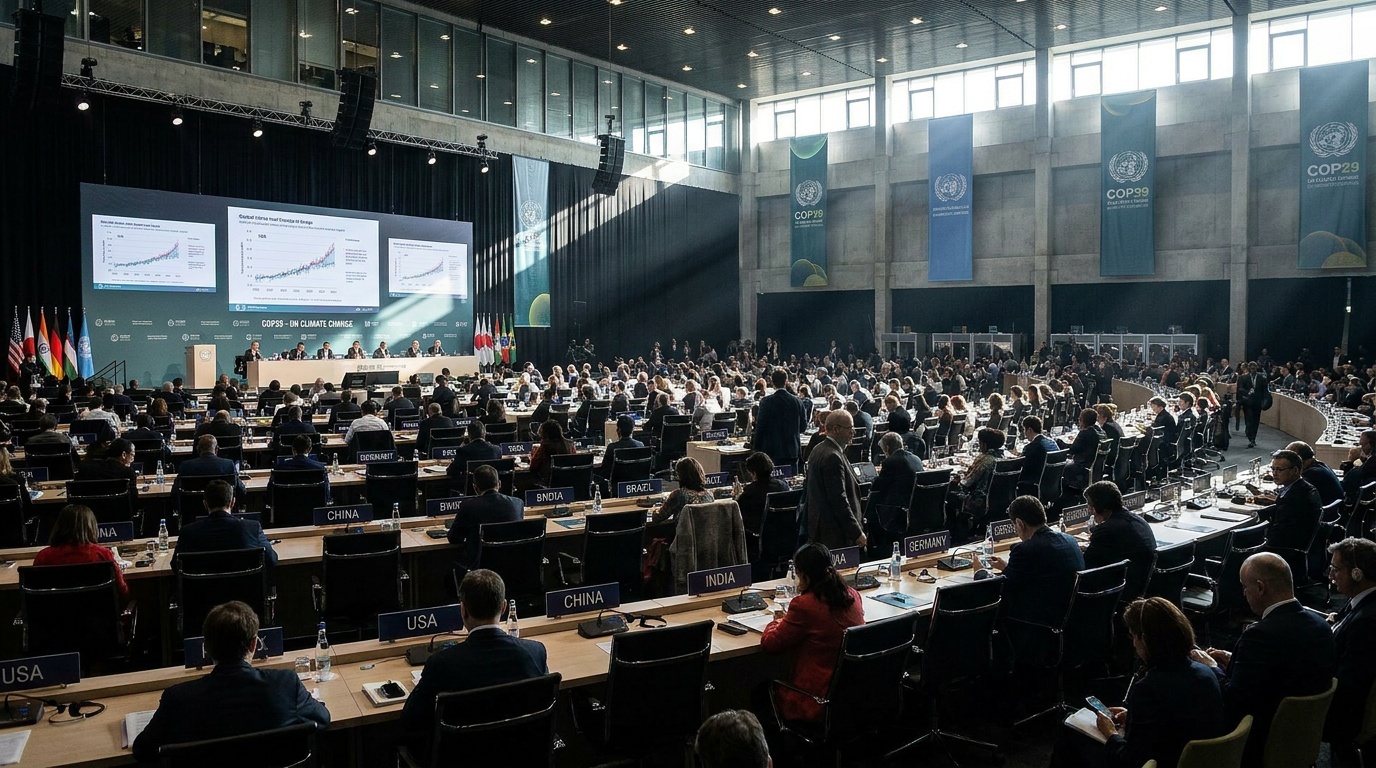
- Climate Scientists & Modelers
- Emphasize the physical data, the shrinking carbon budget, and the unprecedented rate of the Earth's energy imbalance.
- Policy Negotiators
- Focus on the implications for the Paris Agreement, the diplomatic challenges at COP31, and the urgent need for mitigation.
- Adaptation & Health Advocates
- Highlight the immediate impacts of extreme weather, marine heatwaves, and the necessity of preparing for a warmer world.
What's not represented
- · Fossil Fuel Industry Representatives
- · Developing Nation Finance Ministers
Why this matters
The 1.5°C climate target is no longer a distant future goal; it is a threshold the world will cross within three to four years. This timeline forces an immediate shift in how governments, businesses, and communities must prepare for locked-in extreme weather and economic disruption.
Key points
- Human-induced global warming reached 1.37°C above pre-industrial levels in 2025.
- The remaining carbon budget for a 50% chance of limiting warming to 1.5°C is just 130 billion tonnes.
- At current emission rates, this budget will be completely exhausted in approximately three years.
- Global greenhouse gas emissions hit a record high of 56.8 billion tonnes of CO2 equivalent in 2024.
- Reductions in air pollution are unmasking the true warming effect of greenhouse gases, accelerating the temperature rise.
- Marine heatwave days have more than tripled globally since 1991, severely stressing ocean ecosystems.
The margin for error in the global climate system has effectively vanished. According to the latest comprehensive assessment by the international scientific community, human activities pushed long-term global warming to 1.37°C above pre-industrial levels in 2025. This milestone, detailed in the fourth annual Indicators of Global Climate Change (IGCC) report, confirms that the planet is heating at an unprecedented pace. While individual months and years have previously spiked above the 1.5°C threshold due to natural climate patterns like El Niño, the 1.37°C figure represents the permanent, human-induced baseline. The data strips away the noise of natural variability to reveal a stark underlying reality: the fundamental chemistry of the atmosphere has been altered to a degree that makes the primary goal of the Paris Agreement increasingly difficult to secure.[1][2]
The most immediate consequence of this warming trajectory is the rapid depletion of the global carbon budget. The carbon budget represents the total amount of carbon dioxide that humanity can still emit while maintaining a 50 percent chance of limiting long-term warming to 1.5°C. As of early 2026, that budget has shrunk to just 130 billion tonnes of CO2. To put that number into perspective, the global economy currently emits roughly 40 billion tonnes of CO2 every single year. Simple arithmetic dictates that if emissions remain at their current plateau, the entire remaining allowance for the 1.5°C target will be exhausted in just over three years.[1][3]
This timeline places the point of no return squarely at the end of the current decade, around 2029 or 2030. The exhaustion of the 1.5°C budget does not mean the world will instantly combust, but it does mean that any subsequent emissions will guarantee a long-term temperature state above that critical threshold. For policymakers, investors, and communities, the three-year window represents the final opportunity to enact systemic decarbonization before the 1.5°C target transitions from a viable policy objective into a purely historical benchmark. The sheer mathematical constraint of the 130-billion-tonne limit leaves no room for delayed action or gradual transition frameworks.[3][4]

The IGCC report, published in the peer-reviewed journal Earth System Science Data, is not a singular outlier but the consensus view of the climate science establishment. The 2026 update was authored by more than 70 leading scientists from 56 institutions across 17 countries, including numerous lead authors from the Intergovernmental Panel on Climate Change (IPCC). The initiative was designed to bridge the gap between the IPCC’s massive, multi-year assessment cycles and the urgent need for real-time data. By updating the core metrics annually, the IGCC provides negotiators and governments with an unvarnished, up-to-the-minute ledger of the planet's physical state.[1][2]
Beyond the absolute temperature, the rate of warming is perhaps the most alarming metric in the new data pack. Over the decade from 2016 to 2025, human-induced warming increased at a rate of 0.27°C per decade. This is the fastest rate of temperature increase ever recorded in the historical data. The acceleration is driven by a combination of stubbornly high greenhouse gas emissions and complex atmospheric feedback loops. The climate system is responding exactly as physical models predicted it would under sustained greenhouse gas loading, but the velocity of the change is now outpacing the adaptive capacity of many natural and human systems.[1][4]
The primary driver of this acceleration remains the sheer volume of greenhouse gases being pumped into the atmosphere. Global emissions reached an all-time high of 56.8 billion tonnes of carbon dioxide equivalent in 2024, the most recent year with complete data. While the explosive year-over-year emissions growth seen in the early 2000s has largely leveled off, the world has plateaued at a record-high peak rather than beginning the steep descent required to stabilize the climate. This sustained peak means that atmospheric concentrations of carbon dioxide, methane, and nitrous oxide are all continuing to climb, thickening the thermal blanket around the Earth.[1][3]

The primary driver of this acceleration remains the sheer volume of greenhouse gases being pumped into the atmosphere.
Paradoxically, the acceleration in warming is being partially driven by a global success story: the reduction of air pollution. For decades, industrial sulfur dioxide emissions—which cause acid rain and severe respiratory illnesses—acted as a reflective shield, bouncing incoming solar radiation back into space and artificially cooling the planet. As nations have successfully implemented clean air regulations and scrubbed sulfur from shipping fuels and coal plants, this "aerosol masking" effect has diminished. The cleaner air is a massive victory for public health, but it has unmasked the true, underlying warming impact of the accumulated greenhouse gases, contributing to the recent temperature surge.[1][2]
The ultimate ledger of this planetary shift is Earth's energy imbalance. This metric measures the difference between the amount of solar energy arriving at the planet and the amount of thermal energy radiating back out into space. In a stable climate, this number is close to zero. Today, the energy imbalance is at a record high, having more than doubled since the 1970s. This growing surplus of energy is the fundamental engine of climate change, providing the raw thermodynamic fuel that powers stronger hurricanes, deeper droughts, and more intense heatwaves. It is the clearest physical proof that the climate system is actively accumulating heat.[1][2]
The vast majority of this excess heat—roughly 90 percent—is not warming the air, but is instead being absorbed by the world's oceans. To capture the impact of this massive energy transfer, the 2026 IGCC report introduced a new metric: marine heatwave days. Just as atmospheric heatwaves devastate terrestrial crops and human health, marine heatwaves wreak havoc on underwater ecosystems, triggering mass coral bleaching events, disrupting fisheries, and starving marine mammals. By tracking these events, scientists can better quantify the immediate biological toll of the ocean's role as the planet's primary heat sink.[1][5]

The data on marine heatwaves is staggering. The number of days the world's oceans experienced marine heatwave conditions has more than tripled between 1991 and 2025. In 2025 alone, the global ocean endured 65 days of marine heatwave conditions. This sustained thermal stress is pushing critical ecosystems, particularly tropical coral reefs, past their limits of thermal tolerance. The inclusion of this metric in the IGCC report underscores a growing recognition that the impacts of climate change are not just future risks, but present-day ecological crises unfolding beneath the waves.[1][2]
The release of the IGCC report coincided with the United Nations climate meetings in Bonn, Germany, where international negotiators are laying the groundwork for the upcoming COP31 summit. The findings cast a long shadow over the proceedings, fundamentally altering the diplomatic calculus. For years, the political narrative has centered on "keeping 1.5°C alive." The new data forces a reckoning with the reality that the window for that specific goal is closing in real-time. Negotiators are now faced with the dual challenge of maximizing mitigation to prevent even higher temperatures while simultaneously preparing for a world that will likely breach the Paris Agreement's primary threshold.[3][4]
As the 1.5°C budget evaporates, scientific and policy attention is increasingly turning to the budgets for 1.6°C and 1.7°C. The IGCC data indicates that the carbon budget for a 1.6°C limit will be exhausted in roughly eight years at current emission rates, while the budget for 1.7°C provides a runway of about 12 years. These fractions of a degree are not abstract numbers; they represent massive differences in human suffering and ecological destruction. Every tenth of a degree of warming avoided preserves crop yields, saves coastal cities from inundation, and prevents millions of people from being displaced by extreme weather.[4]

The shrinking timelines are forcing a paradigm shift in global climate strategy. While aggressive decarbonization remains the only way to eventually stabilize the climate, the certainty of near-term warming is elevating the urgency of adaptation. Governments and financial institutions are being forced to reallocate capital toward building resilient infrastructure, developing drought-resistant agriculture, and preparing public health systems for unprecedented heat stress. The conversation is no longer just about preventing climate change, but about surviving the climate change that is already mathematically locked into the system.[4][6]
Ultimately, the 2026 Indicators of Global Climate Change report serves as an uncompromising physical audit of the planet. The data does not negotiate, and the physics of the atmosphere do not respond to political declarations. The 1.37°C of human-induced warming and the three-year carbon budget are the hard realities that will dictate the future of the global economy and the biosphere. While the window to limit warming to 1.5°C is closing rapidly, the report's underlying message is that the fight does not end there. The trajectory of the 21st century will be determined by how quickly humanity can zero out emissions and halt the accumulation of heat in the Earth system.[1][6]
How we got here
2015
The Paris Agreement is adopted, setting a global goal to limit warming to 1.5°C above pre-industrial levels.
2019
Global greenhouse gas emissions continue to climb, with CO2, methane, and nitrous oxide all showing significant increases over the subsequent years.
2023
The first Indicators of Global Climate Change (IGCC) report is published to provide annual updates between major IPCC assessment cycles.
2024
Global greenhouse gas emissions reach an all-time high of 56.8 billion tonnes of CO2 equivalent.
2025
Human-induced global warming reaches 1.37°C, and the world experiences 65 days of marine heatwaves.
June 2026
The fourth IGCC report reveals the remaining 1.5°C carbon budget has shrunk to 130 billion tonnes, leaving roughly three years before exhaustion.
Viewpoints in depth
Climate Scientists & Modelers
The physical reality of the Earth's energy imbalance.
For the scientific community, the focus is entirely on the thermodynamic ledger of the planet. Researchers emphasize that the Earth's energy imbalance—the net difference between incoming solar radiation and outgoing heat—is the ultimate metric of climate change. Because this imbalance has more than doubled since the 1970s, scientists argue that the climate system is locked into a warming trajectory regardless of short-term political promises. Their primary concern is the rapid depletion of the 130-gigatonne carbon budget, warning that the physical limits of the atmosphere cannot be negotiated or extended.
Policy Negotiators
The diplomatic crisis of a closing 1.5°C window.
International diplomats and UN negotiators view the IGCC data through the lens of the Paris Agreement and global climate finance. With the 1.5°C target likely to be breached within four years, negotiators face a crisis of credibility. The diplomatic focus is shifting toward preventing 'overshoot'—minimizing the time and magnitude by which temperatures exceed 1.5°C—and securing the massive financial transfers required to help developing nations transition their economies. For this camp, the data is a bludgeon to force higher emission reduction pledges ahead of the COP31 summit.
Adaptation & Health Advocates
The immediate human and ecological toll of 1.37°C.
Public health experts and ecological advocates argue that the obsession with future temperature targets obscures the devastation already occurring at 1.37°C. By pointing to the tripling of marine heatwave days and the unmasking of aerosol warming, this camp stresses that the climate crisis is a present-day emergency, not a future risk. They advocate for a massive reallocation of resources toward adaptation—building heat-resilient cities, protecting vulnerable coastal communities, and fortifying food systems—arguing that mitigation alone is no longer sufficient to protect populations from the locked-in warming.
What we don't know
- Whether the global economy can mobilize fast enough to prevent temperatures from breaching the 1.6°C and 1.7°C thresholds.
- The exact timeline and severity of specific ecological tipping points, such as the complete collapse of tropical coral reefs.
- How the unmasking of aerosol cooling will interact with other complex atmospheric feedback loops over the next decade.
Key terms
- Carbon Budget
- The maximum amount of cumulative net global carbon dioxide emissions that would result in limiting global warming to a given level with a specified probability.
- Earth's Energy Imbalance
- The net difference between incoming solar radiation and outgoing thermal radiation, representing the total heat accumulating in the climate system.
- Marine Heatwave
- A prolonged period of abnormally high sea surface temperatures that can cause devastating impacts on marine ecosystems.
- Aerosol Unmasking
- The phenomenon where the reduction of reflective particulate pollution (like sulfur dioxide) removes a temporary cooling effect, accelerating observable global warming.
Frequently asked
What is the difference between a single year above 1.5°C and the Paris Agreement limit?
A single year can exceed 1.5°C due to natural variability like El Niño. The Paris Agreement limit refers to the long-term, multi-decade average of human-induced warming, which currently stands at 1.37°C.
Why are reductions in air pollution accelerating warming?
Industrial pollutants like sulfur dioxide reflect sunlight and temporarily cool the planet. As countries clean up their air, this 'masking' effect disappears, revealing the full warming impact of accumulated greenhouse gases.
What is Earth's energy imbalance?
It is the difference between the amount of energy from the sun arriving at Earth and the amount returning to space. A growing imbalance means the planet is trapping more heat, primarily in the oceans.
Sources
Source coverage
6 outlets
3 viewpoints surfaced





[1]Earth System Science DataClimate Scientists & Modelers
Indicators of Global Climate Change 2025: annual update of key indicators of the state of the climate system and human influence
Read on Earth System Science Data →[2]University of LeedsClimate Scientists & Modelers
Major climate report shows Earth is getting hotter faster
Read on University of Leeds →[3]Agence EuropePolicy Negotiators
Global warming reached 1.37°C in 2025 and could hit 1.5°C by 2030, according to Indicators of Global Climate Change
Read on Agence Europe →[4]Health Policy WatchAdaptation & Health Advocates
Global Warming 1.5°C Limit to be Breached in Four Years Without Urgent Action
Read on Health Policy Watch →[5]Copernicus Climate Change ServiceClimate Scientists & Modelers
Indicators of Global Climate Change: 2026 Update
Read on Copernicus Climate Change Service →[6]Factlen Editorial TeamAdaptation & Health Advocates
Synthesis by Factlen editorial team
Read on Factlen Editorial Team →

Every angle. Every day.
Get science stories with full source coverage and perspective breakdowns delivered to your inbox.