
How Women's Wrestling Became the NCAA's Newest Championship Sport
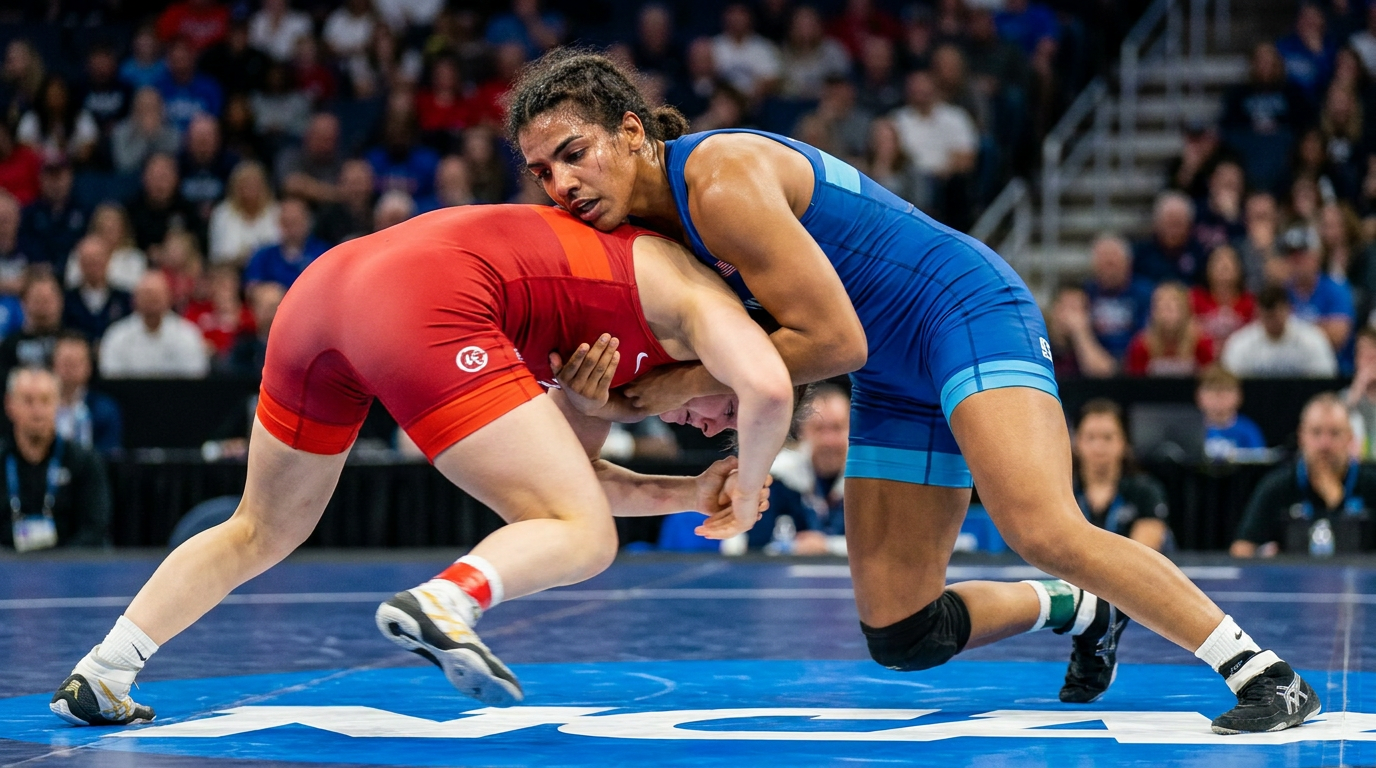
Driven by explosive high school growth and small-college investments, women's wrestling has officially become the 91st NCAA championship sport, creating a new Olympic pipeline for LA 2028.
By Factlen Editorial Team
- Collegiate Administrators
- Focused on enrollment growth, Title IX compliance, and financial ROI.
- Olympic Pipeline Advocates
- Focused on international competitiveness and the road to the LA 2028 Games.
- Grassroots Coaches
- Focused on youth development, mentorship, and equal athletic opportunity.
What's not represented
- · Division I Athletic Directors hesitant to add programs due to budget constraints
- · Male collegiate wrestlers navigating the allocation of athletic department resources
Why this matters
The elevation of women's wrestling to an official NCAA championship sport completes a 30-year grassroots battle for athletic equality. For young female athletes, it provides a fully funded collegiate pathway and a direct pipeline to the Olympic Games, fundamentally changing the landscape of American combat sports.
Key points
- Women's wrestling officially became the 91st NCAA championship sport, holding its first unified national tournament in March 2026.
- High school participation has surged from just 804 girls in 1994 to over 74,000 today.
- The collegiate expansion has been driven heavily by Division II and Division III schools seeking enrollment growth.
- Women's collegiate wrestling uses Olympic freestyle rules, creating a direct training pipeline for Team USA.
- The domestic pipeline is viewed as crucial for securing medals at the upcoming Los Angeles 2028 Olympics.
In 1994, only 804 girls wrestled in United States high schools, almost exclusively competing against boys in a sport that offered them no dedicated collegiate future. Three decades later, the landscape has fundamentally transformed. More than 74,000 girls now wrestle at the scholastic level, making it the fastest-growing high school sport in the country. This grassroots explosion has finally breached the highest levels of American amateur athletics, culminating in a historic milestone for gender equity in combat sports.[2][7]
In March 2026, the National Collegiate Athletic Association (NCAA) hosted its first-ever unified Women's Wrestling Championship in Coralville, Iowa. The event marked the sport's official elevation to the 91st NCAA championship sport, graduating from its previous status as an 'emerging sport.' McKendree University captured the inaugural team title in a closely contested race against the University of Iowa, crowning three individual national champions in the process.[1][5][6]
The mechanism behind this collegiate arrival reveals a unique bottom-up growth model. Unlike many traditional sports driven by massive Division I investments, the rise of women's wrestling was engineered by smaller institutions. Division II and Division III programs currently account for 94 percent of all collegiate women's wrestling teams. For these smaller schools, adding the sport offered a high return on investment: it provided a cost-effective way to boost female enrollment while demonstrating a commitment to Title IX compliance.[1][7]
To achieve official championship status, an NCAA emerging sport must reach a threshold of 40 sponsoring schools at the varsity level. Women's wrestling eclipsed that benchmark during the 2022-2023 academic year and has not slowed down since. Today, more than 150 colleges and universities sponsor varsity programs, providing scholarships and dedicated coaching staffs to a generation of athletes who previously had nowhere to compete after high school.[2][5]

This collegiate boom is directly fed by a massive shift in state-level athletic policies. Prior to 1998, when Hawaii became the first state to sanction girls' wrestling, female athletes had to compete in boys' divisions. Today, 46 states officially sanction girls' wrestling with their own dedicated state championships. Girls now make up 18 percent of all high school wrestlers in the United States, fundamentally changing the culture of local wrestling rooms.[2][5]
The transition from high school to college also introduces a critical technical shift. While American high school boys and collegiate men compete in 'folkstyle' wrestling—a rule set unique to the United States that emphasizes ground control—women's collegiate wrestling utilizes 'freestyle.' Freestyle is the international standard used at the Olympic Games, allowing for fluid upper and lower body attacks with a heavy emphasis on takedowns and exposure points.[3][7]
The transition from high school to college also introduces a critical technical shift.
By adopting freestyle rules, the NCAA has inadvertently created a seamless, state-sponsored pipeline for Team USA's Olympic ambitions. Historically, American women had to rely on specialized regional training centers to learn freestyle after high school. Now, they spend four years competing in the Olympic style against the best domestic talent, fully funded by university athletic departments.[2][7]

The impact of this pipeline is already visible on the global stage. At the 2024 Paris Olympics, Amit Elor dominated the 68-kilogram division to win gold at just 20 years old, becoming the youngest American wrestler to ever win an Olympic title. Elor's victory served as a catalyst, proving that the United States could produce homegrown talent capable of challenging international powerhouses like Japan, which has historically dominated women's freestyle.[4][7]
The stakes for this collegiate pipeline are particularly high as the sport looks toward the 2028 Summer Olympics in Los Angeles. Competing on home soil brings immense pressure, and United World Wrestling (UWW)—the sport's international governing body—has completely overhauled the qualification process for the LA Games.[3][4]
Under the new UWW framework, the 16 Olympic spots per weight class will be allocated through a grueling four-phase system. The process begins with the 2027 World Championships, followed by UWW Rankings, Continental Qualifiers, and a final World Olympic Qualifier. Because quotas are awarded to the National Olympic Committee rather than the individual athlete, the depth of the American collegiate system will be crucial for securing spots across all six women's weight classes.[3][7]

Despite the overwhelming momentum, the sport still faces significant structural uncertainties. The most glaring gap remains at the Division I level, which accounts for only 5 percent of current women's programs. While the University of Iowa made headlines by launching a fully funded Division I team—and immediately finishing as the national runner-up in 2026—other traditional wrestling powerhouses in the Big Ten and Big 12 conferences have been slow to follow suit.[1][6]
Administrators at major universities often cite the financial complexities of the modern NCAA landscape, including the looming costs of direct athlete compensation models, as a barrier to adding new sports. Without broad Division I adoption, the sport risks a tiered reality where the best athletes are concentrated in a handful of elite programs, while the majority of participation remains at the Division III level.[1][7]
Another critical challenge is the coaching bottleneck. The rapid addition of over 150 college programs has vastly outpaced the supply of experienced female coaches. Organizations like the National Wrestling Coaches Association have launched dedicated leadership academies to fast-track women into head coaching roles, but building a sustainable coaching tree takes time.[2]

Nevertheless, the trajectory of women's wrestling represents one of the most successful grassroots sports movements of the 21st century. What began as a handful of girls braving boys' varsity practices has evolved into a sanctioned NCAA championship sport with a direct artery to the Olympic Games. As the countdown to Los Angeles 2028 begins, the American women's wrestling machine is fully operational, funded, and expanding.[4][5][7]
How we got here
1994
Only 804 girls participate in high school wrestling nationwide, mostly competing against boys.
1998
Hawaii becomes the first state to officially sanction girls' high school wrestling.
2020
The NCAA officially recognizes women's wrestling as an emerging sport.
2024
Amit Elor wins Olympic gold in Paris at age 20, highlighting the strength of the American youth pipeline.
March 2026
The NCAA hosts the first-ever unified Women's Wrestling Championship in Coralville, Iowa.
Viewpoints in depth
Collegiate Administrators
Focused on enrollment growth, Title IX compliance, and financial ROI.
For small Division II and III schools, adding women's wrestling is a strategic business decision. Administrators view the sport as a cost-effective way to attract dedicated female student-athletes, boosting overall enrollment numbers while simultaneously balancing Title IX requirements. They argue that the relatively low equipment and facility costs make it an ideal emerging sport compared to capital-intensive additions like hockey or equestrian.
Olympic Pipeline Advocates
Focused on international competitiveness and the road to the LA 2028 Games.
USA Wrestling and international analysts view the NCAA's adoption of freestyle rules as a game-changer. By providing athletes with four years of funded, high-level freestyle competition, the collegiate system serves as a massive, decentralized Olympic training camp. This camp believes the NCAA pipeline is the only way the U.S. can consistently challenge dominant nations like Japan on the global stage, especially with the pressure of the upcoming Los Angeles Games.
Grassroots Coaches
Focused on youth development, mentorship, and equal athletic opportunity.
High school and club coaches emphasize the cultural shift within the sport. They argue that moving away from forcing girls to wrestle boys has unlocked massive participation growth and created a safer, more welcoming environment. Their primary concern now is developing enough experienced female coaches to lead the rapidly expanding number of high school and college programs, ensuring the sport's culture remains empowering for the next generation.
What we don't know
- Whether major Division I wrestling powerhouses (like Penn State or Oklahoma State) will eventually add fully funded women's programs.
- How the impending NCAA athlete-compensation models will impact the funding of emerging Olympic sports.
- If the rapid growth of collegiate programs will outpace the development of experienced female coaches.
Key terms
- Freestyle Wrestling
- The international style of wrestling used in the Olympics and women's collegiate competition, which rewards fluid takedowns and exposing the opponent's back to the mat.
- Folkstyle Wrestling
- A style of wrestling unique to the United States used in high school and men's collegiate competition, heavily emphasizing controlling the opponent on the mat.
- Emerging Sports for Women
- An NCAA program that helps grow women's sports by providing a pathway to official championship status once 40 schools sponsor varsity teams.
- United World Wrestling (UWW)
- The international governing body for the sport of wrestling, responsible for setting Olympic qualification rules.
Frequently asked
When was the first NCAA women's wrestling championship?
The inaugural unified NCAA Women's Wrestling Championship took place in March 2026 at Xtream Arena in Coralville, Iowa, with McKendree University winning the team title.
Do women wrestle freestyle or folkstyle in college?
Women's collegiate wrestling uses freestyle rules. This aligns with the international Olympic standard, unlike men's collegiate wrestling which uses the American folkstyle ruleset.
How many states sanction girls' high school wrestling?
As of 2025, 46 states officially sanction girls' wrestling and host dedicated state championships, up from just one state (Hawaii) in 1998.
Sources
Source coverage
7 outlets
3 viewpoints surfaced







[1]NCAACollegiate Administrators
The first NCAA women's wrestling champions are crowned
Read on NCAA →[2]National Wrestling Coaches AssociationGrassroots Coaches
Building the Future of Women's Wrestling
Read on National Wrestling Coaches Association →[3]United World WrestlingOlympic Pipeline Advocates
United World Wrestling overhauls qualification process for the Olympic Games
Read on United World Wrestling →[4]Sports IllustratedOlympic Pipeline Advocates
These young U.S. athletes made their debuts in Paris and are primed to feature prominently in LA 2028
Read on Sports Illustrated →[5]Formula4MediaCollegiate Administrators
NCAA Adds Women's Wrestling As 91st Championship Sport
Read on Formula4Media →[6]WikipediaGrassroots Coaches
2026 NCAA Women's Wrestling Championships
Read on Wikipedia →[7]Factlen Editorial TeamGrassroots Coaches
Synthesis by Factlen editorial team
Read on Factlen Editorial Team →

Every angle. Every day.
Get sports stories with full source coverage and perspective breakdowns delivered to your inbox.