
How Virtual Power Plants Are Turning Homes Into the Grid's Best Defense
Utilities are networking thousands of home batteries, EVs, and smart thermostats to balance the grid and prevent blackouts. This software-driven approach is proving cheaper than building new power plants while paying consumers for their participation.
By Factlen Editorial Team
- Grid Operators & Utilities
- Utilities see VPPs as a critical tool to manage unprecedented load growth without building expensive new infrastructure.
- Energy Consumers & Prosumers
- Homeowners view VPPs as a way to monetize their smart devices and gain energy independence.
- Clean Energy Advocates
- Advocates focus on decarbonization, retiring fossil-fuel peaker plants, and equitable access to grid benefits.
What's not represented
- · Fossil Fuel Generators
- · Low-Income Ratepayers without Smart Devices
Why this matters
As electricity demand surges and grid infrastructure ages, virtual power plants offer a faster, cheaper way to keep the lights on. For consumers, this shift means your home appliances and vehicles can now generate passive income while helping to stabilize the local power grid.
Key points
- Virtual power plants (VPPs) use software to network home batteries, EVs, and smart thermostats to support the electrical grid.
- VPP capacity costs roughly $280 per kilowatt-year, significantly cheaper than building new natural gas peaker plants.
- The Department of Energy aims to deploy 80 to 160 gigawatts of VPP capacity by 2030 to meet surging electricity demand.
- Participating homeowners can earn direct payouts or bill credits for allowing utilities to access their devices during peak hours.
The U.S. electrical grid is currently facing a mathematical and logistical problem it has not seen in decades. Driven by the explosive growth of artificial intelligence data centers, a massive boom in domestic manufacturing, and the rapid electrification of vehicles and home heating systems, peak electricity demand is projected to surge by up to 200 gigawatts by the year 2030. This unprecedented load growth threatens to overwhelm an aging infrastructure system that was originally designed for a much simpler, analog era of energy consumption.[3]
Historically, utility companies solved these types of demand spikes with a brute-force approach: building massive, centralized fossil-fuel power plants and stringing thousands of miles of new high-voltage transmission lines across the country. However, infrastructure projects of that scale now take many years to permit and billions of dollars to construct. Those soaring capital costs are ultimately passed down to everyday ratepayers, driving up monthly electricity bills at a time when affordability is already a major concern for households across the nation. As a result, grid operators are being forced to rethink their entire approach to capacity planning.
Instead of looking outward for new, large-scale generation facilities, a growing coalition of grid operators, technology companies, and policymakers is looking inward—directly into the homes, businesses, and garages of everyday consumers. They are realizing that the hardware necessary to balance the grid already exists in the wild, sitting idle in basements and driveways. By harnessing these distributed assets, the energy industry is pioneering a decentralized approach to power management that is faster to deploy and significantly cheaper to operate.[8]
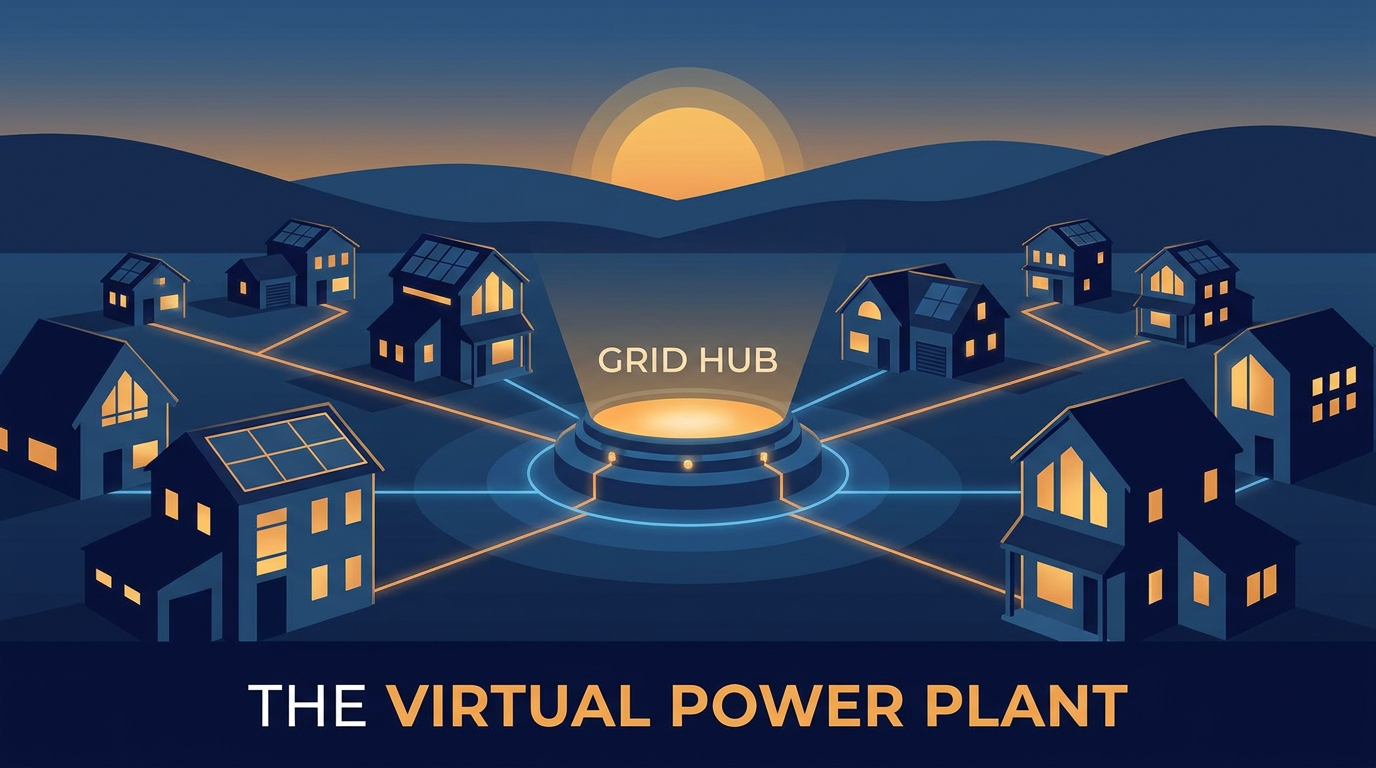
The technological solution driving this shift is known as the 'Virtual Power Plant,' or VPP. Rather than burning coal or natural gas at a single, centralized location, a virtual power plant uses sophisticated cloud-based software to network thousands of decentralized devices together. This digital umbrella aggregates distributed energy resources—such as residential battery storage systems, rooftop solar arrays, electric vehicle chargers, and smart thermostats—into a single, unified network that can be controlled and dispatched remotely by grid operators. By treating these disparate devices as a cohesive unit, the software creates a flexible energy asset that rivals the output of traditional infrastructure.[4][8]

The true power of a VPP becomes apparent when the grid faces a critical peak event. Consider a sweltering summer evening when millions of residents return home from work and simultaneously turn on their air conditioners, pushing the local power grid to its absolute limit. Instead of firing up an expensive and polluting backup generator to meet this sudden spike in demand, the virtual power plant operator simply sends a secure digital signal to the network of enrolled household devices.
Operating in perfect unison, the network responds instantly. Thousands of participating smart thermostats might automatically bump up their set temperature by a single, barely noticeable degree. Electric vehicle chargers in residential garages might pause their charging cycles for an hour until the grid stabilizes. Simultaneously, thousands of home battery systems might discharge a fraction of their stored solar energy back into the neighborhood grid, providing a sudden injection of clean power exactly where it is needed most. This coordinated dance of micro-adjustments effectively shaves the peak off the demand curve, preventing rolling blackouts and keeping the broader system stable.
To the utility operator sitting in a control room, this synchronized orchestration looks and acts exactly like a traditional power plant spinning up its turbines to meet surging demand. But unlike a conventional facility, the virtual power plant responds instantly, operates silently, and accomplishes its mission without burning a single drop of fossil fuel. It is a triumph of software and connectivity over heavy industry, transforming passive consumer electronics into active grid infrastructure. This capability is proving especially vital as extreme weather events become more frequent, requiring grid managers to have highly responsive tools at their disposal to maintain reliability.[7]
The underlying economics driving this decentralized shift are highly compelling for utility executives and regulators alike. According to recent industry intelligence data, the fully loaded cost of virtual power plant capacity has fallen to roughly $280 per kilowatt-year. This figure includes all the necessary expenses for participant acquisition, hardware incentives, telemetry infrastructure, and the sophisticated software licensing required to orchestrate the network securely. As technology improves and more devices roll off assembly lines with built-in grid connectivity, these aggregation costs are expected to drop even further, making the financial case nearly undeniable.[7]
In stark contrast, building a new natural gas 'peaker' plant—a traditional facility specifically designed to sit idle most of the year and run only during times of highest electricity demand—costs between $800 and $1,200 per kilowatt-year. Virtual power plants can deliver the exact same peak capacity and reliability at a fraction of the capital expense. Furthermore, while a physical power plant takes three to five years to build, a software-driven VPP can be spun up and deployed in a matter of months. This speed to market is a critical advantage for utilities racing to accommodate the sudden influx of power-hungry data centers.[7]

Virtual power plants can deliver the exact same peak capacity and reliability at a fraction of the capital expense.
Beyond the macroeconomics of grid management, virtual power plants represent a fundamental shift in the financial relationship between utility companies and their customers. Historically, energy has flowed in one direction, and money has flowed in the other. Now, homeowners are transitioning from passive ratepayers into active 'prosumers' who are financially compensated for the valuable grid services their personal hardware provides. This dynamic turns household appliances into revenue-generating assets. For many families, this means that the upfront cost of installing a solar array or purchasing an electric vehicle can be partially offset by the ongoing passive income generated through grid participation.[6]
This model is already being proven at scale in markets facing severe infrastructure constraints. In California, Pacific Gas & Electric (PG&E) recently partnered with the residential solar provider Sunrun to launch a highly targeted pilot program known as Local PeakShift Power. The initiative successfully aggregated hundreds of residential solar-plus-battery systems located specifically in neighborhoods that were experiencing highly constrained electric distribution circuits. By focusing on these specific geographical bottlenecks, the utility was able to apply surgical load relief exactly where the physical wires were at the greatest risk of overloading.[1][6]
During the pilot's dispatching season, participating homeowners earned $150 per battery simply for allowing the utility to tap into their stored energy during peak evening hours. The program dispatched more than 50 times over the summer, successfully helping PG&E defer expensive local distribution upgrades while generating net savings for all utility customers. It served as a powerful proof of concept that everyday homes can function as reliable, dispatchable grid assets. The success of the pilot has prompted calls to expand the model to tens of thousands of additional homes across the state, fundamentally altering how California plans for its energy future.[6]

The federal government is now aggressively pushing to scale these decentralized models nationwide. The U.S. Department of Energy’s recent 'Liftoff' report laid out a comprehensive strategic roadmap to deploy between 80 and 160 gigawatts of virtual power plant capacity across the country by the year 2030. If achieved, this massive network of distributed resources would be large enough to serve up to 20 percent of the nation's projected peak electricity load. Federal officials view this rapid scaling as an absolute necessity to maintain national energy security and support the ongoing transition toward a fully electrified economy.[3]
Achieving that ambitious scale, the Department of Energy notes, could redirect billions of dollars in grid spending away from legacy fossil-fuel infrastructure and directly into the pockets of participating consumers. The agency estimates that tripling the current scale of virtual power plants could reduce overall grid costs by an estimated $10 billion annually. These savings would theoretically trickle down to all ratepayers, even those who do not personally own smart devices or home batteries. By avoiding the construction of expensive new peaker plants, the entire system becomes more efficient, driving down the baseline cost of electricity for everyone connected to the grid.[3]
State governments are also taking notice and adjusting their regulatory frameworks accordingly. In early 2026, Massachusetts issued a landmark executive order targeting 3.5 gigawatts of demand-management resources by 2035, explicitly prioritizing virtual power plants. Meanwhile, states like Minnesota and Colorado have advanced new legislative rules requiring their local utilities to actively model and integrate distributed energy resources into their long-term capacity planning, rather than treating them as a mere afterthought. These policy shifts signal a growing bipartisan consensus that grid modernization must include decentralized, customer-owned technologies as a core component of the energy mix.[2]

Despite the undeniable momentum and clear economic benefits, significant hurdles remain before virtual power plants become a ubiquitous feature of the American energy landscape. The primary challenge facing the industry today is customer acquisition and the 'attachment rate'—the percentage of eligible smart devices that actually enroll in a utility-sponsored grid program. Building the software is the easy part; convincing millions of homeowners to opt in is proving much more difficult. Many consumers are simply unaware that their existing hardware is capable of generating income, while others are hesitant due to privacy concerns or a general distrust of utility companies.[5]
Currently, industry analysts estimate that less than 20 percent of available distributed energy capacity in North America is actively enrolled in a grid-interactive program. Many consumers remain highly protective of their home environments and are hesitant to hand over even partial control of their thermostats or vehicle chargers to a third-party operator. Overcoming this psychological barrier requires transparent communication and highly lucrative financial incentives that make participation undeniably worthwhile. Providers must prove that they can manage these devices seamlessly, without ever leaving a family in a cold house or with an uncharged car when they need it most.[5]
Furthermore, legacy utility regulations in many regions still make it difficult for distributed resources to compete on a level playing field. Wholesale energy markets were designed decades ago for massive, centralized power plants, and their complex rules often inadvertently exclude aggregations of small residential devices. While federal mandates like FERC Order 2222 aim to open these markets to virtual power plants, the actual implementation at the regional level has been slow and bogged down by bureaucratic red tape. Until these market structures are fully modernized, the true financial potential of decentralized energy will remain partially locked behind outdated regulatory barriers.[1][4]
Overcoming these systemic barriers will require a coordinated effort across the entire energy sector. Utilities must simplify their enrollment processes, moving away from confusing pilot programs toward standardized, easy-to-understand compensation models. Simultaneously, technology manufacturers and grid operators must launch massive consumer education campaigns to clearly explain the tangible benefits of grid participation. The goal is to make joining a virtual power plant as simple and intuitive as downloading a smartphone application. When the friction of enrollment is removed and the financial rewards are made clear, adoption rates are expected to climb exponentially.[3]
If the industry can successfully navigate these challenges, the proliferation of virtual power plants promises to fundamentally rewire the architecture of the modern grid. By transforming millions of isolated homes and businesses into a synchronized, intelligent, and highly responsive network, the energy system of the future will be far more resilient. Ultimately, keeping the lights on in the 21st century may rely less on the massive power plants we build, and much more on the smart devices we already own. This transition from centralized generation to decentralized collaboration represents one of the most empowering and technologically profound shifts in the history of public utilities.[8]
How we got here
2021-2022
California launches emergency load reduction programs to shore up grid reliability in response to rolling blackouts.
2023
The U.S. Department of Energy releases its first 'Liftoff' report, identifying VPPs as a critical tool for the energy transition.
2025
PG&E and Sunrun successfully deploy a hyperlocal VPP pilot, paying customers to use their home batteries to stabilize constrained circuits.
2026
States like Massachusetts and Minnesota advance executive orders and regulatory frameworks mandating VPP integration into utility planning.
Viewpoints in depth
Grid Operators' View
Utilities see VPPs as a critical tool to manage unprecedented load growth without building expensive new infrastructure.
Faced with skyrocketing electricity demand from data centers and electrification, utilities are struggling to maintain reliability. Building new transmission lines and centralized power plants takes years and billions of dollars. Grid operators view Virtual Power Plants as a fast, scalable alternative that can be deployed in months. By tapping into existing customer devices, utilities can shave peak demand, stabilize local circuits, and defer costly distribution upgrades, ultimately keeping ratepayer costs lower.
Consumers' View
Homeowners view VPPs as a way to monetize their smart devices and gain energy independence.
For the everyday consumer, purchasing a home battery or an electric vehicle is a significant upfront investment. VPP programs offer a way to generate a return on that hardware. By allowing utilities to access their stored power or adjust their thermostats during peak events, consumers can earn direct payouts, bill credits, or reduced retail rates. This transforms the home from a passive consumer of electricity into an active, revenue-generating grid asset.
What we don't know
- Whether utilities can successfully streamline enrollment processes to increase the currently low attachment rates for eligible devices.
- How wholesale energy markets will adjust their legacy rules to fully compensate distributed resources on par with traditional power plants.
- The extent to which VPPs can offset the massive, concentrated power demands of new AI data centers.
Key terms
- Virtual Power Plant (VPP)
- A cloud-based network that aggregates decentralized energy resources to supply power or reduce demand on the grid.
- Distributed Energy Resources (DERs)
- Small-scale energy generation or storage technologies located close to where electricity is used, such as rooftop solar or home batteries.
- Peaker Plant
- A traditional power plant, often powered by natural gas, that only runs during times of highest electricity demand.
- Load Shifting
- The practice of moving electricity consumption from times of high demand to times when demand is lower and power is cheaper.
Frequently asked
Do I lose control of my thermostat or battery if I join a VPP?
No. Participants can always opt out of specific dispatch events, though doing so frequently may reduce the financial incentives or bill credits they earn.
Do I need to buy special equipment to participate?
If you already have a compatible smart thermostat, EV charger, or home battery, you typically do not need extra hardware. The VPP provider manages the connection remotely via software.
How much money can I make by joining a VPP?
Compensation varies widely by region and program. It can range from small annual bill credits for smart thermostats to hundreds of dollars per year for sharing a home battery's stored power.
Does a VPP generate its own electricity?
A VPP does not generate power itself. Instead, it coordinates existing devices to either reduce electricity consumption or discharge stored energy back to the grid when demand is highest.
Sources
Source coverage
8 outlets
3 viewpoints surfaced








[1]Utility DiveGrid Operators & Utilities
In 2026, virtual power plants must scale or risk being left behind
Read on Utility Dive →[2]MarketScaleGrid Operators & Utilities
Massachusetts and Minnesota focus on virtual power plants
Read on MarketScale →[3]U.S. Department of EnergyClean Energy Advocates
Pathways to Commercial Liftoff for Virtual Power Plants
Read on U.S. Department of Energy →[4]RMIClean Energy Advocates
Designing VPP Programs to meet utilities' needs
Read on RMI →[5]Pew Charitable TrustsClean Energy Advocates
How States Are Advancing Distributed Energy
Read on Pew Charitable Trusts →[6]SunrunEnergy Consumers & Prosumers
Sunrun completes successful dispatching season of a first-of-its-kind distributed power plant partnership with PG&E
Read on Sunrun →[7]Energy SolutionsClean Energy Advocates
Virtual Power Plants 2026–2035: The $3.5–5.5B Grid Orchestration Oligopoly
Read on Energy Solutions →[8]Factlen Editorial Team
Synthesis by Factlen editorial team
Read on Factlen Editorial Team →
Every angle. Every day.
Get energy stories with full source coverage and perspective breakdowns delivered to your inbox.