
OLED vs. Mini-LED in 2026: The Great Display Convergence
As Tandem OLEDs push brightness boundaries and RGB Mini-LEDs master contrast, the 2026 display market offers no single winner, but rather two distinct engineering paths tailored to different rooms.
By Factlen Editorial Team
- Cinematic Purists
- Prioritizes perfect black levels, infinite contrast, and pixel-level precision for dark-room movie viewing.
- Daytime & Productivity Users
- Values sustained full-screen brightness, glare reduction, and absolute immunity to burn-in for static interfaces.
- Value & Large-Screen Buyers
- Focuses on the price-to-performance ratio, particularly at ultra-large screen sizes of 85 inches and above.
What's not represented
- · Custom Home Theater Installers
- · Environmental Regulators
Why this matters
Televisions and monitors are long-term investments that dictate your daily entertainment and productivity experience. Understanding the 2026 leaps in display physics prevents buyers from overspending on the wrong technology for their specific lighting environment.
Key points
- Tandem OLED technology has pushed peak brightness to 3,000 nits, closing the historical luminance gap.
- RGB Mini-LEDs now feature over 20,000 dimming zones, delivering near-OLED black levels.
- OLED remains vulnerable to Auto Brightness Limiter (ABL) dimming during full-screen white scenes.
- Mini-LED completely eliminates burn-in risk, making it ideal for static productivity and gaming HUDs.
- Mini-LED offers significant cost advantages at ultra-large screen sizes of 85 inches and above.
For years, the television and high-end monitor market operated on a simple, predictable binary: buy an OLED display for perfect dark-room contrast, or buy an LED display for bright-room visibility. In 2026, that conventional wisdom is entirely obsolete. The display industry is currently undergoing a massive technological convergence, with both underlying panel technologies aggressively engineering away their historical weaknesses. Consumers are no longer choosing between a flawed bright screen and a flawed dark screen; they are choosing between two highly refined, flagship-tier engineering paths that have pushed the boundaries of consumer electronics.[5]
The stakes for consumers navigating this shifting landscape are remarkably high. Televisions and premium monitors are long-term investments that dictate daily entertainment, competitive gaming, and professional productivity experiences for years to come. Making the right choice in 2026 requires looking past glossy showroom demo loops—which are specifically designed to hide panel flaws—and understanding the structural physics of modern displays. The marketing terminology has never been louder, but the underlying chemistry and backlighting algorithms tell a much clearer story about which screen belongs in which room.[5]
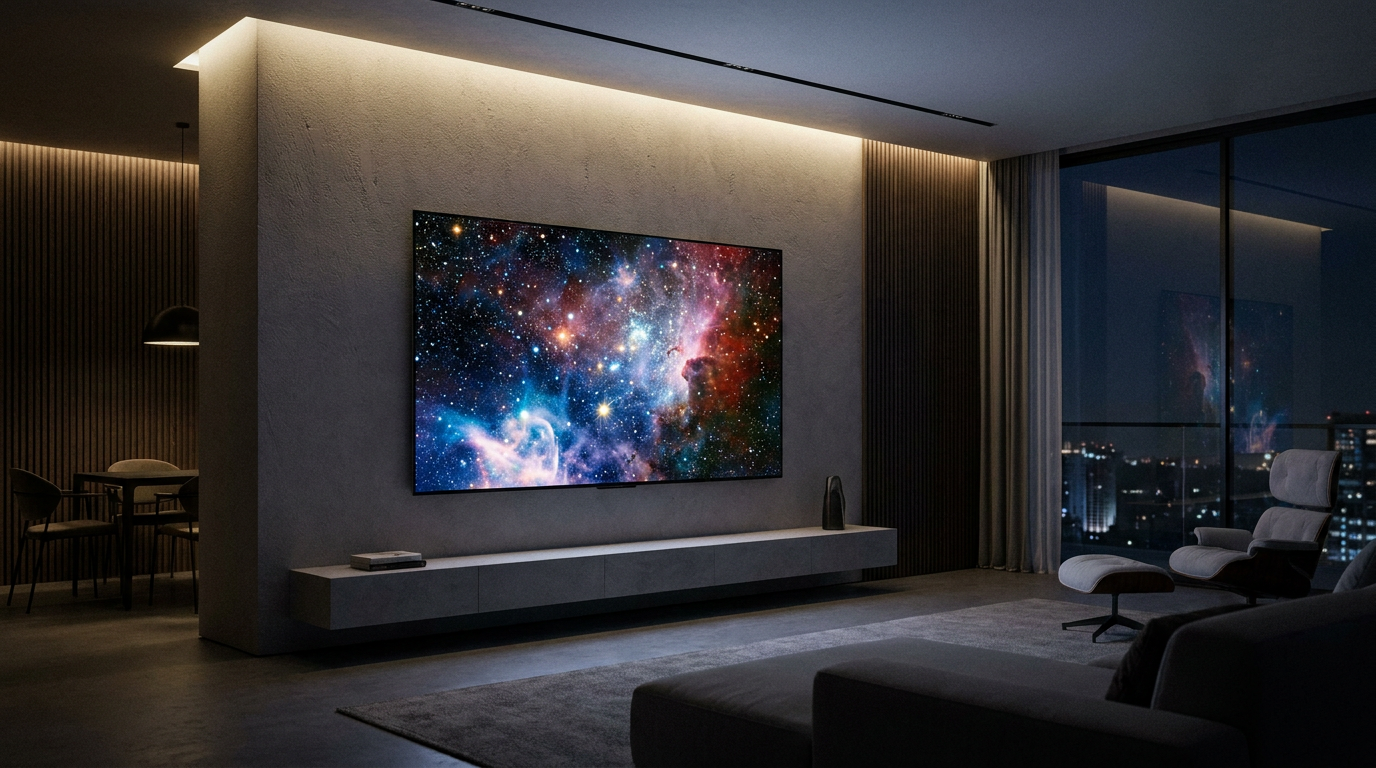
The foundational argument for OLED (Organic Light-Emitting Diode) has always rested on its self-emissive nature. Because each microscopic pixel generates its own independent light and color, an OLED panel can turn individual pixels completely off when displaying black. This achieves an absolute, true black and an infinite contrast ratio. This pixel-level control produces an image with unparalleled depth and three-dimensionality, making it the undisputed champion for cinematic movie viewing in controlled, dimly lit environments where shadow detail is paramount.[4][5]

The evidence for OLED's continued dominance in absolute picture quality is bolstered by the 2026 rollout of 'Tandem OLED' and third-generation Micro Lens Array (MLA 3.0) technologies. By physically stacking multiple organic light-emitting layers and utilizing billions of microscopic convex lenses to focus the generated light outward toward the viewer, manufacturers have drastically increased peak luminance. Flagship models like the LG G5 and Samsung's latest QD-OLEDs can now hit between 2,000 and 3,000 nits in small window highlights, giving specular details like glistening stars or fiery explosions a piercing intensity that previous OLED generations simply could not muster.[2][4][5]
However, the case against OLED continues to center on its organic chemistry and thermal limitations. To protect the carbon-based pixels from overheating and premature degradation, OLED displays utilize an aggressive Auto Brightness Limiter (ABL). When a large portion of the screen displays bright content—such as a daytime hockey game, a snow-covered documentary landscape, or a white web browser window—the ABL automatically dims the entire panel to manage heat. This makes OLED significantly less ideal for sun-drenched living rooms or light-mode desktop productivity, where the screen can feel as though it is constantly 'breathing' or throttling its output precisely when the user needs sustained luminance.[5][7]
Conversely, the argument for Mini-LED is built entirely on brute-force sustained luminance and inorganic durability. Instead of relying on self-lit organic pixels, Mini-LED technology utilizes a traditional liquid crystal layer illuminated by thousands of microscopic diodes positioned directly behind the screen. Because these diodes are constructed from robust, inorganic materials like Gallium Nitride, they do not suffer from the thermal throttling of an ABL. A premium Mini-LED television can hold a full-screen white image at searing brightness indefinitely, easily punching through the harsh glare of floor-to-ceiling windows without breaking a sweat.[1][3][5][7]
Conversely, the argument for Mini-LED is built entirely on brute-force sustained luminance and inorganic durability.
The evidence for Mini-LED's massive 2026 leap lies in the sheer volume of its local dimming zones and the industry's shift to RGB backlighting. Top-tier models now pack upwards of 20,000 individual dimming zones, allowing the television's processor to turn off the backlight behind dark areas of the image with remarkable, granular precision. Furthermore, new RGB Mini-LED designs completely remove traditional color filters, resulting in purer color saturation and peak brightness ceilings that can reach an astonishing 10,000 nits. Reviewers consistently note that flagship models like the Sony Bravia 9 deliver black levels that are virtually indistinguishable from OLED in the vast majority of viewing scenarios.[1][2][3][4][5]

Yet, the case against Mini-LED involves the inescapable physical limitations of those dimming zones. Even with a staggering 20,000 zones, a standard 4K television contains over 8.2 million individual pixels. This mathematical reality means a single backlight zone still illuminates hundreds of pixels simultaneously. When a brilliantly bright object, like a white cursor, a streetlamp, or a subtitle, sits directly against a pitch-black background, a faint halo of stray light—known in the industry as blooming—can sometimes be visible, particularly when viewing the screen from an off-center angle.[1][5]
The long-standing debate over screen burn-in has also evolved significantly, though it remains a dividing line. While 2026 OLEDs utilize deuterium-stabilized pixels, real-time logo detection, and advanced thermal heat sinks to drastically reduce the risk of permanent image retention, burn-in remains a cumulative chemical reality for organic displays. For hardcore gamers who play the same title with static health bars for thousands of hours, or professionals who leave spreadsheet toolbars on screen all day, OLED still carries a tangible long-term risk. Mini-LED, being completely inorganic, offers absolute immunity to burn-in, making it the stress-free, set-it-and-forget-it choice for heavy productivity and static interfaces.[3][7]
Gaming performance presents another distinct and highly quantified trade-off between the two display types. OLED panels boast near-instantaneous pixel response times of roughly 0.03 milliseconds, resulting in absolute motion clarity with zero ghosting or smearing behind fast-moving objects. This makes OLED the holy grail for competitive esports and fast-paced action titles. Mini-LED panels, while highly capable with 144Hz to 240Hz refresh rates, typically hover around a 1-millisecond response time, which is incredibly fast for casual play but not quite at OLED's level of absolute, blur-free motion perfection.[1][5]
Pricing and sizing dynamics heavily favor the Mini-LED ecosystem in 2026, particularly for buyers looking to build a true home cinema. While both technologies command relatively similar premium prices at the standard 55-inch and 65-inch marks, the manufacturing economics of OLED scale poorly at massive sizes. For buyers looking to replicate a true theater experience with 85-inch, 98-inch, or even 115-inch screens, Mini-LED offers flagship-tier performance at a fraction of the cost of an equivalent-sized OLED, making it the undisputed king of the ultra-large living room.[1][6]

Ultimately, the 2026 display market proves that there is no single, objective winner; there is only the right technological tool for a specific viewing environment. OLED fits exceptionally well when placed in a light-controlled room or a dedicated home theater. It remains the superior choice when the primary use case is cinematic movie watching, competitive gaming requiring flawless motion, and when seating arrangements require wide, off-angle viewing without color degradation.[4][5]
Conversely, Mini-LED does not fit well in pitch-black rooms for cinephiles who are highly sensitive to minor blooming artifacts, but it is the undisputed champion for bright, sunlit living spaces. It fits perfectly when the display doubles as a daily productivity monitor with static toolbars, when the household watches a high volume of daytime sports, or when the buyer wants a massive, wall-filling screen without paying an ultra-premium penalty.[3][7]

How we got here
Early 2010s
OLED enters the consumer market, establishing dominance in contrast and dark-room picture quality.
2021
Mini-LED technology goes mainstream, offering a brighter alternative to OLED with improved local dimming.
2024
Micro Lens Array (MLA) and QD-OLED technologies significantly boost OLED brightness capabilities.
2026
Tandem OLED and RGB Mini-LED architectures converge, eliminating the traditional weaknesses of both panel types.
Viewpoints in depth
Home Theater Purists
Advocates for the absolute contrast and pixel-perfect precision of OLED technology.
For cinephiles and home theater enthusiasts, the display is a canvas that must faithfully recreate a director's vision. This camp argues that OLED's ability to turn individual pixels completely off provides an unparalleled sense of depth and three-dimensionality. They point to the fact that even the best 20,000-zone Mini-LEDs still suffer from minor blooming around subtitles or starfields, which can break immersion in a pitch-black room. For this group, the 2026 addition of Tandem OLED brightness simply cements OLED as the ultimate, uncompromised cinematic display.
Bright-Room Power Users
Champions Mini-LED for its sustained luminance and immunity to burn-in.
Users with sunlit living rooms or heavy productivity workloads view OLED's organic chemistry as a fundamental liability. This camp argues that OLED's Auto Brightness Limiter (ABL) ruins the viewing experience during daytime sports or web browsing by constantly dimming the screen. Furthermore, developers and PC users who leave static toolbars on screen for hours demand the peace of mind that comes with Mini-LED's inorganic Gallium Nitride construction. For them, Mini-LED is the only technology that can be used aggressively without fear of permanent screen damage.
Competitive Gamers
Divided between OLED's motion clarity and Mini-LED's safety from HUD burn-in.
The gaming community faces the sharpest divide. Esports competitors heavily favor OLED for its 0.03-millisecond response time, which eliminates motion blur and provides a tangible competitive advantage in fast-paced shooters. However, gamers who play MMOs or sports titles with static Heads-Up Displays (HUDs) for thousands of hours often lean toward Mini-LED. They argue that the slight trade-off in response time (roughly 1 millisecond) is worth the absolute guarantee that their health bars won't permanently burn into a $2,000 display.
What we don't know
- How the long-term degradation curve of Tandem OLED panels compares to traditional single-layer OLEDs after 20,000 hours of use.
- Whether MicroLED technology will become affordable enough by 2028 to render both OLED and Mini-LED obsolete.
Key terms
- Auto Brightness Limiter (ABL)
- A protective software mechanism in OLED displays that dims the screen when large areas of bright white are shown, preventing the organic pixels from overheating.
- Blooming
- A visual artifact on Mini-LED screens where a faint halo of light bleeds into the dark areas surrounding a bright object, caused by a backlight zone illuminating more pixels than necessary.
- Local Dimming Zones
- Specific clusters of LEDs behind an LCD screen that can be turned off independently to create deeper blacks in dark areas of the image.
- Nits
- A unit of measurement for luminance, essentially describing how bright a display can get. One nit is roughly equivalent to the light of one candle per square meter.
Frequently asked
Does OLED still suffer from burn-in in 2026?
While the risk is drastically lower thanks to deuterium stabilization and better heat sinks, burn-in remains a cumulative risk for OLEDs displaying static content (like game HUDs or PC toolbars) over thousands of hours.
What is Tandem OLED?
Tandem OLED is a newer manufacturing technique that stacks multiple organic light-emitting layers on top of each other, allowing the screen to achieve much higher peak brightness without accelerating pixel degradation.
Why does my OLED screen dim during hockey games?
OLEDs use an Auto Brightness Limiter (ABL) to prevent the organic pixels from overheating. When a large portion of the screen is bright white, the ABL automatically dims the entire panel to protect it.
Which TV is better for a bright living room?
Mini-LED is generally superior for bright rooms because it can sustain high full-screen brightness indefinitely without triggering an ABL, easily cutting through window glare.
Sources
Source coverage
7 outlets
3 viewpoints surfaced







[1]RTINGSValue & Large-Screen Buyers
The 5 Best Mini LED TVs of 2026
Read on RTINGS →[2]TechRadarCinematic Purists
The best TVs of CES 2026: brighter OLEDs, 130-inch screens, and RGB mini-LED everywhere
Read on TechRadar →[3]PCWorldDaytime & Productivity Users
It's time to look beyond OLED to Mini-LED
Read on PCWorld →[4]What Hi-Fi?Cinematic Purists
Best TV technology 2026: OLED vs Mini LED review
Read on What Hi-Fi? →[5]DisplayMasterDaytime & Productivity Users
The 2026 Display Dilemma: Which Tech Reigns Supreme?
Read on DisplayMaster →[6]Trusted ReviewsValue & Large-Screen Buyers
Best TVs 2026: The top smart TVs to buy
Read on Trusted Reviews →[7]KTCDaytime & Productivity Users
2026 Mini-LED vs OLED for productivity: brightness, text clarity, burn-in
Read on KTC →
More in shopping
See all 7 stories →Display Tech
OLED vs. Mini-LED in 2026: The Great Convergence in Premium TVs
6 sources
Nursery Gear
Smart Bassinets vs. Traditional Bassinets: Weighing the Costs and Benefits for Newborn Sleep
6 sources

Modular Tech
Modular Electronics Go Mainstream: The 2026 Shopper's Guide to Repairable Tech
9 sources
AI Hardware
The Rise of the 'AI PC': Do You Actually Need an NPU in Your Next Laptop?
9 sources
Every angle. Every day.
Get shopping stories with full source coverage and perspective breakdowns delivered to your inbox.