
How the Live Music Industry is Decarbonizing the Mega-Tour
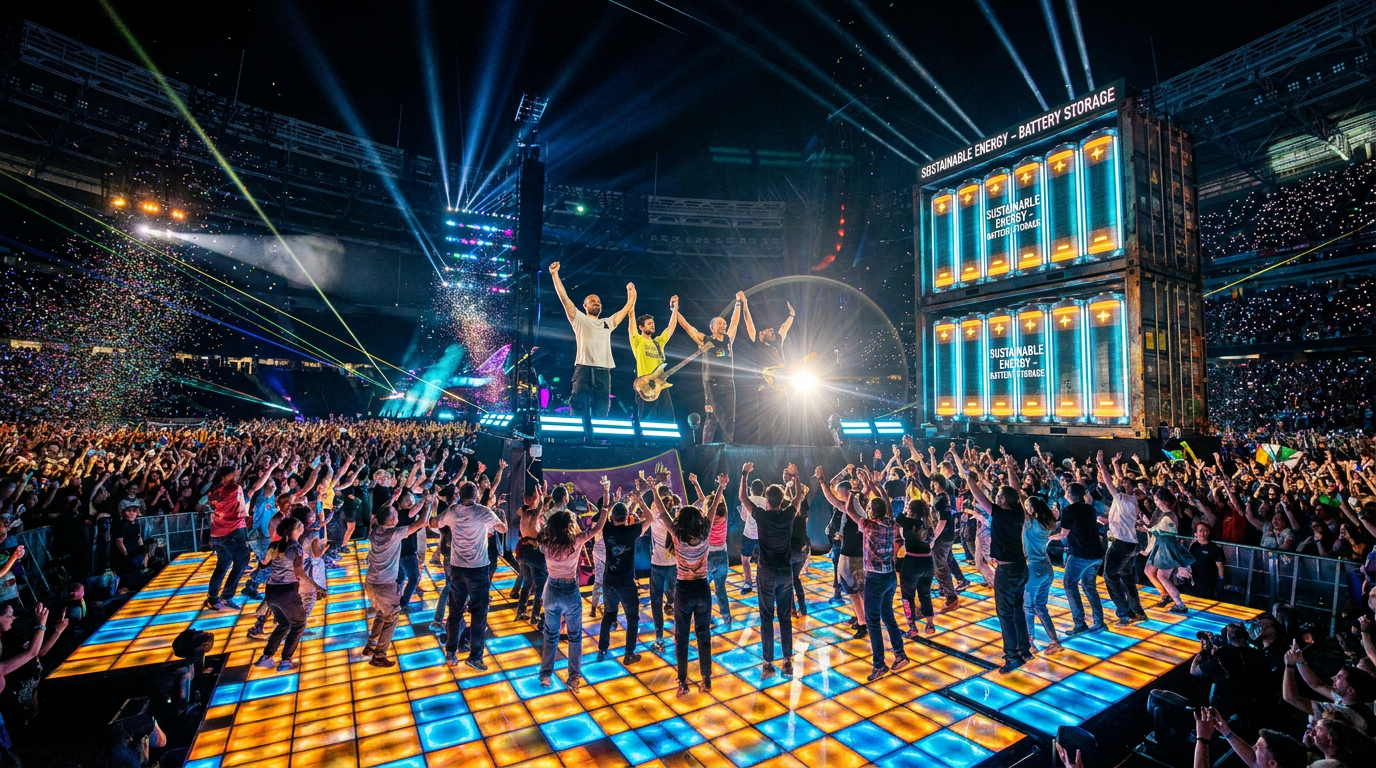
From kinetic dance floors that harvest crowd energy to 100% battery-powered stages, the live entertainment sector is rewriting the logistical rulebook to eliminate its massive carbon footprint.
By Factlen Editorial Team
- Sustainable Touring Advocates
- Argue that the live music industry must urgently decarbonize through structural changes, renewable energy, and fan engagement.
- Major Touring Artists
- Focus on leveraging their massive platforms and budgets to pilot new technologies like kinetic floors and battery-powered stages.
- Venue Operators
- Emphasize the need for standardized "Green Riders" and scalable infrastructure that balances environmental goals with economic realities.
What's not represented
- · Grassroots and Emerging Artists
- · Local Transit Authorities
Why this matters
The live music industry historically generated hundreds of thousands of tonnes of carbon emissions annually. By pioneering scalable green infrastructure—like mobile battery grids and sustainable transit—these mega-events are proving that massive cultural gatherings can thrive without accelerating the climate crisis.
Key points
- Major tours are deploying kinetic dance floors and stationary bikes to harvest electricity directly from the crowd.
- Venues are adopting the 'Green Rider,' a strict contract mandating plant-based food, LED lighting, and the elimination of single-use plastics.
- Massive Attack's 'Act 1.5' concert proved that a 100% battery-powered festival can reduce power emissions by 98 percent.
- To combat audience travel emissions, organizers are eliminating car parking in favor of free electric shuttle fleets and chartered trains.
The era of the diesel-guzzling mega-tour is rapidly coming to an end. As the 2026 summer touring season reaches its peak, the global live music industry is undergoing a massive, structural decarbonization effort. By turning fans into literal power sources, mandating strict environmental contracts, and rewriting the logistical rulebook of global travel, artists and promoters are proving that massive cultural celebrations no longer need to come at the expense of the climate. For decades, the live entertainment industry operated with a staggering environmental footprint. In the United Kingdom alone, the music sector historically generated roughly 540,000 tonnes of carbon dioxide equivalent annually, with the vast majority stemming directly from live shows. Pop-up festival cities relied heavily on diesel generators, while stadium tours required endless fleets of freight trucks and private jets to move equipment across continents.[6]
But the industry has rapidly moved past superficial greenwashing tactics, such as purchasing cheap carbon offsets, in favor of structural engineering. Artists, promoters, and venues are now collaborating to physically re-engineer how a concert operates from the ground up. Coldplay’s multi-year 'Music of the Spheres' world tour has served as a highly visible testing ground for these new technologies. The band pledged to cut their touring carbon emissions by 50 percent, introducing interactive elements that allow fans to literally help power the show. This shift represents a transition from individual environmental gestures to collective, scalable infrastructure that can be adopted by the wider entertainment sector.[1][9]
The centerpiece of this interactive effort is the deployment of kinetic dance floors. Designed by a specialized Dutch engineering firm, these custom floor tiles are constructed from recycled plastics and engineered to withstand the intense wear and tear of a global stadium tour. When fans jump and dance on the tiles, the downward physical movement is instantly converted into renewable electricity. This crowd-generated power is supplemented by banks of stationary bicycles, which fans can pedal before and during the concert to generate an average of 200 watts of energy per bike. The electricity harvested directly from the audience is then fed into the first-ever mobile, rechargeable show battery system, which was developed using recyclable components from BMW i3 electric vehicles.[1][2][3]

Combined with solar photovoltaic panels installed behind the stage and on top of massive speaker towers, this localized renewable grid captures enough energy to entirely power the tour's smaller secondary stages, as well as various audio-visual elements. The band also transitioned their freight trucks to run on Hydrotreated Vegetable Oil, a renewable biofuel derived from waste products like used cooking oil, which drastically cuts transit emissions. While stadium acts gamify energy production, the venues hosting them are implementing strict new operational standards to ensure the building itself is not a weak link in the sustainability chain.[1][3]
Major arenas have begun adopting the 'Green Rider,' a contractual blueprint that dictates exactly how visiting artists and promoters must manage their environmental impact while occupying the building. Historically, a tour rider was famous for demanding specific brands of water or eccentric dressing room snacks. Today, it serves as a legally binding environmental framework that forces touring crews to adhere to the host city's climate goals, standardizing sustainability across hundreds of different events a year.[4]
London's 20,000-capacity O2 Arena was among the first to launch a comprehensive Green Rider, establishing strict guidelines to reduce carbon dioxide emissions and mandate sustainable materials. These riders typically require the total elimination of single-use plastics backstage, the provision of locally sourced plant-based catering, and the use of energy-efficient LED lighting. Crucially, they also mandate the use of 'shore power' for touring vehicles, allowing massive freight trucks and tour buses to plug directly into the venue's electrical grid rather than idling their diesel engines in the loading docks for hours on end.[4][9]
Meanwhile, British trip-hop pioneers Massive Attack took an even more rigorous, scientifically grounded approach to decarbonization. The band hosted a massive outdoor concert in their hometown of Bristol, aptly named 'Act 1.5' in reference to the Paris Agreement's global warming limit, which was billed as the lowest-carbon show of its size ever staged. Rather than relying on off-the-shelf solutions, the band spent years analyzing their own supply chain to understand exactly where a live show bleeds the most carbon into the atmosphere.[5]
Meanwhile, British trip-hop pioneers Massive Attack took an even more rigorous, scientifically grounded approach to decarbonization.
The Bristol concert was the culmination of a multi-year partnership with the Tyndall Centre for Climate Change Research, which was commissioned to map out a comprehensive roadmap for super-low carbon live music. The resulting blueprint proved that a 100 percent battery-powered festival was entirely feasible, eliminating the need for temporary fossil-fuel generators that have long plagued outdoor events. The scientific findings from the Act 1.5 event were staggering. Compared to a standard outdoor live music event, the battery-powered concert achieved a 98 percent reduction in power emissions.[6][7]

The Tyndall Centre's analysis didn't stop at electricity. By serving an exclusively plant-based menu to the tens of thousands of attendees, the organizers successfully reduced catering-related emissions by 89 percent. Furthermore, the production team scrutinized the logistics of moving the stage itself, achieving a 70 percent reduction in equipment transport emissions by sourcing materials locally and utilizing electric freight vehicles wherever possible. It served as a definitive proof of concept that massive outdoor gatherings do not require massive carbon outputs.[6]
However, the most stubborn source of emissions for any live event isn't the stage lighting, the audio equipment, or the food—it is the audience. Fan travel typically accounts for the vast majority of a concert's total carbon footprint, presenting a complex logistical challenge that extends far beyond the venue gates. If 35,000 people all drive individual internal-combustion vehicles to a stadium, the environmental savings of a kinetic dance floor are quickly erased by the parking lot.[5][7]
To combat this, Massive Attack eliminated traditional car parking entirely for their Bristol event, forcing a radical rethink of how fans arrive at a show. Instead, the organizers chartered special post-show trains and provided a massive fleet of free electric shuttle buses to transport attendees to central transit hubs. By integrating the cost of sustainable transit directly into the ticketing ecosystem, they successfully reduced audience travel emissions by nearly a third, proving that fan behavior can be shifted when the right infrastructure is provided seamlessly and without friction.[6]

Financial models across the industry are also evolving rapidly to support this green transition. In Australia, the 'Solar Slice' initiative has gained widespread adoption by embedding a 1.5 percent surcharge into the booking fee of partner events. This micro-tax unlocks dedicated sustainability funding, directing capital to climate-impact agencies that help grassroots venues transition to low-carbon operations. This financial support is crucial, as smaller independent venues often lack the upfront capital to invest in solar arrays or high-capacity battery banks.[8]
Organizations like the Music Sustainability Alliance are stepping in to bridge this gap, providing unbiased research, scalable solutions, and shared vendor networks. By pooling resources and standardizing green practices, these alliances ensure that eco-conscious touring becomes a financial benefit rather than an operational burden for emerging artists. When an entire touring circuit agrees to use the same sustainable vendors and share battery infrastructure, the premium cost of green technology drops significantly, democratizing access for acts playing clubs rather than stadiums.[9]

The 2026 touring landscape demonstrates a profound shift in the entertainment economy, moving away from extractive practices and toward regenerative models. By turning fans into active participants in power generation and rewriting the logistical rulebook from the ground up, the live music industry is proving that cultural celebration and climate responsibility can seamlessly coexist. As kinetic dance floors, battery-powered stages, and strict Green Riders become the undisputed industry standard, the blueprint for a sustainable future is no longer just a theoretical concept—it is playing out live on stage, night after night, for millions of fans around the world.
How we got here
2021
The Tyndall Centre for Climate Change Research publishes a blueprint for climate-friendly concerts, commissioned by Massive Attack.
2022
Coldplay launches the 'Music of the Spheres' tour, introducing kinetic dance floors and stationary power bikes to stadiums worldwide.
Late 2023
London's O2 Arena introduces a comprehensive 'Green Rider,' setting a new sustainability blueprint for major indoor venues.
August 2024
Massive Attack hosts 'Act 1.5' in Bristol, a 100% battery-powered festival that achieves a 98% reduction in power emissions.
2026
Sustainable touring practices, including ticket surcharges for climate action and standardized green contracts, become mainstream across the global live music industry.
Viewpoints in depth
Sustainable Touring Advocates
Argue that the live music industry must urgently decarbonize through structural changes, renewable energy, and fan engagement.
Organizations like the Tyndall Centre and Green Music Australia emphasize that the live events sector can no longer rely on cheap carbon offsets to justify its massive footprint. They argue that true sustainability requires a fundamental re-engineering of how tours operate, from mandating 100% renewable grid power to overhauling audience transit. By treating festivals as 'pop-up cities,' they believe the industry can serve as a high-visibility testing ground for climate technologies that can eventually be scaled to other sectors.
Major Touring Artists
Focus on leveraging their massive platforms and budgets to pilot new technologies like kinetic floors and battery-powered stages.
Acts like Coldplay and Massive Attack view their global reach as a responsibility to force supply-chain changes. They argue that by demanding sustainable biofuels, kinetic energy harvesting, and plant-based catering, they create a financial incentive for vendors to develop green infrastructure. While acknowledging that these technologies are expensive to pilot, they believe that mega-tours must absorb the initial research and development costs so that the resulting innovations eventually become affordable for the rest of the industry.
Venue Operators
Emphasize the need for standardized 'Green Riders' and scalable infrastructure that balances environmental goals with economic realities.
Arena managers and festival promoters argue that sustainability initiatives must be standardized to be effective. They champion the 'Green Rider' as a way to align the expectations of hundreds of different touring acts with the venue's operational capabilities. For venue operators, the challenge lies in balancing the upfront capital required to install shore power and solar arrays with the relentless economic pressure of keeping their doors open, making industry-wide alliances and shared vendor networks essential for survival.
What we don't know
- Whether the premium costs of kinetic floors and mobile battery arrays will drop fast enough for smaller, independent venues to adopt them.
- How effectively the industry can decarbonize international air travel, which remains a stubborn necessity for global stadium tours.
Key terms
- Kinetic Dance Floor
- A specialized flooring system that harvests the physical energy of human movement and converts it into usable electricity.
- Green Rider
- An addendum to a performer's contract that specifies environmental and sustainability requirements for the venue hosting them.
- HVO Biofuel
- Hydrotreated Vegetable Oil, a renewable diesel alternative made from waste products like used cooking oil, which significantly lowers generator emissions.
- Scope 3 Emissions
- Indirect greenhouse gas emissions that occur in a company's value chain, which in live music primarily includes audience travel to and from the venue.
Frequently asked
How do kinetic dance floors generate electricity at concerts?
Custom floor tiles compress slightly when fans jump or dance on them, converting that physical kinetic energy into electricity that is instantly fed into the show's battery system.
What is a 'Green Rider' in the music industry?
A Green Rider is a set of contractual requirements between artists and venues that mandates eco-friendly practices, such as eliminating single-use plastics, providing plant-based catering, and using renewable energy.
How much of a concert's carbon footprint comes from the fans?
Audience travel is typically the largest single source of emissions for a live event, prompting organizers to offer free electric shuttles and partner with public transit to reduce car usage.
Sources
Source coverage
9 outlets
3 viewpoints surfaced









[1]CBC NewsMajor Touring Artists
Coldplay's eco-friendly tour will be partly powered by fans' dancing
Read on CBC News →[2]Energy FloorsSustainable Touring Advocates
Coldplay Music Of The Spheres World Tour
Read on Energy Floors →[3]Coldplay OfficialMajor Touring Artists
Sustainability Initiatives
Read on Coldplay Official →[4]Rolling Stone UKVenue Operators
The O2 Arena launches ‘Green Rider’ to reduce environmental impact of live music
Read on Rolling Stone UK →[5]The IndependentMajor Touring Artists
Massive Attack announce ‘lowest carbon show ever staged’
Read on The Independent →[6]Green QueenMajor Touring Artists
Massive Attack’s Act 1.5: The Blueprint for Low-Carbon Concerts
Read on Green Queen →[7]Tyndall Centre for Climate Change ResearchSustainable Touring Advocates
Super Low Carbon Live Music Roadmap
Read on Tyndall Centre for Climate Change Research →[8]Green Music AustraliaSustainable Touring Advocates
Green Music Australia Partners with FEAT. Live to Scale Sustainable Touring
Read on Green Music Australia →[9]PollstarVenue Operators
Sustainable Touring Resource Guide
Read on Pollstar →



Every angle. Every day.
Get entertainment stories with full source coverage and perspective breakdowns delivered to your inbox.