
The Science of Nutritional Psychiatry: How the Gut Microbiome Actively Shapes Mental Health
Emerging research proves that the digestive tract and the brain are in constant communication, establishing dietary interventions as a powerful, evidence-based treatment for clinical depression and anxiety.
By Factlen Editorial Team
- Nutritional Psychiatrists
- Advocates for integrating dietary interventions as a primary pillar of mental health care.
- Microbiome Researchers
- Focuses on the biochemical and physiological mechanisms linking the gut to the brain.
- Behavioral Nutritionists
- Emphasizes the psychological and autonomic aspects of eating, such as how mindful consumption improves gut motility.
What's not represented
- · Patients with severe eating disorders
- · Low-income communities facing food deserts
Why this matters
For decades, mental health treatment has focused almost exclusively on brain chemistry and psychological therapy. The discovery that dietary changes can actively treat clinical depression offers a powerful, accessible new tool for millions of people seeking to improve their mental well-being.
Key points
- The gut and brain communicate constantly via the vagus nerve and chemical messengers.
- The SMILES trial proved that a Mediterranean-style diet can induce clinical remission in depressed patients.
- 90% of the body's serotonin is synthesized in the digestive tract.
- Beneficial gut bacteria ferment dietary fiber into short-chain fatty acids that reduce neuroinflammation.
- Ultra-processed foods cause 'leaky gut,' allowing inflammatory compounds to reach the brain.
- Nutritional psychiatry is emerging as a powerful, side-effect-free adjunct to traditional mental health treatments.
For decades, the fields of psychiatry and gastroenterology operated in strict isolation. Mental health was treated as a condition of the brain, shaped by genetics, trauma, and neurochemistry, while the digestive system was viewed merely as a metabolic engine responsible for extracting calories.[8]
That paradigm is undergoing a radical shift. A wave of rigorous clinical research has established that the brain is not an isolated fortress. Instead, it is in constant, bidirectional communication with the trillions of microorganisms residing in the human digestive tract.[2][8]
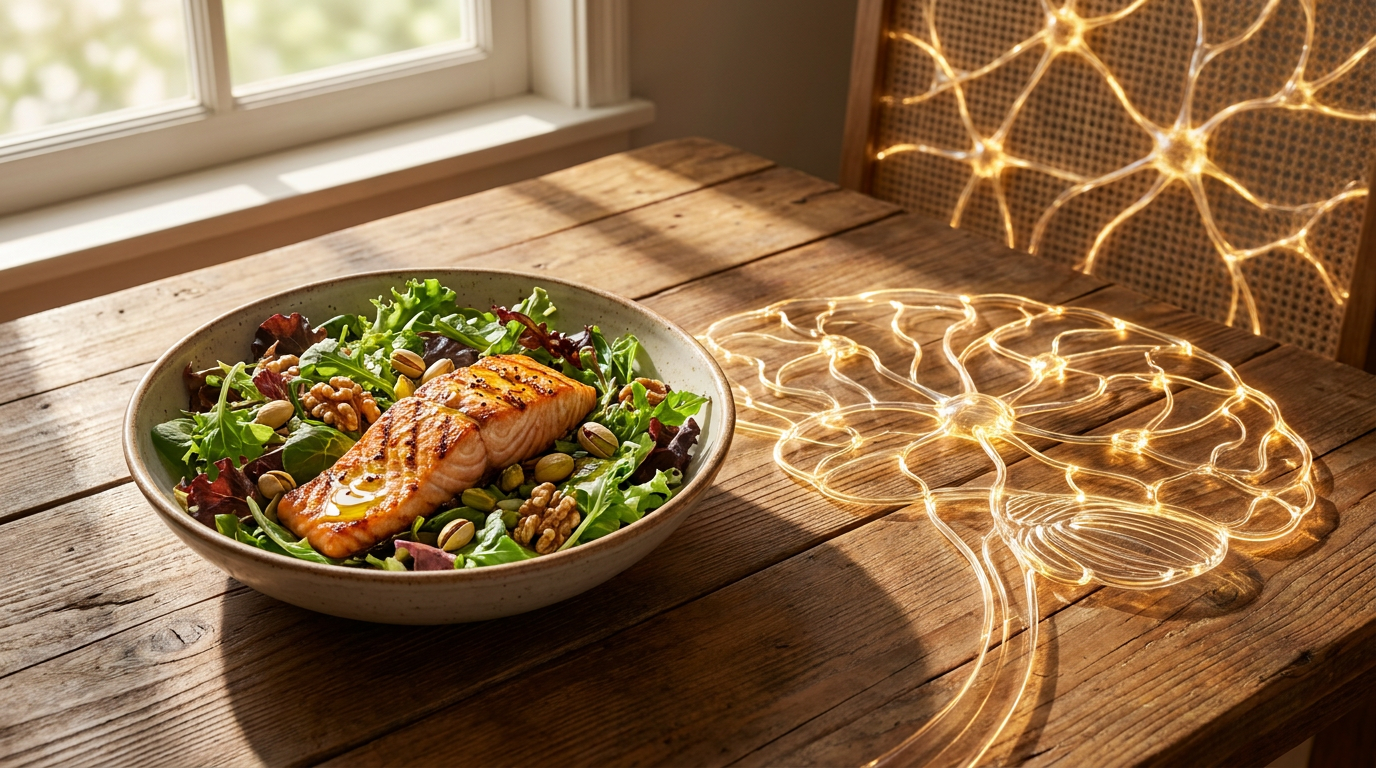
This realization has birthed the field of "nutritional psychiatry," a discipline built on the premise that food is not just fuel for the body, but active medicine for the mind. Rather than treating diet as a peripheral wellness tip, researchers are now proving that specific nutritional interventions can actively treat clinical mood disorders.[7]
The watershed moment for this field arrived with the publication of the SMILES (Supporting the Modification of lifestyle In Lowered Emotional States) trial. Prior to this study, the link between diet and depression was largely observational—researchers knew that people who ate poorly were more likely to be depressed, but they could not definitively prove causation.[1]
The SMILES trial changed that by applying the gold standard of medical research: a randomized controlled trial. Researchers took adults suffering from moderate to severe clinical depression and divided them into two groups. One group received standard social support, while the other underwent a clinical dietary intervention focused on a modified Mediterranean diet rich in whole grains, legumes, fresh produce, and olive oil.[1]
After 12 weeks, the results stunned the psychiatric community. The dietary intervention group experienced a 2.8-fold greater improvement in their depression scores compared to the control group. Most remarkably, 32% of the patients in the diet group achieved full clinical remission of their depression, compared to just 8% in the social support group.[1]

To understand how a bowl of lentils and spinach can rival the efficacy of a pharmaceutical antidepressant, scientists have mapped the "microbiota-gut-brain axis." This is the complex communication network that links the enteric nervous system of the gut with the central nervous system of the brain.[2][3]
The primary physical highway for this communication is the vagus nerve, a thick cable of neurons running directly from the brainstem to the abdomen. The gut microbiome continuously sends chemical signals up the vagus nerve, effectively updating the brain on the body's inflammatory and metabolic state.[4][6]
But the communication is not just electrical; it is heavily chemical. The gut microbiome acts as an endocrine organ, manufacturing many of the exact same neurotransmitters that the brain uses to regulate mood, focus, and reward.[3][6]

But the communication is not just electrical; it is heavily chemical.
The most striking example is serotonin, the neurotransmitter targeted by blockbuster antidepressant drugs like SSRIs. Approximately 90% of the body's serotonin is synthesized not in the brain, but in the gastrointestinal tract by enterochromaffin cells, a process heavily regulated by gut bacteria.[3]
Beyond neurotransmitters, the gut microbiome produces unique chemical messengers called short-chain fatty acids (SCFAs), including butyrate, acetate, and propionate. These SCFAs are created when beneficial gut bacteria ferment dietary fiber that the human body cannot digest on its own.[2][3]
SCFAs are neuroprotective powerhouses. They strengthen the gut barrier, regulate immune cell differentiation, and cross the blood-brain barrier to directly influence microglial cells—the brain's primary immune defenders—thereby reducing neuroinflammation.[2]
Conversely, a diet devoid of fiber and rich in ultra-processed foods, refined sugars, and saturated fats starves these beneficial bacteria. This leads to a state of "dysbiosis," where pathogenic microbes outnumber the beneficial ones, triggering a cascade of negative mental health effects.[3]
Dysbiosis degrades the intestinal lining, creating a condition commonly known as "leaky gut." This permeability allows lipopolysaccharides (LPS)—toxic structural components of harmful bacteria—to leak into the bloodstream. The immune system reacts to LPS with a systemic inflammatory response that travels to the brain, manifesting as brain fog, anxiety, and depressive symptoms.[3]

Recognizing this mechanism, researchers have coined the term "psychobiotics." Originally used to describe specific probiotic supplements that yield mental health benefits, the definition has expanded to include any intervention—including whole dietary patterns—that positively alters the microbiome to improve brain function.[2][6]
A psychobiotic diet is heavily plant-forward. It prioritizes high-fiber vegetables, legumes, and whole grains to maximize SCFA production. It also incorporates fermented foods like kefir, kimchi, sauerkraut, and kombucha, which introduce live, beneficial bacterial strains directly into the digestive ecosystem.[2][8]
Polyphenols, the micronutrients that give berries, dark chocolate, and extra virgin olive oil their rich colors, also play a crucial role. These compounds act as prebiotics, selectively feeding the specific bacterial strains most closely associated with stress resilience and cognitive clarity.[3]

The benefits of a psychobiotic approach extend beyond the plate to the act of eating itself. Emerging research into mindful eating shows that consuming food in a relaxed, parasympathetic state improves vagal tone, which in turn optimizes digestion and fosters a more diverse, resilient microbiome.[4]
Nutritional psychiatrists are careful to emphasize that dietary interventions are not a wholesale replacement for traditional psychiatric care. For patients in acute crisis, life-saving medications and psychotherapy remain the first line of defense.[1][7]
However, the evidence is now overwhelming that diet can no longer be ignored in the psychiatric clinic. By treating the gut microbiome as a modifiable target, nutritional psychiatry offers a powerful, side-effect-free adjunct to traditional treatments, empowering patients to literally feed their mental health.[2][8]
How we got here
2012
Researchers publish landmark papers establishing the concept of 'mind-altering microorganisms' and the gut-brain axis.
2015
The term 'psychobiotics' is coined to describe interventions that alter the microbiome for mental health benefits.
2017
The SMILES trial is published, providing the first randomized controlled evidence that diet can treat clinical depression.
2026
Nutritional psychiatry continues to gain mainstream traction, with 'food as medicine' approaches integrated into clinical care.
Viewpoints in depth
Nutritional Psychiatrists
Advocates for integrating dietary interventions as a primary pillar of mental health care.
This camp argues that the historical separation of psychiatry and gastroenterology has done a disservice to patients. Armed with data from randomized controlled trials like SMILES, nutritional psychiatrists believe that prescribing a high-fiber, Mediterranean-style diet should be as standard as prescribing an SSRI. They emphasize that food is not merely preventative wellness, but active, evidence-based medicine capable of inducing clinical remission in mood disorders.
Microbiome Researchers
Focuses on the biochemical and physiological mechanisms linking the gut to the brain.
For microbiologists and neuroscientists, the focus is on the literal pathways of communication. They study how short-chain fatty acids (SCFAs) cross the blood-brain barrier to reduce neuroinflammation, and how the vagus nerve transmits real-time updates from the intestinal tract to the brainstem. This camp cautions that while the clinical results are exciting, much work remains to map exactly which bacterial strains produce which neuroactive compounds, paving the way for targeted 'psychobiotic' supplements.
Conventional Psychiatrists
Maintains a cautious optimism while prioritizing established pharmacological and psychological therapies.
While acknowledging the robust emerging data on the gut-brain axis, conventional practitioners warn against viewing diet as a panacea. They emphasize that for patients in acute psychiatric distress or those with severe, treatment-resistant depression, traditional medications and cognitive behavioral therapy must remain the first line of defense. They welcome nutritional interventions as a powerful, side-effect-free adjunct, but stress that a patient cannot simply 'eat their way out' of a severe mental health crisis.
What we don't know
- Exactly which specific strains of gut bacteria are most responsible for producing mood-regulating neurotransmitters.
- How individual genetic differences and chronotypes affect a person's response to a psychobiotic diet.
- The precise long-term efficacy of dietary interventions compared head-to-head with modern SSRI medications over multiple years.
Key terms
- Gut-Brain Axis
- The bidirectional communication network that links the enteric nervous system of the gut with the central nervous system of the brain.
- Psychobiotics
- Interventions, including specific diets or probiotic supplements, that positively alter the gut microbiome to yield mental health benefits.
- Short-Chain Fatty Acids (SCFAs)
- Beneficial compounds produced when gut bacteria ferment dietary fiber, known for reducing inflammation and protecting brain health.
- Dysbiosis
- An imbalance in the gut microbiome where harmful bacteria outnumber beneficial ones, often leading to systemic inflammation.
- Vagus Nerve
- A major nerve running from the brainstem to the abdomen that serves as the primary physical highway for gut-brain communication.
Frequently asked
Can changing my diet cure clinical depression?
While diet alone is not considered a universal 'cure,' clinical trials have shown that structured dietary improvements can lead to full remission of depression in roughly a third of patients. It is highly effective as a standalone treatment for some, and a powerful adjunct to therapy and medication for others.
What exactly is a psychobiotic diet?
A psychobiotic diet is a way of eating designed to support brain health by feeding beneficial gut bacteria. It is rich in high-fiber vegetables, whole grains, legumes, and fermented foods like kefir and kimchi, while minimizing ultra-processed foods and refined sugars.
How long does it take for diet to affect mood?
While the gut microbiome can begin to shift its composition within just a few days of a dietary change, clinical trials like the SMILES study typically measure significant, sustained improvements in depressive symptoms over a 12-week period.
Sources
Source coverage
8 outlets
3 viewpoints surfaced








[1]BMC MedicineNutritional Psychiatrists
A randomised controlled trial of dietary improvement for adults with major depression (the 'SMILES' trial)
Read on BMC Medicine →[2]Annual Review of Food Science and TechnologyMicrobiome Researchers
From Fork to Feelings: How Foods Shape Mental Health via the Microbiota–Gut–Brain Axis
Read on Annual Review of Food Science and Technology →[3]NutrientsMicrobiome Researchers
Diet, Gut Microbiota, and Mental Health: A Narrative Review
Read on Nutrients →[4]Frontiers in NutritionBehavioral Nutritionists
Mindful eating as the next therapeutic frontier in nutritional psychiatry
Read on Frontiers in Nutrition →[5]CellMicrobiome Researchers
The gut microbiota mediates the anti-seizure effects of the ketogenic diet
Read on Cell →[6]Nature Reviews NeuroscienceMicrobiome Researchers
Mind-altering microorganisms: the impact of the gut microbiota on brain and behaviour
Read on Nature Reviews Neuroscience →[7]The Lancet PsychiatryNutritional Psychiatrists
Nutritional medicine as mainstream in psychiatry
Read on The Lancet Psychiatry →[8]Factlen Editorial TeamNutritional Psychiatrists
Synthesis by Factlen editorial team
Read on Factlen Editorial Team →

Every angle. Every day.
Get health stories with full source coverage and perspective breakdowns delivered to your inbox.