
How Hydrofoils Solved the Electric Boat Range Problem
By lifting hulls out of the water to eliminate drag, computer-stabilized hydrofoils are finally making long-range, high-speed electric boats a commercial reality.
By Factlen Editorial Team
- Marine Innovators
- Startups and engineers who view hydrofoiling as the only viable path to electrifying maritime transport.
- Urban Transit Authorities
- City planners focused on utilizing waterways to relieve road congestion without increasing emissions.
- Maritime Traditionalists
- Skeptics who caution that the fragility and complexity of foils make them unsuitable for many marine environments.
What's not represented
- · Commercial Fishermen
- · Marine Wildlife Conservationists
Why this matters
Maritime transport is a massive source of global emissions, but electrifying boats has historically been impossible due to the limited range of heavy batteries. Hydrofoiling bypasses this physics problem entirely, unlocking zero-emission coastal transit and drastically reducing the cost of operating urban ferries.
Key points
- Water's density creates immense drag, severely limiting the range of traditional electric boats.
- Hydrofoils act as underwater wings, lifting the hull out of the water and reducing friction by 80 percent.
- Modern hydrofoils use aerospace-grade software to adjust the wings 100 times per second for stability.
- The technology cuts operating costs by up to 90 percent compared to diesel ferries.
- Because they fly above the surface, hydrofoils generate virtually no wake, protecting shorelines.
- Vulnerability to floating debris remains a primary challenge for the technology.
The electrification of transportation has rapidly conquered roads and is making steady inroads into aviation, but it has repeatedly hit a literal wall at the water's edge. The fundamental problem is fluid dynamics: water is roughly 800 times denser than air. Pushing a solid object through that medium creates immense friction, which drains battery reserves at an alarming rate. For years, this physical reality forced marine engineers into a frustrating corner, limiting electric propulsion to slow-moving harbor cruisers or short-distance novelty vessels.[7]
The challenge of electrifying boats is defined by a vicious cycle of weight and drag. To make a traditional electric boat go faster or travel farther, engineers must install a larger battery pack. However, lithium-ion batteries are exceptionally heavy. Adding that mass pushes the boat's hull deeper into the water, which exponentially increases the hydrodynamic drag. To overcome that added drag, the boat requires even more power, which demands an even larger battery.[6][7]
Because of this compounding weight penalty, early electric speedboats were highly impractical. Pushing a conventional deep-V hull to a planing speed of 25 knots required so much continuous energy that the range often dropped to a mere handful of miles. This made electric power entirely unfeasible for commercial passenger ferries, long-distance recreational cruising, or coastal transport, leaving the maritime industry heavily reliant on polluting diesel engines.[6]
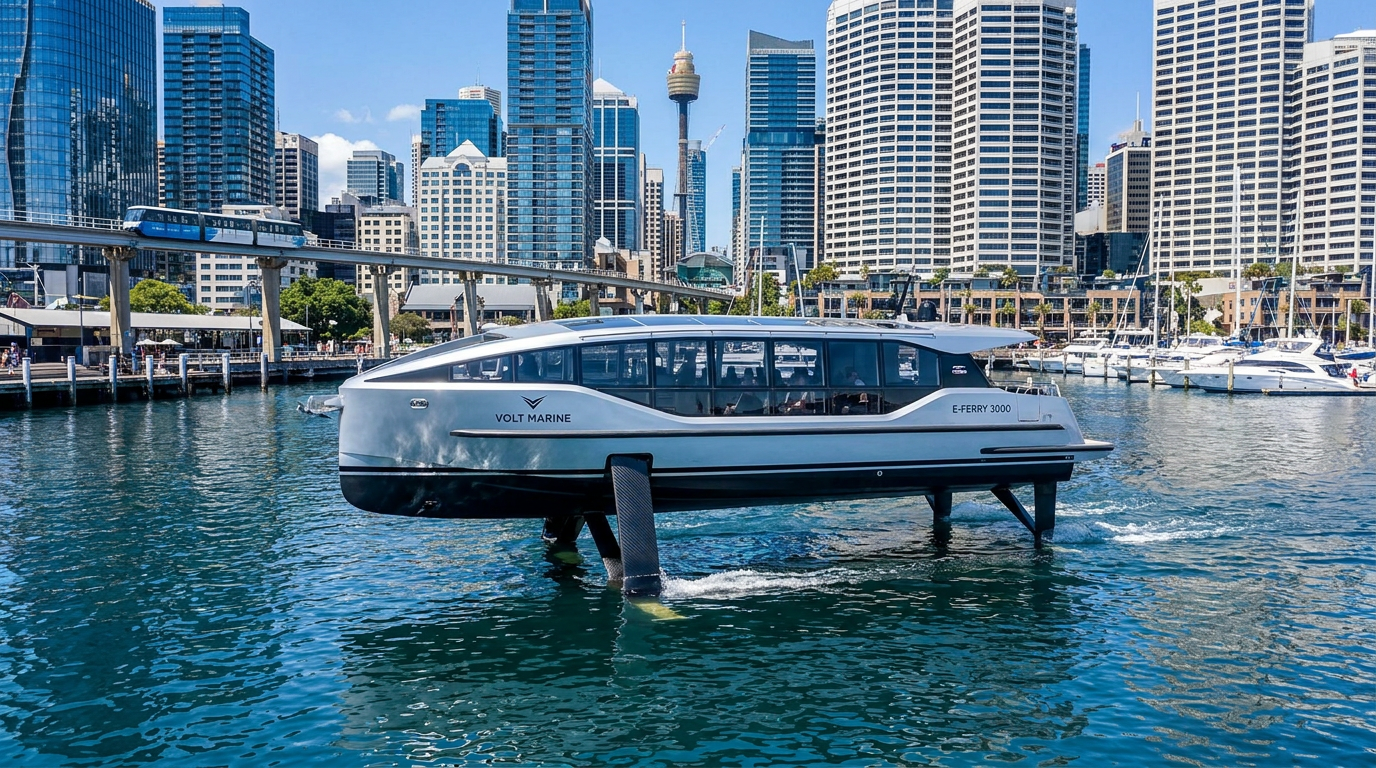
The solution to this physics problem did not come from a miraculous breakthrough in battery chemistry, but rather from removing the boat from the water entirely. Enter the electric hydrofoil, a technology that is currently rewriting the rules of maritime transport. By combining aerospace engineering with marine design, hydrofoiling is turning urban waterways into high-speed, zero-emission transit corridors and proving that long-range electric boating is finally possible.[2][7]
A hydrofoil is essentially an underwater wing attached to the hull by vertical struts. As the boat accelerates, water flows over the curved surface of the foil. According to Bernoulli's principle—the same fluid dynamics law that allows airplanes to fly—the water moving over the top of the curved wing travels faster than the water moving underneath it, creating a localized drop in pressure.[5][6]

This pressure difference generates a powerful upward thrust known as lift. Once the vessel reaches a critical takeoff speed, which typically hovers around 14 to 16 knots depending on the boat's weight, the lift generated by the underwater wings exceeds the total mass of the vessel. At this precise moment, the entire hull rises smoothly above the surface of the water.[5]
The second the hull clears the water, the physics governing the vessel fundamentally change. Hydrodynamic drag plummets by up to 80 percent. Instead of violently plowing through dense water and pushing heavy waves aside, the boat is effectively flying through the air, supported only by the slender carbon-fiber struts and wings gliding silently beneath the surface.[6]
The second the hull clears the water, the physics governing the vessel fundamentally change.
This drastic reduction in friction completely breaks the vicious cycle of electric boating. Because the vessel requires only a fraction of the energy to maintain its cruising speed, hydrofoil boats can achieve ranges of 50 nautical miles or more on relatively small, lightweight battery packs. The efficiency gains are so massive that they offset the energy density limitations of current lithium-ion technology.[2][6]
While the underlying concept of hydrofoils is not new—the first patents date back 160 years, and gas-turbine hydrofoil ferries were popular in the 1970s—early iterations were mechanically complex and notoriously unstable in rough water. The modern breakthrough relies not just on advanced carbon-fiber manufacturing, but on the integration of aerospace-grade software and high-speed sensors.[4][7]
Today's electric hydrofoils utilize active flight controllers that operate much like the fly-by-wire systems in modern fighter jets. Ultrasonic sensors continuously read the wave height ahead of the vessel, and onboard computers adjust the angle of attack of the underwater wings up to 100 times per second. This active stabilization allows the boat to fly perfectly level over choppy seas that would violently batter a traditional hull.[6][7]

The commercial viability of this technology reached a major tipping point in early 2026. Swedish manufacturer Candela, widely considered the pioneer of the space, officially launched the world's first electric hydrofoil ferry service in Stockholm. By deploying its 30-passenger P-12 vessel into the city's public transit network, the company proved that the technology could handle the rigorous demands of daily commuter schedules.[2][3]
The economics of foiling are proving highly attractive to municipal transit operators. Because the vessels use up to 80 percent less energy than conventional ships, and electricity is generally much cheaper than marine diesel, the overall operating costs can drop by as much as 90 percent. This allows cities to run smaller ferries more frequently, improving service without breaking municipal budgets.[4]

Furthermore, because the hull does not displace water at speed, hydrofoils generate virtually no wake. Traditional ferries are often forced to crawl at low speeds through urban canals to avoid damaging shorelines or moored vessels with their waves. Hydrofoils can maintain their 25-knot cruising speeds through these sensitive environments, drastically slashing commute times for passengers.[3][4]
The industry is now moving rapidly from pilot programs to scaled global production. In March 2026, Candela secured an additional €30 million in funding to build a second manufacturing facility in Poland. The company is currently working through a massive backlog of over 65 commercial ferry orders, with fleets destined for Mumbai, the Maldives, and Saudi Arabia's futuristic NEOM project.[1]

Despite the overwhelming momentum, the technology is not without its limitations and risks. The delicate underwater wings are highly vulnerable to floating debris, submerged logs, and marine life. A high-speed strike can severely damage the carbon-fiber foils, requiring expensive repairs and potentially stranding passengers, making them less suitable for rivers with heavy debris.[7]
Additionally, the complex engineering, active software systems, and aerospace-grade materials make these vessels significantly more expensive upfront than their fossil-fuel counterparts. Yet, as production scales and the technology matures, marine engineers are increasingly confident that hydrofoiling will become the standard for coastal and urban water transport, finally bringing the quiet, clean electric revolution to the sea.[1][7]
How we got here
1869
Emmanuel Farcot patents the first hydrofoil concept.
1970s
Boeing develops gas-turbine passenger hydrofoils, known as Jetfoils.
2019
Candela launches the C-7, the first electric hydrofoil leisure boat.
2024
The first P-12 commercial electric ferry enters pilot testing.
March 2026
Candela secures €30M to scale global ferry production.
Viewpoints in depth
Marine Innovators
Startups and engineers who view hydrofoiling as the only viable path to electrifying maritime transport.
This camp argues that traditional displacement hulls are a dead end for electric propulsion due to the inescapable physics of water drag. Companies like Candela and Vessev point to the 80 percent reduction in energy use as proof that foiling is not just a luxury feature, but a mandatory architectural shift. They believe that as software and carbon-fiber manufacturing scale, the upfront costs will plummet, making hydrofoils the default design for all coastal ferries and recreational boats within the next decade.
Urban Transit Authorities
City planners focused on utilizing waterways to relieve road congestion without increasing emissions.
For municipal operators, the appeal of electric hydrofoils lies in their lack of wake and low operating costs. Traditional diesel ferries are expensive to run and must travel slowly near shorelines to prevent their wakes from eroding banks or damaging infrastructure. Transit authorities view foiling vessels as a way to unlock 'blue highways'—running high-speed, zero-emission commuter routes that can compete with trains and cars on travel time, all while cutting fuel and maintenance budgets by up to 90 percent.
Maritime Traditionalists
Skeptics who caution that the fragility and complexity of foils make them unsuitable for many marine environments.
While acknowledging the efficiency gains, traditional boatbuilders and commercial operators highlight the severe vulnerability of underwater wings. They argue that oceans and rivers are unpredictable environments filled with submerged logs, floating trash, and marine life. A high-speed foil strike can cause catastrophic damage to the carbon-fiber struts, resulting in massive repair bills. Furthermore, they note that foiling requires a lightweight vessel, making the technology entirely unsuited for heavy cargo transport or commercial fishing, which will still require alternative fuels.
What we don't know
- How well carbon-fiber hydrofoils will hold up to decades of daily commercial use in debris-filled urban rivers.
- Whether battery energy density will eventually improve enough to make traditional electric hulls viable, rendering the complexity of foils unnecessary.
Key terms
- Hydrofoil
- An underwater wing that generates lift as it moves through the water, raising the boat's hull above the surface to reduce drag.
- Bernoulli's Principle
- A fluid dynamics principle stating that an increase in the speed of a fluid occurs simultaneously with a decrease in pressure, creating the lift needed for foiling.
- Angle of Attack
- The angle at which the hydrofoil meets the oncoming water, which determines the amount of lift generated.
- Flight Controller
- The computerized system that uses sensors to continuously adjust the hydrofoils, keeping the boat stable over waves.
Frequently asked
Why do electric boats have such limited range?
Water is incredibly dense, creating massive hydrodynamic drag. Pushing a traditional hull through water requires huge amounts of continuous energy, draining heavy batteries very quickly.
What happens if a hydrofoil hits a log?
Floating debris is a major risk. While some systems have breakaway mechanisms or reinforced leading edges, a high-speed strike can cause significant damage to the carbon-fiber foils.
Can hydrofoil boats operate in shallow water?
Most modern hydrofoils feature retractable struts, allowing the wings to be raised so the vessel can navigate shallow marinas and docks just like a traditional boat.
Do hydrofoils make people seasick?
Generally, no. Because the hull flies above the waves and the computer actively stabilizes the roll and pitch, the ride is remarkably smooth, reducing the motions that typically cause seasickness.
Sources
Source coverage
7 outlets
3 viewpoints surfaced







[1]ElectriveUrban Transit Authorities
E-boat manufacturer Candela secures €30 million from investors
Read on Electrive →[2]ElectrekMarine Innovators
Candela's hydrofoil ferry just rewrote the limits of electric boats
Read on Electrek →[3]PlugboatsMarine Innovators
World's 1st electric hydrofoil ferry service takes flight in Stockholm
Read on Plugboats →[4]Interesting EngineeringMaritime Traditionalists
How new developments could lead to greener, faster electric vessels
Read on Interesting Engineering →[5]MIT Department of Mechanical EngineeringMaritime Traditionalists
Detail of Hydrofoil Geometry and Fluid Dynamics
Read on MIT Department of Mechanical Engineering →[6]E-SurferMaritime Traditionalists
eFoil (Surfboard with motor) – The electric revolution
Read on E-Surfer →[7]Factlen Editorial Team
Synthesis by Factlen editorial team
Read on Factlen Editorial Team →
Every angle. Every day.
Get automotive stories with full source coverage and perspective breakdowns delivered to your inbox.