
How the Malaria Vaccine Rollout is Rewriting Child Survival in Africa
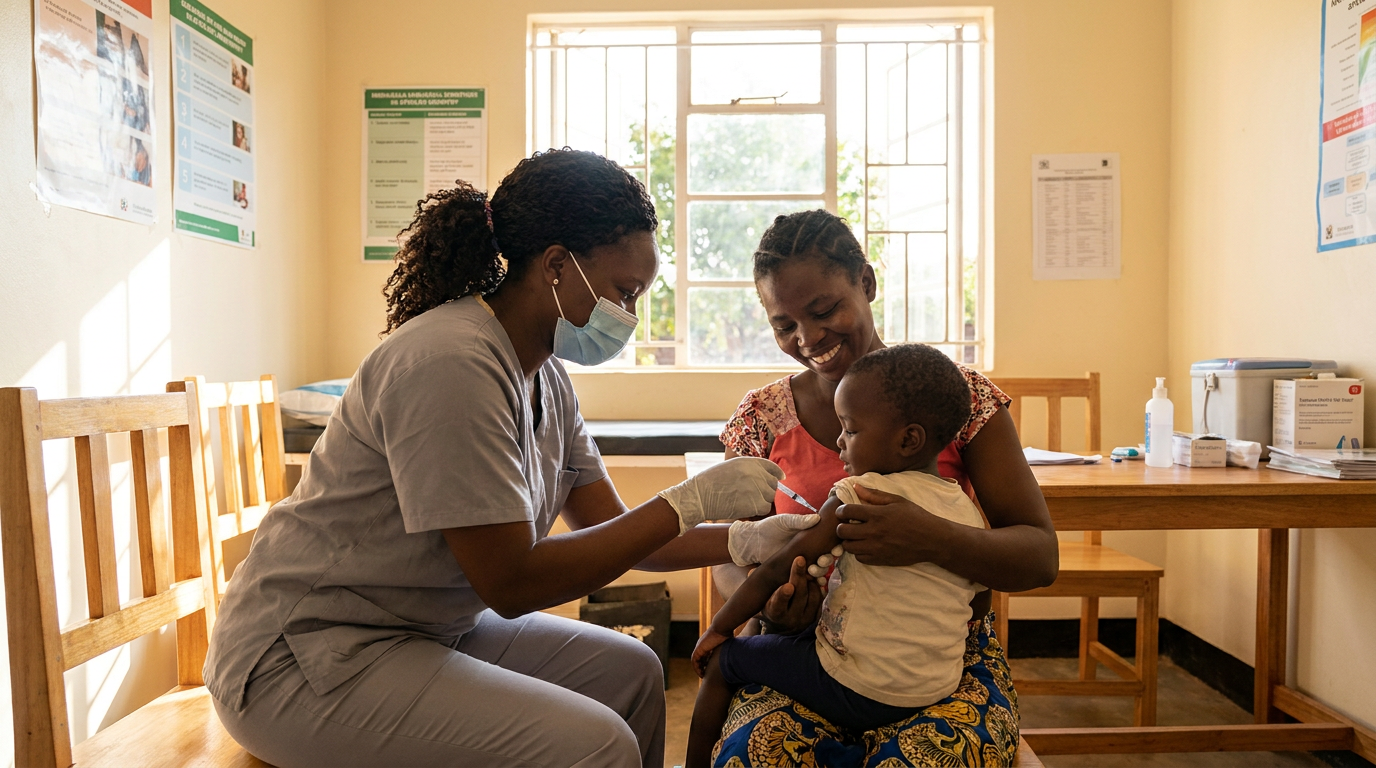
With over 50 million doses delivered across 25 countries, the rapid deployment of the RTS,S and R21 vaccines is driving historic drops in child mortality.
By Factlen Editorial Team
- Public Health Organizations
- Focus on aggressively scaling the vaccine rollout, securing international funding, and integrating immunizations with existing prevention tools.
- Frontline Medical Providers
- Emphasize the logistical realities and successes of reaching highly vulnerable populations in operationally complex settings.
- Vaccine Researchers
- Prioritize clinical efficacy data and the urgent need to develop next-generation, multi-stage vaccines to outpace parasite mutations.
What's not represented
- · Parents and families navigating the logistics of the four-dose schedule in remote areas.
- · Local health ministries balancing the costs of the vaccine against other pressing public health emergencies.
Why this matters
Malaria has been one of the deadliest diseases for children in sub-Saharan Africa for centuries. The successful scale-up of these vaccines proves that a preventable, treatable future is no longer just a scientific promise, but a logistical reality saving tens of thousands of lives right now.
Key points
- More than 50 million doses of malaria vaccines have been delivered across 25 African countries by early 2026.
- Burkina Faso reported a nearly 50% drop in malaria-related child deaths following its nationwide vaccine expansion.
- A landmark Lancet study confirmed the vaccine averted one in eight child deaths in early pilot countries.
- UNICEF secured a price cut to $2.99 per dose for the R21 vaccine, saving $90 million for further scale-up.
- Gavi aims to vaccinate 50 million more children by 2030, though a 30% funding shortfall threatens the timeline.
For decades, a vaccine against malaria was the holy grail of global health—a scientific puzzle that frustrated researchers while the disease claimed hundreds of thousands of young lives each year. Today, that narrative has fundamentally shifted. By the spring of 2026, the rollout of two approved malaria vaccines across Africa has become one of the fastest and most consequential public health interventions in modern history.[7]
More than 50 million doses of the RTS,S and R21/Matrix-M vaccines have now reached children in 25 African nations. Spearheaded by the World Health Organization, Gavi, and UNICEF, this deployment has transitioned from cautious pilot programs to massive, nationwide campaigns. The results emerging from these early adopters are not just promising; they are rewriting the actuarial tables of child survival.[1][2]
The sheer scale of the burden makes these interventions critical. In 2024, an estimated 438,000 African children died from the mosquito-borne disease. Malaria does not just take lives; it overwhelms clinics, drains household savings, and stunts economic growth. The introduction of a preventative vaccine, integrated with traditional tools like insecticide-treated bed nets, is proving to be a highly effective circuit breaker.[2]
To understand the breakthrough, it helps to look at the parasite itself. Plasmodium falciparum is a shape-shifting enemy. When an infected mosquito bites a human, it injects sporozoites into the bloodstream, which quickly travel to the liver to multiply. Both the RTS,S and the newer R21/Matrix-M vaccines are designed to target this initial stage.[1][6]

By training the child's immune system to recognize and attack the sporozoites before they can replicate in the liver and burst back into the blood, the vaccines prevent the onset of severe illness. The R21 vaccine, co-developed by the University of Oxford and the Serum Institute of India, utilizes Novavax's Matrix-M adjuvant to boost this immune response, achieving over 70% efficacy in preventing clinical cases during the first year when administered ahead of peak rainy seasons.[1][6]
Achieving this protection requires a rigorous schedule. Children must receive a primary series of three doses, followed by a fourth booster dose a year later to maintain immunity. While this four-dose regimen presents logistical challenges in remote areas, the real-world data confirms that the effort pays massive dividends.[1]
A landmark evaluation published in The Lancet in May 2026 provided the most definitive proof yet of the vaccines' impact. Analyzing data from the initial pilot programs in Ghana, Kenya, and Malawi between 2019 and 2023, researchers found that the vaccine averted approximately one in eight child deaths among eligible populations.[2][5]
As the rollout expanded beyond the pilot phase, country-wide data began to mirror these clinical findings. In Burkina Faso, the nationwide expansion of the vaccine contributed to a staggering 32% reduction in reported malaria cases between 2024 and 2025. Even more critically, malaria-related deaths among children under five fell by nearly 50% in the country.[1]

As the rollout expanded beyond the pilot phase, country-wide data began to mirror these clinical findings.
Cameroon, which became the first nation to launch the vaccine as part of its routine immunization program in early 2024, has reported similarly striking metrics. Data from the country's Expanded Programme on Immunization showed a 57% drop in malaria-linked deaths among children under five in vaccinating districts, alongside a 17% decrease in all-cause clinic consultations.[1]
These reductions alleviate an immense burden on fragile healthcare systems. In Burkina Faso alone, the Ministry of Health estimated that the drop in cases generated more than $26.6 million in savings from direct healthcare costs in a single year. Families are spared the devastating financial shock of hospitalizations, and clinics are freed up to treat other conditions.[1]
The success of the rollout is not limited to stable, accessible regions. In late 2025, Médecins Sans Frontières completed the first full round of the R21 vaccine in a refugee camp setting. Operating in the Kule refugee camp in Ethiopia's Gambella region—home to over 55,000 South Sudanese refugees—the organization successfully administered the four-dose regimen to 2,100 children under five.[4]
In environments like Kule, where malnutrition and overcrowding amplify the lethality of infectious diseases, the vaccine serves as a vital shield. Medical teams paired the immunization campaign with indoor residual spraying and preventative medications, demonstrating that even in the most operationally complex settings, comprehensive malaria prevention is achievable.[4]

Affordability has been a crucial driver of this rapid scale-up. In late 2025, UNICEF and Gavi secured a landmark agreement to lower the price of the R21 vaccine to $2.99 per dose. This price cut is projected to generate up to $90 million in savings over five years, allowing health ministries to fully vaccinate nearly 7 million additional children.[3]
Despite these monumental gains, the global health community is warning against complacency. Gavi has set an ambitious target to fully vaccinate 50 million more children between 2026 and 2030, a goal that could save an estimated 180,000 lives. However, the organization is currently navigating a 30% funding shortfall, forcing difficult prioritizations.[1]
Without sustained financial commitments from international donors, the momentum could stall. Lower-income countries are currently prioritized, but nations preparing to transition away from Gavi support face the risk of slowed rollouts. In an era where climate change is expanding the geographic range of malaria-carrying mosquitoes, any pause in deployment could invite a resurgence of the disease.[1]

Furthermore, researchers recognize that first-generation vaccines are not the final word in malaria eradication. Because the parasite mutates and adapts, scientists are already developing next-generation, multi-stage vaccines.[6]
In Burkina Faso, the University of Oxford and local research institutes initiated clinical trials in late 2025 to test a combined approach. By pairing the liver-stage R21 vaccine with experimental blood-stage candidates, researchers hope to attack the parasite at multiple points in its lifecycle, potentially offering near-total immunity.[6]
Until those next-generation tools arrive, the current vaccines remain the most powerful new weapons in the fight against malaria. They are not a standalone silver bullet—bed nets, rapid diagnostics, and antimalarial drugs remain essential—but they have fundamentally altered the battlefield.[2][7]
For the millions of parents who previously viewed every fever with dread, the arrival of the RTS,S and R21 vaccines offers something unprecedented: a tangible, working defense. As the rollout continues across the continent, it stands as a testament to what is possible when scientific innovation, political will, and global financing align to protect the most vulnerable.[7]
How we got here
2019
Pilot programs for the RTS,S malaria vaccine launch in Ghana, Kenya, and Malawi.
Oct 2023
The World Health Organization officially recommends the R21/Matrix-M vaccine for the prevention of malaria in children.
Jan 2024
Cameroon becomes the first country to launch the malaria vaccine as part of its routine national immunization program.
Nov 2025
UNICEF and Gavi secure an agreement to lower the price of the R21 vaccine to $2.99 per dose.
Dec 2025
Médecins Sans Frontières completes the first full vaccination round of R21 in a refugee camp in Ethiopia.
May 2026
A landmark Lancet study confirms the vaccine averted 1 in 8 child deaths in the initial pilot countries.
Viewpoints in depth
Public Health Organizations' view
They see the current 50-million-dose milestone as proof of concept but warn that funding shortfalls threaten future goals.
Global health bodies like the WHO, Gavi, and UNICEF celebrate the rapid deployment of the vaccine as a historic victory for child survival. However, they emphasize that the mission is far from complete. With Gavi currently facing a 30% funding shortfall, these organizations argue that sustained donor investment is critical to reaching the goal of vaccinating 50 million more children by 2030. They warn that any pause in the rollout could allow the disease to resurge, particularly as climate change expands the habitats of malaria-carrying mosquitoes.
Frontline Medical Providers' view
They highlight that the vaccine's true test is in fragile settings like refugee camps.
Organizations operating on the ground, such as Médecins Sans Frontières, focus on the logistical realities of the rollout. They point out that administering a four-dose regimen requires intense community outreach and robust supply chains, especially in operationally complex environments. Providers argue that while the vaccine is highly effective, it must be paired with traditional tools like indoor spraying and bed nets to fully protect children facing compounding threats like malnutrition and overcrowding.
Vaccine Researchers' view
Scientists caution that first-generation vaccines are not the endgame and push for multi-stage alternatives.
While researchers celebrate the 1-in-8 mortality reduction confirmed by recent Lancet evaluations, they remain focused on the parasite's ability to mutate and adapt. Scientists argue that the RTS,S and R21 vaccines, which only target the liver stage of the parasite, must eventually be replaced by next-generation tools. They are actively conducting clinical trials, such as those in Burkina Faso, to develop multi-stage vaccines that attack the parasite in both the liver and the bloodstream, aiming for near-total immunity.
What we don't know
- Whether international donors will close Gavi's 30% funding shortfall to ensure the rollout reaches its 2030 targets.
- How quickly next-generation, multi-stage vaccines currently in clinical trials will become available for public use.
- The long-term efficacy of the vaccines beyond the initial years following the fourth booster dose.
Key terms
- Sporozoite
- The infectious form of the malaria parasite that is injected into the human bloodstream by a mosquito bite.
- Adjuvant
- An ingredient used in some vaccines, like Matrix-M in the R21 vaccine, that helps create a stronger immune response in the patient.
- Plasmodium falciparum
- The deadliest species of malaria parasite, responsible for the vast majority of malaria infections and deaths in sub-Saharan Africa.
- First-generation vaccine
- The initial version of a vaccine approved for public use, which researchers often aim to improve upon with subsequent next-generation versions.
Frequently asked
What are the approved malaria vaccines?
The World Health Organization has prequalified two vaccines: RTS,S and the newer R21/Matrix-M. Both target the parasite in its early liver stage.
How effective are the vaccines?
Clinical trials and real-world data show the vaccines reduce clinical malaria cases by over 70% in the first year when given ahead of peak rainy seasons, and have cut child malaria deaths by up to 50% in countries like Burkina Faso.
How many doses are required?
Children need a primary series of three doses, followed by a fourth booster dose a year later to maintain high levels of immunity.
Is the vaccine replacing bed nets?
No. The vaccine is designed to be used alongside traditional prevention tools, including insecticide-treated bed nets and indoor residual spraying, for maximum protection.
Sources
Source coverage
7 outlets
3 viewpoints surfaced






[1]Gavi, the Vaccine AlliancePublic Health Organizations
Malaria vaccines deliver early impact across African nations
Read on Gavi, the Vaccine Alliance →[2]World Health OrganizationPublic Health Organizations
New evidence confirms malaria vaccine saves child lives and will have high impact in wider rollout
Read on World Health Organization →[3]UNICEFPublic Health Organizations
Gavi and UNICEF announce agreement to lower price of R21 malaria vaccine
Read on UNICEF →[4]Médecins Sans FrontièresFrontline Medical Providers
MSF completes first full round of R21 malaria vaccine in Ethiopia refugee camp
Read on Médecins Sans Frontières →[5]The LancetVaccine Researchers
Public health impact of the RTS,S malaria vaccine in Ghana, Kenya, and Malawi
Read on The Lancet →[6]European Vaccine InitiativeVaccine Researchers
Next-generation multi-stage malaria vaccine trials begin in Burkina Faso
Read on European Vaccine Initiative →[7]Factlen Editorial TeamVaccine Researchers
Synthesis by Factlen editorial team
Read on Factlen Editorial Team →
Every angle. Every day.
Get world stories with full source coverage and perspective breakdowns delivered to your inbox.