
How the 'Library of Things' and Repair Cafes Are Transforming Neighborhood Economies
A rapidly growing global movement is replacing individual ownership with community borrowing, saving residents millions while diverting massive amounts of waste from landfills.
By Factlen Editorial Team
- Circular Economy Advocates
- Focuses on the environmental necessity of reducing waste, combating extractive consumerism, and building sustainable sharing networks.
- Civic & Municipal Leaders
- Views sharing libraries as essential public infrastructure that improves community resilience, equity, and quality of life.
- Pragmatic Consumers & Analysts
- Highlights the immediate economic benefits of borrowing over buying, tracking inflation savings and repair data.
What's not represented
- · Traditional tool manufacturers and appliance retailers whose sales models rely on individual ownership.
- · Commercial rental companies that may face competition from subsidized community libraries.
Why this matters
As inflation keeps the cost of living high and e-waste accelerates climate concerns, these community hubs offer a practical, immediate way to save money, learn new skills, and reduce environmental impact.
Key points
- The 'Library of Things' movement allows communities to borrow expensive or rarely used items like tools and appliances instead of buying them.
- Over 3,600 Repair Cafes operate globally, pairing residents with volunteer coaches to fix broken goods and reduce e-waste.
- London's sharing network alone has saved its members an estimated £8.6 million and diverted 423 tonnes of waste from landfills.
- Traditional public libraries are rapidly adopting the model, transforming into neighborhood hubs for the circular economy.
- The movement combats inflation and urban isolation while challenging the environmental toll of one-click consumerism.
The era of frictionless, one-click consumerism is facing a quiet, neighborhood-level rebellion. As the ecological toll of mass production mounts and the cost of living remains elevated, a growing global movement is asking a simple but radical question: why buy what you can borrow? This shift in mindset is driving the rapid expansion of the "Library of Things" (LoT) and the companion "Repair Cafe" network, transforming how communities interact with the physical objects in their lives. By pooling resources, neighborhoods are proving that abundance doesn't have to mean individual ownership.[1][2]
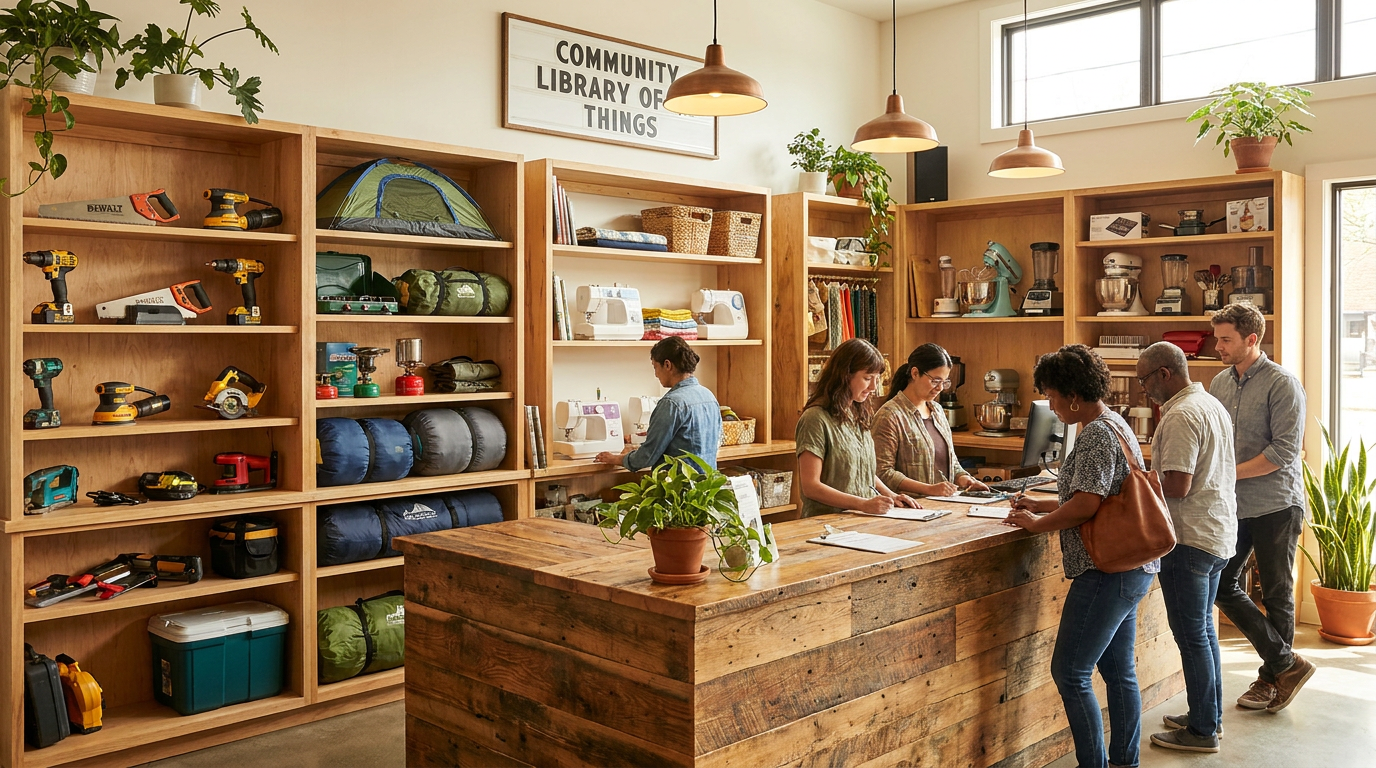
At the heart of this shift is the Library of Things, a community hub that operates on the traditional mechanics of a book library but pushes the boundaries of what can be checked out. Instead of novels and biographies, members borrow power drills, carpet cleaners, sewing machines, and camping gear—items that are typically expensive to purchase, cumbersome to store, and rarely used on a daily basis. The philosophy is simple: most people don't need a power drill; they just need a hole in the wall. By sharing the tool, the community saves money and space.[3][8]
The mechanism behind a modern Library of Things is increasingly sophisticated, blending grassroots community organizing with retail-grade logistics to make borrowing as easy as buying. Many hubs utilize specialized inventory software, such as MyTurn, to track maintenance schedules, manage reservations, and process liability waivers. In cities like London, the model has evolved to include self-serve smart lockers installed in shopping centers and transit hubs, allowing members to reserve a waffle maker or a pressure washer online and pick it up at their convenience without needing staff present.[1]
The economic argument for these libraries has become undeniable in the wake of recent inflationary pressures and rising household expenses. For a nominal borrowing fee—or often for free, depending on the municipal structure—residents can access high-quality tools that would otherwise cost hundreds of dollars to buy outright. According to its 2025 Impact Report, the London-based Library of Things network has saved its 34,000 members an estimated £8.6 million since its inception, proving that the sharing economy can provide tangible financial relief to working families.[2][4]

Beyond household savings, the environmental stakes of this movement are massive. The global economy currently adds billions of metric tons of waste to landfills annually, driven heavily by discarded electronics, cheap appliances, and fast fashion. By prioritizing access over ownership, sharing libraries directly disrupt this extractive cycle, ensuring that a single manufactured item serves dozens of households rather than gathering dust in one garage. In London alone, the LoT network reports diverting 423 tonnes of electrical waste from landfills by keeping shared items in continuous, active circulation.[2][4]
But borrowing is only half of the neighborhood circular economy; the other half is maintenance and longevity. This is where the rapidly expanding 'Repair Cafe' movement steps in to complement the lending libraries. Founded in Amsterdam in 2009, Repair Cafes are free, community-led pop-up events where people bring their broken belongings—from frayed textiles and wobbly chairs to malfunctioning toasters—to be fixed rather than thrown away. They serve as the triage centers for a society accustomed to treating manufactured goods as disposable.[2]
The defining feature of a Repair Cafe is its collaborative, educational mechanism. Visitors do not simply drop off a broken item and leave; they are expected to sit down at a workbench with a volunteer 'repair coach'—often a retired engineer, seamstress, or electrician—and actively participate in the fixing process. The goal is to transfer skills, demystify the inner workings of consumer electronics, and empower individuals to handle future repairs themselves, effectively breaking the cycle of dependency on manufacturers for replacements.[2]
The defining feature of a Repair Cafe is its collaborative, educational mechanism.
By 2025, the scale of this grassroots repair network has become staggering, evolving from a niche hobbyist pursuit into a coordinated global effort. Data collected by the Repair Cafe International Federation indicates there are now over 3,652 registered cafes operating worldwide, spanning from rural villages to major metropolitan centers. Global databases tracking the movement have logged more than 178,750 individual repair attempts, providing unprecedented, crowdsourced insight into the lifespan, durability, and common failure points of modern consumer goods.[5]

This wealth of data is actively being used to hold manufacturers accountable and push for systemic change. Dashboards built by organizations like the Farnham Repair Cafe in the UK track exactly which brands and product categories fail most often, and whether those failures are due to poor design or planned obsolescence. Vacuum cleaners, coffee makers, and household electrics consistently top the charts, highlighting the urgent need for 'Right to Repair' legislation and more durable product design that allows for easy disassembly and part replacement.[5]
While the economic and environmental metrics are easily quantified, the social impact of these hubs is equally profound, addressing the modern epidemic of loneliness. A recent impact survey by Circular Communities Scotland revealed that sharing libraries significantly boost local resilience and mental health among participants. Respondents noted that access to tools empowered them to improve their living conditions and take on new hobbies, while the communal aspect of the libraries and repair events provided a vital, welcoming antidote to urban isolation.[7]
Recognizing this immense civic value, traditional public libraries are rapidly integrating the 'Things' model into their core services, viewing it as a natural extension of their historical mission. Libraries have long served as the original blueprint for the circular economy, offering equitable, free access to shared resources and knowledge. Now, they are expanding their mandate beyond books and digital media to include physical tools, seeds, and maker spaces, cementing their role as the ultimate community resilience hubs.[1][8]
In Texas, the Amarillo Public Library recently launched its own Library of Things, utilizing municipal funding and philanthropic donations to offer patrons items ranging from automotive diagnostic scanners to knitting machines. Similarly, the City of Lake Oswego in Oregon reported that its Library of Things circulated over 7,100 items in a single year, operating alongside a highly successful seed-sharing library that encourages local food production. These municipal adoptions signal that the movement is moving from the activist fringe into mainstream civic infrastructure.[6][8]

The movement is also beginning to influence urban design and housing infrastructure, offering a new amenity model for developers. In Houston, Texas, the Connect Highstar Apartments development recently incorporated a dedicated Library of Things directly into its residential complex. Supported by organizations like Shareable, this integration demonstrates how resource-sharing can be baked into the built environment from day one, offering tangible benefits to residents while reducing the need for individual storage space in increasingly dense urban environments.[3]
Despite the rapid growth and widespread enthusiasm, scaling the circular economy presents distinct operational challenges that organizers must navigate. Running a sharing library is logistically complex, requiring dedicated physical space, rigorous safety testing for electrical items, and constant maintenance to ensure tools remain in safe, working order. Funding remains a persistent hurdle, as many independent hubs rely heavily on volunteer labor, community donations, and precarious grant cycles to keep their doors open and their inventories stocked with high-quality goods.[1][3]
Furthermore, the movement is fighting against deeply ingrained consumer habits and the sheer friction of changing behavior. Retail giants have spent decades optimizing the convenience of next-day delivery, making the act of buying a cheap replacement item the path of least resistance for most consumers. For sharing libraries to truly compete and achieve mass adoption, they must continue to refine their software, expand their automated locker networks, and make the act of borrowing just as frictionless and reliable as buying from an online mega-retailer.[1]

Ultimately, the rise of the Library of Things and Repair Cafes represents a profound shift in how communities define abundance and prosperity. By proving that a neighborhood can thrive on shared access rather than isolated ownership, these initiatives are laying the groundwork for a more resilient, sustainable, and connected future. As the movement continues to scale across cities and continents, it offers a hopeful blueprint for an economy that values the longevity of its goods and the strength of its local ties.[1][4]
How we got here
2009
The first official Repair Cafe is organized in Amsterdam, sparking a global movement focused on community-led fixing.
2014
The Library of Things concept gains significant traction in London, evolving from a grassroots experiment into a scalable model.
2024
The Library of Things Co-Lab trains over 250 organizers globally to launch and manage community resource-sharing spaces.
2025
The global Repair Cafe network surpasses 3,600 registered locations, logging hundreds of thousands of successful repairs.
2026
Traditional public libraries increasingly adopt the model, integrating tool lending and maker spaces into their core municipal services.
Viewpoints in depth
Circular Economy Advocates
Focuses on the environmental necessity of reducing waste and combating extractive consumerism.
For environmental organizers and sustainability advocates, the Library of Things is a direct counter-offensive against a global economy built on planned obsolescence. They argue that the current model of extractive consumerism—where raw materials are mined, manufactured into appliances, used sparingly, and then dumped in landfills—is ecologically disastrous. By prioritizing access over ownership, this camp believes communities can drastically reduce their carbon footprint and e-waste generation. They emphasize that true climate action must be accessible at the neighborhood level, making sustainable choices cheaper and more convenient than buying new.
Civic & Municipal Leaders
Views sharing libraries as essential public infrastructure that improves community resilience and equity.
Public library directors and city planners view the sharing economy through the lens of civic equity. To this camp, a Library of Things is a natural evolution of the traditional library's mandate: providing free or low-cost access to resources that elevate the community's quality of life. They highlight how lending tools, medical equipment, or internet hotspots bridges the gap for low-income residents who cannot afford expensive hardware. Furthermore, municipal leaders see these hubs as vital social infrastructure that fosters neighborly connection, reduces urban isolation, and builds community resilience in the face of economic downturns.
Pragmatic Consumers & Analysts
Highlights the immediate economic benefits of borrowing over buying and the value of repair data.
For economic analysts and everyday consumers, the appeal of the movement is highly practical. Amidst persistent inflation and rising costs of living, borrowing a $300 carpet cleaner for a few dollars simply makes financial sense. This camp is highly focused on the data generated by these interactions—tracking exactly how much money is saved and which consumer brands fail most frequently. They argue that the success of Repair Cafes and sharing libraries proves there is massive consumer demand for durable, repairable goods, and they use this data to push for broader 'Right to Repair' legislation.
What we don't know
- How sharing libraries will secure long-term, sustainable funding beyond initial grants and volunteer labor.
- Whether major retail and manufacturing corporations will adapt their business models in response to the growing demand for repairable, shared goods.
- How liability and insurance regulations might evolve as municipalities scale up the lending of high-risk items like power tools.
Key terms
- Library of Things (LoT)
- A community-run hub or public library extension where people can borrow rarely used physical items—like tools, appliances, and camping gear—instead of buying them.
- Circular Economy
- An economic system aimed at eliminating waste and the continual use of resources by prioritizing sharing, repairing, refurbishing, and recycling.
- Repair Cafe
- A free, community-led pop-up event where volunteers help residents fix broken household items to prevent them from ending up in landfills.
- Right to Repair
- A legislative movement advocating for consumers' ability to repair their own electronic devices and appliances, requiring manufacturers to provide parts and manuals.
Frequently asked
How much does it cost to use a Library of Things?
Costs vary by location. Many public libraries offer items for free to cardholders, while independent community hubs may charge a small sliding-scale membership fee or a nominal per-item rental cost.
What are the most common items borrowed?
The most popular items are typically expensive, bulky, or rarely used tools, such as power drills, carpet cleaners, sewing machines, pressure washers, and camping equipment.
Do I drop off my broken items at a Repair Cafe?
No. Repair Cafes are collaborative spaces. You are expected to stay with the volunteer 'repair coach' and participate in fixing the item so you can learn the skill yourself.
What happens if a borrowed item breaks?
Most libraries expect normal wear and tear and handle routine maintenance themselves. Users are typically only held responsible if an item is lost or intentionally damaged, often managed through a liability waiver.
Sources
Source coverage
8 outlets
3 viewpoints surfaced








[1]The New ClimateCircular Economy Advocates
The Circular Economy Has Arrived: it's called 'The Library of Things'
Read on The New Climate →[2]The HustlePragmatic Consumers & Analysts
The repair revolution
Read on The Hustle →[3]ShareableCircular Economy Advocates
Library of Things
Read on Shareable →[4]Library of Things LondonCircular Economy Advocates
2025 London Impact Report
Read on Library of Things London →[5]ResearchGatePragmatic Consumers & Analysts
Repair Cafes: A Case Study in Data Collection and Analysis
Read on ResearchGate →[6]City of Lake OswegoCivic & Municipal Leaders
Library Strategic Plan 2024-2026
Read on City of Lake Oswego →[7]Circular Communities ScotlandCircular Economy Advocates
Sharing Library Impact Survey Report
Read on Circular Communities Scotland →[8]Amarillo Public LibraryCivic & Municipal Leaders
Library of Things Coming Soon
Read on Amarillo Public Library →

More in culture
See all 32 stories →Art Conservation
Unveiling the Invisible: How AI and Macro-X-Ray Tech Are Rewriting Art History
6 sources
Digital Gardening
The Rise of the 'Slow Web': How Digital Gardening is Saving Internet Culture
8 sources

Solarpunk Movement
The Rise of Solarpunk: How Literature is Trading Dystopia for Climate Optimism
6 sources

Web Trust
The End of the 'Is It Real?' Era: How C2PA is Fixing the Internet's Trust Problem
7 sources

Every angle. Every day.
Get culture stories with full source coverage and perspective breakdowns delivered to your inbox.