
How the Historic Rollout of Two Malaria Vaccines is Reshaping Child Survival in Africa
With 25 countries now administering the RTS,S and R21 vaccines, new data confirms a 13% drop in child mortality, marking a turning point against one of the continent's deadliest diseases.
By Factlen Editorial Team
- Public Health Officials
- Emphasize the proven 13% drop in child mortality and the importance of integrating vaccines with existing tools like bed nets.
- Global Health Financiers
- Focus on the economics of the rollout, celebrating the price cuts that allow millions more doses to be purchased.
- Implementation Researchers
- Prioritize the logistical challenges of ensuring children receive all four doses and tracking real-world safety data.
What's not represented
- · Parents in remote rural areas navigating the logistical challenges of returning to clinics for multiple doses.
- · Local African pharmaceutical manufacturers aiming to produce the vaccines domestically.
Why this matters
Malaria kills over 400,000 African children annually. The successful integration of these vaccines into routine immunization is proving that the disease's devastating toll is preventable, offering a blueprint for large-scale public health victories.
Key points
- As of mid-2026, 25 African countries have integrated malaria vaccines into their routine childhood immunization programs.
- A landmark Lancet study confirms the vaccines have reduced all-cause child mortality by 13% in pilot regions.
- The rollout utilizes two WHO-approved vaccines, RTS,S and R21, which target the deadly Plasmodium falciparum parasite.
- A recent 25% price cut for the R21 vaccine will allow health agencies to procure 30 million additional doses.
- Health ministries are deploying the vaccines alongside traditional tools like insecticide-treated nets to maximize protection.
For decades, malaria has stood as one of the most intractable public health crises on the African continent, claiming the lives of hundreds of thousands of young children every year. In 2024 alone, the mosquito-borne disease killed an estimated 438,000 African children, a staggering toll that has long frustrated global health experts.[1]
But the landscape of global health is undergoing a seismic shift. As of mid-2026, 25 African nations have successfully integrated malaria vaccines into their routine childhood immunization programs, delivering over 39 million doses to the continent's most vulnerable populations.[2]
This unprecedented rollout relies on two World Health Organization-approved vaccines: RTS,S (marketed as Mosquirix) and the newer R21/Matrix-M. Both target Plasmodium falciparum, the deadliest malaria parasite globally and the species responsible for the vast majority of infections across Sub-Saharan Africa.[1][2]
The arrival of the R21 vaccine in late 2023 was a critical turning point. While RTS,S proved the concept and paved the way, its complex manufacturing process left it in chronically short supply. R21, developed by the University of Oxford, is easier to produce at scale, effectively closing the gap between soaring demand and limited global supply.[6][9]

The real-world impact of these vaccines is no longer theoretical. A rigorous evaluation published in The Lancet in May 2026 analyzed data from the initial pilot programs in Ghana, Kenya, and Malawi. The findings confirmed a 13% reduction in all-cause child mortality among those eligible for the vaccine.[1][4]
That 13% drop translates to roughly one in eight child deaths averted over the four-year study period. Crucially, the researchers noted that hospital admissions for severe malaria—which often lead to lifelong neurological complications even when children survive—fell by a staggering 22%.[4]
Dr. Kate O'Brien, the WHO's Director of Immunization, Vaccines and Biologicals, called the findings very solid evidence of the potential for malaria vaccines to change the trajectory of child mortality in Africa. The mortality benefit held equally for both boys and girls, with no significant safety signals detected during the evaluation.[1][4]

The mortality benefit held equally for both boys and girls, with no significant safety signals detected during the evaluation.
The rollout's acceleration through 2025 and 2026 has been fueled by aggressive price negotiations and coordinated international funding. In late 2025, Gavi, the Vaccine Alliance, alongside UNICEF, secured a 25% price reduction for the R21 vaccine, bringing the cost down from $4.00 to $2.99 per dose.[6]
This price cut is expected to free up enough capital to procure an additional 30 million doses by 2030, potentially protecting up to seven million more children. Gavi's overarching goal is to fully immunize 50 million children with the required four-dose regimen between 2026 and 2030.[2][6]
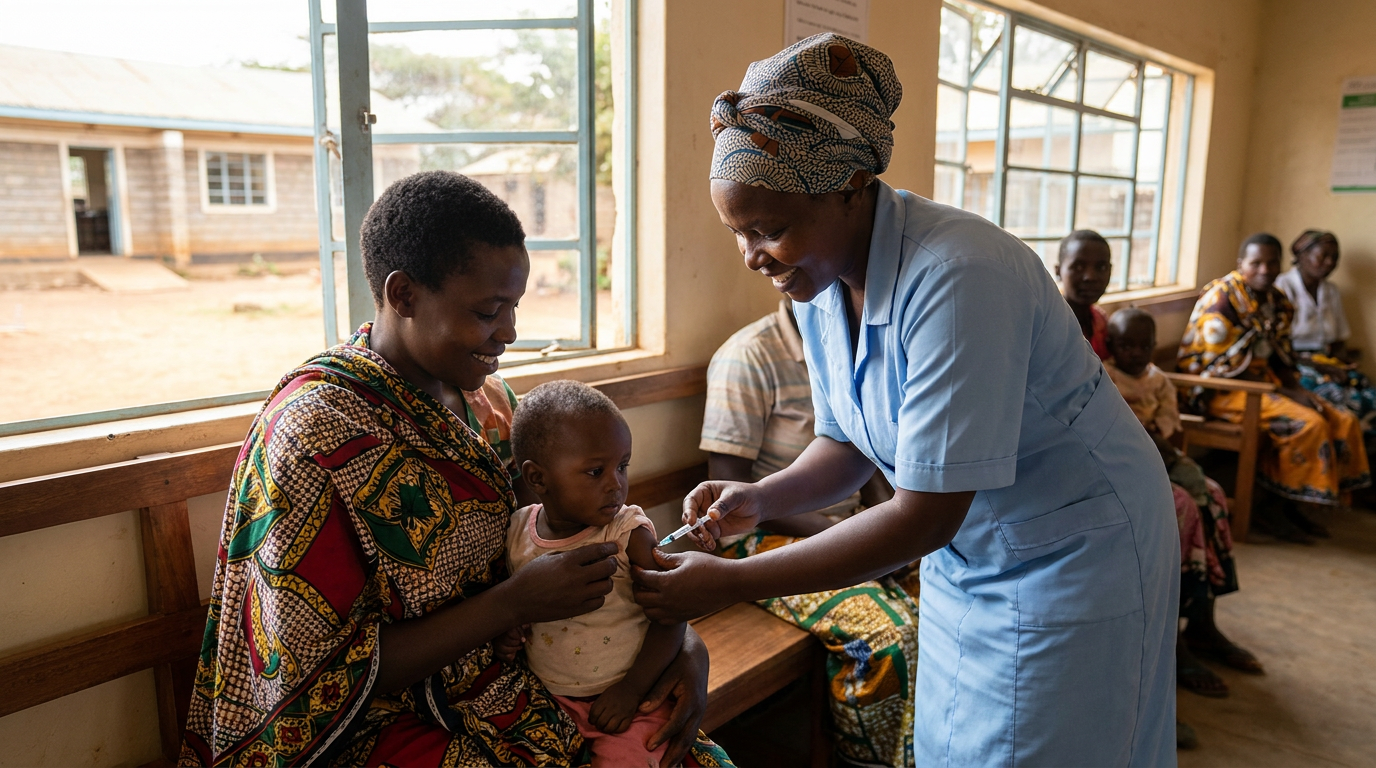
Administering the vaccine requires a sustained logistical effort. The standard regimen involves four doses given at specific intervals—often at 6, 7, 8, and 18 months of age. Ensuring parents return to clinics for the third and fourth doses remains one of the primary operational hurdles for health ministries.[3][7]
To overcome this, countries are launching massive, highly coordinated campaigns. In March 2025, Uganda initiated the continent's largest single rollout to date, distributing 2.27 million doses of the R21 vaccine across 105 districts, targeting 1.1 million children under the age of two.[3]
Other nations are pioneering integrated delivery models. When Ethiopia became the 23rd country to introduce the vaccine in late 2025, it paired the rollout with the distribution of over 12 million insecticide-treated mosquito nets, creating a powerful two-pronged defense in 58 high-burden districts.[5]

Public health officials stress that the vaccine is not a silver bullet meant to replace existing tools. Instead, it adds a vital new layer of protection, particularly in regions where mosquitoes have developed resistance to standard insecticides and the parasite has mutated to evade traditional antimalarial drugs.[6][9]
The Africa Centres for Disease Control and Prevention (Africa CDC) has also stepped up to ensure the rollout is safe and sustainable. Leveraging infrastructure built during the COVID-19 pandemic, the agency is funding robust pharmacovigilance systems to monitor vaccine safety and track adverse events in real-time.[8]
Organizations like the Sabin Vaccine Institute are simultaneously conducting implementation research in countries like Kenya and Liberia to identify the best ways to integrate malaria shots with other routine child health services, ensuring that every clinic visit maximizes a child's protective coverage.[7]
As the rollout expands to more remote communities in 2026, the focus is shifting from procurement to hyper-local delivery. Health ministries are testing cold-chain supply limits and working with community leaders to build trust and ensure high uptake of the full four-dose schedule.[6][8]

For families living in high-risk zones—from the rural villages of Zambia to the densely populated districts of Nigeria—the arrival of these vaccines represents a tangible shift. Each shipment of vials means fewer nights of anxiety and a mathematically higher probability that their children will live to see their fifth birthdays.[6][9]
How we got here
2021
The WHO officially recommends the widespread use of RTS,S, the world's first malaria vaccine.
Oct 2023
The WHO endorses R21/Matrix-M, a second vaccine that is cheaper and easier to manufacture at scale.
2024
Fourteen African nations introduce the vaccines into their routine childhood immunization programs.
Mar 2025
Uganda launches the continent's largest single rollout, distributing over 2.2 million doses.
May 2026
A landmark Lancet study confirms the vaccines have reduced all-cause child mortality by 13% in pilot countries.
Viewpoints in depth
Public Health Officials
Emphasizing the proven mortality drop and the necessity of an integrated approach.
For global health authorities, the primary victory lies in the hard data. The confirmed 13% drop in all-cause child mortality proves that the vaccines work in real-world, imperfect conditions. However, officials stress that these vaccines cannot stand alone; they are designed to complement, not replace, insecticide-treated nets and indoor spraying, forming a multi-layered defense against the parasite.
Global Health Financiers
Focusing on the economics of vaccine procurement and long-term supply sustainability.
Organizations like Gavi and UNICEF view the rollout through the lens of supply and demand. The recent 25% price reduction for the R21 vaccine is seen as a massive breakthrough, stretching limited donor funds to cover millions of additional children. Their ongoing challenge is securing the billions of dollars required to maintain this momentum and hit the target of 50 million fully immunized children by 2030.
Implementation Researchers
Prioritizing the logistical realities of delivering a four-dose regimen in low-resource settings.
Researchers and frontline organizations are focused on the 'last mile' of delivery. Because the vaccine requires four doses—with the final dose given at 18 months, when parents are less likely to bring healthy toddlers to clinics—researchers are testing new ways to bundle the malaria shot with other routine health interventions. They argue that the vaccine's ultimate success depends entirely on community trust and robust tracking systems.
What we don't know
- Whether health ministries can successfully ensure high compliance for the crucial fourth dose, which is administered at 18 months when routine clinic visits are less frequent.
- How long the protective immunity from the four-dose regimen will ultimately last as these children grow into adolescence.
- The exact timeline for when local African manufacturing facilities will be able to produce the R21 vaccine independently.
Key terms
- Plasmodium falciparum
- The deadliest species of malaria-causing parasite globally, and the one responsible for the vast majority of malaria cases and deaths in Africa.
- R21/Matrix-M
- The second malaria vaccine approved by the WHO, developed by Oxford University, noted for being highly effective and easier to manufacture at scale.
- Pharmacovigilance
- The scientific process of monitoring, detecting, and preventing adverse effects or other drug-related problems after a vaccine or medicine has been rolled out.
- Gavi, the Vaccine Alliance
- An international global health partnership that negotiates vaccine prices and helps fund immunizations for children in lower-income countries.
Frequently asked
How effective are the new malaria vaccines?
Both the RTS,S and R21 vaccines reduce clinical malaria cases by over 50% in the first year and have been proven to cut all-cause child mortality by 13% when deployed in real-world settings.
Why are there two different malaria vaccines?
RTS,S was the first to be approved, but complex manufacturing limited its supply. The newer R21 vaccine is easier and cheaper to produce at scale, ensuring enough doses for the entire continent.
Does the vaccine replace mosquito nets?
No. Health officials emphasize an integrated approach; the vaccine is most effective when used alongside insecticide-treated nets and indoor spraying.
How many doses does a child need?
The standard regimen requires four doses, typically administered at 6, 7, 8, and 18 months of age to ensure long-lasting protection.
Sources
Source coverage
9 outlets
3 viewpoints surfaced







[1]World Health OrganizationPublic Health Officials
New evidence confirms malaria vaccine saves child lives and will have high impact in wider rollout
Read on World Health Organization →[2]Gavi, the Vaccine AllianceGlobal Health Financiers
Malaria vaccine support
Read on Gavi, the Vaccine Alliance →[3]NatureImplementation Researchers
Africa launches historic malaria vaccine rollout amid funding uncertainty
Read on Nature →[4]The LancetPublic Health Officials
Major study confirms impact of the malaria vaccine, saving lives and reducing hospitalisations
Read on The Lancet →[5]Malaria ConsortiumImplementation Researchers
Ethiopia becomes the 23rd country in Africa to roll out the malaria vaccine
Read on Malaria Consortium →[6]InAfrikaGlobal Health Financiers
Africa Malaria Vaccine Rollout 2025 Reaches 24 Countries
Read on InAfrika →[7]Sabin Vaccine InstituteImplementation Researchers
Accelerating Malaria Vaccine Uptake
Read on Sabin Vaccine Institute →[8]PubMed CentralImplementation Researchers
Malaria vaccine rollout begins in Africa: the need to strengthen regulatory and safety surveillance systems
Read on PubMed Central →[9]Factlen Editorial TeamPublic Health Officials
Synthesis by Factlen editorial team
Read on Factlen Editorial Team →
Every angle. Every day.
Get world stories with full source coverage and perspective breakdowns delivered to your inbox.