
How Small Language Models Are Bringing AI Directly to Your Phone
Tech giants are shrinking artificial intelligence into 'Small Language Models' that run entirely on smartphones. The shift promises faster responses, zero subscription fees, and absolute data privacy by keeping processing off the cloud.
By Factlen Editorial Team
- Privacy & Edge Advocates
- Focus on data sovereignty, offline access, and the elimination of cloud dependency.
- Mobile Ecosystem Developers
- Focus on the economic and integration benefits of local AI APIs.
- Cloud AI Proponents
- Argue that frontier models in the cloud will always be necessary for complex reasoning.
What's not represented
- · Hardware Manufacturers (Chipmakers)
Why this matters
By moving AI processing from corporate cloud servers directly to your personal device, you gain absolute data privacy and offline access. It also frees app developers from expensive AI subscription fees, meaning smarter apps for users without the premium price tag.
Key points
- Small Language Models (SLMs) are compact AI systems designed to run locally on consumer devices.
- By processing data on the phone, SLMs offer absolute privacy and offline functionality.
- Techniques like high-quality training data and quantization allow these models to punch above their weight.
- Tech giants are adopting hybrid approaches, using local models for daily tasks and cloud models for complex reasoning.
For the past three years, the artificial intelligence revolution has been defined by massive scale. Frontier models like GPT-4 operate on hundreds of billions of parameters, requiring sprawling data centers, immense electrical power, and a constant internet connection to function.[8]
But a quiet counter-revolution is now reshaping the consumer tech landscape. Instead of building bigger models in the cloud, researchers are aggressively shrinking them to fit directly into your pocket. These are known as Small Language Models (SLMs), and they represent a fundamental shift in how everyday users will interact with AI.[3][5]
To understand the shift, one must look at the architecture. A model's "parameters" are the internal neural weights it uses to process language and make predictions. While a massive cloud model might boast over a trillion parameters, SLMs typically range from 1 billion to 7 billion.[3]

Historically, a model that small was considered too weak to be useful. However, researchers discovered that by dramatically improving the quality of the training data—feeding the AI highly curated, "textbook-quality" information rather than unfiltered internet noise—they could punch far above their weight class.[1]
Microsoft's Phi-3-mini is a prime example of this breakthrough. Trained on heavily filtered web data and synthetic datasets, the 3.8-billion-parameter model achieves reasoning scores that rival massive cloud models from just a year prior.[2]
The second piece of the puzzle is a mathematical compression technique called "quantization." By reducing the precision of the model's internal numbers (for example, from 16-bit to 4-bit integers), developers can shrink the model's physical file size without devastating its logic.[3]
The results are striking. Through quantization, a highly capable model like Phi-3-mini can be compressed to just 1.8 gigabytes. In testing, it can run natively on an iPhone 14's processor, generating over 12 words per second while completely disconnected from the internet.[2]

Through quantization, a highly capable model like Phi-3-mini can be compressed to just 1.8 gigabytes.
The world's largest mobile operating systems have already pivoted to this on-device architecture. Google has integrated its own SLM, Gemini Nano, directly into the Android operating system, allowing apps on Pixel and Galaxy devices to tap into local AI processing.[6]
Apple has taken a similar route with Apple Intelligence. The company developed its own Apple Foundation Models designed to run locally on iPhones, iPads, and Macs, handling everyday tasks like summarizing notifications, rewriting emails, and generating images.[4]
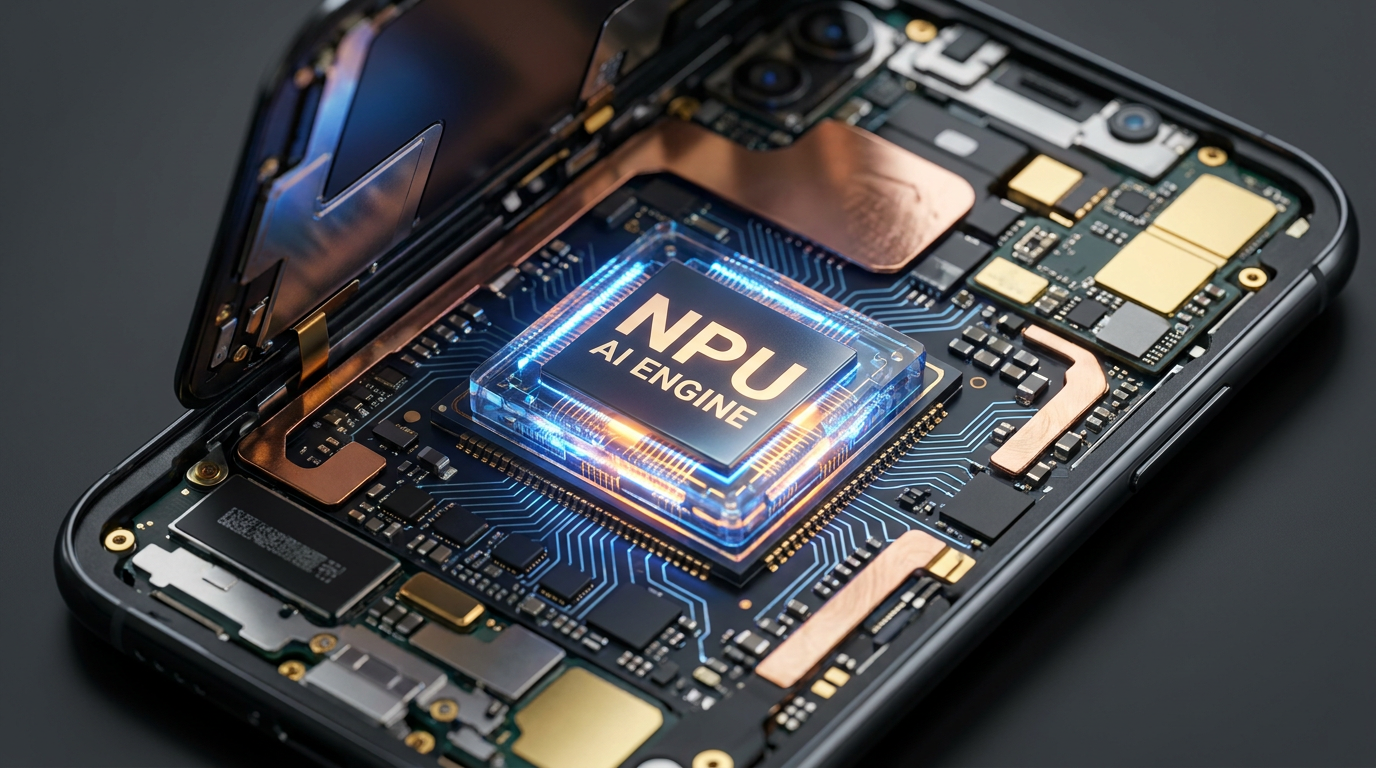
The most immediate benefit for consumers is absolute data privacy. When an AI model runs locally on your phone's Neural Processing Unit (NPU), your personal text messages, health data, and financial notes never leave the device. There is no cloud server to be hacked, and no corporate database harvesting your prompts.[5][7]
On-device AI also eliminates latency. Because the phone doesn't have to beam a request to a server and wait for a response, local models can react instantly. This makes features like real-time translation, predictive typing, and voice transcription vastly more fluid.[3][7]

For software developers, the shift is equally transformative regarding cost. Cloud AI APIs charge by the word, making it prohibitively expensive for independent developers to add AI features to free or low-cost apps. By routing requests to the phone's built-in SLM, developers can offer AI tools with zero ongoing server costs.[6]
However, SLMs are not a complete replacement for their massive cloud counterparts. Because they have fewer parameters, they lack the vast "world knowledge" of a frontier model. An SLM can perfectly summarize a meeting transcript, but it cannot write a dissertation on 14th-century French history or reliably answer obscure trivia.[2]
To bridge this gap, tech giants are adopting hybrid architectures. Your phone will use its local, private SLM for the vast majority of daily tasks. If a request is too complex—like solving an advanced coding problem—the operating system will seamlessly and securely route the query to a larger cloud model.[4]
As mobile hardware continues to advance, the baseline capabilities of what can run locally will only rise. By untethering AI from the cloud, the tech industry is turning artificial intelligence from a premium, server-bound service into an invisible, private, and ubiquitous utility.[8]
How we got here
Late 2023
Researchers demonstrate that highly curated 'textbook' training data can make small models punch far above their weight.
April 2024
Microsoft releases the Phi-3 family, proving a 3.8-billion parameter model can run locally on an iPhone.
May 2024
Google expands Gemini Nano, its on-device SLM, deeper into the Android operating system.
June 2024
Apple unveils Apple Intelligence, heavily emphasizing on-device processing for everyday AI tasks to protect user privacy.
Viewpoints in depth
Privacy & Edge Advocates
Focus on data sovereignty, offline access, and the elimination of cloud dependency.
This camp views on-device AI as a necessary corrective to the massive data harvesting of the early generative AI boom. By keeping processing local, users retain absolute control over their personal information, and AI becomes a resilient tool that works in airplane mode or during network outages. They argue that for AI to be truly trusted with intimate health, financial, or personal data, it must be physically incapable of transmitting that data to a third-party server.
Mobile Ecosystem Developers
Focus on the economic and integration benefits of local AI APIs.
For app creators, cloud-based AI introduces unpredictable API costs that scale with user engagement, making it difficult to offer AI features in free or one-time-purchase apps. Developers argue that built-in models like Gemini Nano and Apple's Foundation Models democratize AI. By providing a free, system-level API that taps into the phone's hardware, indie creators can build intelligent, context-aware features without going bankrupt on server fees.
Cloud AI Proponents
Argue that frontier models in the cloud will always be necessary for complex reasoning.
While acknowledging the utility of SLMs for basic tasks like summarization and text prediction, this camp emphasizes that true reasoning, vast world knowledge, and complex agentic workflows require the massive parameter counts of cloud models. They advocate for hybrid systems where the phone acts as a router, handling the trivial locally while seamlessly outsourcing the complex to data centers equipped with massive GPU clusters.
What we don't know
- How quickly battery technology will scale to meet the increased power demands of running AI models locally for extended periods.
- Whether open-source SLMs will eventually match the reasoning capabilities of proprietary cloud models.
Key terms
- Small Language Model (SLM)
- A compact AI model, typically between 1 billion and 7 billion parameters, optimized to run efficiently on personal devices.
- Parameters
- The internal neural weights and variables an AI model learns during training, which determine its capability and size.
- Quantization
- A mathematical compression technique that reduces the precision of an AI model's internal numbers, drastically shrinking its file size so it can fit on a phone.
- Neural Processing Unit (NPU)
- A specialized hardware chip inside modern smartphones and computers designed specifically to run AI calculations quickly and efficiently.
- Inference
- The process of an AI model actively generating a response or prediction based on a user's prompt.
Frequently asked
What is a Small Language Model (SLM)?
An SLM is a compact artificial intelligence model designed to understand and generate text, small enough to run on consumer hardware like smartphones rather than massive cloud servers.
Does on-device AI work without the internet?
Yes. Because the model's files are stored directly on your phone's memory, it can process text, summarize notes, and translate languages even in airplane mode.
Is my data safe with on-device AI?
On-device AI offers the highest level of privacy. Since the processing happens on your phone's local chip, your personal data and prompts are never sent to a corporate cloud server.
Can an SLM do everything ChatGPT can do?
No. While SLMs are excellent at reasoning and summarizing provided text, they lack the vast 'world knowledge' of massive cloud models and may struggle with obscure trivia or highly complex coding tasks.
Sources
Source coverage
8 outlets
3 viewpoints surfaced








[1]Microsoft ResearchCloud AI Proponents
Phi-3 Technical Report: A Highly Capable Language Model Locally on Your Phone
Read on Microsoft Research →[2]arXivCloud AI Proponents
Phi-3-Mini: A Highly Capable Language Model Locally on Your Phone
Read on arXiv →[3]IBMPrivacy & Edge Advocates
What are small language models?
Read on IBM →[4]LifehackerMobile Ecosystem Developers
How Much of Siri AI Is Apple, and How Much Is Google?
Read on Lifehacker →[5]OracleCloud AI Proponents
What Are Small Language Models (SLMs)? How Do They Work?
Read on Oracle →[6]MediumMobile Ecosystem Developers
Apple Intelligence vs Gemini Nano APIs
Read on Medium →[7]Hugging FacePrivacy & Edge Advocates
Running Small Language Models on Edge Devices
Read on Hugging Face →[8]Factlen Editorial TeamPrivacy & Edge Advocates
Synthesis by Factlen editorial team
Read on Factlen Editorial Team →

More in ai
See all 7 stories →Edge AI
How On-Device AI and Quantization Are Moving LLMs Out of the Cloud
6 sources

Agentic AI
Agentic AI: How Large Action Models Are Automating Digital Chores
7 sources

Global AI Governance
EU Delays Key AI Act Enforcement as 'Brussels Effect' Fractures Under US Deregulation
8 sources

Drug Discovery
New AI Model Accelerates Molecular Simulations 10,000-Fold, Promising Faster Drug Discovery
6 sources

Every angle. Every day.
Get ai stories with full source coverage and perspective breakdowns delivered to your inbox.